The job description is the most read document in recruiting and the least invested in. Every hire starts with one. Every candidate reads it before applying. Every hiring manager refers to it during evaluation. Every offer letter is predicated on it. And in most organizations, it is written in 45 minutes by someone who is not fully sure what the role requires, using a template from a previous job description that was itself written quickly, probably by someone who also wasn’t fully sure.
A job description is a formal written document that defines the purpose, responsibilities, required qualifications, reporting relationships, and working conditions of a specific role, serving simultaneously as the internal definition of what the position entails, the external communication that attracts and self-selects candidates, and the evaluation baseline against which candidates are assessed and hiring decisions are made.
In the AI hiring era, the job description has taken on new dimensions. It is now also the primary input to AI-powered matching algorithms: the quality of the language, structure, and specificity of a job description directly determines how well AI systems on job boards and ATS platforms can match the posting to qualified candidates.
A job description that is internally logical but uses non-standard terminology, vague requirements, or inflated credential criteria will be poorly matched by AI systems regardless of how good the underlying role is.
The core metric governing job description effectiveness is Application Quality Rate: the proportion of applications generated by the posting that meet minimum qualification criteria.
Application Quality Rate (%) = (Qualified Applications ÷ Total Applications) × 100
Well-crafted job descriptions that accurately describe the role, use candidate-facing language, and set realistic qualification thresholds achieve Application Quality Rates of 35–55% for professional roles. Vague, internally-oriented, or credential-inflated descriptions produce rates of 12–22%, generating two to four times as many applications as necessary to find the same number of qualified candidates.
What is a Job Description?
A job description is the foundational document of the hiring process, a written articulation of a role’s purpose, core responsibilities, required and preferred qualifications, reporting structure, and working conditions, written with sufficient specificity to enable qualified candidates to accurately self-assess their fit, enable recruiters to build targeted sourcing strategies, and enable interviewers to assess candidates against defined criteria.
The operative word is “foundational”: a poorly constructed job description creates misalignment at every subsequent stage of the hiring process, misaligned sourcing, misaligned candidate expectations, misaligned evaluation criteria, and ultimately misaligned hires. A well-constructed one creates alignment at every stage, enabling the process to run faster, with higher candidate quality, and with better outcomes.
Is Your Job Description Helping You Hire, or Helping You Screen Out?
The job description is doing two things simultaneously: it is attracting candidates who should apply, and it is filtering out candidates who should not. Most organizations’ job descriptions are doing the second job too aggressively and the first job not well enough.
The over-filtering problem is well-documented. Harvard Business Review’s “Hidden Workers” research found that 88% of employers acknowledged using degree requirements, years of experience thresholds, or skills checklists in job descriptions that systematically excluded qualified candidates, candidates who could perform the job well but whose backgrounds didn’t match the stated criteria. More significantly, the research found that employers who removed inflated requirements from job descriptions hired from a wider, more diverse pool and showed no measurable decline in hire quality at 12 months.
The specific pattern is pervasive: job descriptions written by hiring managers without recruiter guidance tend to describe the ideal candidate, not the qualified candidate. “5+ years of experience, advanced degree, proficiency in X, Y, Z, A, B, C” for a role where 3 years of experience and proficiency in X and Y would genuinely meet the performance threshold. The inflated requirements do not make the hire better. They reduce the qualified application rate, extend the time-to-fill, and disproportionately filter out candidates whose non-traditional backgrounds include the required skills in non-credentialed forms.
The AI-era dimension adds another layer of urgency. AI matching systems on job boards and ATS platforms use job description content to identify and rank candidate fits. Requirements that are stated as mandatory are treated as filters by matching algorithms; requirements stated as preferred are treated as ranking signals. A job description that lists “Bachelor’s degree required” will be matched only against candidates who have listed a degree, regardless of whether the algorithm’s top non-degree candidate has ten years of directly relevant experience. The job description is now programming the matching system as much as it is communicating with candidates.
The cost of a poor job description is straightforwardly calculable. An organization posting a role that generates 200 applications at a 15% qualified application rate spends recruiter time screening 170 unqualified applications to find 30 qualified ones. The same role with an optimized description generating 80 applications at a 40% qualified application rate produces 32 qualified applications from 80 total, with more than half the screening burden, a better candidate experience (faster response times when there is less volume to process), and a more representative applicant pool.
The ROI of investing in job description quality is among the highest in the TA function. A well-designed JD template process, with recruiter-hiring manager intake conversations, market vocabulary audits, and qualification calibration, takes approximately 90 minutes per role and recovers that time in screening efficiency within the first week of a typical professional posting.
Your Resume Isn’t Getting Read
Let’s Get That Fixed!
75% of resumes get auto-rejected. avua’s AI Resume Builder optimizes formatting, keywords, and scoring in under 3 minutes, so you land in the “yes” pile.
The Psychology Behind Job Description Language
Loss Aversion in Qualification Reading
Candidates reading job descriptions apply loss aversion asymmetrically: they are significantly more deterred by requirements they do not meet than they are attracted by requirements they exceed. A job description with 12 bullet points of requirements, where a candidate meets 9, is more likely to produce a non-application than a job description with 6 core requirements, where the same candidate meets all 6. Keeping requirement lists to the genuine minimums reduces the loss-aversion deterrence effect and produces better application rates from qualified candidates who would have self-filtered under inflated lists.
Identity Signal and Belonging Uncertainty
Research on job description language and application behavior, particularly by Gaucher, Friesen, and Kay (2011), found that masculine-coded language in job descriptions (“competitive,” “dominant,” “assertive,” “rock star”) produced significantly lower application rates from women, not because women lacked the described qualities, but because the language signaled a culture where they might not belong. Belonging uncertainty, the concern that one would not be accepted or valued in the described environment, is a powerful deterrent that operates independently of qualification confidence.
Cognitive Load and Description Length
There is a well-documented inverse relationship between job description length and application completion rate. Descriptions exceeding 700–800 words show significantly lower application engagement than those in the 400–600 word range for equivalent role types. The cognitive load of processing a very long description introduces friction that is disproportionately deterring to candidates who are casually evaluating fit, the semi-passive candidates who would be excellent hires if they engaged, but who abandon the evaluation when it feels like work.
Job Description vs. Related Hiring Documents
| Document | Purpose | Audience | Timing | Key Difference from Job Description |
|---|---|---|---|---|
| Job Description | Define role; attract and filter candidates | External candidates + internal | Pre-posting | Comprehensive role definition for recruitment |
| Job Posting | External communication of specific opening | Job seekers on specific platforms | Active posting period | Subset of JD adapted for channel-specific format |
| Job Requisition | Internal approval request to create/fill role | HR, Finance, Hiring Manager | Pre-JD | Administrative approval document, not candidate-facing |
| Role Profile / Competency Profile | Internal evaluation framework | Hiring panel | Post-JD, pre-interview | Interview-stage tool; more detailed than JD |
| Offer Letter | Formal employment offer with specific terms | Candidate | Post-interview | Legal document; role defined by reference to JD |
What the Experts Say?
Most job descriptions are written from the inside out, they describe what the organization needs and what the candidate must prove. The best ones are written from the outside in, they describe the work, its impact, and why a talented person would want to do it.
– Laszlo Bock, Former SVP People Operations, Google
How to Measure Job Description Effectiveness?
Formula
Application Quality Rate (%) = (Qualified Applications ÷ Total Applications) × 100
JD Bounce Rate (%) = (Candidates Who Viewed JD but Did Not Apply ÷ Total JD Views) × 100
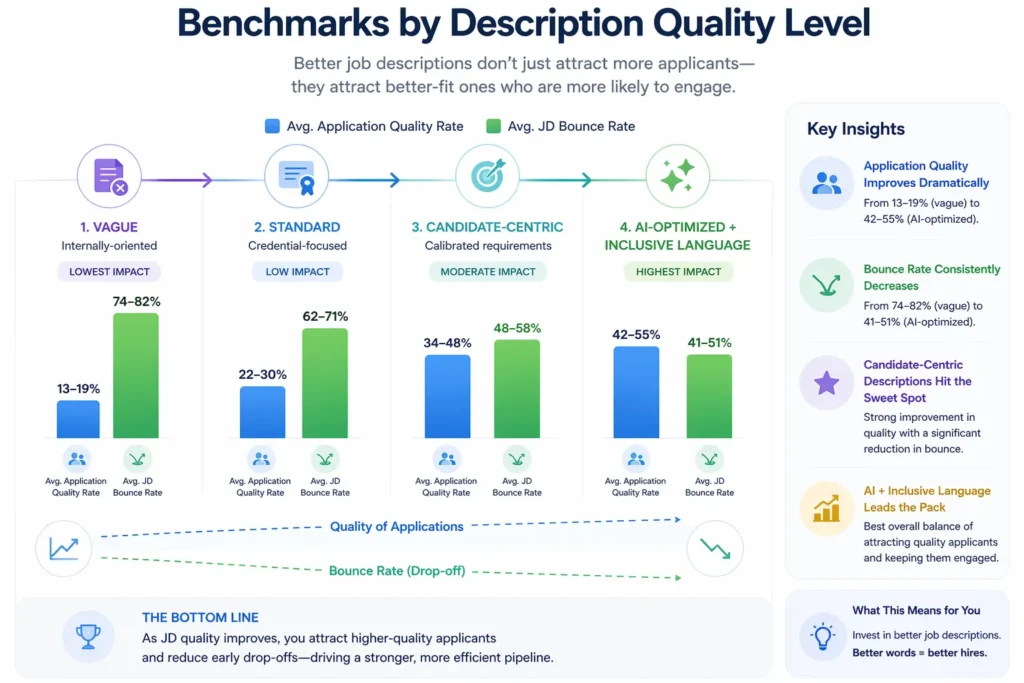
Benchmarks by Description Quality Level
| JD Quality Level | Avg. Application Quality Rate | Avg. JD Bounce Rate |
|---|---|---|
| Vague / internally-oriented | 13–19% | 74–82% |
| Standard / credential-focused | 22–30% | 62–71% |
| Candidate-centric / calibrated requirements | 34–48% | 48–58% |
| AI-optimized + inclusive language | 42–55% | 41–51% |
Key Strategies for Effective Job Description Writing
How Can AI and Automation Improve Job Description Quality?
AI-Assisted JD Generation
Natural language AI tools can draft role-specific job descriptions from a brief input describing the role’s purpose and key responsibilities, generating structured, candidate-facing content that incorporates market-standard vocabulary, calibrated requirement language, and inclusive writing principles. The AI draft serves as a high-quality starting point that a recruiter refines with hiring manager input, rather than a blank page that requires a significant time investment.
Inclusive Language Analysis
AI-powered writing tools can analyze job description drafts for exclusionary language patterns, identifying masculine-coded terms, credential inflation, unnecessarily complex language, and accessibility barriers, and providing specific revision suggestions. This automated review is faster and more consistent than manual editing and ensures that inclusive language standards are applied uniformly across all postings.
Requirements Calibration Against Market Data
AI tools that integrate job market intelligence can compare a draft job description’s requirements against the market profile of candidates actually being hired for similar roles, flagging requirements that are inflated relative to market norms and suggesting calibrations that will improve qualified application rates without compromising hire quality.
SEO and Matching Optimization
AI tools can analyze job description content against the search terms and profile language used by target candidate populations on specific platforms, identifying gaps between how the JD describes the role and how candidates describe their own experience, and recommending specific language additions that improve matching algorithm performance.
Stop Juggling
10 Job Boards.
Search One
Your next role is already here. avua pulls opportunities from across the web into a single searchable feed; filtered by role, location, salary, and remote preference.
1.5 Million+
Active Jobs
380+
Job Categories
Job Descriptions and Diversity & Inclusion
Language as a Demographic Filter
Job description language is one of the earliest-acting demographic filters in the hiring process, operating before any application is submitted or any candidate is evaluated. Masculine-coded language, credential requirements that proxy for socioeconomic background, geographic requirements that exclude candidates in lower-cost markets, and complexity of language that creates barriers for non-native speakers all reduce demographic diversity in the application pool before the organization has any opportunity to exercise equitable evaluation.
Requirements Inflation and Socioeconomic Exclusion
Degree requirements and years-of-experience thresholds disproportionately filter out candidates from lower socioeconomic backgrounds, not because those candidates lack the ability to perform the role, but because their career development has taken non-traditional paths that don’t generate the credentials that conventional JD requirements specify. Organizations that have audited and reduced their requirement inflation consistently report improved representation at the application stage, with no corresponding decline in hire quality.
Accessible Job Description Formats
Digital accessibility of job descriptions, compliance with WCAG 2.1 standards for screen reader compatibility, appropriate heading structure for assistive technology, and alt text for any embedded graphics, is a technical inclusivity requirement that most organizations have not fully addressed. Accessible job descriptions do not disadvantage any candidate through the technical format of the posting; inaccessible ones create barriers that disproportionately affect candidates with specific disabilities.
Common Challenges and Solutions
| Challenge | Solution |
|---|---|
| Hiring managers inflating requirements beyond what the role genuinely needs | Build a requirement calibration conversation into the intake process; provide market data showing the actual profiles of people being hired for similar roles |
| JDs written from templates that don’t reflect actual role evolution | Audit and refresh JDs at least annually for active role families; require a fresh intake conversation for any role that has been open for more than 60 days without fill |
| Same JD language used for both external posting and internal role definition | Maintain separate documents: an internal role profile (detailed, technical) and an external job posting (candidate-facing, SEO-optimized) |
Real-World Case Studies
Case Study 1: The Technology Company
A technology company with chronically low qualified application rates for its data roles (averaging 11%) conducted a JD audit and found that their data analyst descriptions listed 14 required qualifications, including a master’s degree, five years of experience, and proficiency in seven specific tools. Analysis of their highest-performing data analyst hires over the previous two years found that the modal profile was a candidate with three years of experience, a bachelor’s degree, and proficiency in three of the seven listed tools. They rebuilt their JD template around this actual hire profile. Qualified application rate for data roles rose from 11% to 38%.
Case Study 2: The Healthcare Network
A healthcare network redesigned its clinical coordinator job descriptions to remove masculine-coded language and reduce credential inflation following an inclusive language audit. The revised descriptions replaced “competitive,” “aggressive targets,” and “strong leadership” with “collaborative,” “patient impact,” and “team development.” Application rates from female candidates, who had been systematically underrepresented in applicant pools despite being the dominant demographic in the role’s talent market, increased by 34%. Hire quality (measured at 12 months) was unchanged.
Case Study 3: The Financial Services Firm
A financial services firm implemented a mobile-first JD format after discovering that 62% of their job posting views occurred on mobile devices but their standard JD format, long, dense, and list-heavy, showed a 79% bounce rate on mobile versus 51% on desktop. The mobile-optimized format used shorter sections, clear headers, and a prominent “Core responsibilities in 3 bullets” opening. Mobile bounce rate fell from 79% to 54%, and mobile application completion rates improved by 44%.
Building a Job Description Quality Dashboard: What to Track?
Job Descriptions Across the Hiring Lifecycle
Pre-Posting: Role Clarity and Intake Quality
The quality of the job description depends primarily on the quality of the intake conversation between recruiter and hiring manager. A rushed intake produces a vague description; a thorough one produces a precise one. The investment of 45–60 minutes in a structured intake conversation recovers that time many times over in screening efficiency, sourcing precision, and reduced candidate experience friction.
Active Posting: Performance Monitoring and Iteration
Job descriptions should be treated as live hypotheses, not final documents. Posting performance data, application rate, qualified application rate, bounce rate, time-to-first-qualified-application, is real-world feedback on whether the description is achieving its sourcing objectives. Organizations that monitor this data and iterate the description when performance is below benchmark produce better sourcing outcomes than those that post and forget.
Interview: Evaluation Baseline
The job description is the implicit evaluation baseline for every interview in the hiring process. Interviewers who have read the JD and understand what the role requires make better evaluation decisions than those who have not. Making JD review a formal step in interview preparation, and ensuring the description is specific enough to be a useful evaluation reference, connects the sourcing and evaluation phases of the process.
Onboarding: Expectation Alignment
The job description is the document that new hires and hiring managers both implicitly hold as the baseline for role expectations. When the description accurately reflects the role’s actual demands and priorities, onboarding conversations about expectations are confirmatory. When it does not, because the description was aspirational, vague, or out of date, onboarding becomes a negotiation about what the role actually is, which is an early attrition risk.
The Real Cost of a Poor Job Description
| JD Quality Level | Qualified App Rate | Applications to Screen (for 10 qualified) | Recruiter Screening Time |
|---|---|---|---|
| Poor (vague, inflated) | 14% | 71 applications | 10.7 hours |
| Standard | 24% | 42 applications | 6.3 hours |
| Optimized | 41% | 24 applications | 3.6 hours |
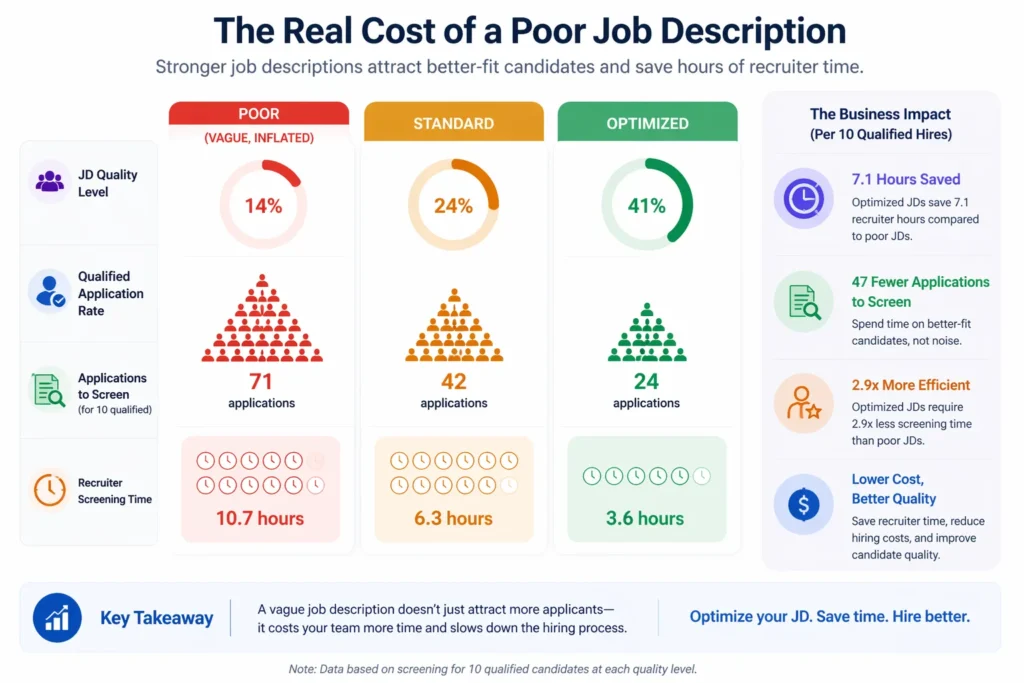
Screening time assumes 9 minutes per application for initial screen.
Related Terms
| Term | Definition |
|---|---|
| Job Posting | The public-facing advertisement of a specific job opening on a job board or career site |
| Job Requisition | The internal approval document requesting authorization to recruit for a specific role |
| Competency Framework | A defined set of skills and behaviors used as evaluation criteria for hiring and development |
| Employer Branding | The reputation and identity of an organization as an employer, partially shaped by job description tone and content |
| ATS (Applicant Tracking System) | Software that manages candidate applications, and often uses JD content for initial candidate filtering |
Frequently Asked Questions
How long should a job description be?
Research on posting engagement consistently points to 400–700 words as the optimal range for most professional roles, long enough to provide genuine specificity, short enough to maintain candidate engagement. Descriptions exceeding 800 words show measurably declining engagement; those under 300 words often lack the specificity needed for accurate self-selection and AI matching.
Should job descriptions include salary ranges?
In markets with pay transparency laws (California, New York, Colorado, EU member states, and others), yes, as a compliance requirement. Beyond compliance, research consistently shows that salary-inclusive postings generate 30–35% more qualified applications with no increase in unqualified ones. Transparency in compensation is a sourcing efficiency tool that most organizations have been slow to adopt voluntarily.
How often should job descriptions be updated?
Active role families should be audited and refreshed at least annually. Any role that has been open for 60+ days without fill should prompt a fresh JD review, extended vacancy with low qualified application rate is the most reliable signal that the description is the problem, not the market.
Who should write the job description?
The recruiter and hiring manager should write it collaboratively. The hiring manager provides domain knowledge about what the role actually requires and what success looks like; the recruiter translates that into candidate-facing language, calibrates requirements against market norms, and ensures the description is optimized for the platforms where it will be posted. Neither should write it alone.
Can AI write job descriptions?
AI can draft a strong starting point from a brief input describing the role, which the recruiter and hiring manager then refine. The risk of fully AI-generated JDs that are not reviewed is that they can be generically accurate but specifically wrong, using standard language for the role category that doesn’t reflect the specific team’s culture, working style, or actual priority requirements. AI draft plus human refinement produces better results than either alone.
Conclusion
The job description is the cheapest and most impactful marketing document in the hiring process, it reaches every candidate who considers the role, shapes their decision to apply, and programs the matching systems that determine who else finds it.
Organizations that treat JD quality as a genuine investment, dedicating real intake time, auditing language for inclusivity and inflation, optimizing for AI matching, and iterating based on performance data, produce better-targeted pipelines, lower screening costs, and more representative candidate pools than those treating the JD as a 45-minute form-filling exercise.
Every hire starts with a job description. Make it count.