You have found the right candidate, they have aced the interviews, and everyone is aligned. Now comes the moment that can quietly make or break the whole process: the job offer. It sounds straightforward, but a poorly structured or badly timed offer loses candidates that were already won.
A job offer is the formal proposal extended to a selected candidate, outlining the role, base salary, and terms of employment. It marks the transition from recruitment to decision, and it is where candidate engagement either holds firm or falls apart. How an offer is communicated matters just as much as what is in it.
For hiring teams tracking cost per hire and candidate experience, a fumbled offer at the finish line is an expensive mistake. This guide covers how to get it right.
The core metric governing offer stage effectiveness is Offer Acceptance Rate: the proportion of formal employment offers that are accepted by candidates.
Offer Acceptance Rate (%) = (Offers Accepted ÷ Total Offers Extended) × 100
Best-in-class recruiting organizations maintain Offer Acceptance Rates above 85%. The industry average across professional roles is approximately 68–73%. The gap between best-in-class and average is driven primarily by offer stage process quality, how the offer is presented, personalized, and communicated, not by compensation level alone.
What is a Job Offer?
A job offer is a formal proposal from an employer to a specific candidate to take a defined role at a specified compensation, typically extended after a completed evaluation process, comprising at minimum the role title, base compensation, start date, reporting relationship, and principal employment terms, constituting the organization’s binding proposal that the candidate may accept, decline, or negotiate.
The job offer is both a commercial transaction (the terms of an employment agreement) and a relationship milestone (the moment the organization communicates its conviction that this specific candidate is the one they want). Organizations that treat only the transactional dimension and ignore the relational one consistently underperform on offer acceptance rates, even when their compensation is competitive.
Why Do Offers Get Declined, and What Can You Actually Do About It?
The conventional explanation for offer declines is compensation: the candidate took a higher-paying offer elsewhere. This is the explanation that makes organizations feel helpless, there will always be someone paying more, and it is also significantly incomplete.
Research on offer decline reasons, collected through post-decline surveys and recruiter exit conversations, consistently finds that compensation is the stated reason in approximately 45% of declines. But when candidates are asked about the complete set of factors that influenced their decision, compensation accounts for only 28–34% of the variance in acceptance versus decline, with the remainder explained by process quality factors that are entirely within the organization’s control.
The factors that predict offer acceptance beyond compensation include: the quality and timing of communication during the offer stage, the presence of a personal connection communication from the hiring manager (not just a formal offer letter), the candidate’s confidence that the role described in the offer matches the role described in the interviews, the clarity and flexibility of the decision timeline, and the candidate’s sense of whether the organization genuinely wants them specifically, or is extending a standardized offer to whoever cleared the process.
A concrete data point: LinkedIn research on offer acceptance behavior found that candidates who received a personal call from the hiring manager before or alongside the written offer accepted at 79% versus 61% for candidates who received only the written offer letter. The 18-point difference, representing potentially hundreds of thousands of dollars in avoided re-sourcing costs for a moderately active hiring organization, required one five-minute phone call.
The ROI calculation for offer stage process quality is straightforward. An organization extending 100 professional offers per year at an average cost-per-offer of $8,000 in recruiting investment that is lost on a decline: moving from a 68% to an 80% Offer Acceptance Rate saves 12 re-sourcing cycles at $8,000 each, $96,000 in avoided cost, from process improvements that require no additional budget, only deliberate design.
For TA leaders, the offer stage represents one of the highest-leverage, lowest-cost improvement opportunities in the entire recruiting process. The candidates who decline at the offer stage were, by definition, qualified enough to receive an offer. They were already in the building. The loss is not a sourcing failure, it is a closing failure.
Your Resume Isn’t Getting Read
Let’s Get That Fixed!
75% of resumes get auto-rejected. avua’s AI Resume Builder optimizes formatting, keywords, and scoring in under 3 minutes, so you land in the “yes” pile.
The Psychology Behind Job Offer Decisions
Anticipated Regret and the Comparison Frame
Candidates evaluating a job offer are not assessing it in isolation, they are comparing it against alternatives (current role, competing offers, idealized opportunities they might pursue if they decline) and running an anticipated regret calculation: which choice will I be more likely to regret? Organizations can positively influence this frame by providing the candidate with genuine, specific reasons why the role, team, and organization represent a compelling opportunity, converting the comparison from “this offer versus abstract alternatives” to “this specific, well-articulated opportunity versus staying where I am.”
Commitment and the Verbal Offer Transition
Behavioral economics research on commitment shows that candidates who verbally indicate positive intention toward an offer during an informal compensation discussion are significantly more likely to follow through with acceptance when the formal offer arrives, provided the formal offer matches what was discussed. This is the rationale for verbal offer conversations before written offer extension: they generate micro-commitments that make formal acceptance more likely, and they surface any misalignments between candidate expectations and organizational constraints before the written offer creates a formal decision point.
Trust and the Consistency Effect
Candidates evaluate the formal offer in the context of their entire experience with the organization. If the interview process was respectful, responsive, and accurately represented the role, the offer arrives in a context of high organizational trust, and candidates extend the benefit of the doubt on minor concerns. If the process was disrespectful, slow, or felt like the role was misrepresented, the offer arrives in a context of low trust, and candidates interpret every ambiguity in the offer terms negatively. The offer stage is the last act of the candidate experience; the candidate experience is the context in which the offer is received.
Job Offer vs. Related Employment Stage Terms
| Term | Timing | Binding? | Key Difference from Job Offer |
|---|---|---|---|
| Verbal Offer | Before written offer | No (informal intent) | Informal; not contractually binding |
| Written Offer Letter | After verbal acceptance or simultaneously | Binding on acceptance | Formal document; creates legal basis |
| Employment Contract | Post-acceptance | Binding | Full legal employment agreement |
| Conditional Offer | Extended with conditions (background check, references) | Binding on condition fulfillment | Offer terms contingent on further steps |
| Counter Offer | Employer response to candidate negotiation | Binding on acceptance | Modification of original offer |
What the Experts Say?
An offer decline is not a compensation problem. It’s a trust problem. The candidate decided they weren’t confident enough in what they were walking into to give up what they already had. That confidence is built in every interaction that precedes the offer, and it’s lost the same way.
– Laszlo Bock, Former SVP People Operations, Google
How to Measure and Improve Offer Acceptance Rate?
Formula
Offer Acceptance Rate (%) = (Offers Accepted ÷ Total Offers Extended) × 100
Offer-to-Start Rate (%) = (Candidates Who Start After Acceptance ÷ Total Offers Accepted) × 100
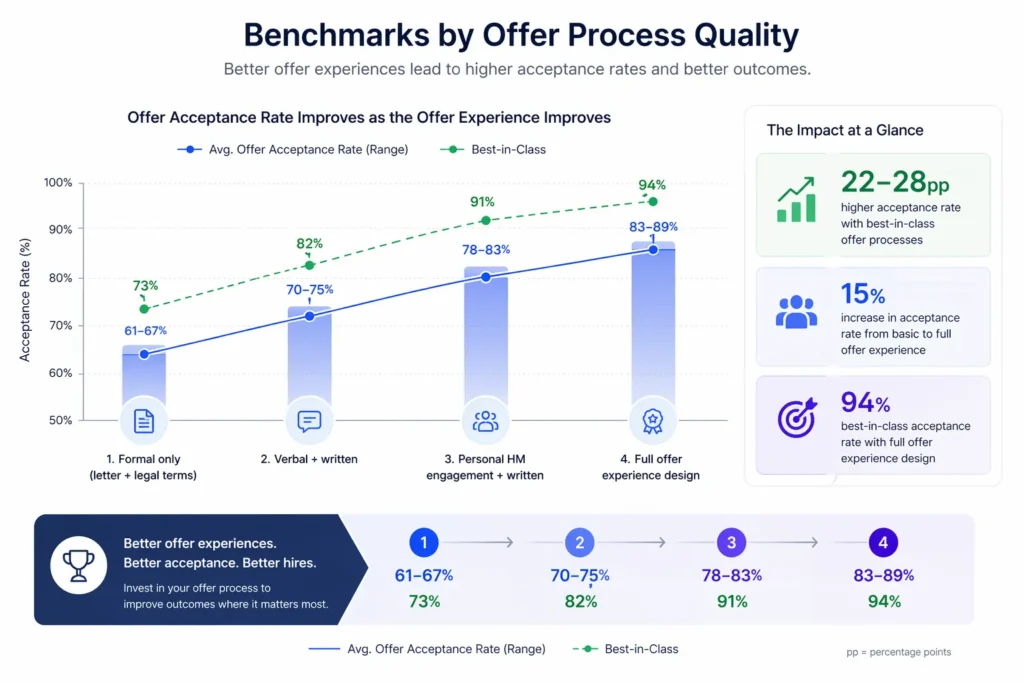
Benchmarks by Offer Process Quality
| Offer Process Quality | Avg. Offer Acceptance Rate | Best-in-Class |
|---|---|---|
| Formal only (letter + legal terms) | 61–67% | 73% |
| Verbal + written | 70–75% | 82% |
| Personal HM engagement + written | 78–83% | 91% |
| Full offer experience design | 83–89% | 94% |
Key Strategies for Improving Offer Acceptance Rate
How Can AI and Automation Improve the Offer Stage?
Real-Time Compensation Benchmarking
AI-powered compensation intelligence tools integrate market salary data, cost-of-living adjustments, peer compensation benchmarks, and internal equity analysis to recommend offer ranges that are competitive in the specific market at the specific moment of the offer, rather than relying on annual salary surveys that are typically six to twelve months out of date by the time they are used.
Offer Acceptance Prediction Modeling
Machine learning models trained on historical offer outcome data can predict, based on candidate profile, process quality indicators, and compensation positioning, which candidates are at elevated risk of offer decline, enabling targeted pre-offer interventions (additional hiring manager engagement, benefits walk-through, team introductions) for high-risk, high-priority candidates before the formal offer is extended.
Automated Offer Document Generation
AI-powered document generation tools can produce customized offer letters that incorporate the specific compensation, benefits, role, and reporting terms agreed in the verbal offer conversation, reducing the turnaround time from verbal agreement to formal written offer from days to hours and eliminating the drafting errors that sometimes introduce discrepancies between verbal and written terms.
Counter-Offer Intelligence
AI tools that monitor competitive compensation and timing signals can flag when a candidate is at elevated counter-offer risk, based on employer size, industry, and the candidate’s likely market value position, enabling proactive communication and counter-offer preparation before the competing offer materializes.
Stop Juggling
10 Job Boards.
Search One
Your next role is already here. avua pulls opportunities from across the web into a single searchable feed; filtered by role, location, salary, and remote preference.
1.5 Million+
Active Jobs
380+
Job Categories
Job Offers and Diversity & Inclusion
Compensation Equity at the Offer Stage
The offer stage is where compensation inequity is most often introduced and most consequential in the long run. Research on compensation offers by gender and race consistently finds that, controlling for role, level, and experience, initial offers vary by demographic group, with women and underrepresented minorities receiving lower initial offers on average than majority candidates with equivalent profiles. Because subsequent compensation growth is typically anchored to the initial offer, equity gaps introduced at the offer stage compound over the course of a career.
Negotiation Dynamics and Demographic Disparities
Salary negotiation behavior varies by demographic group in ways that interact negatively with organizations that reserve their best compensation for candidates who negotiate assertively. Women and candidates from some cultural backgrounds negotiate less frequently or less assertively than majority-group counterparts, not because they value compensation less but because the social risk and relational cost of negotiation is not equally distributed. Organizations that design their offer process to present their best offer first, rather than anchoring low and expecting negotiation, produce more equitable compensation outcomes without disadvantaging candidates who don’t negotiate.
Offer Timing and Competing Offer Dynamics
Candidates from underrepresented groups who are in active job markets frequently receive competing offers simultaneously, not because they are particularly mobile, but because deliberate DEI recruiting by multiple organizations simultaneously creates overlapping offer timelines. Organizations that move slowly from decision to offer consistently lose diverse candidates to faster-moving competitors. Compressing offer timeline, from hiring decision to verbal offer within 48 hours, is a DEI-relevant process improvement as well as a general effectiveness one.
Common Challenges and Solutions
| Challenge | Solution |
|---|---|
| Offer declined after verbal acceptance | Implement a structured post-acceptance check-in within 48 hours; maintain hiring manager personal communication through pre-boarding |
| Internal approval processes delaying offer extension by 5+ days after decision | Build offer approval into the process before the final interview round, not after, so the offer is ready to extend within 48 hours of the decision |
| Candidate negotiating for significantly above budget | Prepare pre-approved compensation flexibility ranges before the offer stage; enable recruiters to negotiate within a defined band without requiring new approval |
Real-World Case Studies
Case Study 1: The Technology Scale-Up
A technology scale-up with a 61% Offer Acceptance Rate analyzed the 39% of declines over a 12-month period and found that 44% of declined candidates cited “the offer took too long” as a contributing factor, with an average of 8.4 days between hiring decision and written offer. They redesigned their approval workflow to pre-authorize compensation for each role band before the search opened, enabling verbal offers within 24 hours and written offers within 48 hours of hiring decision. Offer Acceptance Rate improved from 61% to 77% within two quarters.
Case Study 2: The Financial Services Firm
A financial services firm introduced hiring manager personal offer calls as a standard process step for all roles above analyst level. Hiring managers received a 90-second briefing script tailored to each candidate, specific reasons why that candidate was selected, and called within 24 hours of the decision. Offer Acceptance Rate for manager-and-above roles improved from 69% to 86%. The most cited reason in post-acceptance surveys: “The call from my future manager made me feel like the decision was genuinely mutual.”
Case Study 3: The Healthcare Network
A healthcare network redesigned their offer letter format for mobile delivery after discovering that 73% of candidates were opening offer letters on mobile devices but the PDF format was unreadable without zooming. The mobile-optimized offer format (HTML with responsive design) was accompanied by a video message from the hiring manager. Offer-to-start rate (candidates who accepted and actually started) improved from 89% to 96%, and pre-start withdrawal declined by 63%.
Building a Job Offer Performance Dashboard: What to Track?
Job Offers Across the Hiring Lifecycle
Pre-Offer: Compensation Conversation and Expectation Alignment
The offer stage effectively begins in the first recruiter conversation, when compensation expectations and constraints are first surfaced. Organizations that engage in genuine, specific compensation conversations early in the process, rather than deferring the subject until the formal offer, arrive at the offer stage with far fewer surprises on either side.
Verbal Offer: The High-Leverage Commitment Point
The verbal offer conversation, whether conducted by the recruiter or the hiring manager, is the highest-leverage individual interaction in the offer stage. It is the moment where the organization’s conviction about the candidate is most personally communicated and where the candidate’s commitment to the decision is first formed. Designing this conversation deliberately, with specific, personalized content about why this candidate specifically was chosen, consistently outperforms scripted or generic verbal offers.
Written Offer: Precision and Speed
The written offer should arrive quickly (within 24–48 hours of verbal acceptance of terms), precisely (matching what was discussed verbally), and clearly (in a format that the candidate can read on their preferred device and share with a partner or advisor if needed). Delays, discrepancies, and format barriers all introduce doubt at the moment the candidate should be converting enthusiasm into commitment.
Post-Acceptance: Pre-Boarding Engagement
The offer stage does not end at acceptance. The period between offer acceptance and the first day of work is a high-risk attrition window, candidates who receive competing offers, develop second thoughts, or hear concerning things about the organization during this period are at risk of pre-start withdrawal. Structured pre-boarding engagement that maintains connection and enthusiasm between acceptance and start date dramatically reduces this risk.
The Real Cost of Poor Offer Stage Management
| Scenario | Offer Acceptance Rate | Re-Sourcing Cost (100 offers) | Time Lost to Declines |
|---|---|---|---|
| Reactive offer process | 63% | $296,000 | 2,590 days |
| Standard offer process | 73% | $216,000 | 1,890 days |
| Best-in-class offer process | 87% | $104,000 | 910 days |
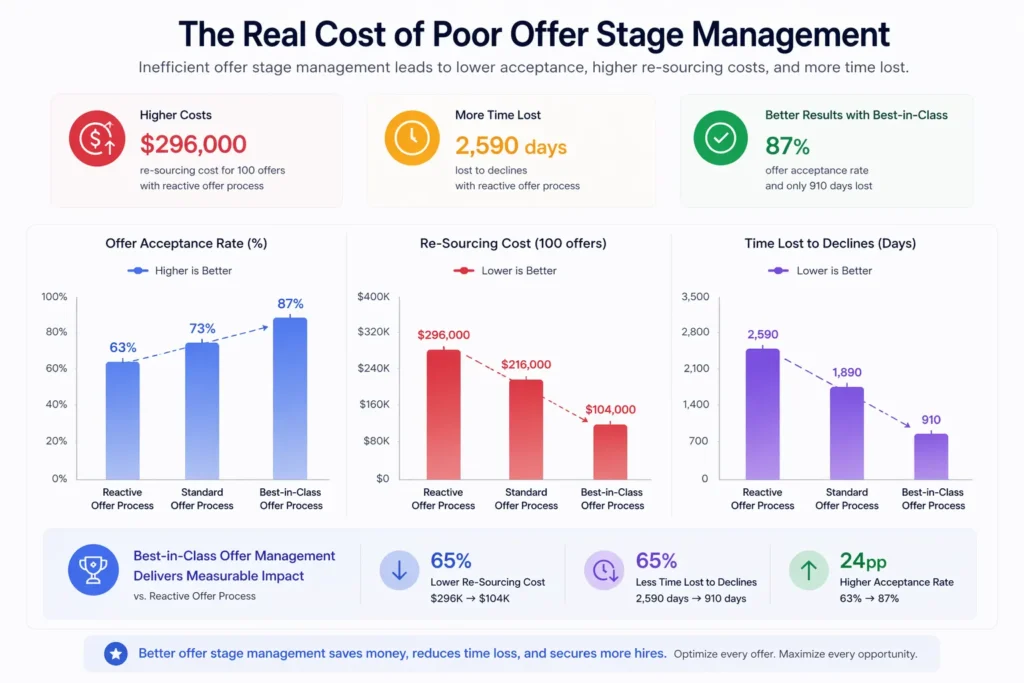
Re-sourcing cost assumes $8,000 per declined offer re-sourced; time lost at 37 days average TTF per re-sourced role.
Related Terms
| Term | Definition |
|---|---|
| Offer Acceptance Rate | The proportion of formal employment offers that are accepted by candidates |
| Counter Offer | A proposal from the candidate’s current employer to match or exceed the new offer to retain the employee |
| Total Compensation | The full value of an employment package including base salary, bonus, equity, benefits, and non-monetary perks |
| Pre-Boarding | The period between offer acceptance and first day of employment |
| Verbal Offer | An informal communication of offer intent before the formal written offer is extended |
Frequently Asked Questions
What should a job offer letter include?
A complete job offer letter should include: the role title, start date, reporting relationship, base salary, bonus or commission structure (if applicable), equity terms (if applicable), benefits summary, working location and arrangement (hybrid/remote/on-site), conditions of employment (background check, references), and the offer expiration date. It should be written in plain language, avoid unexplained legal jargon, and be available in a mobile-accessible format.
How do you handle salary negotiation?
Enter negotiation with a pre-approved flexibility range, not a single fixed number. Know the market rate for the role before extending the offer. Present the initial offer as competitive within the range you have flexibility to operate in, and be prepared to move within that range for strong candidates without requiring new approval rounds. Candidates who negotiate and receive a considered counter-offer accept at higher rates than those who negotiate and receive a rigid rejection.
What is the ideal time between a hiring decision and an offer?
For most professional roles, 24–48 hours from hiring decision to verbal offer, and an additional 24–48 hours to written offer after verbal terms are agreed. Total time from decision to written offer in five days or fewer is the benchmark for best-in-class offer stage speed. Beyond seven days, decline risk increases measurably.
How do you reduce counter-offer risk?
The most effective counter-offer risk mitigation is not competing on compensation in real time, it is building the candidate’s commitment to the opportunity through the hiring process and offer stage so that the counter-offer is assessed in the context of a genuine desire to make the move, not just a financial comparison. Candidates who are genuinely excited about the new role, trust the organization, and feel personally wanted decline counter-offers at much higher rates than those who are primarily motivated by the compensation delta.
Should offers be extended verbally or in writing first?
Verbally first, in almost all cases. The verbal offer conversation serves as a commitment-building and expectation-alignment step before the formal document creates a binary accept/decline decision point. It surfaces negotiation points in a conversational context where they are easier to address. And it communicates organizational enthusiasm in a way that a written document cannot replicate. The written offer confirms what the verbal conversation established; it should not be the first time the candidate hears the terms.
Conclusion
The job offer is the last conversation of the hiring process and the first conversation of the employment relationship.
Organizations that treat it as a formality, a compensation number in a legal document, consistently lose candidates at the stage where they have already invested the most.
Those that treat it as a deliberate, personalized, relationship-building close, with precise compensation, personal conviction, and thoughtful process, convert their qualified candidates into committed new employees at rates that make the entire upstream sourcing and evaluation investment worthwhile.
The offer isn’t where the hiring decision is made. It is where the candidate’s decision is made. Design for that.