Most resumes do not fail in front of a recruiter. They fail before one ever sees them. With AI resume screening now sitting at the top of most hiring funnels, the words on your resume determine whether you make it through the first filter, and keyword optimization is how you make sure they do.
Resume keyword optimization is the practice of strategically aligning your resume language with the terms, skills, and phrases that appear in a job description, making your application readable and rankable by both automated screening tools and human recruiters. It is not about stuffing in buzzwords. It is about speaking the right language for the right role.
Get it right and your resume lands in front of a hiring manager. Get it wrong and it disappears into the applicant pool without a trace.
The core metric governing resume keyword optimization is ATS Relevance Score: the percentage match between a resume’s keyword profile and the target job description’s keyword profile, as calculated by the specific ATS or matching platform being applied to.
ATS Relevance Score (%) = (Matching Keywords in Resume ÷ Total Keywords in JD) × 100
Resumes achieving ATS Relevance Scores above 75% for a target role are significantly more likely to be surfaced to recruiter review. Below 60%, the risk of ATS filtering before any human review is substantially elevated, regardless of the candidate’s actual qualifications.
What is Resume Keyword Optimization?
Resume keyword optimization is the systematic process of reviewing and revising a resume to ensure it uses the specific terms, phrases, skills, and qualifications that appear in target job descriptions, improving its performance in ATS keyword searches and AI matching algorithms while maintaining an authentic, readable professional narrative for human evaluators who receive it after the ATS stage.
The practice encompasses: identifying the most important keywords in a target job description, assessing which of those keywords are already present in the resume, adding missing keywords where the underlying experience genuinely supports them, and adjusting terminology to match the specific vocabulary the hiring organization uses for the skills and experience the candidate possesses.
Are You Getting Rejected by Software That Has Never Read Your Resume?
Here is an uncomfortable truth most job seekers find out too late: the person rejecting your resume might not be a person at all. Before a human ever opens your application, an Applicant Tracking System has already scored it, ranked it, and in many cases, filtered it out entirely. You could be the most qualified candidate in the applicant pool and still never make it to a recruiter’s screen.
This is exactly why resume keyword optimization exists. When a recruiter builds a job posting, they use specific terms, skills, and phrases that reflect what they are actually looking for. The automated screening system scans incoming applications for those exact terms. No match, no visibility. It does not matter how strong your experience is if the language on your resume does not mirror the language in the job description. The ATS is not reading between the lines. It is reading the lines, literally.
Keyword optimization is not a hack or a loophole. It is the practice of making sure your resume communicates your experience in terms that both software and recruiters can immediately recognise and act on. Resume keyword optimization done well does not make your application look stuffed or robotic. It makes it relevant. It signals to the system, and to the hiring manager who eventually reads it, that you understand the role and speak its language.
Think of resume keyword optimization as translation work. You are taking everything you have done, every project, every result, every skill, and presenting it in the format that modern AI resume screening is built to reward. The qualifications were always there. Keyword optimization is simply how you make them visible.
Your Resume Isn’t Getting Read
Let’s Get That Fixed!
75% of resumes get auto-rejected. avua’s AI Resume Builder optimizes formatting, keywords, and scoring in under 3 minutes, so you land in the “yes” pile.
The Psychology Behind Keyword Optimization
Pattern Recognition and Cognitive Shortcuts
Human recruiters and ATS systems share a cognitive pattern in resume screening: both are looking for familiar markers of relevant experience, and both use keyword presence as a rapid relevance proxy. A recruiter scanning a resume for a data engineering role responds positively to the visible presence of “Apache Spark,” “dbt,” and “data warehouse” in the same way that an ATS scores positively for their presence in a string-match comparison. Keyword optimization works because it aligns the candidate’s signal with the evaluator’s recognition pattern, whether that evaluator is algorithmic or human.
Authenticity and the Optimization Tension
The most common objection to resume keyword optimization is that it feels inauthentic, as if the candidate is pretending to be something they are not. This tension is real but manageable: there is a meaningful difference between adding keywords that describe genuine experience (translation) and adding keywords that describe experience the candidate does not have (fabrication). The former is professional presentation strategy; the latter is misrepresentation. Effective keyword optimization never adds experience that does not exist, it ensures that existing experience is described in the language that makes it recognizable.
Anchoring and Terminology Familiarity
Hiring managers evaluating resumes in a specific field develop strong familiarity with the vocabulary of that field, they recognize the tools, frameworks, and methodologies that define current practice, and they anchor their assessment of a candidate’s currency and depth partially on the presence of those terms. A candidate who uses a proprietary company-specific term for a skill that the market calls something else will be assessed as less current than their actual knowledge level supports. Keyword optimization corrects this anchoring miscalibration.
Keyword Optimization vs. Related Resume Enhancement Practices
| Practice | Focus | Primary Benefit | Key Difference from Keyword Optimization |
|---|---|---|---|
| Keyword Optimization | Terminology alignment | ATS and AI match score improvement | Language-level; targets system recognition |
| Resume Formatting | Visual structure | Human readability and ATS parsing | Design-level; targets both ATS and human |
| Quantification | Adding metrics to achievements | Impact communication | Content-level; targets credibility |
| Tailoring | Customizing content per application | Relevance to specific role | Scope-level; broader than keyword addition |
| Skills Section Design | Organizing visible skill taxonomy | Quick human scan and ATS keyword density | Format-level; concentrated keyword presentation |
What the Experts Say?
The resume has two audiences: the software that decides whether a human sees it, and the human who decides whether to call you. Most candidates optimize for neither systematically. Keyword optimization is about making sure the software doesn’t eliminate the human from ever making a decision.
– Hung Lee, Curator, Recruiting Brainfood
How to Measure and Improve ATS Keyword Performance?
Formula
ATS Relevance Score (%) = (Matching Keywords ÷ Total Target Keywords in JD) × 100
Keyword Density Rate (%) = (Target Keyword Occurrences ÷ Total Resume Word Count) × 100
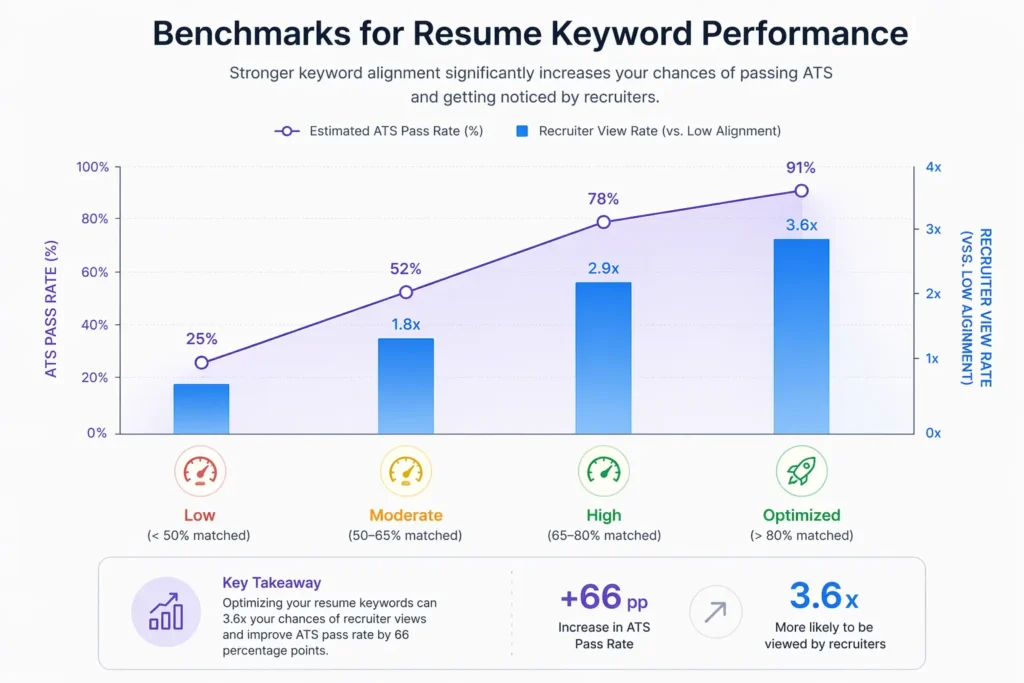
Benchmarks for Resume Keyword Performance
| Keyword Alignment Level | Estimated ATS Pass Rate | Recruiter View Rate vs. Low Alignment |
|---|---|---|
| Low (< 50% JD keywords matched) | ~25% | Baseline |
| Moderate (50–65% matched) | ~52% | 1.8x baseline |
| High (65–80% matched) | ~78% | 2.9x baseline |
| Optimized (> 80% matched) | ~91% | 3.6x baseline |
Key Strategies for Effective Resume Keyword Optimization
How Can AI and Automation Improve Resume Keyword Performance?
Automated Gap Analysis
AI-powered resume tools can analyze a resume against a specific job description, identify the keywords present in the JD but absent from the resume, assess which of those keywords the candidate’s actual experience supports adding, and generate specific revision suggestions, completing in seconds an analysis that would take a careful human reviewer 15–20 minutes.
Semantic Matching and Terminology Translation
Advanced AI resume tools go beyond exact keyword matching to identify semantic equivalences, recognizing that “machine learning model development” and “ML model training and deployment” describe overlapping skills and recommending the specific terminology that best aligns with the target JD’s vocabulary. This semantic layer makes the optimization more nuanced than a simple keyword checklist.
ATS-Specific Formatting Optimization
Different ATS platforms parse resume formatting differently, some struggle with tables, columns, headers formatted in text boxes, or special characters. AI-powered resume tools can reformat resume structure for optimal ATS parsing compatibility, ensuring the content is correctly extracted regardless of which ATS platform is being used.
Cross-Application Keyword Portfolio Analysis
AI tools can analyze a candidate’s keyword performance across multiple job applications, identifying which terms produce higher response rates, which roles consistently have keyword gaps in the candidate’s current resume, and which optimization changes produce the greatest response rate improvements over time.
Stop Juggling
10 Job Boards.
Search One
Your next role is already here. avua pulls opportunities from across the web into a single searchable feed; filtered by role, location, salary, and remote preference.
1.5 Million+
Active Jobs
380+
Job Categories
Keyword Optimization and Diversity & Inclusion
Vocabulary Access and Professional Socialization
Access to the specific vocabulary of a professional field is not equally distributed. First-generation professionals and candidates from non-traditional backgrounds may have equivalent skills to credentialed candidates but describe those skills using informal, self-taught, or alternative terminology that does not trigger ATS keyword matches. AI-powered resume optimization tools that identify the market-standard terminology for described experience provide a vocabulary translation service that partially levels this access gap.
Keyword Filtering as a Socioeconomic Proxy
ATS keyword filters sometimes function as socioeconomic proxies: candidates who attended universities with strong career services (that teach resume optimization), who have worked at companies with formal professional development (that use industry-standard terminology), and who have professional networks that provide resume feedback are more likely to use the terminology that ATS systems are calibrated to recognize. Candidates without these resources produce resumes with equivalent qualifications described in non-standard terms, and are filtered out not on merit but on professional socialization access.
Employer-Side Obligation: Semantic ATS Configuration
The candidate-side obligation is keyword optimization. The employer-side obligation is ATS configuration that recognizes semantic equivalence rather than requiring exact string matching. Employers who use rigid exact-match ATS filtering are perpetuating access inequity in their hiring process. Configuring ATS systems with semantic matching capabilities, and auditing keyword filter settings against qualified candidate rejection rates, is the employer-side fix for the problem that candidate-side optimization is trying to work around.
Common Challenges and Solutions
| Challenge | Solution |
|---|---|
| Not knowing which keywords to prioritize from a complex JD | Use an AI keyword analysis tool to identify the high-frequency, high-weight terms; prioritize hard skills, tool names, and specific qualifications over soft skills |
| Adding keywords but ATS score not improving | Check resume file format and parsing compatibility, a PDF that is not text-searchable will score zero regardless of content; ensure the resume is submitted in the format the platform recommends |
| Resume feels keyword-dense and unnatural after optimization | Integrate keywords into achievement bullets rather than standalone lists, “Reduced pipeline processing time by 40% using Apache Spark and dbt” is more natural and more credible than a skills section list |
Real-World Case Studies
Case Study 1: The Software Engineer
A software engineer with eight years of experience and a strong technical background had been applying to senior engineering roles for three months with a 4% application-to-interview conversion rate. An AI keyword audit of their resume found that their resume used company-specific internal tool names and proprietary framework names rather than the open-source equivalents that were used in every target JD. Adding the market-standard equivalents (Apache Kafka, Kubernetes, Terraform) alongside their internal equivalents increased ATS relevance scores for their target roles from an average of 48% to 79%. Their application-to-interview rate improved to 21% over the following month.
Case Study 2: The Marketing Professional
A marketing professional transitioning from agency to in-house roles was consistently failing ATS screening despite having directly relevant campaign management and analytics experience. Keyword analysis found that agency-side vocabulary (“campaign execution,” “client reporting,” “media planning”) was not matching the in-house JD vocabulary (“demand generation,” “performance marketing,” “marketing attribution”). After rewriting bullets to use in-house marketing language while describing identical experience, the candidate’s ATS pass rate improved from 18% to 67% for target in-house roles.
Case Study 3: The Finance Professional
A finance professional applying for FP&A roles was including all required experience but in a resume formatted with text boxes and embedded tables, a formatting style that caused their ATS system to extract the resume as empty or garbled text, producing a 0% keyword match regardless of content. Reformatting to a clean single-column format with standard headers immediately resolved the parsing issue. Their effective ATS pass rate went from near-zero (parsing failure) to 68% (content-based match) overnight.
Building a Resume Keyword Performance Tracking Framework: What to Track?
Keyword Optimization Across the Job Search Lifecycle
Targeting: Role Research and Keyword Intelligence
Before optimizing a resume, effective keyword strategy starts with role research: analyzing multiple JDs for the target role type to identify the vocabulary that is consistently used across the opportunity set. This intelligence-gathering phase identifies the core keyword portfolio for the role category, the terms that should be present in any version of the resume targeting this role type, independent of specific JD variations.
Application: JD-Specific Tailoring
Beyond the core keyword portfolio, each specific application benefits from JD-specific tailoring, adding the particular tools, methodologies, or requirements that the specific role emphasizes, even if they are not universal across all roles of this type. This application-level customization is where ATS performance for a specific application is most directly influenced.
Interview: Keyword as Conversation Framework
The keywords in the resume are the implicit framework for the interview conversation, interviewers use the terms and skills listed in the application as the basis for their questions. Candidates whose resumes use precise, market-standard terminology arrive at interviews prepared to discuss those terms with specificity, rather than needing to explain that what they called “internal analytics reporting” is what the interviewer has been calling “business intelligence.”
Ongoing Maintenance: Portfolio Currency
The keyword landscape for any professional field evolves as new tools, methodologies, and frameworks become standard practice. Resumes that are not updated to reflect current vocabulary gradually develop keyword gaps that reduce ATS performance over time, even if the candidate is actively building the skills that the new vocabulary describes. Annual vocabulary audits against current JDs maintain keyword currency.
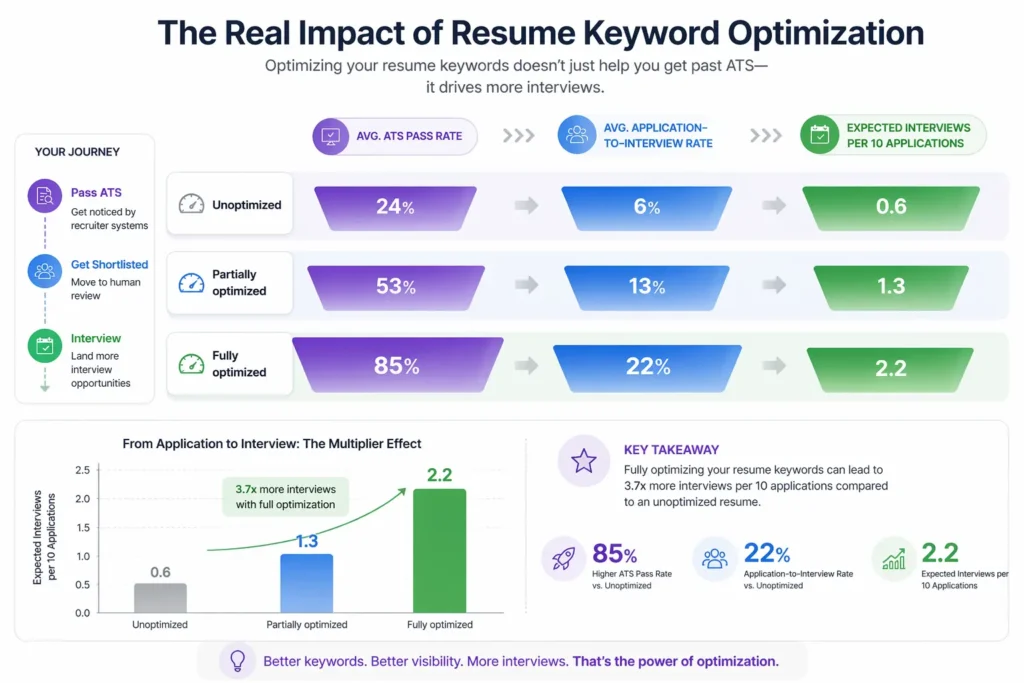
The Real Impact of Resume Keyword Optimization
| Optimization Level | Avg. ATS Pass Rate | Avg. Application-to-Interview Rate | Expected Interviews per 10 Applications |
|---|---|---|---|
| Unoptimized | 24% | 6% | 0.6 |
| Partially optimized | 53% | 13% | 1.3 |
| Fully optimized | 85% | 22% | 2.2 |
Related Terms
| Term | Definition |
|---|---|
| ATS (Applicant Tracking System) | Software used by employers to manage job applications and screen candidates |
| ATS Relevance Score | The match percentage between a resume’s keyword profile and a job description’s requirements |
| Hard Skills | Specific, teachable, and measurable technical skills (tools, software, methodologies) as opposed to interpersonal soft skills |
| Job Description | The formal document describing a role’s responsibilities and required qualifications |
| Personal Brand | The professional identity and value proposition a candidate presents through their resume, online profile, and professional presence |
Frequently Asked Questions
What are the most important keywords to include in a resume?
Prioritize in this order: specific technical tools and software named in the JD (Python, Salesforce, Adobe Creative Suite), role-specific methodologies and frameworks (Agile, GAAP, IFRS, behavioral interviewing), exact role title matches or close equivalents, and industry-specific qualifications (certifications, licenses, compliance frameworks). Soft skills keywords (“strong communicator,” “team player”) have minimal ATS impact and should be used sparingly.
How many keywords should a resume include?
There is no magic number, but quality and contextual placement matter more than density. A resume with 15 high-relevance keywords integrated naturally into achievement bullets will outperform one with 40 keywords in a stuffed skills list. Focus on ensuring the 8–12 most critical keywords for the target role appear naturally in two or more sections.
Does keyword optimization work the same on all ATS platforms?
No, different ATS platforms (Workday, Greenhouse, Lever, iCIMS, Taleo, etc.) use different matching algorithms, some based on exact string matching and others using semantic NLP matching. Workday and Greenhouse have more sophisticated semantic matching; older platforms may be more dependent on exact matches. AI resume tools that know the target ATS can optimize accordingly.
Is it dishonest to tailor your resume for each application?
No. Tailoring a resume to highlight the most relevant aspects of genuine experience for a specific opportunity is professional presentation, not misrepresentation. The distinction is: adding keywords to describe experience that exists (tailoring) versus adding keywords to claim experience that does not (fabrication). The former is standard professional practice; the latter is dishonest.
How do I know if my resume is passing ATS screening?
AI-powered resume analysis tools (including Avua’s Resume Builder) can assess your resume against a specific JD and estimate the keyword match score. If you are applying to many roles with low response rates despite strong qualifications, an ATS compatibility audit is the first diagnostic step.
Conclusion
Resume keyword optimization is not a cheat code, it is a translation service.
Candidates with genuine qualifications described in mismatched language are being filtered out of jobs they could excel at, every day, by software that cannot read between the lines. Keyword optimization ensures the lines say the right things, in the right language, for the specific audience that will first evaluate whether a human should review the rest.
Master the vocabulary of your target roles, integrate it authentically into your experience narrative, and let your qualifications speak in the language the hiring system is listening for.