Your job posting is not just an announcement. It is the first impression a potential hire has of your organisation, and in a competitive talent market, a poorly written one will cost you the right candidates before you ever get a chance to meet them.
A job posting is the external-facing advertisement that communicates an open role to prospective applicants, and it does a lot more than list responsibilities. It shapes candidate experience from the very first touchpoint, influences your application completion rate, and directly affects the quality of your applicant pool.
Done well, a job posting attracts the right people and filters out the wrong ones before you even open the background check stage. This guide covers what makes a job posting work, and what quietly kills it.
The core metric governing job posting effectiveness is Click-to-Apply Rate: the proportion of job posting views that result in a completed application.
Click-to-Apply Rate (%) = (Completed Applications ÷ Total Posting Views) × 100
Well-optimized job postings achieve Click-to-Apply Rates of 12–18% for professional roles. Industry average is approximately 5–8%. The gap is driven almost entirely by posting quality and application friction, both within the organization’s control.
What is a Job Posting?
A job posting is the candidate-facing communication of a specific employment opening, a purposefully crafted advertisement that describes the role’s purpose and responsibilities, the candidate’s experience and qualifications needed, the organization’s value proposition as an employer, and the application pathway, distributed through channels where the target candidate population actively or passively searches for opportunities.
The posting’s dual function, attracting the right candidates while filtering out the wrong ones, means that effective posting design requires explicit choices about what to include, what to exclude, what to foreground, and what to de-emphasize. A posting that includes everything is effective at neither attracting nor filtering. One that makes specific, candidate-centric choices at each of those decisions produces better qualified application rates than either extreme.
Why Most Job Postings Fail Before Anyone Reads Them?
A job posting can fail in two places: before it is read and after it is read. Most organizations focus their posting optimization attention on the after, the content. The before, whether the posting reaches the right candidates and compels them to click, is often overlooked entirely.
The “before” problem is an algorithmic one. On virtually every major job board platform, postings are not displayed to all candidates in a chronological or random order, they are ranked and surfaced by matching algorithms based on relevance signals. A posting that uses internal HR nomenclature instead of the job titles candidates search, that lists experience requirements as vague competencies rather than specific tools and skills, or that is structured without standardized fields for role category and level will receive less algorithmic distribution than an equivalent posting that is precisely formatted for platform matching.
The numbers are striking. A LinkedIn study on job posting discoverability found that roles with optimized titles and structured requirements fields received 3.6x more qualified impressions than equivalent roles with non-standard titling and unstructured content, with no additional distribution spend. The reach gap was attributable entirely to algorithmic discoverability, not to paid promotion.
The “after” problem is a conversion one. Of the candidates who do reach the posting, the proportion who complete an application depends on three factors: whether the content answers their primary self-assessment question (am I qualified for this, and do I want to be?), whether the application process is accessible on their preferred device, and whether the posting signals an employer worth investing the effort of applying to.
Research on posting content preferences consistently finds that candidates prioritize specific content (what will I actually do day-to-day), authentic content (what is the team and culture genuinely like), and actionable content (what are the realistic qualifications, not the aspirational ones).
A concrete data point: Appcast’s annual recruiting benchmarks found that job postings with salary information receive an average of 35% more applications from qualified candidates, with no corresponding increase in unqualified ones. The posting improvement that generates 35% more qualified applicants at zero additional cost is not a marginal optimization, it is a structural change that most organizations have been slow to make.
For TA leaders, the practical priority is treating the job posting as a conversion funnel with two stages, reach and apply, and optimizing each independently. Reach optimization: title standardization, structured skills fields, platform distribution strategy. Apply optimization: salary transparency, mobile-accessible format, candidate-centric language, and application friction reduction. Organizations that systematically address both stages consistently outperform those addressing only content quality.
Your Resume Isn’t Getting Read
Let’s Get That Fixed!
75% of resumes get auto-rejected. avua’s AI Resume Builder optimizes formatting, keywords, and scoring in under 3 minutes, so you land in the “yes” pile.
The Psychology Behind Job Posting Engagement
Relevance Heuristic and Title Scanning
Candidates evaluating a list of job search results scan titles first and bodies second. The title is the primary relevance signal, candidates decide whether to click based on whether the title matches their self-concept and search intent. Job titles that use standard market terminology (“Product Manager,” “Data Analyst”) perform significantly better than internal nomenclature (“Business Value Architect,” “Insights and Analytics Associate”) because they match the mental models candidates are using to evaluate relevance.
First Paragraph Abandonment
Research on job posting reading behavior shows that approximately 60% of candidates who click a posting read only the first paragraph or the requirements list before deciding to apply or move on. The opening content of a job posting, the first 100 words, is therefore disproportionately influential in the apply/abandon decision. Organizations that lead with compelling role purpose and impact (what this person will do and why it matters) consistently outperform those that lead with company boilerplate (“Company X is a leading provider of…”).
Application Friction and Mobile Abandonment
The gap between desktop and mobile application completion rates is one of the most consistent findings in modern recruitment research. On mobile, every redirect to an external ATS, every required document upload, and every form field beyond six loses a meaningful proportion of applicants. Mobile abandonment rates on redirected applications average 72–79%; native or simplified mobile applications average 38–44%. The friction difference is not about candidate commitment, it is about UX design.
Job Posting vs. Related Terms
| Term | Audience | Purpose | Timing | Key Difference from Job Posting |
|---|---|---|---|---|
| Job Posting | External candidates | Attract and filter applicants | Active recruitment | External-facing advertisement |
| Job Description | Internal HR + hiring manager | Define role requirements | Pre-posting | Internal role definition document |
| Job Requisition | HR, Finance | Approval to recruit | Pre-posting | Approval document, not candidate-facing |
| Social Media Post | Social platform audience | Awareness and sharing | Parallel to posting | Shorter, engagement-optimized format |
| Boolean Search String | Sourcing tools | Proactive candidate identification | Parallel to posting | Outbound tool; not a posting |
What the Experts Say?
A job posting is the first impression your employer brand makes with a candidate who doesn’t know you exist. It has to earn attention, communicate authenticity, and make applying feel worth the effort, in about 400 words. Most postings are doing none of those three things.
– Madeline Laurano, Founder, Aptitude Research
How to Measure Job Posting Effectiveness?
Formula
Click-to-Apply Rate (%) = (Completed Applications ÷ Total Posting Views) × 100
Qualified Application Rate (%) = (Qualified Applications ÷ Total Applications) × 100
Posting Reach Index = Posting Views ÷ Estimated Relevant Candidate Pool Size
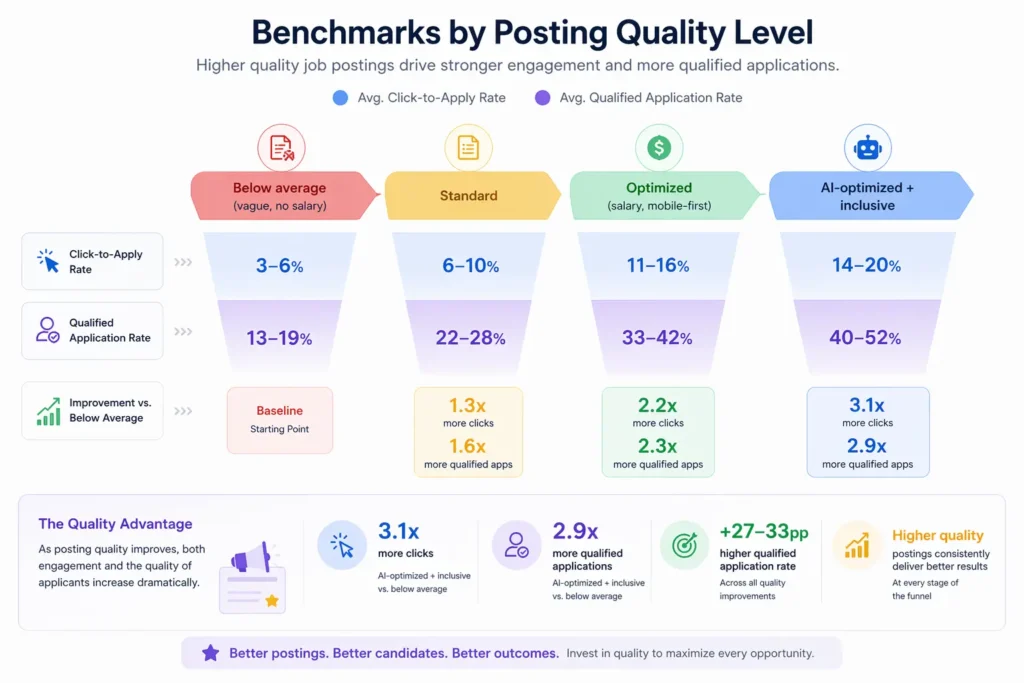
Benchmarks by Posting Quality Level
| Posting Quality Level | Avg. Click-to-Apply Rate | Avg. Qualified Application Rate |
|---|---|---|
| Below average (vague, no salary) | 3–6% | 13–19% |
| Standard | 6–10% | 22–28% |
| Optimized (salary, mobile-first) | 11–16% | 33–42% |
| AI-optimized + inclusive | 14–20% | 40–52% |
Key Strategies for High-Performance Job Postings
How Can AI and Automation Improve Job Posting Performance?
AI-Powered Posting Optimization
Natural language AI tools can analyze posting drafts against performance benchmarks, title search volume, inclusive language standards, requirement calibration, and competitive positioning, and provide specific improvement recommendations before the posting goes live. This converts posting quality from an individual writer’s skill to a consistently enforced standard.
Programmatic Distribution Optimization
AI-powered programmatic advertising tools manage posting distribution budgets in real time across multiple platforms, allocating spend toward the channels and posting formats producing the highest qualified application rates and reducing spend on those underperforming. For organizations running high volumes of active postings, programmatic management produces 20–35% efficiency improvements versus manual distribution management.
Dynamic Salary Benchmarking
AI-powered compensation intelligence can recommend real-time salary ranges for inclusion in postings based on the specific role, location, experience level, and competitive market context, ensuring salary transparency is accurate and current, not drawn from annual surveys that are already out of date.
A/B Testing at Posting Level
AI-powered recruitment marketing platforms can run systematic A/B tests on posting variables, testing different titles, different opening paragraph styles, different requirements structures, and different salary presentation formats, to identify the posting design elements that produce the highest conversion rates for specific role types.
Stop Juggling
10 Job Boards.
Search One
Your next role is already here. avua pulls opportunities from across the web into a single searchable feed; filtered by role, location, salary, and remote preference.
1.5 Million+
Active Jobs
380+
Job Categories
Job Postings and Diversity & Inclusion
Language as the First DEI Filter
The job posting’s language is the first demographic filter in the hiring process, operating before any application is submitted or any candidate is evaluated. Masculine-coded language, credential inflation, location restrictions that exclude candidates in less affluent geographies, and unnecessarily technical language all reduce demographic diversity in the applicant pool before the organization has any opportunity to exercise equitable evaluation.
Salary Transparency and Pay Equity
Salary transparency in job postings is a structural DEI intervention as well as a legal requirement in many jurisdictions. Research on salary negotiation dynamics consistently shows that candidates from underrepresented groups negotiate less assertively than majority counterparts, meaning organizations that do not disclose salary ranges systematically advantage candidates who negotiate aggressively (a behavior that is not equally distributed by demographic group) over those who do not. Transparent salary ranges level the compensation playing field before negotiation begins.
Accessibility Standards
Job postings should comply with WCAG 2.1 accessibility standards, ensuring screen reader compatibility, adequate contrast ratios, keyboard navigability, and alt text for any images or graphics. Non-compliant postings create access barriers for candidates with disabilities that are entirely preventable through standard web accessibility implementation.
Common Challenges and Solutions
| Challenge | Solution |
|---|---|
| Mobile abandonment rates above 70% on application redirect | Enable native apply or simplify ATS application to under 6 fields for mobile-sourced candidates |
| Posting generates high volume but low qualified application rate | Refine job title for precision; add qualification screening questions; consider whether generalist platform is right channel for this role type |
| Posting receives very low view count despite active promotion | Audit title against search volume data; check category and location tagging on the platform; verify sponsored distribution is active |
Real-World Case Studies
Case Study 1: The Technology Company
A technology company redesigned their engineering job postings with three changes: market-standard titles (replacing internal nomenclature), salary ranges added to all postings, and a “day in the life” section replacing the standard company boilerplate. Click-to-apply rate improved from 6.1% to 14.3%. Qualified application rate improved from 17% to 38%. Time-to-first-qualified-application dropped from 9 days to 3 days.
Case Study 2: The Healthcare Network
A healthcare network analyzing their posting performance found that clinical role postings had a 77% mobile abandonment rate, candidates were clicking through from mobile but dropping out when redirected to a desktop-built ATS. They enabled mobile-native application for all clinical postings, reducing the required fields from 18 to 6 for initial application. Mobile abandonment fell from 77% to 39%, and clinical role application volume increased by 61%.
Case Study 3: The Retail Franchise
A retail franchise group standardized their job posting titles across 200+ locations, replacing location-specific variations (“Customer Happiness Associate – Regional,” “Floor Team Member 2”) with standardized market titles (“Retail Sales Associate”). Search discoverability improved significantly, Indeed organic impressions for their postings increased by 4.2x within 30 days of the title standardization, with no change in posting content or budget.
Building a Job Posting Performance Dashboard: What to Track?
Job Postings Across the Hiring Lifecycle
Pre-Launch: Intake and Optimization
The highest-leverage posting investment happens before the posting goes live: the intake conversation that produces a clear role description, the title optimization against market search data, the requirements calibration conversation with the hiring manager, and the inclusive language review. Organizations that treat posting as a design challenge, not a form to fill, produce consistently better results.
Active Posting: Performance Monitoring and Iteration
A posting is a live hypothesis. Within the first week, performance data, view counts, click-to-apply rates, qualified application rates, provides feedback on whether the posting is achieving its objectives. Organizations that monitor this data and iterate (refreshing the title, adjusting requirements, increasing or decreasing sponsored promotion) outperform those that post and wait.
Application Processing: Source Attribution
Every application should carry its source attribution, the specific platform and campaign from which it arrived, through the entire ATS pipeline. Source attribution maintained to hire level enables source-to-hire analysis; attribution lost at the ATS intake stage reduces channel performance measurement to application volume, which is a significantly less useful metric.
Post-Fill: Posting Archive and Learning
Completed postings are research data for future ones. Organizations that archive posting performance metrics, what worked, what was changed and why, what the final qualified application rate and source-to-hire rate were, build institutional posting knowledge over time. Those that treat each posting as a fresh start repeat the same design learning process each time.
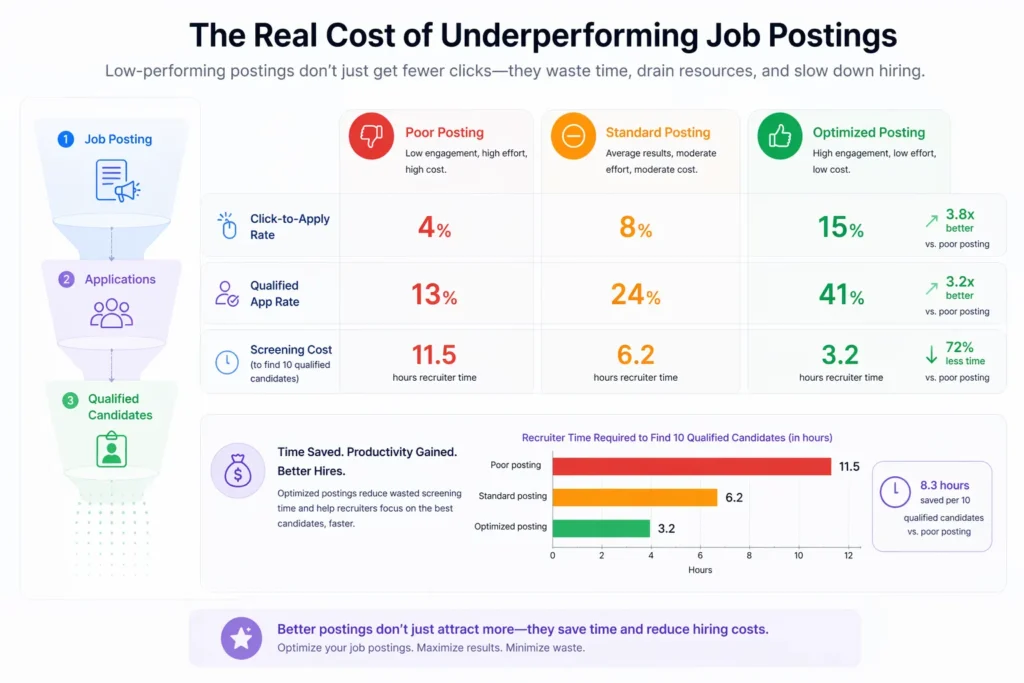
The Real Cost of Underperforming Job Postings
| Scenario | Click-to-Apply Rate | Qualified App Rate | Screening Cost (to find 10 qualified candidates) |
|---|---|---|---|
| Poor posting | 4% | 13% | 11.5 hours recruiter time |
| Standard posting | 8% | 24% | 6.2 hours recruiter time |
| Optimized posting | 15% | 41% | 3.2 hours recruiter time |
Related Terms
| Term | Definition |
|---|---|
| Job Description | The internal document defining a role’s responsibilities and requirements |
| Click-to-Apply Rate | The proportion of job posting views that result in a completed application |
| Employer Branding | The reputation and identity of an organization as an employer, partially shaped by posting tone and quality |
| Programmatic Advertising | Automated, data-driven management of job posting distribution and spend across platforms |
| ATS (Applicant Tracking System) | Software that manages candidate applications from posting to hire |
Frequently Asked Questions
What is the difference between a job posting and a job description?
A job description is an internal document defining what a role entails, written for HR, the hiring manager, and the evaluation process. A job posting is the external advertisement designed to attract qualified candidates, written for job seekers on platforms where they are searching. The posting draws from the description but is shorter, more candidate-centric, and optimized for the channels where it will be distributed.
How long should a job posting be?
Research on posting engagement consistently points to 400–700 words as optimal for most professional roles. Shorter postings lack the specificity needed for accurate self-selection; longer ones show declining engagement beyond 800 words due to cognitive load. Lists of 8–12 requirement bullet points are significantly less effective than two clearly differentiated tiers (required: 4–5 items; preferred: 3–5 items).
Should job postings include the company name?
For most postings, yes, company name improves trust and enables candidates to research the organization before applying, which typically improves application quality. For confidential searches (CEO succession, pre-announcement restructuring), anonymous postings through a search firm or neutral ATS link are appropriate.
How often should you refresh an active posting?
Organic posting performance typically peaks in the first two weeks and declines significantly after day 30 as the audience of relevant active seekers is exhausted. Refreshing the posting content, re-posting as new, or rotating sponsored promotion every 30–45 days maintains performance through extended searches.
Does posting quality affect employer brand?
Significantly. Every candidate who reads a job posting forms an impression of the organization as an employer. Poorly written, vague, or exclusionary postings generate negative employer brand impressions at scale, across thousands of candidates who will never apply, will tell others, and will remember the experience when evaluating the organization in future contexts. A well-crafted posting builds employer brand even among candidates who decide not to apply.
Conclusion
The job posting is a 400-word conversation with thousands of candidates, candidates who are deciding in 90 seconds whether your organization is worth their time.
Organizations that invest in posting quality, optimizing for algorithmic reach, candidate-centric language, salary transparency, and mobile accessibility, consistently outperform those treating the posting as a form-filling step in the workflow. The best posting is not the longest, the most credential-heavy, or the most formally worded. It is the one that efficiently communicates why the right candidate should apply, in the language they are searching in, on the device they are using, with the information they need to decide.
Everything else is noise.