Every hire starts somewhere.
Before a job goes live, before a single candidate pipeline is built, and before any boolean search is run on LinkedIn, there is a document sitting in an approval queue that makes all of it official. That document is a job requisition.
A job requisition is a formal internal request to open a new position, capturing the business justification, budget approval, and role specifics that hiring teams need before recruitment can begin. It is the starting gun for the entire hiring process, yet it is one of the most overlooked steps in data-driven recruiting.
Get the job requisition right and everything downstream gets easier, from writing a sharper job posting to reducing your overall cost per hire.
The core metric governing requisition management is Req-to-Post Time: the elapsed days from requisition submission to job posting going live.
Req-to-Post Time (days) = Date of First Job Posting − Date Requisition Submitted
Best-in-class organizations achieve Req-to-Post Times of 3–5 days for standard roles. Industry average is approximately 10–14 days. The gap is almost entirely driven by approval process design, not by the complexity of the roles.
What is a Job Requisition?
A job requisition is the formal internal authorization document that initiates a recruitment process, comprising the role’s title, department, level, compensation band, business justification, reporting relationships, headcount classification (new hire, backfill, or contractor conversion), and the stakeholder approvals required to release the role for active sourcing.
The req is the organizational system of record for a hire from its earliest inception through to completion. It is the document against which budget is tracked, headcount is managed, and workforce planning is reconciled. Its accuracy and completeness are foundational to both the efficiency of individual hiring processes and the integrity of organizational workforce data.
Is Your Requisition Process a Governance Tool or a Speed Bump?
The stated purpose of the job requisition process is governance: ensuring that hiring decisions are authorized, budgeted, and strategically aligned before organizational resources are committed to recruitment. This is a legitimate and valuable purpose. The problem is that in many organizations, the req process has accumulated procedural overhead that bears no relationship to the governance value it theoretically provides.
The symptom is a Req-to-Post Time significantly longer than the role’s actual approval complexity warrants. A role replacement for a departing employee, a backfill that has identical compensation, identical requirements, and a pre-existing budget allocation, should require a streamlined approval process measured in days. When it takes three weeks because it is routed through the same seven-step approval chain as a new senior leadership hire, the approval process is adding cost, not value.
The cost of approval delay is real and often invisible. At an average vacancy cost of $300–500 per day per role (reflecting productivity loss, additional workload on remaining team members, and client or customer impact), a ten-day difference between a five-day and fifteen-day Req-to-Post Time costs $3,000–5,000 in vacancy impact, before accounting for the competitive talent market implications of a posting that goes live ten days later than it needed to.
LinkedIn research on req processing found that organizations with average Req-to-Post Times above 14 days consistently show higher time-to-fill by 8–12 days than equivalent organizations with faster req processing, because the late posting means the sourcing pipeline starts later, the first qualified application arrives later, and the entire downstream process is shifted back. For an organization making 80 hires per year, a 10-day improvement in Req-to-Post Time translates to approximately 800 fewer vacancy days per year, at $300/day, a $240,000 annual productivity recovery from a process design change.
For TA leaders, the practical opportunity is a req process audit: mapping every step of the current approval workflow, identifying which steps add genuine governance value and which are process artifacts accumulated over time, and designing a tiered approval model that matches approval rigor to role complexity and budget impact. Backfill roles with established compensation bands need a different approval path than new senior leadership hires, and treating them identically is where most req process waste originates.
Your Resume Isn’t Getting Read
Let’s Get That Fixed!
75% of resumes get auto-rejected. avua’s AI Resume Builder optimizes formatting, keywords, and scoring in under 3 minutes, so you land in the “yes” pile.
The Psychology Behind Requisition Process Friction
Risk Aversion in Multi-Step Approvals
Multi-step approval processes accumulate when organizations experience bad hiring outcomes and respond by adding approval layers to prevent recurrence. Each layer made sense at the moment it was added, it addressed a real governance gap at a specific historical moment. The layers then persist after the gap has been addressed, because removing an approval layer feels riskier than keeping it. The result is an approval process that reflects the organization’s historical risk concerns rather than its current governance needs.
Approval as Organizational Power Signal
In many organizations, being on the approval chain for headcount decisions is a form of organizational power, it signals budget authority, strategic influence, and involvement in significant decisions. Stakeholders who have approval authority frequently exercise it slowly (as a demonstration of diligence) or with revision requests (as a demonstration of influence) rather than efficiently, because the efficiency of the approval process is not what is being optimized. Building time-to-approval SLAs with genuine accountability addresses this dynamic.
Completeness Anxiety and Req Quality
Requisitions that are submitted with incomplete information stall in approval because approvers cannot assess the request without the missing information and require revision cycles rather than approving or rejecting. The root cause is often that the req form is more detailed than the hiring manager is prepared to complete at the point of submission, creating a structural mismatch between what the form requires and what the manager knows. Tiered req forms that collect the information available at approval stage and the information available at posting stage separately reduce incompleteness-driven stalls.
Job Requisition vs. Related Process Documents
| Document | Purpose | Audience | Timing | Key Difference from Req |
|---|---|---|---|---|
| Job Requisition | Authorization to recruit | HR, Finance, Leadership | Pre-posting | Internal approval request |
| Job Description | Role definition | HR, Hiring Manager | Pre-posting | Role content, not approval request |
| Job Posting | External advertisement | Candidates | Active sourcing | External-facing; post-approval |
| Offer Letter | Employment terms proposal | Candidate | Post-selection | End of process, not beginning |
| Headcount Budget | Approved role count | Finance, HR | Annual planning | Annual aggregate, not individual role |
What the Experts Say?
The req process is where talent acquisition meets organizational governance. When it works well, it is invisible, roles get approved, posted, and filled efficiently. When it works badly, it is the most expensive invisible process in the company.
– Josh Bersin
How to Measure Requisition Process Effectiveness?
Formula
Req-to-Post Time (days) = First Posting Date − Req Submission Date
Req Approval Rate (%) = (Approved Reqs ÷ Total Reqs Submitted) × 100
Req Revision Cycle Rate (%) = (Reqs Requiring at Least One Revision ÷ Total Reqs Submitted) × 100
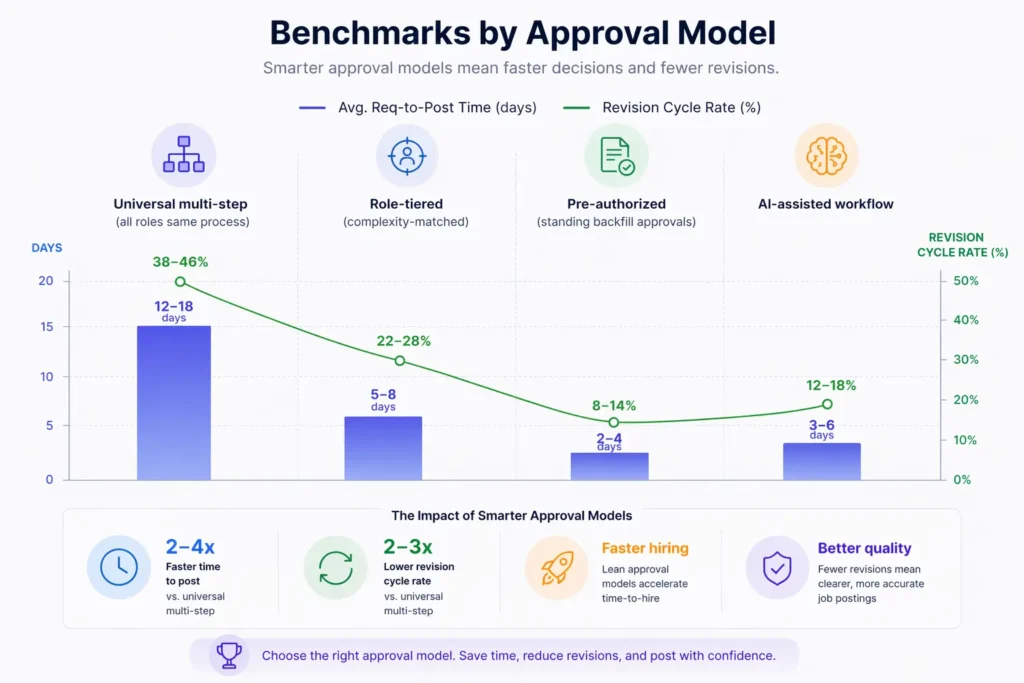
Benchmarks by Approval Model
| Approval Model | Avg. Req-to-Post Time | Revision Cycle Rate |
|---|---|---|
| Universal multi-step (all roles same process) | 12–18 days | 38–46% |
| Role-tiered (complexity-matched) | 5–8 days | 22–28% |
| Pre-authorized (standing backfill approvals) | 2–4 days | 8–14% |
| AI-assisted workflow | 3–6 days | 12–18% |
Key Strategies for Requisition Process Optimization
How Can AI and Automation Improve Requisition Management?
Automated Approval Routing
AI-powered workflow tools can automatically route requisitions to the correct approval chain based on role tier, department, budget threshold, and headcount type, eliminating the manual triage step that adds delay before the approval process even begins. Smart routing also ensures that approvers receive the specific information most relevant to their approval decision, reducing information requests that create revision cycles.
Req Completeness Validation
AI tools integrated with req submission forms can validate completeness at the point of submission, checking for required fields, flagging inconsistencies (compensation outside approved band for the role level, mismatched job family and role classification), and prompting the submitter to complete or correct before submission. Catching completeness issues at submission prevents the revision cycles that are the primary source of req processing delay.
Workforce Intelligence for Approval Support
AI-powered workforce analytics can provide approvers with contextual intelligence at the point of decision, market salary data for the requested compensation range, typical time-to-fill for the role type in the hiring market, and vacancy cost modeling for the expected approval timeline. This intelligence converts approval decisions from judgment calls into data-informed assessments.
Predictive Req Volume Modeling
Machine learning models trained on historical req patterns and business cycle data can predict future req volumes by department and role type, enabling TA teams to pre-position recruiter capacity, sourcing tools, and budget allocations before req volumes materialize. This converts TA capacity planning from reactive to predictive.
Stop Juggling
10 Job Boards.
Search One
Your next role is already here. avua pulls opportunities from across the web into a single searchable feed; filtered by role, location, salary, and remote preference.
1.5 Million+
Active Jobs
380+
Job Categories
Job Requisitions and Diversity & Inclusion
Req Classification and DEI Tracking
The requisition is the first point in the hiring process where demographic representation targets can be specified and tracked. Organizations with DEI hiring targets should capture those targets at the req level, defining the representation objectives for each role’s candidate pipeline, and track progression against those targets through the hiring funnel using the req as the anchor record.
Compensation Band Assignment and Pay Equity
The req process is where compensation bands are assigned to roles, making it the upstream intervention point for pay equity. Ensuring that the compensation band for a req accurately reflects the market rate for the role (rather than anchoring to the previous incumbent’s salary, which may reflect historical equity gaps) prevents pay equity issues from being baked into the role before the first candidate is screened.
Approval Bias and Role Classification
Roles serving underrepresented populations or organizational equity initiatives sometimes face slower approval timelines than core business function roles, not through intentional discrimination but through informal priority hierarchies in approval chains. Monitoring req-to-post time by role type and department, and investigating systematic slowdowns in specific role categories, surfaces this pattern before it accumulates into a structural DEI disadvantage.
Common Challenges and Solutions
| Challenge | Solution |
|---|---|
| Req approval taking 3+ weeks for standard backfill roles | Implement pre-authorization for high-frequency backfill role families; introduce SLAs with escalation for approvers who miss them |
| Req submitted with incomplete information requiring revision cycles | Build AI-powered completeness validation at submission; provide hiring manager req guidance documentation before submission |
| Req data inconsistencies causing ATS setup errors | Standardize req field formats for ATS integration; implement automated data validation between HRIS and ATS at req transfer |
Real-World Case Studies
Case Study 1: The Technology Company
A technology company with a 17-day average Req-to-Post Time audited their approval process and found that all requisitions, from junior engineer backfills to VP-level new hires, were routed through the same seven-step approval chain. They redesigned to a three-tier model: Tier 1 (backfill, same band) at 48-hour two-approver process; Tier 2 (new role, within budget) at five-day four-approver process; Tier 3 (above-band or strategic) at ten-day full-committee process. Average Req-to-Post Time fell from 17 to 6 days across all tiers. Annual vacancy cost reduction estimated at $320,000.
Case Study 2: The Healthcare System
A healthcare system with high clinical staff turnover implemented standing annual headcount authorizations for their highest-turnover clinical role families. Backfill reqs for these roles were pre-approved at the annual planning cycle, requiring only a notification to HR that a vacancy had occurred rather than a new approval request. Req-to-Post Time for pre-authorized roles fell from 11 days to 1.5 days. The system reached full staffing targets for critical clinical roles three weeks earlier in each quarter than in the prior year.
Case Study 3: The Financial Services Firm
A financial services firm connected their HRIS requisition approval system directly to their ATS and job board posting tools via API integration. When a req received final approval, an ATS job record and job board postings were automatically created from the req data within four hours, without manual data entry. Req-to-post time fell from 14 days to 5 days, with most of the remaining time attributable to job description refinement and compensation review rather than the technical process of posting.
Building a Requisition Management Dashboard: What to Track?
Requisitions Across the Hiring Lifecycle
Workforce Planning: The Req as Planning Output
In mature organizations, the job requisition is not a reactive document, it is the operational output of a workforce planning process. Hiring plans identify what roles will be needed in what timeframes; requisitions are the mechanism by which those plans are converted to approved recruitment actions. Organizations that plan their req submissions in advance, preparing req drafts for planned hires before the quarter begins, reduce req-to-post time significantly by eliminating the preparation lag at the point of submission.
Approval Stage: Governance Without Obstruction
The approval stage should be designed to achieve its governance purpose, budget validation, strategic alignment, organizational authorization, in the minimum time required. Governance value and approval speed are not opposites; a well-designed approval process achieves high governance quality in low elapsed time by providing approvers with the right information in the right format with clear decision parameters.
Posting and Sourcing: Req as Data Foundation
The approved req is the data foundation for the posting and sourcing workflow. The job title, compensation band, role classification, and requirements fields in the req should flow directly into the posting and ATS setup without manual re-entry. Organizations with clean req data and effective ATS integration achieve posting accuracy and completeness rates that are significantly higher than those relying on manual data transfer.
Post-Fill: Req Closure and Workforce Data
When a hire is made, the req should be formally closed with the hire record, capturing start date, compensation actuals, and source of hire, to update headcount tracking, close the budget commitment, and provide the data for post-hire analysis. Req closure data is the foundation for workforce planning accuracy in subsequent cycles.
The Real Cost of a Slow Req Process
| Scenario | Avg. Req-to-Post Time | Annual Vacancy Days (80 reqs/year) | Estimated Vacancy Cost |
|---|---|---|---|
| Slow process (15+ days) | 16 days | 1,280 days | $384,000 |
| Average process (10 days) | 10 days | 800 days | $240,000 |
| Optimized process (5 days) | 5 days | 400 days | $120,000 |
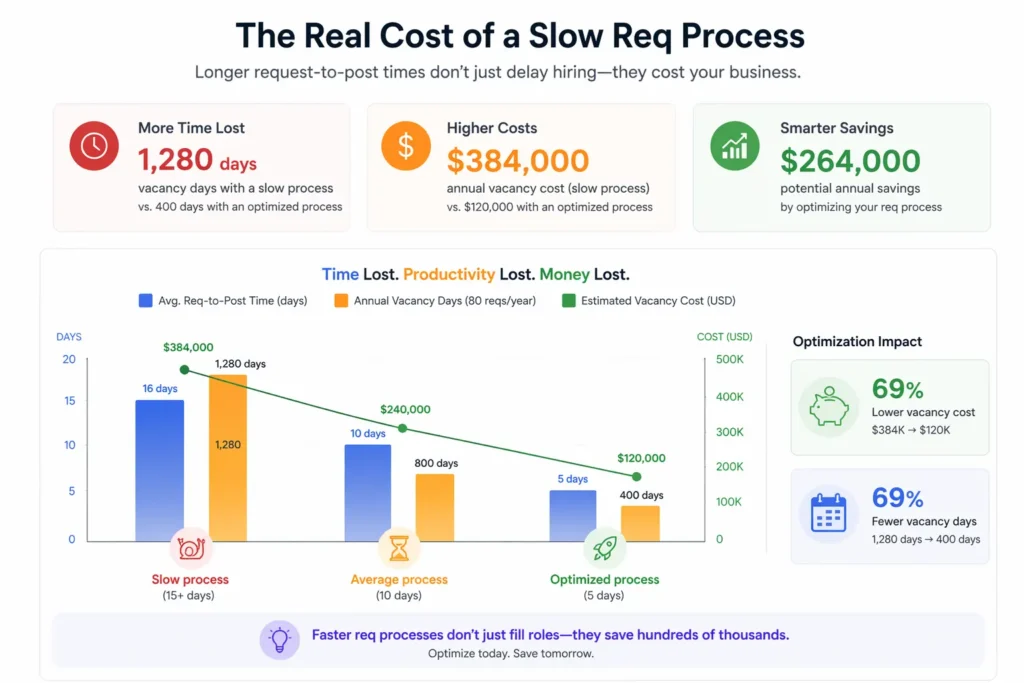
Vacancy cost at $300/day per role.
Related Terms
| Term | Definition |
|---|---|
| Headcount Budget | The approved number and cost of authorized employee positions for a defined period |
| Job Description | The internal document defining a role’s responsibilities and requirements |
| Workforce Planning | The strategic process of identifying organizational talent needs and planning how to meet them |
| Backfill | Recruiting to replace an employee who has departed from an existing role |
| ATS (Applicant Tracking System) | Software that manages candidate applications and recruits from requisition to hire |
Frequently Asked Questions
What is the difference between a job requisition and a job description?
A job requisition is the internal authorization request to recruit, it is a governance and budget document that requires approval before sourcing begins. A job description is the content document defining what the role involves, it provides the basis for the job posting and the evaluation criteria. The req typically references or includes the job description, but their purposes and audiences are different.
Who typically approves a job requisition?
Standard approval chains include the hiring manager, the hiring manager’s manager (for budget authority), HR or talent acquisition (for workforce planning alignment), and finance (for budget validation). Leadership-level roles typically also require CHRO and CEO involvement. The appropriate chain varies by organization size, role level, and whether the role is a new position or a backfill.
Can recruitment start before a req is approved?
In most governed organizations, no, sourcing and posting activity before req approval creates compliance, budget, and candidate experience risks (sourcing a candidate for a role that may not be approved). Some organizations maintain a “pre-approved” sourcing window for critical or recurring roles, which allows informal pipeline building before formal approval, but this approach requires careful candidate communication.
How should reqs be structured for ATS integration?
Req fields should use controlled vocabulary (standardized job family codes, level designations, and compensation band identifiers) that maps cleanly to ATS and HRIS field structures. Free-text fields should be limited to fields where standardization is not possible (role-specific requirements). Organizations with multiple HR systems should design a canonical req data model that defines how each field maps across systems.
What happens to a req if the role is no longer needed?
A req that is cancelled before being filled should be formally closed in the HRIS with a cancellation reason, preserving the governance record and accurately reflecting headcount planning. An open req that is never formally closed creates phantom headcount in workforce reporting. Regular audits of open reqs against active sourcing activity identify and resolve req data quality issues before they distort planning data.
Conclusion
The job requisition is where organizational governance and recruiting efficiency meet, and where they frequently collide.
Organizations that have designed their req processes for governance quality and operational speed, rather than treating these as competing objectives, achieve both: rigorous authorization workflows that take days rather than weeks, clean data foundations that enable AI-powered sourcing, and vacancy impact reductions that more than justify the process design investment.
The req is not paperwork. It is the starting gun for the most expensive and consequential process your organization runs.
Treat it accordingly.