The device your next best candidate is using to browse job listings right now is almost certainly not a desktop.
Mobile recruiting is no longer a forward-thinking strategy, it is the baseline expectation of a workforce that lives on their phones, and hiring teams that have not optimised for it are quietly losing candidates before the process even begins.
Mobile recruiting refers to the practice of designing and delivering the entire hiring experience, from job discovery to candidate engagement and application submission, with a mobile-first mindset. It touches everything from how your branded job posting renders on a small screen to how smoothly your application completion rate holds up when someone is applying on a commute.
The stakes are higher than most hiring teams realise. A clunky mobile experience does not just frustrate candidates, it actively damages candidate experience at the very first touchpoint. For organisations tracking data-driven recruiting metrics, a spike in drop-off rates at the application stage is often a mobile problem in disguise.
Done right, mobile recruiting widens your applicant pool, shortens time-to-apply, and signals to candidates that your organisation understands how people actually live and work today.
The core metric governing mobile recruiting effectiveness is Mobile Application Completion Rate: the proportion of mobile application sessions started that result in a submitted application.
Mobile Application Completion Rate (%) = (Mobile Applications Submitted / Mobile Application Sessions Started) x 100
High-performing mobile recruiting programs achieve Mobile Application Completion Rates of 72 to 84%. Industry average sits around 34 to 41%. The gap is almost entirely explained by application length, form design, and mobile UX quality, not by the quality of the roles being advertised.
What is Mobile Recruiting?
Mobile recruiting is the end-to-end design and optimization of the recruitment process for candidate interaction via smartphones and mobile devices, encompassing every touchpoint from initial job discovery through to offer acceptance, ensuring that no stage of the candidate journey requires a desktop experience to complete or creates meaningful friction for a candidate operating exclusively on mobile.
The distinction between mobile-compatible recruiting and mobile-first recruiting is the difference between accommodation and design. A mobile-compatible career site resizes for a smaller screen but was built for desktop and adapted. A mobile-first career site was designed for mobile interaction as the primary experience, with desktop as the secondary adaptation. The functional difference in candidate experience is significant: mobile-compatible sites consistently produce 30 to 50% higher drop-off rates than mobile-first equivalents, because the interaction model, button sizes, form lengths, and information hierarchy reflect the wrong primary user context.
Why Mobile Recruiting Is a Strategic Priority in the Modern Talent Landscape
The business case for mobile recruiting investment has moved from compelling to inescapable. As of 2025, over 68% of all job searches globally begin on a mobile device according to Google’s annual jobs intent report, and in the 18-to-34 demographic that represents the largest share of active candidates in most professional markets, that figure exceeds 80%. Organizations that have not optimized for mobile are not making a product quality choice; they are making a candidate exclusion decision, systematically filtering out the majority of potential applicants before they ever encounter the employer’s actual value proposition.
The ROI case is equally clear. Research published by the Talent Board’s Candidate Experience research program found that candidates who experience significant friction in a mobile application process are 3.5 times more likely to share negative employer brand feedback within their professional network than those who complete a streamlined mobile experience. For every qualified candidate who abandons a mobile application because the form is too long or the upload function does not work on their phone, there is a network of connected professionals who hears about that experience.
The financial modeling of mobile recruiting investment is straightforward. Consider an organization receiving 10,000 annual applications for professional roles, of which 65% are initiated on mobile. If the mobile application completion rate is 35% (the industry average for non-optimized mobile experiences), the organization is completing 2,275 mobile applications per year. If mobile optimization investment raises that rate to 72%, the same traffic produces 4,680 mobile applications, an increase of 2,405 completed applications from the same candidate interest. Assuming a conversion rate of 1 hire per 85 applications, that additional mobile completion represents approximately 28 additional hires per year from the same sourcing spend, with zero additional traffic acquisition cost.
The failure cost is equally concrete. A retail organization managing 200 open roles at any given time estimates that 60% of candidates who initiate their application on mobile do not complete it. Exit survey data from incomplete applications reveals that 71% of dropouts cite process length or technical difficulty on mobile as the primary reason, not lack of interest in the role. The organization calculates that its mobile drop-off rate is costing it approximately 840 applications per month in candidates who were interested enough to start but not supported well enough to finish, representing a substantial untracked sourcing loss that does not appear in the standard candidate pipeline metrics.
For TA leaders, the practical conclusion is that mobile recruiting investment is not a nice-to-have in a candidate experience improvement roadmap. It is the primary barrier between the organization’s existing sourcing investment and the candidate pool that sourcing investment should be reaching.
Your Resume Isn’t Getting Read
Let’s Get That Fixed!
75% of resumes get auto-rejected. avua’s AI Resume Builder optimizes formatting, keywords, and scoring in under 3 minutes, so you land in the “yes” pile.
The Psychology Behind Mobile Recruiting
Friction Sensitivity and Abandonment Thresholds
Mobile users have measurably lower friction tolerance than desktop users, because mobile interactions compete with a constant stream of alternative attention claims (notifications, messages, social media) in a way that desktop sessions typically do not. Behavioral research on mobile form completion consistently shows that the abandonment probability increases significantly after the third form field and dramatically after the seventh. Job applications that require more than 10 distinct input fields on mobile have structural abandonment rates above 60%, regardless of how interested the candidate is in the role. The design implication is that mobile application processes must treat every additional field as carrying a measurable candidate loss cost.
Immediacy and the Impulse Application Window
A significant proportion of mobile job applications are initiated in an impulse window, when a candidate encounters a role in a moment of readiness, whether browsing social media, reading a professional newsletter, or receiving a recruiter message. This impulse window is typically 5 to 8 minutes long before external demands reclaim the candidate’s attention. Mobile recruiting processes that can be completed within this window convert at dramatically higher rates than those requiring a session break, a document upload, or a return visit to continue. Organizations that design for the impulse window rather than the sustained research session capture a candidate conversion opportunity that desktop-primary processes systematically miss.
Trust Signals in Mobile-Optimized Candidate Experiences
Mobile-optimized career pages and application flows communicate organizational competence through their design quality. A career page that is visually broken, text-heavy, or requires horizontal scrolling on a phone signals to candidates that the organization’s investment in candidate experience is low, and by extension, that its investment in employee experience may be similarly limited. Research on candidate experience perceptions from the Candidate Experience Awards program consistently shows that mobile UX quality is one of the top three factors candidates use to form their initial impression of an organization as a place to work, ahead of the content of the employer value proposition itself.
Mobile Recruiting vs. Related Candidate Engagement Approaches
| Approach | Primary Channel | Application Completion Rate | Candidate Reach | Best Use Case |
|---|---|---|---|---|
| Mobile-First Recruiting | Smartphone (primary) | 72-84% | Maximum (all mobile users) | All role types where mobile search is primary |
| Desktop-Compatible Mobile | Smartphone (adapted) | 38-48% | Partial (lower-friction desktop users) | Traditional professional roles |
| Desktop-Primary Recruiting | Desktop / laptop | 71-79% desktop only | Limited to desktop-first job seekers | Executive-level or document-intensive roles |
| Social Media Recruiting | Mobile social platforms | Variable (platform-dependent) | High for passive candidates | Awareness and early engagement |
| SMS / Text Recruiting | SMS on any mobile | Response rate 45-60% | Direct contact, no app needed | High-volume, time-sensitive roles |
The critical distinction between mobile-first and mobile-compatible recruiting is not technical; it is a design philosophy difference that produces a measurable candidate experience and application completion rate differential.
What the Experts Say?
We talk about candidate experience as if it is a hospitality problem. It is not. It is a design problem. The candidates are not dropping out because they don’t want the job. They are dropping out because your phone experience is not good enough to hold their attention for six minutes. That is an engineering failure, not a talent failure.
– Jared Spataro, Corporate VP, Microsoft 365 and Modern Work
How to Measure Mobile Recruiting Effectiveness?
Formula
Mobile Application Completion Rate (%) = (Mobile Applications Submitted / Mobile Application Sessions Started) x 100
Mobile-to-Desktop Application Completion Rate Differential = Desktop Completion Rate minus Mobile Completion Rate
Mobile Candidate Pipeline Share (%) = (Mobile-Initiated Applications in Pipeline / Total Applications in Pipeline) x 100
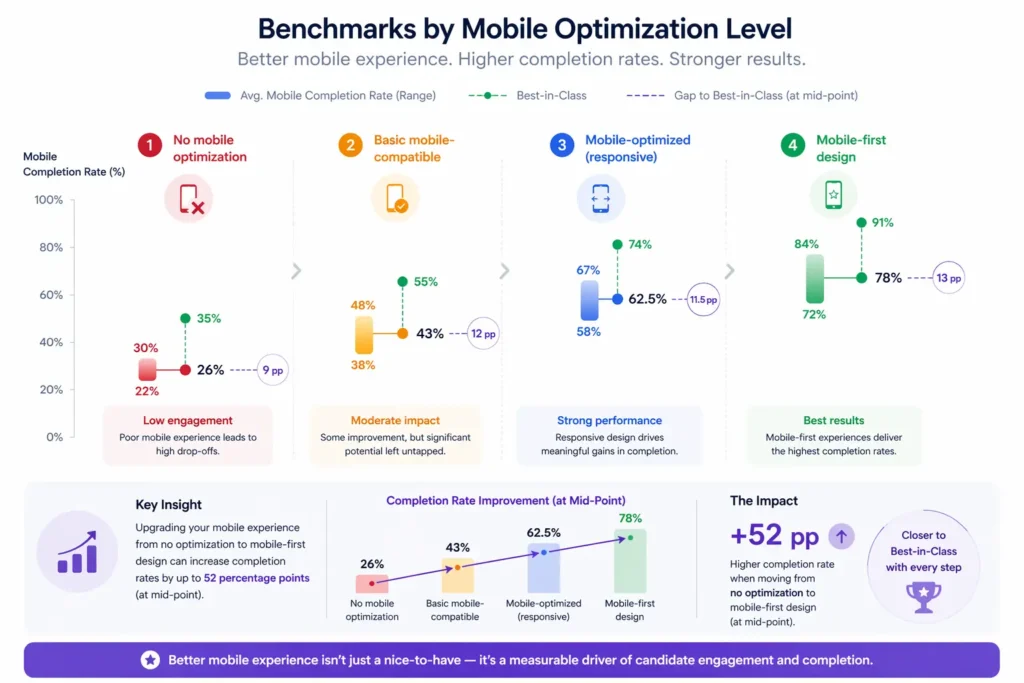
Benchmarks by Mobile Optimization Level
| Mobile Optimization Level | Avg. Mobile Completion Rate | Best-in-Class |
|---|---|---|
| No mobile optimization | 22-30% | 35% |
| Basic mobile-compatible | 38-48% | 55% |
| Mobile-optimized (responsive) | 58-67% | 74% |
| Mobile-first design | 72-84% | 91% |
Key Strategies for Effective Mobile Recruiting
How Can AI and Automation Support Mobile Recruiting?
AI-Powered One-Click Application
AI-driven application tools can parse a candidate’s existing profile data, whether from LinkedIn, a previous application, or an uploaded resume, to pre-populate mobile application fields, reducing the average mobile application completion time from 12 to 15 minutes to under 3 minutes. This one-click application capability is the single highest-impact intervention for mobile application completion rates and is now available as a standard feature in leading mobile recruiting platforms.
Conversational AI and Chatbot Application Flows
AI-powered chatbot recruiting tools can replace traditional mobile application forms with conversational interfaces that collect the same information through a messaging-style interaction that feels native to mobile. Candidates who complete conversational applications report significantly higher experience quality than those completing form-based applications, and completion rates for well-designed conversational flows are consistently 15 to 25 percentage points higher than for equivalent form-based mobile applications.
Predictive Content Delivery for Mobile Job Discovery
AI-powered job matching algorithms can deliver personalized role recommendations to candidates through mobile notification, social media, and email channels at the moments of highest receptivity, based on candidate behavior signals, device usage patterns, and historical application timing data. This predictive delivery layer ensures that job postings reach candidates at the mobile moments when they are most likely to engage rather than arriving uniformly regardless of timing.
Mobile-Optimized Digital Interview Platforms
AI-powered asynchronous interview tools designed for mobile capture candidate video responses through a mobile-native interface that requires no software download, supports all major smartphone operating systems, and can be completed in under 10 minutes. These mobile-compatible assessment tools remove the desktop requirement that causes the most significant drop-off between application completion and interview participation in non-mobile-optimized recruiting processes.
Stop Juggling
10 Job Boards.
Search One
Your next role is already here. avua pulls opportunities from across the web into a single searchable feed; filtered by role, location, salary, and remote preference.
1.5 Million+
Active Jobs
380+
Job Categories
Mobile Recruiting Through an Equity and Inclusion Lens
Mobile as the Primary Access Point for Underrepresented Candidates
Research on device access patterns across demographic groups consistently shows that candidates from lower socioeconomic backgrounds, younger candidates, and candidates from emerging markets are significantly more likely to access employment resources exclusively via mobile device, without consistent desktop computer access. An organization that maintains a desktop-primary application process is not simply creating inconvenience for these candidate groups; it is structurally excluding them from the candidate pool. Mobile recruiting is therefore not merely a conversion rate optimization exercise; it is an equity intervention that determines who has access to employment opportunity at all.
Language and Localization in Mobile Recruiting
Mobile recruiting for multilingual or multinational talent markets must account for text rendering, input method variability, and content length differences across languages, all of which affect mobile UX quality in ways that desktop UX is more forgiving of. Organizations with inclusive hiring commitments across language communities should audit their mobile recruiting experience in every language they operate in, not just their headquarters language, since UX degradation in non-primary languages is frequently severe and invisible to headquarters-based teams.
Accessibility Standards in Mobile Recruiting Design
Mobile recruiting experiences must meet Web Content Accessibility Guidelines (WCAG) standards for accessibility, including screen reader compatibility, sufficient color contrast, appropriately sized touch targets, and alternative text for visual elements. Candidates with visual, motor, or cognitive disabilities accessing the candidate experience via mobile assistive technologies encounter the same barriers as other mobile users, compounded by accessibility failures that desktop sites may handle better through keyboard navigation. Mobile accessibility is a legal compliance requirement in many jurisdictions and a foundational equity commitment in any organization with genuine DEI standards.
Common Challenges and Solutions
| Challenge | Solution |
|---|---|
| High mobile application abandonment rate despite traffic | Audit the mobile application flow for field count, upload requirements, and session breaks; reduce to 8 or fewer initial fields; implement AI-powered profile pre-population |
| Interview scheduling drop-off between mobile application completion and interview | Implement mobile-native scheduling tools with one-tap confirmation and automatic time zone detection; eliminate calendar integration requirements from the candidate-facing scheduling experience |
| Candidates dropping out when process moves from mobile to desktop-required platforms | Audit every stage of the candidate journey for desktop dependency; rebuild document submission, assessment, and interview tools to be fully mobile-functional before transitioning |
Real-World Case Studies
Case Study 1: The Retail Chain
A national retail chain with 12,000 annual seasonal hires redesigned its application process to be mobile-first after discovering that 73% of applications were initiated on mobile but only 29% were completed. The redesign reduced the initial application from 22 fields to 6, implemented SMS-based interview scheduling, and eliminated the PDF resume upload requirement for entry-level roles, replacing it with a work history form native to mobile. Mobile application completion rate rose from 29% to 71% within one hiring cycle. The chain reached full seasonal headcount 3 weeks ahead of the prior year’s timeline using the same sourcing budget.
Case Study 2: The Technology Scale-Up
A 400-person technology scale-up implementing its first mobile-optimized recruiting process discovered through an abandonment rate analysis that 61% of mobile application drop-offs occurred at the cover letter upload field, which was required and did not support the copy-paste input method that most mobile candidates used. Removing the cover letter requirement for the initial application and moving it to a later stage for shortlisted candidates eliminated the single highest-drop-off field. Mobile completion rate rose from 38% to 64%, and the quality of mobile applications did not decline, contradicting internal assumptions that cover letters were serving a screening function.
Case Study 3: The Healthcare Network
A regional healthcare network implementing mobile-first recruiting for nursing and allied health roles found that its existing interview scheduling system required candidates to access a desktop-only calendar integration that 48% of mobile candidates could not complete. It implemented a text-message-based scheduling system with a single-link confirmation requiring no app download or account creation. Interview scheduling compliance among mobile applicants rose from 52% to 88%. Time-to-hire for nursing roles fell by an average of 11 days, which the organization attributed directly to eliminating the scheduling friction that was adding a week or more to the candidate journey at the interview booking stage.
Performance Indicators That Define Mobile Recruiting Success
Mobile Recruiting Across the Candidate Journey
Awareness: Mobile Job Discovery and Employer Brand
The candidate journey begins on mobile for the majority of modern job seekers, through social media, job board apps, search engine results, or recruiter messages. Mobile employer brand assets, including career page mobile experience, social media content, and mobile-optimized job postings, are the first impression. Organizations with compelling, visually clear, and fast-loading mobile career pages see 40 to 60% higher click-to-application initiation rates than those with desktop-primary career pages scaled down to mobile.
Application: Conversion and Completion
This is the highest-impact stage in mobile recruiting optimization. Every additional field, every upload requirement, and every platform transition between the job posting and the completed application represents a measurable candidate loss. The design objective at this stage is to minimize the distance between a candidate’s first interest and a completed application to the maximum extent possible without sacrificing the information quality needed for screening.
Assessment and Interview: Mobile-Compatible Evaluation
Candidates who complete a mobile application expect to continue the process on mobile. Organizations that require desktop participation for assessments or interviews at this stage experience drop-off rates of 25 to 40% among mobile-first candidates, even when those candidates were highly engaged during the application stage. Building mobile-compatible assessment and interview tools is not an accommodation; it is the continuation of the mobile candidate experience the organization chose to provide.
Offer and Onboarding: Mobile Closing and Handover
The offer stage is where mobile recruiting investments either pay off or collapse. Offer letters that require desktop electronic signature platforms, onboarding document packages requiring desktop download, and I-9 or compliance processes that are not mobile-compatible extend the time between offer and accepted start date and create a negative final impression of the organization immediately before the new hire joins. Mobile-optimized offer and onboarding document management is the final design investment that closes the mobile candidate experience with the same quality it began with.
The Real Cost of Mobile Recruiting Neglect
| Mobile Optimization Level | Mobile Completion Rate | Applications Captured (10K monthly mobile traffic) | Annual Hiring Capacity Impact |
|---|---|---|---|
| No mobile optimization | 28% | 2,800 | Baseline (significant loss) |
| Basic mobile-compatible | 42% | 4,200 | +50% vs. no optimization |
| Mobile-first design | 78% | 7,800 | +178% vs. no optimization |
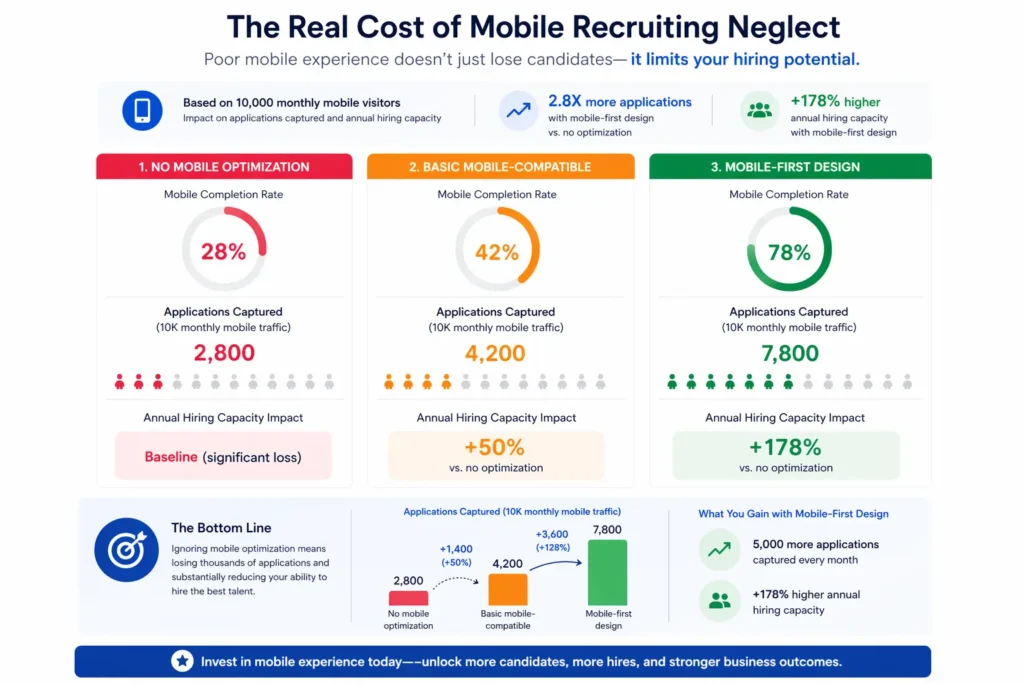
Hiring capacity impact assumes 1 hire per 85 completed applications. Calculation illustrates the candidate volume impact of mobile optimization level on the same inbound traffic volume.
Related Terms
| Term | Definition |
|---|---|
| Candidate Experience | The sum of all interactions and impressions a candidate has with an organization throughout the recruitment process |
| Application Completion Rate | The proportion of started job applications that are fully submitted by candidates |
| Conversational AI | AI-powered tools that engage candidates through natural language conversation rather than form-based data collection |
| SMS Recruiting | The use of text message communications for candidate outreach, scheduling, and engagement throughout the hiring process |
| Responsive Design | A web design approach that ensures interfaces adapt to and function optimally across all screen sizes and device types |
Frequently Asked Questions
What is mobile recruiting and why does it matter?
Mobile recruiting is the practice of designing all stages of the recruitment process to be fully functional on smartphones. It matters because the majority of candidates now begin and conduct their job searches on mobile devices. Organizations that have not optimized for mobile are systematically losing candidates to application friction before those candidates encounter the employer’s actual value proposition.
What is a good mobile application completion rate?
The industry average mobile application completion rate for non-optimized experiences is 34 to 41%. Well-optimized mobile-first recruiting programs achieve 72 to 84%. If your current mobile completion rate is below 50%, mobile UX optimization should be the highest priority investment in your candidate experience roadmap.
How do you reduce mobile application drop-off?
Audit the application process for field count, upload requirements, and desktop dependencies. Reduce the initial application to 8 or fewer fields. Eliminate required uploads (cover letters, portfolios) from the first stage. Implement AI-powered profile pre-population to reduce manual entry. Each of these interventions independently improves completion rates by 10 to 20 percentage points.
Does mobile recruiting affect the quality of applicants?
Not negatively when optimized correctly. Research consistently shows that mobile application completion rate improvements produce higher-quality candidate pools because they remove friction barriers that systematically excluded qualified candidates who happened to be mobile-first, not because they lower the quality threshold for the screening process.
What tools are essential for mobile recruiting?
The essential mobile recruiting technology stack includes a mobile-first career page and application flow, mobile-compatible scheduling tools, SMS or messaging app communication capability, mobile-accessible assessment tools, and mobile-compatible offer and onboarding document management. The specific platform varies, but the functional requirements are consistent across role types and industries.
Conclusion
Mobile recruiting is not a future consideration; it is the current standard of practice for any organization that wants to compete for the majority of the candidate population.
The organizations that have built mobile-first candidate experiences are not technology innovators; they are organizations that accepted an obvious truth about where candidates live and designed their recruitment process accordingly.
Those that have not are paying the cost in application abandonment, pipeline quality, and employer brand perception with every candidate who starts their journey on a phone and stops when the experience fails them.
Fix the mobile experience first.
Everything else in the candidate journey gets easier after that.