Recruiting has never had a shortage of tasks.
Screening applications, scheduling interviews, sending follow-ups, updating candidate records, chasing hiring managers for feedback. The list is long, repetitive, and relentless. Recruiting automation is how modern talent teams are finally getting that time back.
Recruiting automation is the use of technology to handle repetitive, rule-based tasks across the hiring process, freeing recruiters to focus on the work that actually requires human judgement. It touches everything from automated screening at the top of the funnel to candidate nurturing sequences that keep applicants warm without a single manual email being sent.
The impact is measurable across the metrics that matter most. Automation shortens time-to-fill, improves application completion rate, and reduces cost per hire by eliminating the administrative drag that slows every stage of the process down. It also strengthens candidate experience by ensuring timely, consistent communication that manual processes rarely sustain at scale.
For teams building a data-driven recruiting function, automation is not the end goal. It is the foundation everything else is built on.
The core metric governing recruiting automation effectiveness is the Automation ROI Rate: the ratio of time saved by automated process steps to the cost of automation implementation and operation, expressed as a productivity multiple.
Automation ROI Rate = (Recruiter Hours Saved per Month x Recruiter Hourly Rate) / Monthly Automation Platform Cost
Best-in-class TA functions achieve Automation ROI Rates of 4 to 7x, meaning every dollar invested in automation infrastructure returns four to seven dollars in recruiter productivity value. Industry average sits at 2.1x. The gap is almost entirely explained by the depth and consistency of automation adoption across the full process, not by the sophistication of the technology selected.
What is a Recruiting automation?
Recruiting automation is the use of technology tools, including artificial intelligence, machine learning, robotic process automation, and workflow software, to systematize and accelerate defined, repeatable steps in the talent acquisition process, from requisition opening through offer acceptance, reducing manual effort per hire while maintaining or improving process quality, compliance, and candidate experience.
The critical qualifier is defined and repeatable. Recruiting automation is effective precisely where the process step has a consistent structure, clear decision criteria, and a predictable outcome. Resume parsing, interview scheduling, status communication, assessment delivery, and compliance documentation are all high-automation-suitability tasks. First-contact candidate relationship building, cultural fit evaluation, offer negotiation, and executive assessment are low-automation-suitability tasks where human judgment remains the value-creating input.
Why Recruiting Automation Is Transforming the Modern Workplace?
The economic case for recruiting automation is straightforward at the macro level. The average corporate recruiter spends approximately 30% of their time on scheduling-related tasks and 25% on administrative communication and status management. Together, these activities consume more than half of a recruiter’s working week on tasks that produce no hiring quality improvement; they are process maintenance, not process value creation. Automating these tasks does not change the outcome; it returns 55% of recruiter capacity to the activities that do change outcomes, including sourcing, relationship building, assessment quality, and offer management.
The speed dimension of automation is equally consequential. Research on candidate behavior consistently finds that top candidates, defined as those with multiple active opportunities, withdraw from processes that take longer than two weeks from application to first interview. The companies losing those candidates are not losing them because of compensation or culture; they are losing them to administrative latency, the accumulated delay of manual screening queues, scheduling email chains, and status update cycles. Recruiting automation eliminates this latency structurally, not by working harder but by removing the process steps that create it.
For TA leaders, the ROI model for recruiting automation investment is typically built around three components: direct cost reduction from reduced recruiter hours per hire; speed improvement measured in reduced time-to-fill and its associated vacancy cost savings; and quality improvement measured in reduced early attrition and improved Quality of Hire scores when automation delivers more consistent assessment processes. A TA function spending $1.2 million annually on recruiter compensation that automates 40% of recruiter time is not reducing headcount; it is deploying that 40% capacity to activities that drive measurable quality improvement in hire outcomes.
Organizations that have implemented full-stack recruiting automation, covering sourcing intelligence, resume screening, candidate communication, scheduling, assessment, and reporting, report average time-to-fill reductions of 28 to 35% and cost-per-hire reductions of 20 to 30%, while simultaneously improving candidate experience scores. The combination of faster, cheaper, and better in a core business process is a rare proposition; recruiting automation is one of the clearest examples of it in the HR technology landscape. For deeper context, explore what data-driven recruiting looks like in operational practice.
A concrete data point from LinkedIn’s 2025 Talent Trends research: organizations with formally documented automation frameworks covering at least four major process areas achieve time-to-fill rates 31% faster than those operating on primarily manual workflows. The difference is not team size, budget, or industry; it is the operational discipline of automation adoption. For TA leaders making the business case for automation investment, the LinkedIn benchmark provides the clearest external validation currently available.
Your Resume Isn’t Getting Read
Let’s Get That Fixed!
75% of resumes get auto-rejected. avua’s AI Resume Builder optimizes formatting, keywords, and scoring in under 3 minutes, so you land in the “yes” pile.
The Psychology Behind Recruiting Automation
Algorithmic Aversion and Candidate Trust
Candidates have complex and sometimes contradictory reactions to automated recruiting processes. Research on algorithmic aversion, the tendency to trust human judgment over algorithmic decisions even when the algorithm demonstrably outperforms, finds that candidates are more likely to accept a negative outcome if they believe it was made by a human than if they know it was made by an algorithm. Organizations implementing automated screening must therefore design transparency into their candidate communication: explaining what the automated process does and does not do reduces the perceived fairness gap and improves candidate experience scores even among candidates who do not advance.
Decision Fatigue in Manual Processes
The behavioral economics research underlying automation’s quality case is as important as its efficiency case. Recruiters and hiring managers making sequential screening decisions show measurable decision fatigue effects: later-reviewed candidates are scored lower on average than earlier-reviewed candidates of equivalent quality. Automated screening systems do not experience decision fatigue; they apply consistent criteria to every application regardless of volume or review order. The quality floor established by well-designed automated screening is therefore more consistent than the quality floor of even skilled human screeners working at volume.
Speed as a Trust Signal
From the candidate’s perspective, response speed functions as a trust proxy for organizational quality. Candidates who receive an automated acknowledgment within minutes of application, an interview invitation within 48 hours, and scheduling confirmation within the same day interpret the organization as efficient, professional, and genuinely interested in them. Candidates who wait five days for a screening call and ten days for an interview invitation interpret the silence as indifference. The automated process produces a dramatically superior candidate experience outcome even when organizational interest levels are identical.
Recruiting Automation vs. Related Hiring Technologies
| Technology | Primary Function | Human Involvement | Key Benefit | Key Limitation |
|---|---|---|---|---|
| Recruiting Automation | Systematize repeatable process steps | Low (oversight only) | Scalability, consistency, speed | Cannot replace relationship judgment |
| ATS (Applicant Tracking System) | Application management and workflow | High (data entry, review) | Compliance, data organization | Passive; requires human operation |
| AI Sourcing Tools | Identify passive candidates | Medium (review, outreach) | Talent pool expansion | Outreach quality still needs human craft |
| Chatbot Recruiting | Candidate communication and screening | Very Low | 24/7 candidate engagement | Limited conversational nuance |
| Video Interview Platforms | Asynchronous interview delivery | Medium (review) | Schedule flexibility, consistency | Candidate experience variability |
What the Experts Say?
Recruiting automation does not make recruiting less human. It makes the humans in recruiting more valuable, because it removes the transactional work that was always beneath their capability and leaves the relationship work that only they can do.
– Kris Dunn, Founder, HR Capitalist; Partner, Kinetix Recruiting
How to Measure Recruiting Automation Effectiveness?
Formulas
Automation ROI Rate = (Recruiter Hours Saved per Month x Hourly Rate) / Monthly Platform Cost
Time-to-Screen (days) = Date First Screen Completed minus Date Application Received
Automation Adoption Rate (%) = (Process Steps Automated / Total Definable Process Steps) x 100
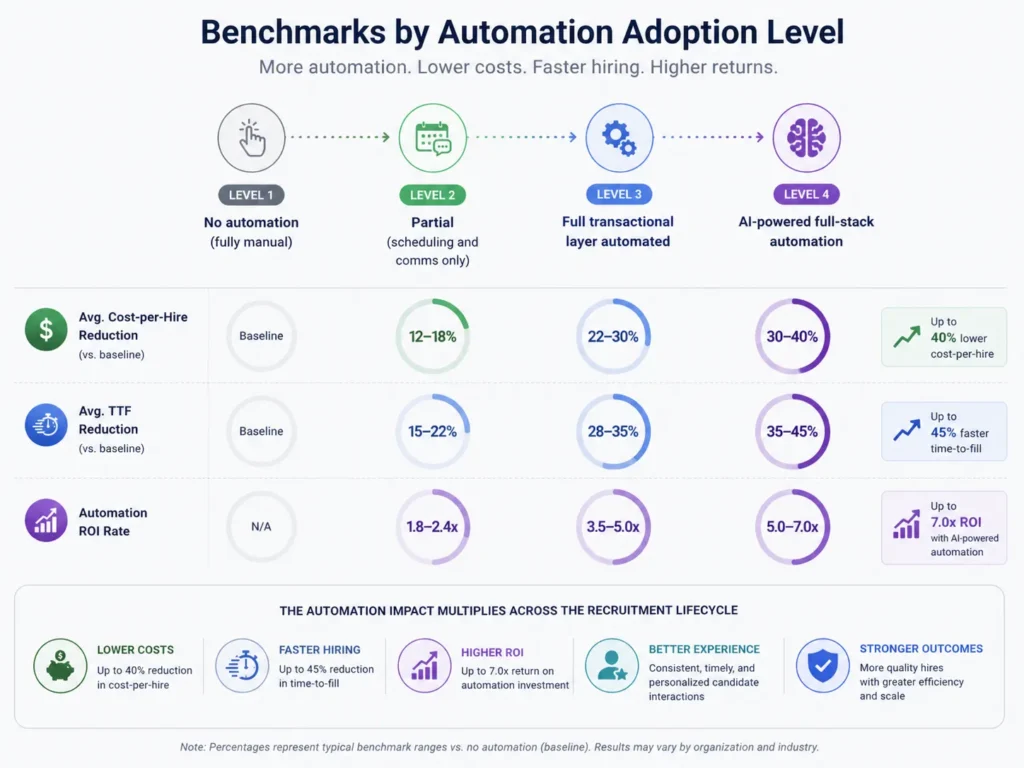
Benchmarks by Automation Adoption Level
| Automation Level | Avg. Cost-per-Hire Reduction | Avg. TTF Reduction | Automation ROI Rate |
|---|---|---|---|
| No automation (fully manual) | Baseline | Baseline | N/A |
| Partial (scheduling and comms only) | 12-18% | 15-22% | 1.8-2.4x |
| Full transactional layer automated | 22-30% | 28-35% | 3.5-5.0x |
| AI-powered full-stack automation | 30-40% | 35-45% | 5.0-7.0x |
Key Strategies for Effective Recruiting Automation
How Can AI and Automation Support Recruiting Automation?
Resume Screening and Parsing
AI-powered resume screening applies machine learning models trained on role-specific criteria to evaluate applications against defined competency requirements, ranking and filtering candidates at a speed and consistency that manual review cannot replicate. Best-in-class screening models reduce time-to-screen from an average of three to five days to under two hours, while improving screening-to-interview conversion rate quality by 20 to 30%. The automated screening layer should be treated as a floor-raising tool, not a ceiling-setting one, and calibrated continuously against downstream quality outcomes.
Chatbot-Driven Candidate Engagement
Chatbot recruiting tools enable 24/7 candidate communication, answering application status questions, conducting initial screening conversations, collecting supplementary information, and scheduling interviews without recruiter involvement. Organizations implementing chatbot engagement report 40 to 60% reductions in recruiter time spent on status communication and 25 to 35% improvements in application completion rates, as candidates receive immediate responses to questions that previously delayed their application process.
Interview Scheduling Automation
Automated scheduling tools eliminate the email back-and-forth that typically consumes two to four days in the scheduling phase of a hiring process. By integrating with hiring manager and interviewer calendars, these tools allow candidates to self-select available interview slots in real time, reducing scheduling time from days to minutes. Organizations implementing scheduling automation report candidate satisfaction improvements at the scheduling stage of 25 to 40% and recruiter time savings of four to six hours per hire across all role types.
Predictive Candidate Ranking
Machine learning models applied to candidate pipeline data can rank candidates by predicted job fit, organizational culture alignment, and likely offer acceptance probability, enabling recruiters to prioritize outreach and interview resources on the candidates most likely to produce successful placements. Predictive ranking models trained on role-specific outcome data consistently outperform unranked pipeline management in time-to-fill and Quality of Hire metrics by 15 to 25%.
Stop Juggling
10 Job Boards.
Search One
Your next role is already here. avua pulls opportunities from across the web into a single searchable feed; filtered by role, location, salary, and remote preference.
1.5 Million+
Active Jobs
380+
Job Categories
Recruiting Automation Through an Equity Lens
Recruiting automation carries a significant and often underappreciated equity risk: when trained on historical hiring data from organizations with historically non-diverse workforces, automated screening systems learn to replicate the demographic patterns of past hires. An algorithm that identifies the characteristics of successful historical employees and screens for them is not neutral; it is a precision instrument for reproducing the demographic composition of the past. Multiple high-profile audits of AI screening systems have found significant demographic differential selection rates that would fail disparate impact analysis under employment law.
The responsibility for algorithmic fairness in recruiting automation sits with the organizations deploying these systems, not exclusively with the technology vendors. Procurement decisions for automated screening tools should include audit results for demographic differential impact, ongoing monitoring commitments, and explicit contractual requirements for bias testing at defined intervals. The candidate experience for underrepresented groups should also be tested specifically: do automated communication templates use language that signals inclusion? Do scheduling tools accommodate the accessibility needs of candidates with disabilities?
Automation can also be a pro-equity tool when designed intentionally. Blind resume screening, automated anonymization of demographic markers before review, structured scoring rubrics applied consistently across all candidates, and bias-flagging systems that alert reviewers when evaluation patterns diverge across demographic groups are all automation applications that improve equity outcomes. The design choice between automation that replicates historical bias and automation that structurally corrects it is a governance decision, not a technology constraint.
Common Challenges and Solutions
| Challenge | Solution |
|---|---|
| Automated screening systems produce shortlists that still convert to non-diverse offers at the interview stage | Audit demographic conversion rates at every funnel stage, not only at the automated screening step; address interview-stage attrition with structured evaluation tools and calibration protocols |
| Candidates report the automated process feels impersonal and reduces employer brand perception | Design human handoff moments at key experience points: a personal recruiter contact after automated screening and personalized offer delivery regardless of automation at earlier stages |
| Hiring managers resist automation-generated shortlists, preferring to review all applications | Provide transparency data showing correlation between automated shortlist quality and 12-month hire performance; build manager trust through validated outcomes rather than system mandates |
Real-World Case Studies
Case Study 1: The E-Commerce Company
A 3,000-person e-commerce company implemented end-to-end recruiting automation across its warehouse and logistics hiring, which accounted for 800 annual hires. Prior to automation, the average time-to-fill for hourly logistics roles was 34 days, with a recruiter team of 12 managing the full cycle. Post-automation implementation covering resume screening, skills assessment delivery, automated scheduling, and status communication, time-to-fill fell to 11 days. The recruiter team was reduced by three positions through attrition, and the remaining nine recruiters were redeployed to complex salaried role hiring that had previously been under-resourced. Cost-per-hire for logistics roles fell by 38%.
Case Study 2: The Healthcare System
A regional healthcare network implemented AI-powered candidate ranking for its nursing and allied health recruitment, trained on outcome data from 1,400 historical hires across four years linking screening scores to 12-month performance ratings and 18-month retention outcomes. Within two quarters of implementation, the shortlist-to-offer conversion rate improved from 1-in-6 to 1-in-3.4, and 12-month retention for nursing hires improved from 71% to 84%. The network’s recruiter team reported a 40% reduction in time spent on resume review and a corresponding increase in time available for candidate relationship building and DEI-targeted sourcing.
Case Study 3: The Technology Scale-Up
A Series B technology company found that its candidate drop-off rate between application and first interview was 47%, driven primarily by slow screening response time (average 4.8 days) and scheduling difficulty (average 3.2 email exchanges to confirm a single interview slot). They implemented automated screening with same-day response, chatbot pre-screening for 15 qualifying questions, and self-serve scheduling linked to live interviewer calendars. Application-to-interview conversion rate improved from 23% to 41%, candidate satisfaction scores at the screening stage improved by 38 points, and time-to-fill across all roles fell from 41 to 27 days.
Performance Indicators That Define Recruiting Automation Success
Recruiting Automation Across the Hiring Lifecycle
Awareness and Application Stage
Automation at the awareness and application stage includes programmatic job advertising, AI-powered job description optimization for search visibility and inclusive language, and automated application acknowledgment and status communication. These are the first experiences a candidate has with the organization’s hiring process, and their quality sets the tone for the entire subsequent journey. Automation here should be designed to signal organizational professionalism and genuine interest, not merely to reduce recruiter administrative effort.
Screening and Assessment Stage
The screening and assessment stage is the highest-value automation opportunity in the recruiting process. AI-powered resume parsing and scoring, automated skills assessment delivery and scoring, and structured video interview analysis can reduce screening time from weeks to hours while improving consistency. The governance imperative at this stage is ensuring that automated screening criteria are validated against actual job performance requirements and audited for demographic differential impact on a defined schedule.
Interview and Evaluation Stage
Automation at the interview stage is primarily logistical rather than evaluative: scheduling automation, interview guide distribution, structured feedback form delivery, and calibration session coordination. The evaluative judgment at this stage remains human, but automation ensures the infrastructure around that judgment is consistent and efficient. Post-interview, AI tools can analyze evaluation form completion patterns for bias signals and flag outlier assessments for calibration review before offer decisions are made.
Offer and Onboarding Stage
At the offer stage, automation handles offer letter generation, background check initiation, compliance documentation collection, and pre-boarding communication sequences. These administrative steps, when manual, create unnecessary delay between offer acceptance and start date, during which candidate dropout risk is elevated. Automated offer and pre-boarding workflows reduce this gap and maintain candidate engagement and momentum into their first day. For context on what follows, see how automated screening connects to the broader talent acquisition infrastructure.
The Real Cost of Manual Recruiting Processes
| Scenario | Recruiting Approach | Avg. Time-to-Fill | Avg. Cost-per-Hire | Annual Cost (50 hires/year) |
|---|---|---|---|---|
| No automation | Fully manual process | 52 days | $5,800 | $290,000 |
| Partial automation | Scheduling and comms only | 41 days | $4,400 | $220,000 |
| Full transactional automation | AI-assisted full layer | 33 days | $3,600 | $180,000 |
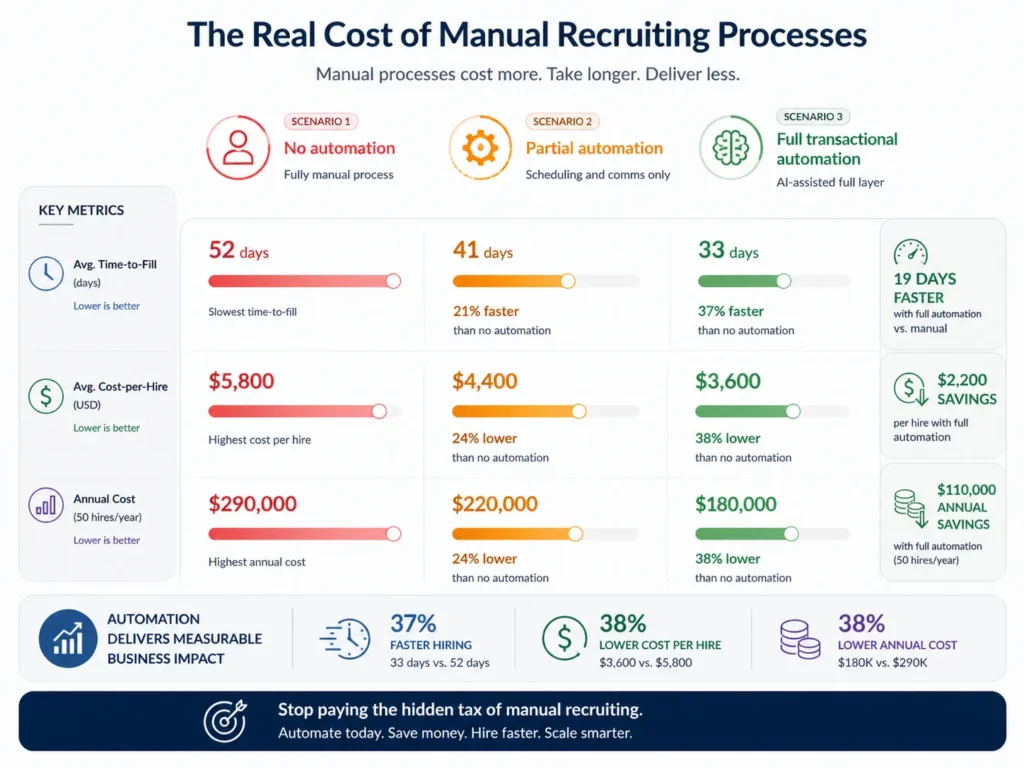
Cost-per-hire includes recruiter time, technology, and advertising spend. Vacancy cost not included. 50-hire scenario assumes mid-market organization with average role salary of $85,000.
Related Terms
| Term | Definition |
|---|---|
| Applicant Tracking System (ATS) | Software that manages the collection, organization, and workflow of job applications through the recruitment process |
| AI Sourcing | The use of artificial intelligence to identify and prioritize potential candidates from large databases and professional networks |
| Candidate Experience | The totality of perceptions and interactions a job seeker has with an organization throughout the recruitment process |
| Boolean Search | An advanced search technique using logical operators to refine candidate searches across databases and professional networks |
| Predictive Hiring Analytics | The use of data and machine learning models to forecast hiring outcomes including candidate success, retention likelihood, and time-to-fill |
Frequently Asked Questions
What recruiting processes can be fully automated?
The highest-suitability processes for full automation include resume parsing and initial scoring, interview scheduling, status communications and candidate updates, assessment delivery and scoring, offer letter generation, and compliance documentation collection. These are all high-volume, rules-based steps with consistent structure and predictable outcomes that do not require human relationship judgment to execute correctly.
Does recruiting automation improve candidate experience?
When implemented well, yes significantly. The primary candidate experience improvements come from response speed (automated acknowledgments within minutes versus days), scheduling efficiency (self-serve booking versus email chains), and communication consistency (no candidate left without status updates). The risk is automation that sacrifices personalization for efficiency; the best implementations balance speed with genuine human contact at the key relationship moments in the process.
Can small organizations benefit from recruiting automation?
Yes. Modern recruiting automation platforms are available at price points accessible to organizations hiring as few as 20 to 30 roles per year, and the ROI calculation is favorable at that scale because the per-hire time saving from scheduling and automated screening is consistent regardless of annual hiring volume. Small organizations often see the largest proportional benefit because their recruiting teams have the least capacity buffer to absorb manual process overhead.
How does recruiting automation affect diversity outcomes?
Recruiting automation has a dual relationship with diversity: uncritical implementation of screening algorithms trained on historical data can entrench historical demographic patterns, while intentional design of blind screening, structured assessment, and bias-monitoring systems can improve diversity outcomes. The determining factor is governance, including what the system is trained on, how it is audited, and whether demographic differential impact is actively monitored on a defined schedule.
What is the typical implementation timeline for recruiting automation?
Basic scheduling and communication automation can be operational within two to four weeks for most organizations. Full-stack AI-powered automation, including predictive screening, automated assessment integration, and reporting dashboards, typically requires eight to twelve weeks for configuration, data integration, and user training. The ongoing optimization of automation models, including bias auditing and screening quality calibration, is a continuous process rather than a one-time implementation step.
Conclusion
Recruiting automation is not the future of talent acquisition; it is the present operating standard for organizations that intend to hire competitively. The question is not whether to automate the transactional layer of recruiting but how quickly and how well.
Organizations that automate thoughtfully, with candidate experience, equity governance, and quality measurement built into the design, will find that their human recruiters become dramatically more effective, their candidates have a dramatically better experience, and their hiring outcomes improve in parallel with their efficiency.
The goal is not to remove humans from recruiting; it is to ensure that every moment of human recruiter time is spent on the work that only humans can do.