Data has transformed finance, marketing, and operations.
HR was always next, and people analytics is how that transformation is actually happening. Where gut instinct and anecdotal evidence once drove workforce decisions, people analytics brings structured, evidence-based thinking to some of the most consequential choices an organisation makes about its people.
People analytics is the practice of collecting, analysing, and applying workforce data to improve hiring, retention, performance, and organisational design. It sits at the more strategic end of HR analytics, moving beyond tracking what happened to understanding why it happened and what should happen next. For HR teams tired of being the last function at the table when business decisions are made, it is the clearest path to genuine influence.
The scope is broad. People analytics informs everything from data-driven recruiting and candidate pipeline quality to employee engagement trends and flight risk modelling. It connects hiring decisions to business outcomes in ways that make the value of talent strategy visible and measurable.
Organisations that invest in people analytics also tend to make faster progress on diversity hiring, because the data surfaces disparities that gut-feel processes quietly obscure. Paired with a focus on employee retention, it becomes one of the most complete lenses available for understanding and improving workforce health.
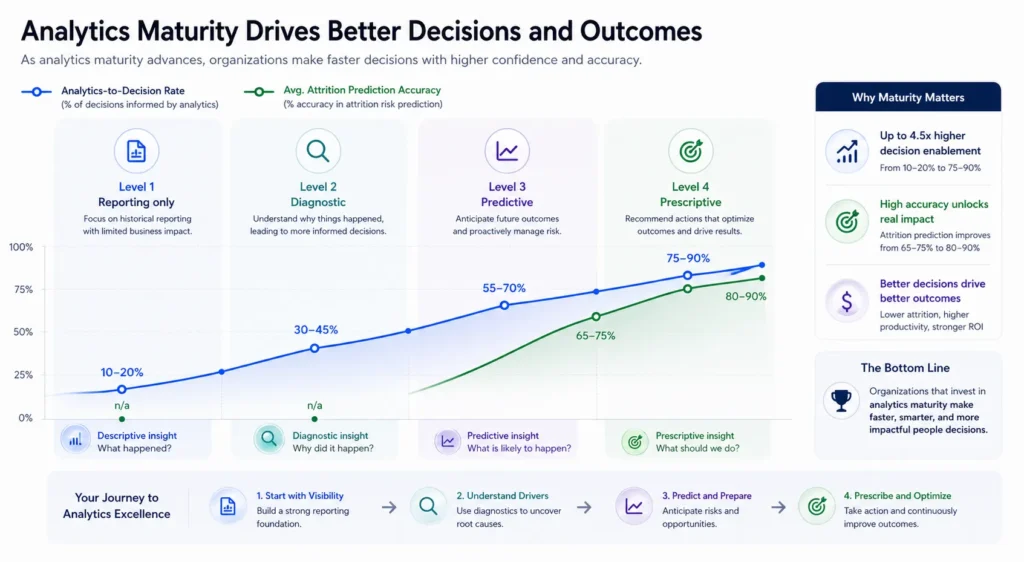
The core metric governing people analytics maturity is the Analytics-to-Decision Rate: the proportion of significant HR decisions (hiring, promotion, compensation, workforce planning) that are informed by structured data analysis rather than made exclusively on intuition or precedent.
Analytics-to-Decision Rate (%) = (HR Decisions Informed by Data Analysis / Total Significant HR Decisions) x 100
High-maturity people analytics organizations achieve Analytics-to-Decision Rates above 75%. The industry average sits around 34%, according to Deloitte’s Global Human Capital Trends research. The gap is not primarily explained by data availability; most organizations have more HR data than they use. It is explained by analytical capability, data infrastructure quality, and the organizational willingness to act on findings that challenge existing assumptions.
What is People Analytics?
People analytics is the systematic application of data science methodologies to the understanding and optimization of workforce-related decisions. It treats questions about talent, such as which candidates are most likely to succeed in a role, which employees are most at risk of leaving, or which management practices are most associated with high team performance, as empirical questions answerable with data rather than purely as matters of experience and judgment.
The discipline is distinct from HR reporting (which describes what has happened) in that people analytics explains causality, identifies patterns, and generates predictions that enable forward-looking decisions. An HR report tells you that voluntary attrition was 14% last year. A people analytics model tells you which employees are most likely to leave in the next six months, which managers have the highest attrition-predictive engagement scores, and what organizational interventions would most effectively reduce the projected attrition.
Why People Analytics Is the Competitive Intelligence Function HR Has Always Needed?
The strategic case for people analytics does not rest on the intrinsic value of data. It rests on the quality of decisions that data enables. Every HR decision made on incomplete information carries decision risk: the risk of hiring the wrong person, retaining the wrong people, investing in the wrong skills, or restructuring in a way that destroys the organizational capabilities the business needs. People analytics does not eliminate this risk. It systematically reduces it, and the reduction is measurable.
Deloitte’s Global Human Capital Trends research found that organizations with high people analytics maturity are 3.1 times more likely to report improved talent outcomes, defined as reduced attrition, improved quality of hire, and faster time-to-productivity for new hires, than those with low analytics maturity. The gap is not explained by organizational size, industry, or budget. It is explained by the quality of evidence on which talent decisions are made.
The concrete financial case is equally direct. A professional services firm with 2,000 employees and 14% annual voluntary attrition can expect to spend approximately $8.4 million per year on replacement hiring alone, assuming an average replacement cost of $30,000 per departure. A people analytics model that identifies the 20% of employees at highest attrition risk and enables targeted retention interventions for that group, reducing their attrition rate from 14% to 9%, saves approximately $1.68 million in replacement cost. If the analytics program and retention interventions cost $400,000 annually, the net return is $1.28 million, a 3.2:1 ROI on a single analytics use case.
The ROI extends beyond attrition. Quality of hire improvement, the ability to predict which candidates will perform well in a role rather than guessing, is consistently cited as the highest-value people analytics outcome by organizations that have measured it. A 10% improvement in quality of hire, defined as the proportion of new hires who meet or exceed performance expectations at twelve months, produces compounding value across every subsequent year of those employees’ tenure.
For HR and talent acquisition leaders, the practical framing is this: every HR decision made without data is a decision made at full risk. People analytics is not a technology investment; it is a risk management discipline. The organizations that have built analytics infrastructure are not just making better decisions, they are making decisions with known confidence levels rather than unknown ones.
Your Resume Isn’t Getting Read
Let’s Get That Fixed!
75% of resumes get auto-rejected. avua’s AI Resume Builder optimizes formatting, keywords, and scoring in under 3 minutes, so you land in the “yes” pile.
The Psychology Behind People Analytics
The Intuition-Data Tension in HR Decision-Making
Experienced HR professionals often have genuine reservations about people analytics: the concern that reducing human decisions to data models strips out the contextual judgment that makes those decisions good. This tension is real and legitimate. Data models built on historical patterns reflect historical conditions, including historical biases. A predictive attrition model built on past data will predict future attrition based on the organizational conditions that produced past attrition, which may not be the conditions the organization wants to perpetuate. The resolution is not to choose between intuition and data but to use data to surface the assumptions embedded in intuition and to identify patterns that intuition cannot detect at scale.
Confirmation Bias in Data Interpretation
People analytics findings are not immune to confirmation bias. Analysts and HR leaders who hold existing beliefs about what drives attrition, or what predicts hiring success, tend to interpret ambiguous data findings in ways that confirm those beliefs. Rigorous people analytics practice includes explicit protocols for challenging findings, presenting data to skeptical audiences, and testing alternative explanations for observed patterns. The discipline of people analytics is not just the technical discipline of building models; it is the organizational discipline of acting on findings that contradict existing assumptions.
Data-Driven Decision Anxiety
Organizational leaders accustomed to making HR decisions intuitively sometimes experience anxiety when transitioning to data-informed decision-making, not because they doubt the data’s validity but because data-informed decisions come with quantified confidence levels, which means they come with quantified uncertainty. A predictive model that says a manager has a 73% probability of high team performance is less reassuring than the instinct that “this person has what it takes,” because the 73% makes the 27% probability of error visible. Managing this transition requires framing data not as certainty but as structured risk reduction, which is what it actually is.
People Analytics vs. Related Data Functions
| Function | Primary Question | Data Scope | Horizon | Output |
|---|---|---|---|---|
| People Analytics | Why do workforce outcomes occur and what will happen? | Workforce-wide | Predictive | Models, recommendations |
| HR Reporting | What happened in the workforce last period? | Workforce-wide | Descriptive | Reports, dashboards |
| Talent Intelligence | Who are the best external candidates? | Market-wide | Current | Candidate lists |
| Workforce Planning | How many people of what type do we need? | Strategic | 1-5 years | Headcount models |
| HR Analytics | Broad synonym for people analytics, same scope | Workforce-wide | All horizons | Variable |
The critical distinction between HR analytics and HR reporting is the directional flow of insight. HR reporting tells leadership what has happened. People analytics tells leadership what will happen and what they should do about it.
What the Experts Say?
The organizations winning the talent war are not the ones with the most data. They are the ones that have built the organizational muscle to act on what the data says, even when it contradicts what their most experienced leaders believe.
– Josh Bersin, Global HR Analyst, The Josh Bersin Company
How to Measure People Analytics Effectiveness?
Formulas
Analytics-to-Decision Rate (%) = (Data-Informed HR Decisions / Total Significant HR Decisions) x 100
Attrition Prediction Accuracy (%) = (Correctly Predicted Attrition Events / Total Predicted Attrition Events) x 100
HR Decision Outcome Improvement (%) = ((Post-Analytics Decision Quality - Pre-Analytics Decision Quality) / Pre-Analytics Decision Quality) x 100
Benchmarks by Analytics Maturity
| Analytics Maturity | Analytics-to-Decision Rate | Avg. Attrition Prediction Accuracy |
|---|---|---|
| Level 1: Reporting only | 10-20% | n/a |
| Level 2: Diagnostic | 30-45% | n/a |
| Level 3: Predictive | 55-70% | 65-75% |
| Level 4: Prescriptive | 75-90% | 80-90% |
Key Strategies for Building People Analytics Capability
How Can AI and Automation Support People Analytics?
Automated Data Aggregation and Integration
AI-powered data integration tools can connect HRIS, ATS, performance management, engagement survey, and compensation data into a unified analytical dataset automatically, eliminating the manual data assembly process that has historically made people analytics expensive and slow. This integration is the foundation of any meaningful analytics capability, and its automation makes comprehensive analytics feasible for organizations without large data engineering teams.
Predictive Attrition Modelling
Machine learning models trained on historical attrition data, combined with current engagement signals, performance trends, compensation positioning, and manager relationship indicators, can predict with meaningful accuracy which employees are most likely to leave within a defined window. These predictive attrition models allow retention investment to be targeted at the employees most at risk rather than distributed uniformly across the workforce, dramatically improving the ROI of retention programs.
Quality of Hire Prediction
AI-powered candidate assessment tools can analyze candidate characteristics against the historical performance data of previous hires in the same or similar roles, producing a predicted quality of hire score that supplements rather than replaces human evaluation. Over time, as the model is trained on placement outcomes, its predictive accuracy improves, enabling increasingly precise candidate selection guidance.
Workforce Planning and Skills Gap Analysis
AI-driven workforce analytics platforms can compare the current workforce’s skill profile against projected business needs, identifying skill gaps at the team, function, and organizational level. This skills gap analysis converts workforce planning from a headcount exercise into a capability-building exercise, enabling HR leaders to specify not just how many people they need to hire but what skills they need to build and from where.
Stop Juggling
10 Job Boards.
Search One
Your next role is already here. avua pulls opportunities from across the web into a single searchable feed; filtered by role, location, salary, and remote preference.
1.5 Million+
Active Jobs
380+
Job Categories
People Analytics, Equity, and the Ethics of People Decisions
Algorithmic Bias in People Analytics Models
People analytics models trained on historical workforce data inherit the biases embedded in that data. A quality of hire model trained on historical performance ratings will encode whatever biases affected those ratings. An attrition model built on historical turnover data will reflect the historical organizational conditions that produced that turnover, including potentially inequitable ones. Ethical people analytics practice requires explicit bias testing of all models before deployment, including analysis of whether model outputs produce differential predictions across demographic groups that are not explained by legitimate job-related variables.
Employee Data Privacy and Consent
The ethical and legal obligations around employee data use in people analytics are more complex than those governing customer data, because the power asymmetry between employer and employee creates coercive risk in data collection contexts. Employees who feel their data is being used to surveil rather than support them respond with reduced engagement and elevated attrition. People analytics programs that are transparent about data use, that give employees agency over their data contributions, and that demonstrably use analytics to improve employee outcomes consistently report higher employee participation.
Using Analytics to Advance DEI Outcomes
When properly designed and governed, people analytics is one of the most powerful tools available for advancing diversity, equity, and inclusion. Analytics can identify where in the hiring funnel diverse candidates are disproportionately screened out, which managers produce the most equitable promotion outcomes, and which compensation decisions have introduced demographic pay gaps. The same analytical capability that can perpetuate historical inequity if applied uncritically to biased historical data can reveal and correct that inequity when applied with the explicit intent of doing so.
Common Challenges and Solutions
| Challenge | Solution |
|---|---|
| HRIS data quality is too poor to support meaningful analysis | Conduct a data quality audit before investing in analytics tools; identify the five most critical data fields for your primary use cases and fix those first |
| Business leaders do not trust or act on analytics findings | Present findings with confidence intervals, not just point estimates; pair every finding with a specific recommended action and a business-outcome framing |
| Analytics function produces insights but HR partners do not know how to use them | Embed analytics capability in HR business partner teams rather than concentrating it in a central analytics function; capability proximity drives adoption |
Real-World Case Studies
Case Study 1: The Professional Services Firm
A 3,000-person professional services firm experiencing 21% annual voluntary attrition deployed a predictive attrition model trained on three years of HRIS, performance, and engagement data. The model identified 340 employees at high attrition risk in the following six months, with 78% confidence. HR business partners implemented targeted retention conversations and compensation adjustments for the highest-risk employees. Voluntary attrition in the modelled cohort fell to 13% in the following six months, compared to 19% in the non-modelled equivalent cohort. The estimated attrition cost saving was $2.1 million against a program cost of $280,000.
Case Study 2: The Technology Scale-Up
A Series D technology company used data-driven recruiting methodology and people analytics to identify that their strongest engineering performers shared a set of characteristics not weighted in their current screening process: open source contribution history, specific programming language depth, and tenure patterns suggesting progressive responsibility growth. They redesigned their engineering assessment accordingly. Quality of hire for engineering roles improved from 61% meeting expectations to 84% meeting or exceeding expectations over two hiring cycles.
Case Study 3: The Retail Organization
A national retail chain used workforce analytics to identify that stores with managers who had completed a specific leadership development program had 34% lower team attrition than stores without such managers. The analytics also showed that the program’s effect was largest in stores with high customer-facing role intensity. The chain expanded the program from 120 managers to 380, prioritizing high-intensity stores. Team attrition across the expanded group fell by 28% in the following 12 months, reducing seasonal restaffing cost by approximately $1.4 million.
People Analytics Metrics That Drive Actionable Decisions: What to Track
People Analytics Across the HR Lifecycle
Talent Acquisition
People analytics transforms talent acquisition from a process-management function to a predictive function. Predictive sourcing models identify which candidate characteristics are most predictive of role success. Pipeline analytics optimize recruiter effort allocation. Candidate pipeline conversion analytics identify the interview stages where the highest-quality candidates are disproportionately lost. The cumulative effect of analytics-informed talent acquisition is a systematic improvement in quality of hire that compounds across hiring cohorts.
Performance and Development
Analytics-informed performance management identifies which development investments produce the greatest performance improvement for which employee segments. It surfaces the managers whose teams consistently outperform organizational averages, enabling the identification and scaling of the management practices that produce those outcomes. It also identifies performance trends that predict future attrition risk before the attrition occurs.
Retention and Engagement
Predictive attrition modelling is the people analytics use case with the most immediate and measurable financial return. By identifying at-risk employees before they resign, enabling targeted retention conversations, and measuring the effectiveness of those interventions, analytics-driven retention programs consistently outperform intuition-driven programs in both precision and cost-efficiency. Employee retention strategy becomes proactive rather than reactive when analytics are in place.
Workforce Planning
People analytics enables hiring plans to be built on predictive attrition models rather than on historical headcount assumptions, converting reactive backfill hiring into proactive workforce shaping. Skills gap analysis identifies the capability investments required to meet projected business needs, enabling workforce planning to address future capability requirements rather than just current vacancy management.
The Real Cost of Low People Analytics Maturity
| Analytics Maturity | Analytics-to-Decision Rate | Annual Attrition Cost (2,000 employees) | Quality of Hire Rate |
|---|---|---|---|
| Level 1: Reporting only | Below 20% | $8.4M+ | 58% |
| Level 2: Diagnostic | 30-45% | $6.2M | 68% |
| Level 3: Predictive | 55-70% | $4.1M | 78% |
| Level 4: Prescriptive | 75%+ | $2.8M | 87% |
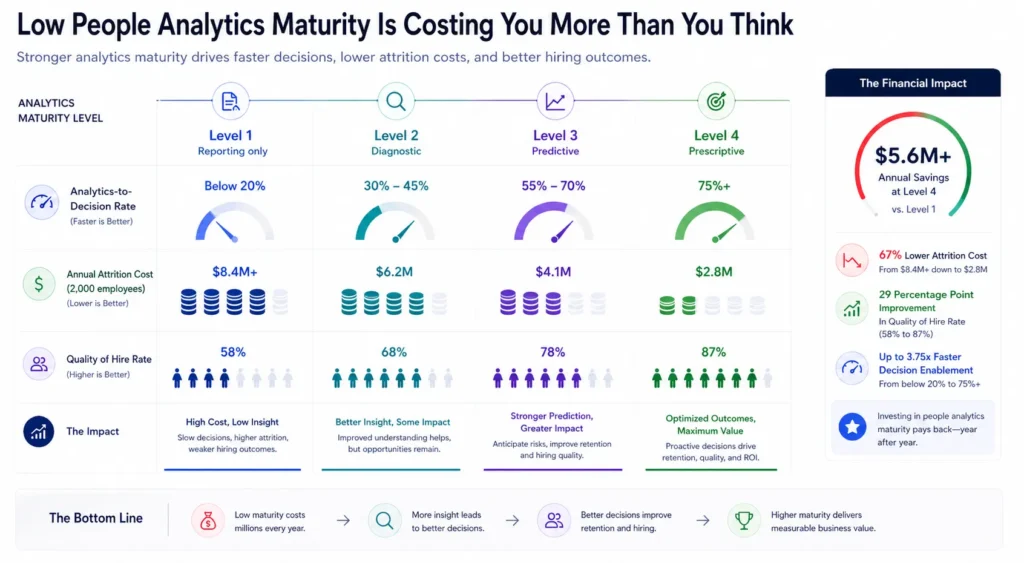
Attrition cost assumes $30,000 average replacement cost and 14% baseline attrition. Quality of Hire rate reflects proportion of hires meeting or exceeding 12-month performance expectations.
Related Terms
| Term | Definition |
|---|---|
| HR Analytics | Broad synonym for people analytics; the application of data analysis to human resources questions |
| Predictive Analytics | Statistical models that use historical data to forecast future events or outcomes |
| HRIS | Human Resources Information System; the data infrastructure that stores and manages employee data |
| Workforce Planning | Strategic analysis of current and future workforce needs against organizational goals |
| Quality of Hire | A composite metric measuring the value a new hire delivers relative to organizational expectations |
Frequently Asked Questions
What is the difference between people analytics and HR reporting?
HR reporting describes what has already happened in the workforce. People analytics explains why it happened, predicts what will happen next, and recommends what to do about it. The distinction is between backward-looking description and forward-looking intelligence.
How large does an organization need to be to benefit from people analytics?
Organizations with as few as 100 employees can benefit from basic people analytics, particularly predictive attrition modelling, which requires sufficient historical data rather than a specific headcount threshold. Full prescriptive analytics capability typically becomes viable at 500 or more employees, where there is sufficient data volume to support reliable predictive models.
Is people analytics a privacy concern for employees?
Yes, and managing this concern responsibly is essential. Employees should know what data is collected, how it is used, and what decisions it informs. Analytics programs that use data to improve employee outcomes, rather than exclusively to optimize employer outcomes, consistently report higher employee acceptance and lower trust erosion.
How long does it take to build people analytics capability?
A basic descriptive analytics capability can be built in three to six months with the right data infrastructure. Predictive capability typically requires 12 to 18 months of model development and validation before it is reliable enough to inform significant decisions. Full prescriptive capability is typically a two to three-year organizational development journey.
What is the most common people analytics use case?
Attrition rate prediction is consistently the most commonly implemented use case, both because the business case is immediately quantifiable and because most organizations have sufficient HRIS and engagement data to build a useful model within a reasonable timeframe. Quality of hire prediction is the second most common, though it requires more sophisticated outcome data.
Conclusion
People analytics is the discipline that converts HR from a function that describes what happened to one that shapes what happens next.
The organizations that have built genuine analytics capability, built on reliable data, governed by ethical principles, and connected to business decisions, are consistently outperforming those that manage their workforces by intuition and precedent. The technology to do this is more accessible than it has ever been.
The organizational will to act on findings that challenge existing assumptions remains the harder discipline to develop. But the organizations that build both, the technical capability and the decision culture to act on it, are building a talent advantage that compounds over time and is genuinely difficult for competitors to replicate.