Nobody handed in their notice. Nobody made a scene.
But somewhere between the pandemic and the return-to-office mandates, a significant portion of the workforce made a quiet, individual decision to stop going above and beyond. Quiet quitting did not make headlines because employees were leaving. It made headlines because they were staying, just doing the bare minimum while they did.
Quiet quitting is not about quitting at all. It is the phenomenon of employees psychologically withdrawing from discretionary effort, fulfilling their job description and nothing more, without any formal disengagement or resignation. For HR teams, it is one of the harder workforce challenges to detect because it leaves no obvious footprint in HR analytics until the damage is already embedded in culture and output.
The root causes almost always trace back to broken employee experience and declining employee engagement. When people feel undervalued, overlooked, or simply exhausted, withdrawal becomes a rational response. Left unaddressed, quiet quitting accelerates attrition rate and erodes the kind of discretionary effort that employee retention strategies are built to protect.
The core metric governing quiet quitting impact is the Employee Discretionary Effort Index: the proportion of measurable above-minimum-requirement contributions, including voluntary overtime, cross-functional collaboration, and innovation input, relative to the baseline for equivalent role populations.
Employee Discretionary Effort Index = (Actual Discretionary Effort Score / Baseline Score for Role) x 100
Organizations with index scores below 65 in a given team or department are statistically correlated with voluntary attrition spikes within the following two quarters. Index scores above 85 correlate with the highest-performing innovation and customer satisfaction outcomes. The gap between organizations that track this index and those that do not is almost entirely explained by the presence or absence of an early detection and intervention discipline.
What is Quiet quitting?
is the workplace behavior pattern in which an employee remains employed but systematically withdraws discretionary effort, initiative, and emotional investment from their role, performing only the tasks explicitly required to maintain their employment while declining to engage in the above-and-beyond contributions that organizations implicitly depend on but rarely formally recognize or compensate.
The term is deliberately provocative and deliberately misleading. The employee is not quitting. They are renegotiating, unilaterally and without announcement, the informal contract that existed between their ambition and their employer’s expectations. The result is an employee who arrives on time, completes assignments, and contributes nothing more, creating a profile that is difficult to manage out, expensive to ignore, and increasingly common across industries and seniority levels alike.
Why Quiet Quitting Is Transforming the Modern Workplace?
The question organizations should be asking is not whether quiet quitting is real, but how much it is already costing them, and whether they have the tools to see it. Gallup’s research on the State of the Global Workplace consistently finds that only 23% of employees globally are actively engaged at work. The remaining 77% fall somewhere on a spectrum from indifferent to actively disengaged, with quiet quitters, those doing the minimum required, representing the largest single cohort in most organizations.
The financial implication is stark. Gallup estimates that low engagement costs the global economy approximately $8.9 trillion annually, or 9% of global GDP. For a company of 500 employees with an average salary of $70,000, the cost of a workforce performing at 60% of its potential engagement level is not a rounding error in the HR budget; it is a strategic liability measured in millions of foregone productivity, innovation, and customer value.
What makes quiet quitting particularly challenging is that it does not look like a problem on paper. Performance management systems designed around minimum standards, attendance records, and task completion metrics will register a quiet quitter as performing adequately. The loss is in the contribution that never happens: the process improvement not suggested, the customer call not followed up on, the mentorship not offered to a junior colleague. These are precisely the contributions that drive organizational outperformance, and they are exactly what quiet quitters have stopped providing.
For TA and people leaders, the practical implication is that quiet quitting is a leading indicator of voluntary attrition, not an endpoint. Research from the Harvard Business Review found that quiet quitting behavior typically precedes voluntary resignation by six to twelve months. An organization with a measurable quiet quitting cohort is not just losing productivity today; it is building a pipeline of voluntary departures for the next three quarters. The ROI of early detection and intervention is the avoided cost of the subsequent replacement hire, typically 50 to 200% of the departing employee’s annual salary.
The organizations leading on this issue are treating quiet quitting detection as a people analytics investment, not a management communication problem. They are building systems that identify the behavioral early warning signals, including declining collaboration patterns, reduced communication frequency, and engagement score trajectories, and equipping managers with the data and tools to intervene at the moment when re-engagement is still possible. The cost of building those systems is substantially lower than the cost of the replacements they prevent.
Your Resume Isn’t Getting Read
Let’s Get That Fixed!
75% of resumes get auto-rejected. avua’s AI Resume Builder optimizes formatting, keywords, and scoring in under 3 minutes, so you land in the “yes” pile.
The Psychology Behind Quiet Quitting
Psychological Contract Breach
The psychological contract, the unwritten set of expectations between an employee and their employer about what each party will contribute and receive, is the most important explanatory framework for quiet quitting. When employees perceive that the organization has failed to honor its side of the implicit agreement, whether through withdrawn flexibility, stalled career development, or misaligned recognition, they respond by recalibrating their own contributions downward to restore their sense of reciprocal fairness. The behavior is not passive resistance; it is a rational response to perceived imbalance that will not self-correct without organizational intervention.
Self-Determination Theory and Autonomy Withdrawal
Self-determination theory identifies autonomy, competence, and relatedness as the three core psychological needs that, when met, sustain intrinsic motivation. Quiet quitting behavior tracks precisely with the withdrawal of these needs: employees who feel micromanaged, underutilized, or isolated from a sense of meaningful team connection stop performing the discretionary behaviors that intrinsic motivation produces. The manager who addresses only performance output without addressing the underlying needs deficit will find the intervention fails repeatedly.
The Burnout-to-Boundary Continuum
A critical distinction that organizations frequently fail to make is between quiet quitting as a response to burnout and quiet quitting as a deliberate boundary-setting decision. The former represents an employee who has given too much and has nothing left to give. The latter represents an employee who has made a conscious decision to stop giving more than their compensation and conditions justify. Both produce the same behavioral profile, but they require very different organizational responses. Diagnosing which is present requires the kind of individualized manager-employee conversation that automated systems alone cannot replace.
Quiet Quitting vs. Related Workforce Behaviors
| Behavior | Definition | Visibility | Typical Trigger | HR Response |
|---|---|---|---|---|
| Quiet Quitting | Minimum effort while remaining employed | Low | Contract breach, burnout, misalignment | Re-engagement, role redesign |
| Active Disengagement | Undermining colleagues or culture | High | Deep organizational resentment | Performance management |
| Burnout | Exhaustion-driven performance collapse | Medium | Sustained overwork, poor boundaries | Leave, workload reduction |
| Voluntary Attrition | Choosing to leave the organization | Complete | Better external opportunity | Retention offer, exit interview |
| Career Coasting | Stable minimum effort, long-term pattern | Very Low | Comfort zone, limited growth ambition | Development planning |
What the Experts Say?
The antidote to quiet quitting is not demanding more from employees. It is creating conditions where people want to give more, because the work is meaningful, the manager is trusted, and the culture rewards genuine contribution rather than visible activity.
– Adam Grant, Organizational Psychologist, Wharton School; Author of Think Again
How to Measure Quiet Quitting Impact?
Formulas
Employee Discretionary Effort Index = (Actual Discretionary Effort Score / Baseline Score for Role) x 100
Disengagement Rate (%) = (Employees Scoring Below Engagement Threshold / Total Employees) x 100
Re-engagement Success Rate (%) = (Quiet Quitters Who Recovered Full Engagement / Total Interventions) x 100
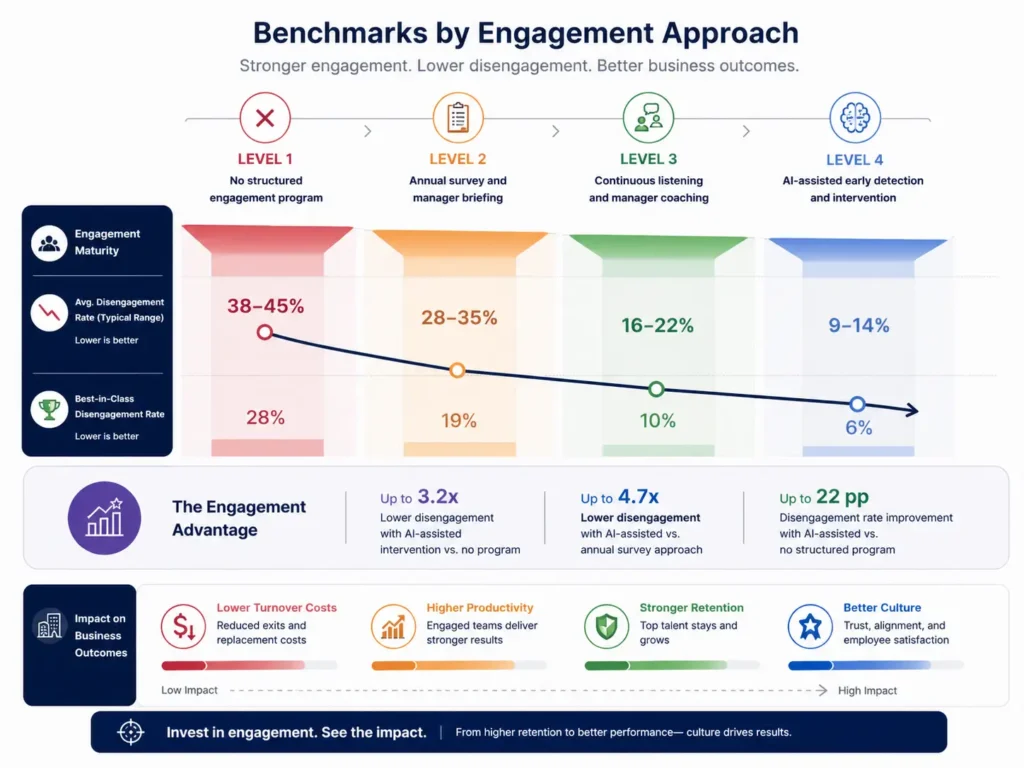
Benchmarks by Engagement Approach
| Management Approach | Avg. Disengagement Rate | Best-in-Class |
|---|---|---|
| No structured engagement program | 38-45% | 28% |
| Annual survey and manager briefing | 28-35% | 19% |
| Continuous listening and manager coaching | 16-22% | 10% |
| AI-assisted early detection and intervention | 9-14% | 6% |
Key Strategies for Addressing Quiet Quitting
How Can AI and Automation Support Quiet Quitting Detection?
Behavioral Pattern Analytics
AI-powered workforce analytics tools can monitor behavioral signals that correlate with disengagement, including declining contribution frequency in collaborative platforms, reduced initiation of cross-team communications, and changes in meeting participation patterns. These behavioral signals precede self-reported disengagement by weeks, giving managers a meaningful intervention window that traditional survey tools cannot provide. Organizations implementing behavioral analytics consistently report detecting disengagement at a stage when re-engagement remains achievable.
Sentiment Analysis at Scale
Natural language processing applied to internal communication data, including anonymized email metadata, collaboration tool activity, and survey open-text responses, can identify sentiment trajectory changes at the team and individual level. Organizations implementing sentiment analysis at scale report detecting disengagement signals with 60 to 70% accuracy six to eight weeks before visible performance impact, providing a materially useful early warning system that manual management observation cannot replicate at any meaningful scale.
Predictive Disengagement Modeling
Machine learning models trained on historical employee tenure patterns, role change history, manager changes, compensation competitiveness, and performance trajectory can identify the employees with the highest statistical likelihood of disengaging in the next quarter. This predictive layer allows HR teams to prioritize retention conversations based on risk scores rather than gut feel, significantly improving the efficiency of manager intervention time and ensuring that the highest-risk individuals receive proactive attention.
Manager Enablement Dashboards
AI-powered manager dashboards that surface team engagement signals in real time, including flagged individuals, team sentiment trends, and suggested conversation prompts, convert organizational engagement intelligence into actionable manager behavior. Evidence on manager dashboard adoption consistently shows that managers who receive structured data about their team’s engagement state have more frequent and more effective re-engagement conversations than those relying entirely on informal observation.
Stop Juggling
10 Job Boards.
Search One
Your next role is already here. avua pulls opportunities from across the web into a single searchable feed; filtered by role, location, salary, and remote preference.
1.5 Million+
Active Jobs
380+
Job Categories
Quiet Quitting Through an Equity Lens
The quiet quitting conversation has a significant equity dimension that most organizations have not yet addressed. Research on workplace belonging and psychological safety consistently finds that employees from underrepresented groups experience higher rates of unmet psychological contract expectations, including fewer mentorship relationships, slower career progression, and lower perceived recognition equity, which are the same conditions most predictive of quiet quitting behavior. A disengagement rate analysis that does not segment by demographic group will systematically mask disproportionate quiet quitting in the populations that face the greatest structural barriers to voiced dissatisfaction.
DEI-aware quiet quitting strategy requires disaggregating engagement data by demographic groups and identifying whether engagement gaps follow demographic lines. Where they do, the diagnosis is not a personal motivation problem in the affected population; it is an organizational structural problem that requires structural intervention: sponsorship program investment, pay equity audit, promotion rate analysis, and psychological safety measurement at the team level.
The intervention design for quiet quitting also carries equity implications. Manager coaching programs that build re-engagement capability need to address the specific dynamics that affect underrepresented employees, including affinity bias in opportunity allocation, exclusion from informal networks, and the additional emotional labor of navigating non-inclusive team environments. A generic re-engagement conversation guide will be insufficient for managers working with teams that have complex equity dynamics requiring individualized approaches.
Common Challenges and Solutions
| Challenge | Solution |
|---|---|
| Managers struggle to distinguish quiet quitting from healthy boundary-setting | Train managers in structured one-on-one formats that open conversation about workload, role fit, and growth expectations without conflating reasonable limits with disengagement signals |
| Engagement surveys produce low response rates in populations most at risk | Supplement annual surveys with always-on micro-feedback tools and behavioral analytics that do not rely on voluntary self-report participation from already-disengaged employees |
| Leadership resists investing in re-engagement when performance metrics still show acceptable output | Build a disengagement cost model that translates quiet quitting prevalence into projected attrition cost and innovation deficit over a rolling 12-month horizon with concrete financial figures |
Real-World Case Studies
Case Study 1: The Professional Services Firm
A 1,200-person professional services firm noticed a significant decline in voluntary contributions across its consulting practices, including reduced knowledge-sharing, lower participation in cross-practice working groups, and declining internal mentorship relationships, while formal performance metrics remained stable. They implemented a behavioral analytics program tracking collaboration patterns across project management and communication platforms. The analytics identified 22% of mid-level staff as statistically high-risk for quiet quitting based on behavioral pattern divergence. Targeted manager coaching conversations over eight weeks resulted in 74% of identified employees reporting renewed clarity about career growth, and voluntary contribution metrics recovered to baseline within two quarters. The program cost approximately $42,000 against an estimated avoided attrition cost of $380,000.
Case Study 2: The Financial Technology Company
A 400-person fintech company observed that eNPS scores among its product and engineering functions had declined from +32 to +11 over six months without a corresponding change in turnover or formal performance issues. Exit interview analysis of 18 voluntary departures revealed that 14 cited lack of recognition and growth opportunity as primary motivators. The company redesigned its career ladder structure, introduced quarterly public recognition mechanisms, and implemented bi-weekly structured one-on-ones across all engineering teams. Within two quarters, eNPS recovered to +28 and voluntary attrition rate in the product engineering function fell by 34% year-over-year.
Case Study 3: The Healthcare Network
A regional healthcare network identified a disengagement pattern concentrated in its nursing staff following a shift scheduling restructuring that reduced flexibility. Rather than interpreting the behavioral changes as performance issues, the HR team implemented a listening program consisting of monthly pulse surveys, manager coaching, and a workload redistribution pilot in three high-disengagement units. The pilot gave nurses direct input into scheduling parameters within clinical safety constraints and produced a 29-point engagement score improvement in participating units within three months. The network subsequently rolled the model out organization-wide, with sustained engagement improvement at 12-month follow-up.
Performance Indicators That Define Quiet Quitting Detection
Quiet Quitting Across the Employee Lifecycle
Onboarding and Early Tenure
The foundation of quiet quitting resistance is laid in the onboarding period. New employees arrive with discretionary effort deposits that reflect their expectations and enthusiasm. The first 90 days either confirm or contradict those expectations. Organizations where onboarding is structured, managerially engaged, and connected to a clear growth narrative retain significantly higher discretionary effort levels at 12 months than those where onboarding is treated as an administrative process. See how employee lifecycle planning intersects with long-term retention strategy.
Mid-Tenure Engagement
The 18-to-36-month tenure band is where quiet quitting is statistically most prevalent. By this point, employees have experienced the gap between onboarding promises and organizational reality, have formed clear opinions about their growth trajectory, and have sufficient institutional knowledge to perform their role at minimum standard without apparent difficulty. This is the period where the quality of the manager relationship is most predictive of whether discretionary effort is sustained or withdrawn, making mid-tenure the highest priority for structured manager development investment.
The Disengagement Inflection Point
The disengagement inflection point is the moment at which an employee makes the internal decision to stop investing above the minimum required. Research suggests this decision is rarely gradual; it is typically triggered by a specific event: a promotion denied without explanation, a project reassigned without consultation, a commitment from management not honored. The window for intervention is the period immediately following this event, when the employee has made the internal decision but has not yet reorganized their behavioral patterns around it. Organizations with behavioral analytics capability can identify this window; those without it typically discover the decision six to twelve months later.
Recovery and Re-engagement
Re-engagement of confirmed quiet quitters is achievable but time-constrained. Research on re-engagement intervention effectiveness consistently finds that interventions delivered within 60 days of behavioral signal detection produce full engagement recovery in approximately 60 to 70% of cases. Beyond 90 days, the success rate drops to 30 to 40%, and beyond 180 days the behavioral pattern is typically entrenched. Speed of response matters as much as quality of intervention, and employee retention outcomes are significantly better for organizations that act on early signals.
The Real Cost of Ignoring Quiet Quitting
| Scenario | Disengagement Rate | Annual Productivity Loss (500 employees) | Projected Attrition Cost (12 months) |
|---|---|---|---|
| No detection or intervention | 35-42% | $4.2M-$5.1M | $1.8M-$2.4M |
| Annual survey and reactive management | 24-30% | $2.9M-$3.6M | $1.1M-$1.6M |
| AI-assisted early detection and coaching | 10-15% | $1.2M-$1.8M | $0.4M-$0.7M |
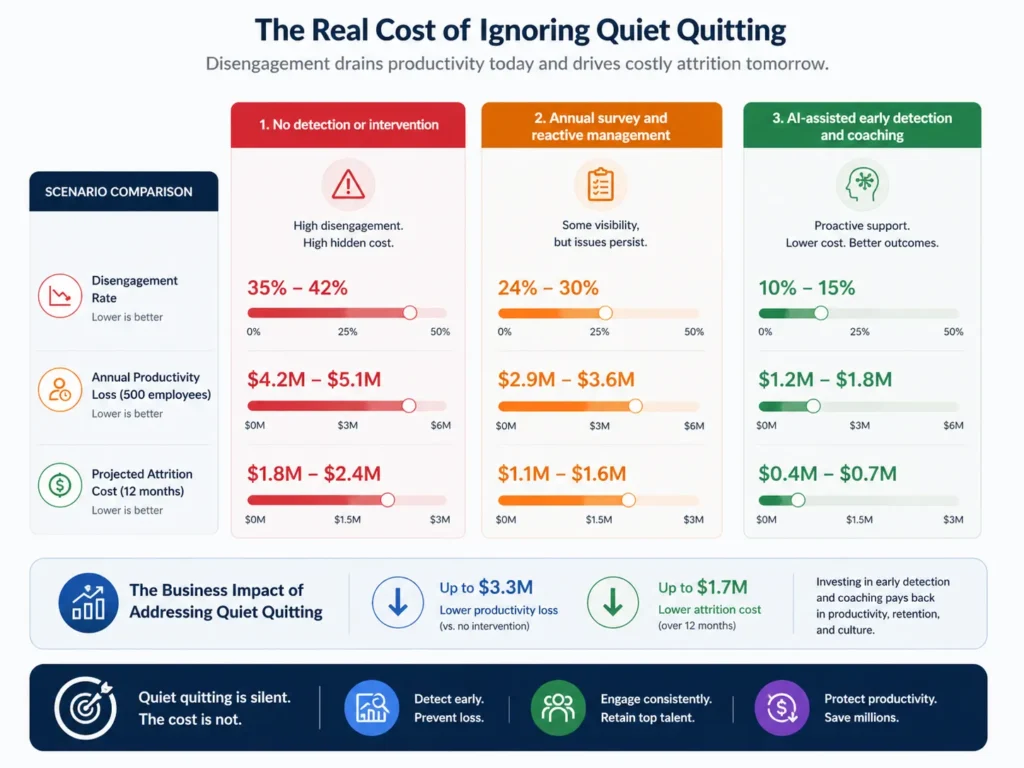
Productivity loss calculated at 30% of salary cost for each disengaged employee. Attrition cost assumes 75% of annual salary per voluntary departure, with quiet quitters showing 3x higher attrition probability than fully engaged colleagues.
Related Terms
| Term | Definition |
|---|---|
| Employee Engagement | The degree of enthusiasm, commitment, and discretionary effort an employee brings to their role and organization |
| Psychological Contract | The unwritten set of mutual expectations and obligations between an employee and employer beyond the formal employment agreement |
| Discretionary Effort | Contributions an employee makes above and beyond the minimum requirements of their job description |
| Burnout | A state of chronic workplace stress characterized by exhaustion, cynicism, and reduced professional efficacy |
| Voluntary Attrition | The departure of employees who choose to leave their organization, distinct from involuntary terminations or workforce reductions |
Frequently Asked Questions
Is quiet quitting actually quitting?
No. Quiet quitting refers to employees performing only the minimum requirements of their role while remaining employed. The behavior is better understood as a withdrawal of discretionary effort rather than resignation. Employees who are quiet quitting are still at work; they have simply stopped contributing above what their job description explicitly requires, creating a profile that is difficult to address through standard performance management tools.
What causes quiet quitting?
The most common causes are psychological contract breach, where employees feel the organization has not honored its implicit commitments; manager quality failures, where the immediate manager relationship is poor or absent; and sustained overwork without recognition. Research from SHRM consistently identifies lack of recognition and career growth opportunity as the leading antecedents of disengagement behavior across industries and seniority levels.
How can managers identify quiet quitting?
The behavioral signals include declining participation in voluntary initiatives, reduced communication initiation, withdrawal from cross-functional collaboration, and a shift from proactive to reactive work patterns. These are detectable through structured observation and behavioral analytics tools. Importantly, the absence of a formal performance problem does not rule out quiet quitting; by definition, quiet quitters continue to meet minimum standards.
Can quiet quitting be reversed?
Yes, particularly when detected early. Re-engagement interventions that address the root cause, whether through role redesign, manager relationship repair, growth opportunity creation, or recognition adjustment, are effective in 60 to 70% of cases when delivered within 60 days of behavioral signal detection. The window closes significantly after 90 days, making early detection the most important factor in re-engagement success.
Does remote work increase quiet quitting risk?
Remote and hybrid environments do increase quiet quitting risk, primarily because they reduce the informal social and professional touchpoints that sustain discretionary effort and provide managers with visibility into engagement levels. Organizations with strong employee experience outcomes in remote environments have invested heavily in structured connection, intentional recognition, and behavioral analytics that compensate for the reduced in-person signal environment.
Conclusion
Quiet quitting is not a generational failure of work ethic, and it is not a communication problem solvable with a town hall. It is a structural signal that the implicit employment contract between a significant proportion of the workforce and their organizations has broken down, and that employees have responded by rationally recalibrating their contributions to match their compensation and conditions.
Organizations that recognize this signal for what it is, a people analytics challenge with a measurable ROI on intervention, and invest accordingly in early detection, manager capability, and psychological contract redesign, will build workforces that outperform those still treating quiet quitting as a morale problem. The discretionary effort of your people is not a given. It is earned, continuously, by the conditions you create.