The average corporate job posting attracts over two hundred applications. Most hiring teams have the bandwidth to meaningfully evaluate a fraction of that.
Resume screening is the process that bridges that gap, and how well it is designed determines whether the best candidates make it through or quietly disappear into a pile nobody ever reaches the bottom of.
Resume screening is the systematic evaluation of applications to identify which candidates meet the minimum requirements for a role and deserve further consideration. It is the first real filter in the hiring funnel, sitting between application submission and the first live interaction, and it sets the tone for everything that follows. For teams managing high applicant pool volumes, it is where hiring efficiency is won or lost.
The tools have evolved significantly. Where manual screening once dominated, AI resume screening and automated screening now handle initial filtering at a speed and scale no human team can match. But speed without structure creates its own problems, particularly around bias in hiring, where automated systems can quietly encode the same prejudices that structured screening was designed to eliminate.
Done well, resume screening feeds a cleaner candidate pipeline and protects recruiter time for the conversations that actually require human judgement.
The core metric governing resume screening effectiveness is the Screening-to-Interview Conversion Rate: the proportion of screened candidates who advance to an interview stage, a direct indicator of screening precision and criteria quality.
Screening-to-Interview Conversion Rate (%) = (Candidates Advanced to Interview / Total Applications Screened) × 100
High-performing talent acquisition teams operating structured screening processes achieve Screening-to-Interview Conversion Rates of 18-25%. The industry average across all screening approaches sits at 12-15%. The gap is almost entirely explained by the quality of defined screening criteria, the consistency of application, and the accuracy of the matching methodology, not by the difficulty of the roles being screened for.
What is Resume Screening?
Resume screening is the structured evaluation of submitted applications against predefined role requirements to identify the subset of candidates who are most likely to be qualified, culturally aligned, and worth investing further interview resources in. It translates a large, heterogeneous applicant pool into a focused, manageable candidate pipeline.
An effective resume screening process evaluates candidates across multiple dimensions: minimum qualification thresholds (education, certifications, years of experience), skills alignment (technical and functional competencies required for the role), career progression patterns, and contextual indicators of fit (sector experience, scale of previous responsibilities). Crucially, it does so consistently, applying the same criteria to every application rather than allowing the variability, fatigue, and bias that characterise manual review of large applicant pools.
What makes resume screening strategically significant is its position as the primary determinant of pipeline diversity and quality. The candidates who reach the interview stage are the candidates the screening process allowed through. If screening criteria are poorly defined, or applied inconsistently, or systematically biased toward credential proxies rather than genuine capability signals, the entire downstream hiring process is compromised, regardless of how well-designed the interview stage is. Screening is where talent acquisition either opens or closes opportunity.
Why Resume Screening Is a Game-Changer for Modern Talent Acquisition?
The organizations that treat resume screening as a compliance exercise, something to get through quickly so interviews can begin, are systematically underperforming against those that treat it as a strategic function. The difference shows up in offer acceptance rates, quality of hire scores, and time-to-productivity for new hires. It is that consequential.
Consider the volume reality: a mid-market company posting 50 roles per year with an average of 200 applications per role receives 10,000 applications annually. Without structured, scalable resume screening, that volume is either unmanageable (producing hiring delays that cost the business productivity) or poorly managed (producing fast but low-precision screening decisions that generate bad hires). Neither outcome is acceptable in a competitive talent market where the cost of a bad hire at mid-level typically exceeds $25,000 in replacement and productivity loss costs.
Structured resume screening solves the volume-quality tension by applying consistent, criteria-driven evaluation at scale. It is not enough to read resumes and make a judgment call, the research is unambiguous that unstructured screening judgments are heavily influenced by factors unrelated to job performance. According to SHRM research, structured screening processes, using predefined criteria with explicit pass/fail thresholds, improve predictive validity for job performance by 26% compared to unstructured resume review. That 26% translates directly to fewer bad hires, higher quality shortlists, and better hiring outcomes for every role in the plan.
The AI dimension has changed not whether to screen, but how to screen at scale. Platforms applying AI-assisted resume screening report screening cycle times reduced from days to minutes without sacrificing, and often while improving, shortlist quality. A recruiting team that previously spent 40% of their time reading resumes can redirect that capacity to the relationship conversations, candidate engagement, and interview calibration work that genuinely differentiates great talent acquisition from adequate talent acquisition.
A concrete data point illustrates what is at stake: LinkedIn Talent Solutions research found that companies using structured, criteria-based screening processes fill roles 30% faster than those using conversational, impression-based screening, and produce new hires whose 12-month performance ratings are 22% higher. The speed improvement comes from higher precision in the screening stage; the performance improvement comes from better criteria alignment. Both are products of the same investment: defining clearly what you are screening for before the resumes arrive.
For talent acquisition leaders, the practical implication is that resume screening process design is a leverage point that most organizations have not fully invested in. The organizations that build structured screening criteria as a required step before any requisition is activated, rather than allowing hiring managers and recruiters to define informally as they read, are systematically producing better hiring outcomes with the same or lower resource investment. This is not a technology question. It is a process design and discipline question, with technology as an accelerant.
The ROI of structured screening investment is direct to calculate. A 200-person company making 40 hires per year that improves its Screening-to-Interview Conversion Rate from 12% to 20%, by implementing structured criteria and consistent application, processes 40% fewer interviews to produce the same number of hires. At an average interview cost of $350 per candidate (recruiter time, hiring manager time, coordination), that is $112,000 in avoided interview costs annually. Redirected to sourcing and employer brand investment, that freed capacity compounds over time.
Your Resume Isn’t Getting Read
Let’s Get That Fixed!
75% of resumes get auto-rejected. avua’s AI Resume Builder optimizes formatting, keywords, and scoring in under 3 minutes, so you land in the “yes” pile.
The Psychology Behind Resume Screening
Confirmation Bias and First-Impression Filtering
Research consistently demonstrates that recruiters form an initial impression of a candidate’s suitability within the first 30 seconds of reviewing their resume. Everything read after that initial impression is then unconsciously filtered through it, information confirming the first impression is weighted heavily, while information contradicting it is minimised or overlooked.
This confirmation bias is not a character flaw; it is a fundamental feature of human pattern recognition applied to a task for which it produces systematic errors. Structured screening criteria that define specific pass/fail thresholds before resumes are read, rather than criteria applied post-hoc to justify an impression, substantially reduce the influence of confirmation bias on screening decisions.
The Paradox of Choice in High-Volume Screening
When a recruiter faces 300 applications for a single role, the cognitive experience is closer to paralysis than selection. The paradox of choice, the psychological principle that more options produce worse decisions, not better ones, operates powerfully in high-volume screening contexts.
Recruiters processing large applicant pools tend to apply increasingly reductive criteria as fatigue and cognitive overload build: first filtering on obvious disqualifiers, then on heuristics that feel reliable but are not (school pedigree, employer brand, title seniority) rather than on the genuine capability signals that predict performance. AI-powered screening tools resolve this by applying consistent criteria across the full applicant pool without fatigue, maintaining screening precision at application number 300 as effectively as at application number 1.
Loss Aversion and the Risk-Averse Screener
Loss aversion, the tendency to weigh potential losses more heavily than equivalent potential gains, produces a specific and consequential bias in resume screening: the over-rejection of non-obvious candidates. A recruiter who is uncertain whether a non-traditional background candidate meets the brief will, under loss aversion, default to rejection rather than advancement, because the personal cost of advancing a candidate who fails is felt more acutely than the invisible cost of rejecting a candidate who would have succeeded.
This risk aversion systematically disadvantages career changers, candidates from non-target industries, and candidates with unconventional career narratives, who are often exactly the candidates that deliver the highest performance uplift in organizations with strong development cultures.
Resume Screening vs. Related Screening Methods
| Screening Method | Approach | Speed | Accuracy | Bias Risk | Best For |
|---|---|---|---|---|---|
| Manual Resume Review | Human reads and evaluates | Slow | Variable | High | Low-volume, senior roles |
| AI-Powered Screening | Algorithmic scoring against criteria | Very fast | High with quality criteria | Moderate (requires auditing) | High-volume, defined roles |
| Keyword/ATS Filter | Rule-based pass/fail matching | Very fast | Low (context-blind) | Moderate | Basic intake pre-filter |
| Phone Screening | Short verbal qualification conversation | Moderate | Moderate | Moderate | Post-resume, pre-interview |
| Skills Assessment Screening | Test-based evaluation | Moderate | High for assessed dimensions | Low | Technical and specialist roles |
The critical distinction between AI-powered resume screening and keyword-based ATS filtering is sophistication of interpretation. A keyword filter identifies whether the word “Python” appears in a resume. An AI screening tool assesses whether the candidate’s demonstrated use of Python across described projects and contexts meets the role’s actual requirement, a meaningfully different evaluation that produces materially different shortlists.
What the Experts Say?
The resume screen is not a reading exercise, it is a criteria calibration exercise. Recruiters who walk into a screening process without rigorously defined pass/fail criteria are not screening; they are browsing. The quality of your shortlist is determined before you open the first application, not while you are reading it.
– Lou Adler, CEO, The Adler Group; Author, Hire With Your Head
How to Measure Resume Screening Effectiveness?
Formula
Screening-to-Interview Conversion Rate (%) = (Candidates Advanced to Interview / Total Applications Screened) × 100
Screening Accuracy Rate (%) = (Hires Sourced from Screened Candidates / Total Candidates Screened to Interview) × 100
Application-to-Shortlist Rate (%) = (Shortlisted Candidates / Total Applications Received) × 100
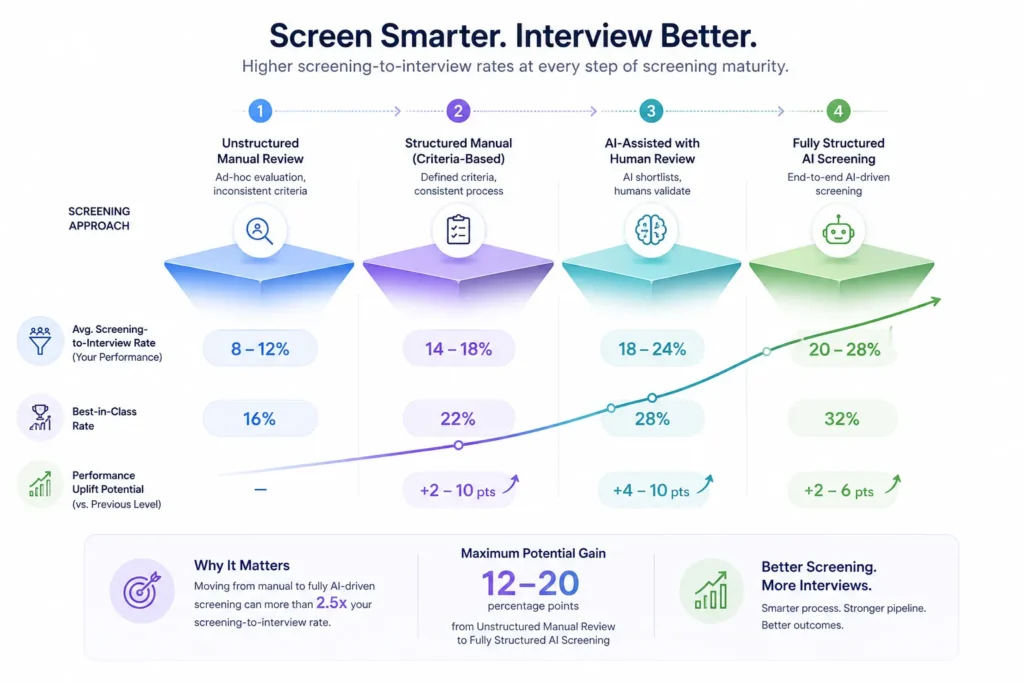
Benchmarks by Screening Approach
| Screening Approach | Avg. Screening-to-Interview Rate | Best-in-Class |
|---|---|---|
| Unstructured manual review | 8-12% | 16% |
| Structured manual (criteria-based) | 14-18% | 22% |
| AI-assisted with human review | 18-24% | 28% |
| Fully structured AI screening | 20-28% | 32% |
Key Strategies for Effective Resume Screening
How Can AI and Automation Support Resume Screening?
Structured Criteria Matching at Scale
AI-powered screening platforms apply predefined role criteria, skills, experience thresholds, qualification requirements, industry context, to every application in a standardized way, producing ranked outputs that reflect genuine criteria alignment rather than the order in which resumes were reviewed or the energy level of the reviewer on a given afternoon. This consistent criteria application across the full applicant pool is the primary quality advantage of AI-assisted screening.
Contextual Fit Scoring Beyond Keywords
Advanced AI screening tools evaluate applications using contextual language understanding rather than literal keyword matching. A candidate who describes “building revenue attribution models for a $50M DTC brand” is correctly recognised as having marketing analytics experience even if the phrase “marketing analytics” does not appear in their resume. This contextual intelligence dramatically reduces the false-negative rate in screening, the proportion of genuinely qualified candidates who fail keyword-based filters due to language variation.
Bias Detection and Screening Audit
AI screening platforms with built-in fairness monitoring analyse screening output for demographic differential patterns, identifying whether candidates from specific groups are being advanced at lower rates than their application quality would predict. This automated bias detection layer enables TA leaders to investigate and correct systematic screening bias before it compounds into a pipeline representation problem that affects hiring outcomes.
Predictive Fit Modeling
Machine learning models trained on historical hire data can weight screening criteria based on their actual predictive relationship to 12-month performance outcomes in the organization, rather than on a hiring manager’s intuitive belief about what matters. This predictive layer refines screening criteria over time, progressively improving the correlation between screening decisions and hire quality.
Stop Juggling
10 Job Boards.
Search One
Your next role is already here. avua pulls opportunities from across the web into a single searchable feed; filtered by role, location, salary, and remote preference.
1.5 Million+
Active Jobs
380+
Job Categories
Resume Screening and Equitable Hiring Practices
Structured Criteria as the Primary Equity Lever
The single most effective intervention for equitable resume screening is also the most basic: defining screening criteria explicitly before reviewing applications, and applying those criteria consistently to every candidate. Research on structured versus unstructured screening processes consistently finds that structured processes produce more demographically equitable advancement rates, not because they are designed for equity, but because they evaluate candidates against defined standards rather than subjective impressions that are vulnerable to affinity bias, similarity effects, and credentialing shortcuts. Structured screening is equity infrastructure.
Credential Signals Versus Capability Signals
Many organizations’ screening criteria over-index on credential proxies, degree level, employer brand, years of experience, that are correlated with socioeconomic access rather than job performance. Capability-based screening, prioritizing demonstrated skill signals, project outcomes, and performance evidence over institutional pedigree, consistently produces more diverse shortlists from equivalent applicant pools. For organizations serious about blind hiring and pipeline diversification, auditing screening criteria for credential over-indexing is a high-priority intervention.
Screening Communication and Candidate Experience
How rejected candidates are notified of screening decisions, or whether they are notified at all, has significant equity implications. Candidates from underrepresented groups report higher rates of experiencing screening ghosting, and research on candidate experience consistently finds that the quality of rejection communication is one of the primary determinants of employer brand perception among screened-out applicants. An equitable screening process communicates decisions promptly, respectfully, and with enough information for candidates to understand the outcome.
Common Challenges and Solutions
| Challenge | Solution |
|---|---|
| Screening criteria too vague to apply consistently | Conduct a 30-minute screening criteria calibration session with the hiring manager before the req opens; define explicit pass/fail thresholds for every criterion |
| AI screening advancing technically matched but culturally misaligned candidates | Add team context and working-style criteria to the screening brief; configure AI scoring models to weight collaboration and communication indicators alongside technical criteria |
| Screening volume overwhelming recruiter capacity and producing fatigue errors | Implement AI-assisted pre-screening to reduce the manual review queue to a manageable high-precision sample; use structured scoring rubrics to maintain consistency across large volumes |
Real-World Case Studies
Case Study 1: The Financial Services Firm
A mid-market financial services firm reviewing 8,000 applications per year across 30 roles found that their Screening-to-Interview Conversion Rate was 9%, indicating either massively over-broad sourcing or significantly under-precise screening criteria. Investigation revealed that screening was conducted entirely through unstructured manual review, with each recruiter applying their own implicit criteria.
They implemented a standardized screening brief template requiring explicit must-have and preferred criteria for every role, and introduced a two-recruiter calibration process for high-volume roles. Screening-to-Interview Conversion Rate improved to 19% within two hiring cycles, and interview-to-offer rates, a downstream quality indicator, improved from 1-in-8 to 1-in-4.5.
Case Study 2: The Technology Company
A technology company using keyword-based ATS filtering for engineering roles discovered through a pipeline audit that 31% of candidates advancing to phone screen were failing the first technical screening question, indicating a significant screening precision problem. Investigation found that their keyword filter was passing candidates who listed relevant programming languages in any context (including side projects completed years earlier) regardless of proficiency level.
They replaced the keyword filter with an AI screening tool configured to evaluate experience context, recency, and depth of demonstrated use. The phone screen failure rate dropped from 31% to 9%, saving approximately 400 hours of recruiter and engineering hiring manager time per year.
Case Study 3: The Healthcare System
A regional healthcare system identified through demographic funnel analysis that applications from candidates who had completed nursing degrees at community colleges were advancing past screening at 40% lower rates than candidates from four-year university nursing programmes, despite no performance data suggesting quality differences. Investigation found that screening criteria included “degree from accredited four-year institution” as a hard filter, which had been intended to exclude non-accredited programmes but was eliminating accredited community college graduates.
The criteria were revised to specify accreditation status rather than institution type. Community college graduate advance rates normalized within one hiring cycle, and the nursing candidate pipeline expanded materially in exactly the demographics the organization had targeted for workforce diversification.
Essential Performance Indicators for Resume Screening Success
Resume Screening Across the Hiring Lifecycle
Pre-Screening: Criteria Design and Calibration
The highest-leverage work in resume screening happens before any application is reviewed. Defining screening criteria with explicit thresholds, calibrating those criteria in conversation with the hiring manager, and aligning on what a strong versus acceptable versus unqualified candidate looks like for this specific role at this specific stage converts a subjective impression exercise into a replicable, auditable process. TA leaders who invest 30 minutes per role in pre-screening calibration consistently report better shortlist quality and fewer second-round screening loops.
Active Screening: Consistent Criteria Application
The screening stage itself should apply defined criteria uniformly across every application, in the same order, using the same evaluation standards. For manual screening, this means using a structured scoring form and completing it for every candidate before moving to the next. For AI-assisted screening, this means auditing AI outputs against criteria alignment before accepting the ranked shortlist. Consistency is not a nicety, it is the mechanism through which screening criteria produce the quality outcomes they promise.
Post-Screening: Candidate Communication and Pipeline Management
Every candidate who submits an application is owed a screening outcome communication. The timing and quality of that communication shapes employer brand perception at scale, the screened-out candidates who receive prompt, respectful notifications are the future applicants, referrers, and consumers who will remember how they were treated. Post-screening pipeline management also includes maintaining contact with near-miss candidates, those who passed initial criteria but were not advanced for this specific role, for future candidate nurturing and consideration.
Feedback Integration: Screening to Interview to Outcome
The most underutilized step in screening process improvement is feeding interview outcomes back into screening criteria calibration. Candidates who pass screening and then fail at interview, or fail at interview but later succeed elsewhere, contain information about which screening criteria are genuinely predictive and which are noise. Closing this feedback loop, formally, through a post-hire screening criteria review, progressively improves screening precision over time.
The Real Cost of Poor Resume Screening
| Scenario | Screening Approach | Interview-to-Offer Rate | Estimated Annual Cost (30 hires/year) |
|---|---|---|---|
| Unstructured manual screening | Impression-based | 1-in-9 | $315,000 in interview costs and bad hire risk |
| Structured manual screening | Criteria-based rubric | 1-in-5 | $175,000 |
| AI-assisted structured screening | Criteria-based AI + human review | 1-in-3.5 | $122,500 |
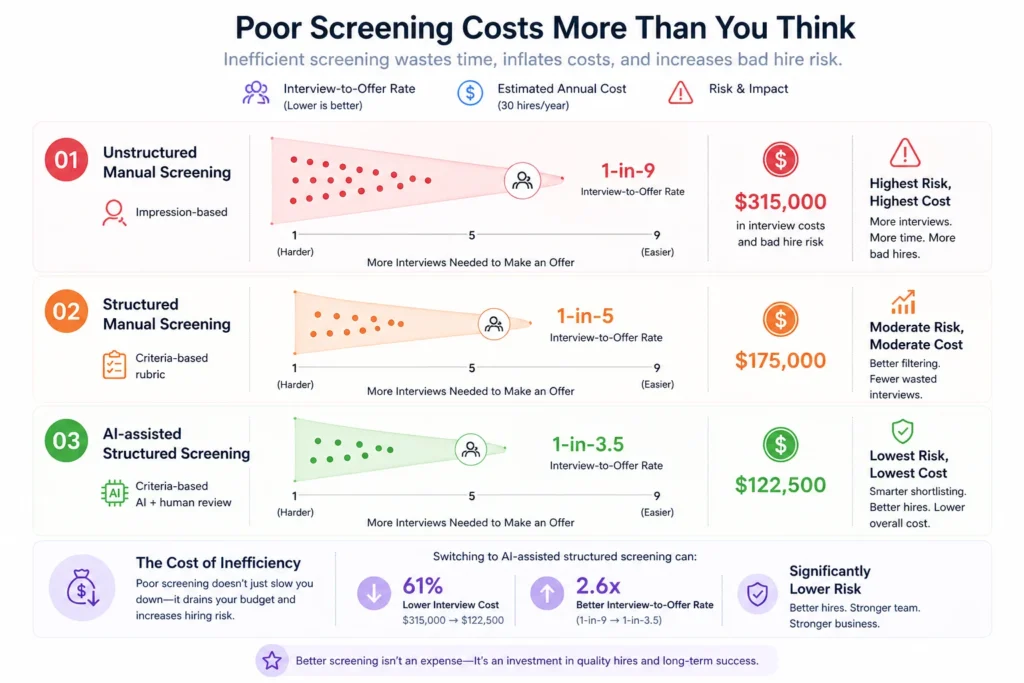
Interview cost estimated at $350 per candidate across recruiter and hiring manager time. Bad hire cost estimated at $25,000 per instance applied to proportion of hires from low-precision screening processes.
Related Terms
| Term | Definition |
|---|---|
| Applicant Tracking System (ATS) | Software platform managing job applications, candidate data, and recruitment workflows |
| Structured Interview | An interview format using predefined, consistently applied questions evaluated against explicit criteria |
| Candidate Pipeline | The pool of candidates at various stages of engagement within a recruitment process |
| Blind Hiring | A screening and evaluation approach that removes identifying information to reduce unconscious bias |
| Bias in Hiring | Systematic, often unconscious patterns of evaluation that favour or disadvantage candidates based on characteristics unrelated to job performance |
Frequently Asked Questions
What is resume screening and why does it matter?
Resume screening is the process of evaluating submitted applications against defined role criteria to determine which candidates advance. It matters because it is the primary quality filter between the applicant pool and the interview stage, the quality of your shortlist is almost entirely determined by the quality of your screening process.
How is AI resume screening different from traditional screening?
Traditional screening relies on a recruiter reading applications and applying subjective judgment. AI screening applies predefined criteria algorithmically across every application simultaneously, producing consistent, criteria-aligned outputs without fatigue or bias drift. AI screening is faster, more consistent, and, with quality criteria, more accurate than unstructured manual review.
What makes a good screening criterion?
A good screening criterion is specific (clearly defined, not vague), relevant (directly linked to job performance requirements), consistent (applied the same way to every candidate), and auditable (the reasoning for pass/fail against it can be explained). Criteria that cannot be defined specifically enough to apply consistently should be moved from the screening stage to the interview stage, where they can be explored in conversation.
How do you avoid bias in resume screening?
The primary bias-reduction interventions are: defining criteria explicitly before reviewing resumes, applying criteria consistently to every candidate using a structured form, auditing demographic advance rates across screening stages, and avoiding criteria that function as credential proxies rather than genuine capability signals. AI screening tools with built-in fairness monitoring add an analytical layer to this process.
What is a good Screening-to-Interview Conversion Rate?
Industry average Screening-to-Interview Conversion Rates sit at 12-15%. High-performing teams using structured screening processes achieve 18-25%. Rates below 10% suggest sourcing is generating insufficiently targeted applicant pools; rates above 30% may indicate screening criteria are too permissive, creating downstream interview burden.
Conclusion
Resume screening is the lever that most organizations have pulled the least, despite its outsized influence on every downstream hiring outcome.
The talent acquisition function can invest in employer brand, sourcing technology, and candidate experience, and all of those investments will underdeliver if the screening process that determines who reaches the interview stage is inconsistent, biased, or poorly calibrated to genuine role requirements.
Organizations that treat screening criteria design as a strategic discipline, audit their screening outcomes rigorously, and apply consistent structured evaluation across every application produce shortlists that translate into better hires, fewer wasted interviews, and talent pipelines that genuinely reflect the available market rather than the limits of a recruiter’s implicit preferences.
The most important moment in your hiring process is often the one no candidate ever sees.