Every professional journey starts with a single document.
Before the interview, before the phone screen, before anyone knows your name, there is a resume sitting in a hiring system being evaluated in a matter of seconds. It is the most consequential piece of professional writing most people will ever produce, and yet it is one of the least understood.
A resume is a structured summary of a candidate’s work experience, skills, education, and achievements, designed to convince a hiring manager that the next step should be a conversation. But in the modern hiring landscape, a resume has to do something more demanding first: survive automated screening and resume parsing before it ever reaches human eyes.
Getting that balance right, readable by both software and people, is what keyword optimization is designed to solve. A resume that reads beautifully but fails an AI resume screening filter never gets the chance to impress anyone.
The stakes are higher than most candidates realise. A weak resume does not just fail to land interviews, it actively damages candidate experience from the applicant side, creating a frustrating cycle of applications that disappear without response. Understanding what makes a resume work is the first step to breaking that cycle.
Resume-to-Interview Conversion Rate (%) = (Interview Invitations Received / Applications Submitted) × 100
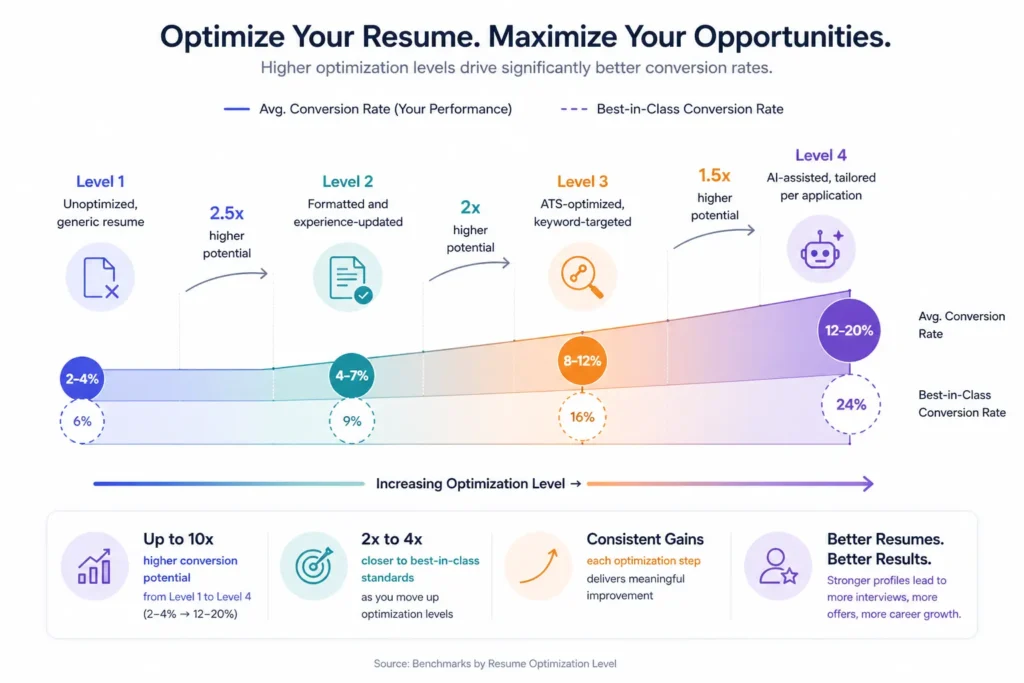
The average Resume-to-Interview Conversion Rate for an unoptimized resume submitted to relevant roles is approximately 2 to 4%. A well-optimized, tailored resume submitted to well-matched roles achieves conversion rates of 12 to 20%. The gap is almost entirely explained by ATS optimization, keyword alignment, and the clarity of achievement quantification – not by the underlying qualifications of the candidate.
What is a Resume?
A resume is a concise, structured professional document presenting a candidate’s career history, relevant skills, educational background, and key accomplishments to a prospective employer – typically submitted as part of a formal job application and used as the primary basis for initial candidate screening decisions at every stage from entry-level to senior executive hiring.
What distinguishes an effective resume from a comprehensive career record is deliberate curation. A resume is not a complete professional history – it is a targeted argument for fit with a specific role or role type. The most common resume failure is attempting to list everything rather than to communicate the most relevant, most compelling, and most credibly quantified version of the candidate’s contributions. Length, formatting, keyword selection, and achievement framing are persuasion tools, not documentation choices.
Why Your Resume Remains the Most Powerful Career Asset in a Competitive Job Market?
The obituary for the resume has been written many times. LinkedIn would replace it. Portfolio sites would make it obsolete. AI sourcing tools would render it irrelevant. None of this has happened. Despite sweeping technological change throughout the recruitment process, the resume remains the universal entry document for formal employment – the first artifact reviewed by the majority of hiring processes and the primary basis for screening decisions across industries, geographies, and role levels.
The reason for the resume’s persistence is not institutional inertia. It is that no other single document conveys the same density of structured, comparable professional information in a format that works across recruiters, industries, ATS systems, and hiring contexts simultaneously. A LinkedIn profile is an ongoing, audience-facing professional presence. A portfolio demonstrates outputs but not career trajectory. An AI-sourced candidate profile reflects what the algorithm found, not what the candidate chose to present. The resume remains the one document where the candidate controls the narrative entirely – and that control is only valuable if the narrative is constructed deliberately.
Research using eye-tracking technology found that recruiters spend an average of 6 to 7 seconds in initial review of a resume before deciding whether to continue reading. In those seconds, the recruiter’s eye travels a predictable path: name and current position, then most recent role title and employer, then most recent role dates. If any of these elements fail to immediately signal relevance and credibility, the resume is set aside. The entire rest of the document is irrelevant if those first seconds do not result in continued reading. This is not a flaw in the system – it is a signal about where resume investment produces the highest return.
The stakes are amplified by ATS systems that precede human review. According to Jobscan’s analysis of recruitment technology, approximately 98% of Fortune 500 companies use ATS software, and an estimated 75% of resumes are eliminated before a human reviewer sees them – not because the candidates are unqualified, but because the resume fails to meet the system’s extraction and matching criteria. A resume presenting strong qualifications in a complex, design-heavy format with graphics, text boxes, or non-standard section headings will frequently be unreadable by ATS parsing engines, regardless of the strength of the underlying content.
The ROI of resume investment is among the highest in any career development activity. If a resume rewrite increases a candidate’s conversion rate from 3% to 12% over 50 applications, it converts what would have been 1 to 2 interview invitations into 5 to 6 – a difference that, in a competitive job search, is often the margin between a successful outcome and months of additional searching. For mid-to-senior professionals, a better resume is not a cosmetic improvement. It is a quantifiable return on time and money that compounds across every application submitted.
The practical conclusion for job seekers is direct: resume optimization is not a one-time activity. Each application to a materially different role type should prompt targeted revision – keyword alignment, relevance curation, and achievement framing adjusted to the specific requirements of the target role. According to research by Harvard Business Review, tailored resumes outperform generic submissions by a factor of three or more in conversion rate. The single most impactful resume improvement any candidate can make is to treat each application as its own persuasion task, not as an opportunity to submit the same document to a new address.
Your Resume Isn’t Getting Read
Let’s Get That Fixed!
75% of resumes get auto-rejected. avua’s AI Resume Builder optimizes formatting, keywords, and scoring in under 3 minutes, so you land in the “yes” pile.
The Psychology Behind Resume Evaluation
The 6-Second Scan and Attention Economics
Eye-tracking research on recruiter behavior reveals a consistent, predictable pattern: visual hierarchy determines reading behavior more than content quality in the initial review pass. Recruiters do not read resumes from top to bottom on first contact – they scan for pattern-matching signals that confirm or disconfirm candidacy within seconds. A resume with clear visual hierarchy – strong header, readable font, consistent formatting, easily scannable role titles and dates – retains recruiter attention significantly longer than an equivalent document with cluttered layout or dense text blocks. Formatting is not aesthetic. It is functional, and a visually inaccessible resume loses evaluation opportunities the candidate is genuinely qualified to earn.
Anchoring Bias and the Primacy Effect
The first professional role or achievement a recruiter encounters establishes an anchor that colors the evaluation of everything that follows. Candidates who lead their resume with the strongest, most relevant evidence of their capability – through a powerful professional summary, a prominently positioned key achievement, or a clearly signaled most-recent role at a credible employer – benefit from anchoring bias working in their favor. Candidates who bury strong credentials below weak opening statements or chronologically ordered but relevance-miscalibrated entries lose the anchoring advantage and must fight for attention throughout the rest of the document.
Credibility Calibration and the Quantification Effect
Human evaluators reading resumes perform a continuous, unconscious credibility calibration: assessing whether each claim is believable, measurable, and consistent with the organizational context in which it is set. Resumes that make vague, superlative claims – “results-driven professional,” “passionate team player,” “dynamic leader” – without supporting evidence trigger skepticism rather than attraction. Resumes that anchor every significant claim in a specific, quantified outcome (“reduced customer onboarding time by 34%,” “managed a $2.8M digital transformation budget”) satisfy the evaluator’s credibility calibration and generate significantly more interview invitations per application submitted.
Resume Formats Compared
| Resume Format | Best For | ATS Compatibility | Recruiter Reception | Key Risk |
|---|---|---|---|---|
| Reverse Chronological | Most professional backgrounds | High | Strongly preferred | Exposes employment gaps directly |
| Functional | Career changers, significant gaps | Low | Often viewed skeptically | Signals red flags to experienced reviewers |
| Combination | Senior professionals, career pivots | Medium | Generally accepted | Can become too long without careful curation |
| Targeted/Tailored | High-competition applications | High | Most effective format | Time-intensive for each individual application |
| Infographic/Visual | Creative roles, portfolio submissions | Very low | Context-dependent | Fails most ATS parsing systems entirely |
The reverse chronological resume remains the standard format accepted by the widest range of ATS systems and preferred by the majority of human reviewers. Functional resumes are frequently viewed with suspicion by experienced recruiters because the format tends to obscure career history – a pattern that experienced screeners are trained to identify. For most candidates in most contexts, a reverse-chronological format with a strong professional summary section provides the best combination of ATS compatibility and human readability.
What the Experts Say?
The best resumes I have seen follow a simple principle: every bullet point should communicate what you accomplished, how it was measured, and how you achieved it. Duties are not accomplishments. Titles are not achievements. The resume that shows me what changed because of your work is the one that earns a conversation.
– Laszlo Bock, Former SVP People Operations, Google; Author of Work Rules!
How to Measure Resume Effectiveness?
Formulas
Resume-to-Interview Conversion Rate (%) = (Interview Invitations Received / Applications Submitted) × 100
ATS Pass Rate (%) = (Applications Reaching Human Review / Total Applications Submitted) × 100
Application-to-Offer Rate (%) = (Job Offers Received / Total Applications Submitted) × 100
Benchmarks by Resume Optimization Level
| Optimization Level | Avg. Conversion Rate | Best-in-Class |
|---|---|---|
| Unoptimized, generic resume | 2-4% | 6% |
| Formatted and experience-updated | 4-7% | 9% |
| ATS-optimized, keyword-targeted | 8-12% | 16% |
| AI-assisted, tailored per application | 12-20% | 24% |
Key Strategies for a High-Performing Resume
How Can AI Support Resume Writing and Optimization?
AI-Powered Keyword Optimization
AI keyword optimization tools analyze a target job description and identify the specific terms, phrases, and skills that the ATS system is likely to prioritize, then flag gaps between the candidate’s current resume language and the job description’s requirements. This eliminates the manual, error-prone process of attempting to identify common keyword patterns across multiple job postings – a task that AI tools perform with significantly higher accuracy and consistency than manual review.
Automated ATS Compatibility Scoring
AI-powered resume checkers simulate the ATS parsing process, identifying specific formatting elements, section structures, and content patterns that commonly cause parsing failures and providing actionable recommendations for improvement before the application is submitted. These tools give candidates visibility into their automated screening performance – a fundamentally different level of quality control than submitting and waiting for silence.
Natural Language Enhancement
Natural language AI tools improve the quality and impact of resume bullet point language – converting passive, duty-focused descriptions into active, achievement-focused statements, suggesting stronger action verbs, and flagging vague superlatives that reduce credibility. This language enhancement function is particularly valuable for candidates who are strong performers but weak self-promoters, a common profile in technical and research-oriented professional careers.
Skill Gap Analysis and Recommendations
AI tools that analyze a candidate’s resume against a target role category can identify specific skill gaps – certifications, tools, or experience types that appear consistently in job descriptions for the target role but are absent from the candidate’s current profile – and recommend targeted development activities to close those gaps. This converts resume analysis from a backward-looking document audit into a forward-looking career development tool.
Stop Juggling
10 Job Boards.
Search One
Your next role is already here. avua pulls opportunities from across the web into a single searchable feed; filtered by role, location, salary, and remote preference.
1.5 Million+
Active Jobs
380+
Job Categories
Resume Equity: How Structural Bias Affects Who Gets Seen and Who Gets Skipped?
Name-based screening bias is among the most consistently documented forms of hiring discrimination. Controlled studies have repeatedly demonstrated that identical resumes submitted with names signaling minority ethnic backgrounds receive significantly fewer interview callbacks than the same resumes submitted with names coded as belonging to majority groups. This bias operates at the resume screening stage, before any human interaction, and is not eliminated by ATS systems – which learn from human-labeled training data and frequently replicate human biases at scale.
Blind resume review processes – removing names, addresses, graduation years, and other identity-signaling information before human evaluation – are the most direct structural intervention for addressing name-based screening bias. Organizations implementing blind review at the resume screening stage consistently report more demographically representative interview shortlists from equivalent candidate pools. The correction is organizational and process-based, not candidate-facing.
From the candidate’s perspective, bias in hiring that operates at the resume screening stage creates an unequal landscape where equivalent qualifications produce different outcomes depending on name, address, educational institution, and career path signals that correlate with demographic characteristics. Skills-based resume formats – leading with capabilities, certifications, and quantified achievements rather than employer prestige and institutional pedigree – partially reduce the surface area for bias by emphasizing what candidates can do over where they have been.
The institutional prestige bias embedded in many resume screening processes – the tendency to weight educational and employer brand signals heavily relative to demonstrated achievement – creates structural disadvantages for candidates from non-traditional educational backgrounds, career changers, and those whose professional histories include employers that lack name recognition despite strong individual performance records. Competency-based screening criteria that explicitly define the skills and outcomes required for a role, rather than the institutions from which candidates should emerge, produce more equitable screening results and, consistently, a higher-quality candidate pool.
Common Challenges and Solutions
| Challenge | Solution |
|---|---|
| Resume passes ATS but fails to secure interviews | Audit bullet points for quantification and specificity; ensure the professional summary directly addresses the target role type and uses role-specific language |
| Resume fails ATS screening despite strong qualifications | Remove complex formatting elements; use standard section headings; mirror job description keywords more precisely and specifically throughout the document body |
| Employment gaps drawing negative recruiter attention | Address gaps briefly and directly in the professional summary or cover letter; use a years-only date format for gap periods to reduce visual prominence |
| Resume too long for the candidate’s experience level | Remove roles older than 15 years unless directly relevant; consolidate early-career roles into single entries; reduce each role to the strongest two or three achievement bullets |
Real-World Case Studies
Case Study 1: The Career Changer
A 38-year-old secondary school teacher seeking to transition into corporate training and learning design submitted 43 applications over three months with zero interview responses. Her resume led with teaching credentials and classroom experience, described entirely in education sector language. A resume rewrite repositioning her experience as learning design, curriculum development, performance assessment, and stakeholder facilitation – using the exact language of her target job descriptions – produced 11 interview invitations from the next 31 applications. The underlying qualifications had not changed. The document’s ability to communicate relevance to the target context had transformed.
Case Study 2: The Over-Qualified Senior Executive
A VP-level marketing professional applying for Director-level roles received consistent feedback suggesting she appeared overqualified. Her resume listed all 22 years of career history in comprehensive detail, with prominent placement of P&L responsibility and enterprise-scale financial achievements that signaled seniority and compensation expectations mismatched to the roles she was targeting. A revised, two-page resume curated to emphasize functional skills and team scale most relevant to Director-level responsibilities – and removing the most senior-level financial metrics – produced a 40% improvement in interview conversion rate from an equivalent application set without changing the candidate’s underlying qualifications.
Case Study 3: The Technical Specialist
A data engineer with strong technical qualifications was consistently passing initial ATS screens but failing at the hiring manager review stage. Feedback gathered through a recruiter contact indicated that his resume was highly technical but communicated no business impact – listing tools, platforms, and technical processes without any reference to the business problems those systems solved, the scale of data they handled, or the outcomes they enabled for end users.
A revised resume leading with business impact statements (“Reduced data processing time by 67%, enabling real-time reporting for a 200-person sales organization”) before technical detail produced a significantly higher hiring manager engagement rate and resulted in three offers within six weeks.
Resume Performance Indicators Every Job Seeker Should Track
Resume Across the Job Search Lifecycle
Role Research and Keyword Mapping
Effective resume construction begins with role research, not with writing. Before revising a resume for a specific application target, the candidate should analyze 10 to 15 job descriptions for the target role type, identifying the skills, tools, credentials, and outcome types that appear consistently across postings. This pattern analysis becomes the keyword and content framework for the tailored resume, ensuring every version of the document is built around what the target employer market actually values rather than what the candidate assumes they value.
Content Construction and Achievement Framing
The content construction phase should prioritize quantified achievement bullets above all other resume elements. Each bullet describing a professional accomplishment should follow a consistent structure: action verb, specific outcome, quantified measure, and context that makes the achievement interpretable. Formatting decisions should be made with both ATS compatibility and human readability in mind – clean layouts, standard fonts, consistent hierarchy, and conservative use of design elements that may interfere with automated parsing.
ATS Submission and Final Optimization
At the submission stage, ATS optimization involves a final comparison of the resume against the specific job description – checking keyword coverage, ensuring the most important skills and credentials appear in the document body rather than headers or footers that some systems skip, and saving the file in the format specified by the application system. Most modern ATS platforms handle both PDF and Word formats, but some older enterprise systems parse Word documents more reliably.
Post-Application Review and Iteration
The most underutilized practice in resume management is systematic outcome tracking. Candidates who track application outcomes – role type, company, resume version, application date, and result – by application cycle accumulate data that enables continuous improvement. Patterns in which resume variants produce the highest conversion rates, which role types convert most consistently, and which company types appear to be filtering before human review all inform targeted resume revision that compounds in effectiveness over multiple application cycles.
The Real Cost of Resume Underinvestment
| Scenario | Resume Quality Level | Applications Needed per Interview | Estimated Time to First Interview |
|---|---|---|---|
| Unoptimized generic resume | No targeted revision | 40-60 applications | 10-16 weeks |
| Formatted but untailored resume | Basic updates only | 20-35 applications | 6-10 weeks |
| ATS-optimized, tailored resume | Deliberate keyword alignment | 8-15 applications | 2-5 weeks |
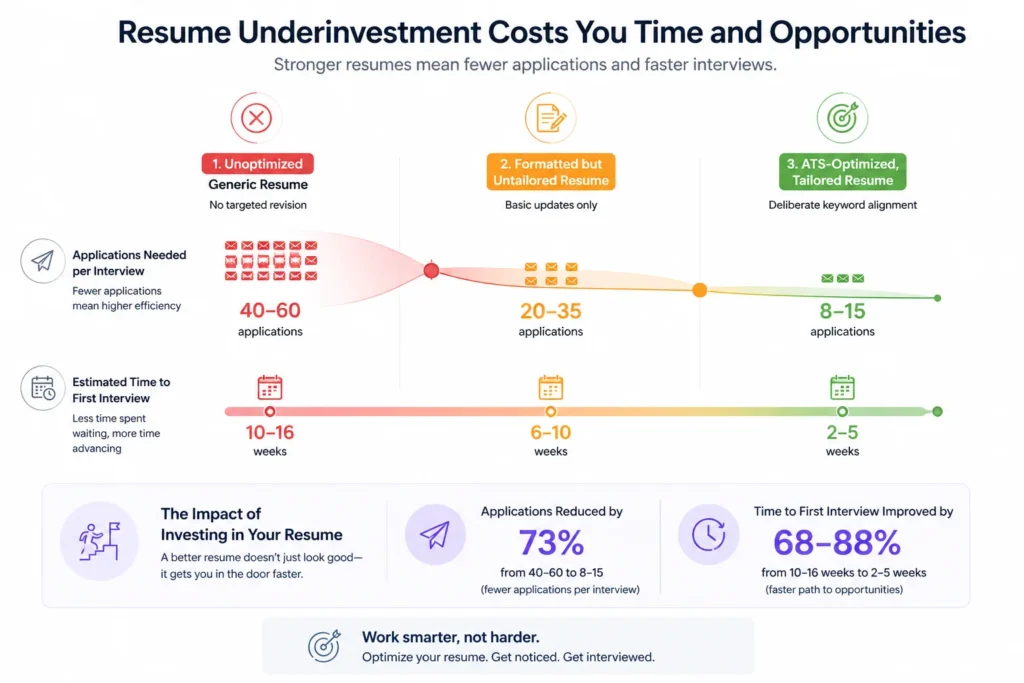
Time estimates assume 5 to 10 applications per week in a standard professional job search. ATS optimization impact varies by role type, market competitiveness, and application volume.
Related Terms
| Term | Definition |
|---|---|
| ATS (Applicant Tracking System) | Software used by employers to receive, parse, sort, and manage job applications automatically before human review |
| Cover Letter | A supplementary document submitted alongside a resume that provides narrative context for the candidate’s application and directly addresses the target role |
| Keywords | Specific words and phrases from job descriptions that ATS systems use to match and rank candidate resumes against role requirements |
| Professional Summary | A 3 to 5 sentence section at the top of a resume that positions the candidate’s core value proposition directly for the target role type |
| Transferable Skills | Capabilities developed in one professional context that are applicable and valuable across different role types, industries, or career stages |
Frequently Asked Questions
What is the ideal length for a resume?
One page is appropriate for candidates with fewer than 10 years of relevant professional experience. Two pages are standard for professionals with 10 or more years of relevant history. Resumes beyond two pages are rarely appropriate unless the role specifically requires a comprehensive CV – common in academic, research, and medical contexts but not in standard commercial hiring.
How important are keywords on a resume?
Keywords are critical for ATS compatibility. An estimated 75% of resumes are filtered by ATS systems before reaching a human reviewer, and the primary filtering mechanism is keyword matching against the job description. A resume using the exact language of the target role – for skills, tools, certifications, and competencies – will consistently outperform a resume describing equivalent qualifications in different words.
Should a resume include a photo?
In most English-speaking markets including the United States, Canada, the UK, and Australia, including a photo on a resume is not standard practice and may introduce unconscious bias into the screening process. In some European and Asian markets, photos are expected. Follow the professional norms of the specific market in which you are applying.
How often should a resume be updated?
At minimum, a resume should be updated immediately following any significant professional change – a new role, a completed certification, a major project or achievement. In addition, the resume should be actively tailored for each distinct application target rather than submitted generically.
What is the difference between a resume and a CV?
A resume is a concise, targeted document (typically 1 to 2 pages) summarizing the most relevant experience for a specific role or role type. A CV (Curriculum Vitae) is a comprehensive, chronological record of a professional’s full career history, publications, presentations, and academic credentials – typically used in academic, research, and medical hiring contexts, and often significantly longer than a standard resume.
Conclusion
The resume is not a historical document – it is an active persuasion tool operating in a technically demanding, competitively dense screening environment. The candidates who treat it as such – tailoring deliberately, quantifying rigorously, formatting for both algorithmic and human evaluation, and iterating systematically based on outcome data – consistently outperform those who treat it as a record of employment.
In a job market where the margin between an interview invitation and a rejection can be a single missing keyword or an improperly formatted element, resume quality is not a soft concern. It is a measurable, improvable competitive advantage that compounds across every application in a job search.