The word “headhunter” carries a certain mystique in the professional world. Mention it at a networking event and watch the room react: some people straighten up instinctively (am I being hunted?), others reach for another canape and pretend they didn’t hear. That reaction is the whole point. A headhunter is not a job board. A headhunter is a phone call you weren’t expecting, about an opportunity you weren’t looking for, from someone who decided you were worth pursuing.
In the context of recruitment, a headhunter is a professional recruiter, typically working independently or for a specialist executive search firm, who proactively identifies, approaches, and recruits candidates for senior, specialized, or hard-to-fill roles on behalf of a client organization. Unlike contingency recruiters who work from active candidate pools, headhunters source people who are not looking. Their currency is intelligence, relationships, and discretion.
In the AI hiring era, headhunting has not disappeared, it has bifurcated. Transactional search work that once required headhunters (sourcing mid-level professionals from LinkedIn, building longlist spreadsheets, cold outreach at scale) is now largely automated. What remains is the high-value core: the ability to build trust with passive candidates who have no reason to take a call, read a market well enough to identify talent others have missed, and represent an opportunity with enough nuance that a happy, well-compensated executive actually listens.
AI-powered hiring platforms like avua have automated the transactional layer, which means the human headhunter is now expected to operate almost entirely at the relationship layer.
The core metric governing headhunting effectiveness is Search-to-Placement Rate: the proportion of retained search engagements that result in a successful placed hire within the agreed timeline.
Search-to-Placement Rate (%) = (Successful Placements / Total Retained Searches Completed) × 100
Top executive search firms maintain Search-to-Placement Rates above 92%. Industry average sits closer to 74%. The gap is almost entirely explained by the quality of the headhunter’s market knowledge, candidate relationships, and process discipline, not by the difficulty of the brief.
What is Headhunter?
A headhunter is a specialized recruiter who proactively identifies and approaches qualified candidates; typically passive, not actively job-seeking, for senior, specialized, or confidential roles on behalf of a client organization, usually working on a retained or exclusive basis and operating with significant independence from the client’s internal HR function.
What distinguishes a headhunter from other recruiters is not the word; it’s the sourcing motion. A standard recruiter manages inbound applications. A headhunter generates outbound interest. The target candidate has a job they’re reasonably content with, no particular reason to move, and no knowledge that the opportunity exists. The headhunter’s task is to change all three of those conditions.
Is Headhunting Still Relevant in the Age of AI Recruitment?
The question comes up in every TA leadership conversation now, and the honest answer is: yes, more relevant than ever, but for a narrower set of tasks than it used to be.
Before AI-powered sourcing tools, headhunters earned their fees partly by knowing where people were. They had databases, networks, and institutional knowledge about who had moved where. That intelligence was genuinely scarce and genuinely valuable. Today, a reasonably competent recruiter with access to LinkedIn Recruiter, ZoomInfo, and an AI sourcing tool can build a longlist of 200 qualified professionals for a Director-level role in an afternoon. The talent map is public. The intelligence is commoditized.
What that means is that the traditional headhunter’s sourcing advantage has largely evaporated at mid-market level. Companies looking for a VP of Marketing or a Head of Engineering in a major metro have more self-service sourcing capacity than most contingency search firms had five years ago. The transactional case for paying a headhunter 25% of first-year salary to find someone who was technically findable on LinkedIn is increasingly hard to make.
But at the executive and specialist extremes, something different is happening. Senior executives are not LinkedIn-searchable in any meaningful sense. A Fortune 500 CFO or a top-tier fund manager does not update their profile hoping to be recruited. Their signal-to-noise problem on digital channels is severe, and their willingness to respond to cold digital outreach is near zero.
They can be reached through a single channel: trusted relationships. The headhunter who has had three conversations with a candidate over five years, who called to congratulate them on a promotion and sent a thoughtful note when their board seat was announced, is the person that candidate will return a call from. That relationship infrastructure cannot be replicated by an AI sourcing tool, and it is what justifies executive search fees.
A concrete data point: Spencer Stuart’s research on C-suite appointments found that 67% of successful senior executive placements in organizations with over $1B in revenue involved a search firm that had a pre-existing relationship with the placed candidate. The hire was not the result of a search; the search was the mechanism for surfacing a relationship the headhunter had already built.
The ROI math is stark. For a CFO role with a $400,000 base salary, the cost of a retained executive search at 33% of first-year compensation is $132,000. If a bad hire or an extended vacancy costs the organization a conservative $250,000 in productivity loss and re-recruitment cost, the fee is not a cost, it is insurance.
An organization that saves the fee and makes a bad hire, or leaves the role open for six months while running an internal process, typically pays far more than the fee it avoided.
For TA leaders, the practical conclusion is clear: headhunting should be segmented by role level and search difficulty. Internal sourcing and AI-powered recruitment handles everything up to the threshold where relationship capital and market intelligence become the differentiating factor. Above that threshold, retained executive search is not a luxury, it’s a rational resource allocation decision.
Your Resume Isn’t Getting Read
Let’s Get That Fixed!
75% of resumes get auto-rejected. avua’s AI Resume Builder optimizes formatting, keywords, and scoring in under 3 minutes, so you land in the “yes” pile.
The Psychology Behind Headhunting
Flattery and Identity Activation
The headhunter call works, when it does, because it activates something specific in the recipient: the recognition that they have been selected. Not screened in from an application pool, not auto-matched by an algorithm; personally chosen, by someone with market knowledge, as a candidate worth a conversation. This identity activation is psychologically potent.
It signals market value. It implies external validation. And it arrives at the exact moment when the candidate is not thinking about the job market, which makes it more powerful, not less: the unsolicited call is interpreted as a signal about the caller’s conviction, not about the candidate’s job search.
Reciprocity and Relationship Debt
The best headhunters build long-term relationships with candidates before they need anything from them. They share market intelligence, make introductions, provide career advice, and track career progression over years. By the time they call about a specific role, the relationship has accumulated reciprocity, the candidate feels a natural inclination toward responsiveness because of what the headhunter has given without asking. This reciprocity dynamic is a deliberate relationship investment strategy, not just professional courtesy. It converts cold outreach into warm conversation.
Information Asymmetry and Trust Transfer
A headhunter calling on behalf of a confidential client represents an opportunity the candidate cannot evaluate through any other channel. They cannot Google the role, research the company, or assess fit before deciding whether to engage.
The entire first conversation is an exercise in trust transfer: the headhunter’s credibility substitutes for the organizational information the candidate cannot access. This is why headhunter reputation matters so disproportionately in executive search, candidates decide whether to engage based almost entirely on their assessment of whether the caller is worth trusting.
Headhunter vs. Related Recruitment Roles
| Role | Sourcing Motion | Candidate Pool | Fee Structure | Typical Level |
|---|---|---|---|---|
| Headhunter / Executive Search | Outbound, proactive | Passive, not job-seeking | Retained (upfront) | Senior / C-suite |
| Contingency Recruiter | Mixed inbound/outbound | Active and semi-passive | Contingency (on placement) | Mid-level |
| Internal Recruiter | Inbound-primary | Active applicants | Salary (employee) | All levels |
| RPO Recruiter | Process-managed, inbound | Active applicants | Contract / per-hire | Volume roles |
| Talent Sourcer | Outbound research | Passive, pre-approach | Salary (employee) | All levels |
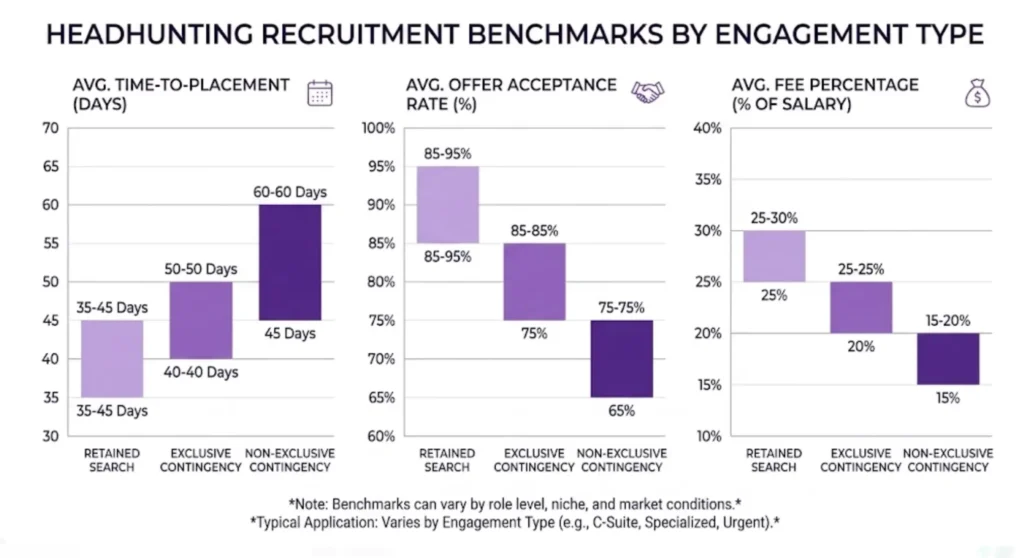
The critical distinction between a headhunter and a contingency recruiter is the fee structure and what it implies about commitment. A contingency recruiter earns nothing unless they place a candidate, which means they have a financial incentive to submit candidates quickly and broadly, and limited incentive to invest deeply in a single search.
A retained headhunter is paid regardless of whether the search is completed (typically one-third of fee at engagement, one-third on shortlist delivery, one-third on placement), which creates alignment with search quality rather than search speed.
What the Experts Say?
The best executive search consultants are not recruiters. They are market makers. They understand an industry’s talent landscape at a depth that neither the client’s HR team nor any database can replicate, and they have built the trust to broker conversations that would never happen otherwise.
– Laszlo Bock, Former SVP People Operations, Google; Author of Work Rules!
How to Measure Headhunter Effectiveness?
Formula
Search-to-Placement Rate (%) = (Successful Placements ÷ Total Retained Searches) × 100
Time-to-Shortlist (days) = Date Shortlist Delivered − Date Search Commenced
Offer Acceptance Rate (%) = (Offers Accepted ÷ Offers Extended) × 100
Benchmarks by Engagement Type
| Search Type | Avg. Search-to-Placement Rate | Best-in-Class |
|---|---|---|
| C-Suite / Board | 78% | 94% |
| VP / Senior Director | 84% | 96% |
| Specialist / Technical | 81% | 93% |
| Confidential / Competitive | 71% | 89% |
Key Strategies for Effective Headhunting
How Can AI and Automation Support Headhunting?
Intelligent Talent Mapping
AI-powered talent intelligence tools can now construct comprehensive talent maps for any role type, function, and geography in minutes; aggregating signals from professional networks, company databases, published research, and job change data to identify the strongest candidates in any given market.
What once took a research analyst two weeks now takes an AI tool forty minutes, and the output is typically more comprehensive because it is not subject to the human researcher’s network biases.
Predictive Career Move Modeling
Machine learning models trained on career history data can predict which professionals are likely to be open to a career conversation in the next six to twelve months, based on tenure patterns, career progression velocity, role change signals, and company performance indicators. This predictive layer allows headhunters to time their outreach to the moments of maximum candidate receptivity, rather than calling randomly and hoping for timing.
Automated Outreach Sequencing
AI-powered CRM and outreach tools can manage the sequencing of initial approach communications; personalizing the first message, timing follow-ups, and tracking engagement signals (opens, link clicks, response timing), freeing the headhunter from the administrative labor of managing outreach at scale. The headhunter’s personal involvement begins at the moment of genuine interest response, not at the cold outreach stage.
AI-Assisted Reference and Due Diligence
Natural language processing tools can analyze publicly available information about shortlisted candidates; published interviews, conference talks, articles, board memberships, reported decisions, to construct a preliminary profile of working style, professional reputation, and potential concerns before reference calls begin. This background intelligence preparation makes reference conversations more targeted and more valuable.
Stop Juggling
10 Job Boards.
Search One
Your next role is already here. avua pulls opportunities from across the web into a single searchable feed; filtered by role, location, salary, and remote preference.
1.5 Million+
Active Jobs
380+
Job Categories
Headhunting and Diversity & Inclusion
Network Homophily in Passive Sourcing
The headhunter’s reliance on relationship networks creates a structural DEI risk that is not present in open-application processes: networks tend toward homophily, meaning people are more connected to, and more trusting of, people who resemble them demographically. A headhunter whose professional network was built primarily in a specific demographic context will systematically over-represent that demographic in their passive candidate pools, not through intentional bias but through structural network composition.
Accessibility of Executive Pipelines
Headhunting concentrates on the passive candidate market, which means the DEI implications of headhunting decisions are upstream of the hiring process: who gets put on the longlist before the client ever sees a name. Organizations relying on headhunters for senior hiring without explicit DEI briefs frequently find that their senior hire demographics reflect the headhunter’s network rather than the available talent market. Explicit DEI requirements in the search brief, with defined demographic representation targets for the longlist are the primary tool for correcting this.
Language and Representation in Opportunity Description
How a headhunter describes an opportunity to a passive candidate in the first conversation shapes who agrees to proceed. Research on how senior professionals from underrepresented groups evaluate career opportunities shows consistent differences in the factors they weight most heavily, growth potential, cultural safety, flexibility, and leadership representation, versus factors that tend to dominate how headhunters traditionally describe roles (compensation, title, organizational scale).
Headhunters who adapt their opportunity framing to address the factors that matter most to the specific candidate they are calling, rather than defaulting to a standard pitch, produce more diverse shortlists from equivalent candidate pools.
Common Challenges and Solutions
| Challenge | Solution |
|---|---|
| Client brief is too vague to begin a targeted search | Conduct a formal brief qualification session with all hiring stakeholders before search commences; use a structured brief template |
| Candidate declines further interest after initial positive response | Implement a structured candidate engagement protocol with regular touchpoints and proactive information sharing between stages |
| Search produces technically qualified shortlist that client finds uninspiring | Reframe the talent map to include non-obvious candidates from adjacent industries or non-traditional backgrounds |
Real-World Case Studies
Case Study 1: The Private Equity Portfolio Company
A mid-market private equity firm needed a CFO for a portfolio company in the industrial services sector. The internal process had produced three candidates, none of whom the CEO found compelling. They engaged a specialist finance search firm who had a pre-existing relationship with the eventual placed candidate from a previous search three years earlier, the candidate had not been placed at the time but had been kept warm with periodic market updates and one introduction to a board member.
The search-to-shortlist timeline was 19 days (versus 47 days for the failed internal process). The placed CFO was not actively seeking a move and would not have been identified through any standard sourcing approach. The retained search fee represented 0.6% of the portfolio company’s annual EBITDA, a figure the PE firm characterized as “categorically immaterial against the quality improvement.”
Case Study 2: The Tech Scale-Up
A Series C technology company conducting its first VP of Engineering search ran a contingency recruiter process for eight weeks before switching to a retained headhunter. The contingency process had generated 22 candidates, 18 of whom had active profiles on LinkedIn and had been submitted by multiple recruiters simultaneously. The retained headhunter’s shortlist of six included three candidates who had no digital footprint suggesting they were movable, one of whom was eventually hired. The retained fee was 32% of first-year compensation versus the contingency arrangement’s 22%, but the retained process produced the hire in week four, versus the contingency process producing no hire in eight weeks.
Case Study 3: The Mobile-First Approach
An executive search firm redesigned its candidate engagement process to be mobile-first after discovering that 71% of senior executive candidates were responding to initial outreach on mobile devices but dropping out of their process once it moved to desktop-required platforms (document submission, video interviews on non-mobile-optimized systems).
They rebuilt their candidate-facing process to be fully mobile-compatible, reduced average initial document submission requirements by 60%, and implemented WhatsApp as a primary communication channel for candidates who preferred it. Candidate drop-off between initial interest and shortlist submission fell from 34% to 12%.
Building a Headhunting Performance Dashboard: What to Track?
If you’re serious about treating abandonment rate as a strategic KPI, you need a dedicated dashboard. Here’s what belongs on it.
Headhunting Across the Hiring Lifecycle
Pre-Search Intelligence Building
Effective headhunting begins before the search brief arrives. The best headhunters maintain ongoing market maps for their core specialisms, tracking executive career movements, company performance changes, sector consolidation, and professional reputation signals continuously so that when a client calls, the response is “I have three people in mind” rather than “let me start researching.”
Active Search and Candidate Qualification
The core search phase involves longlist construction, initial approach, and qualification conversations to determine genuine interest and fit. AI tools now handle the longlist construction phase almost entirely; the headhunter’s distinctive contribution is the qualification conversation that converts a technically qualified candidate into a motivated, well-informed shortlist candidate.
Shortlist Presentation and Client Management
The shortlist presentation is a critical headhunter performance moment, not because of the quality of the candidates on the list (which should already be established) but because of the quality of the briefing on each candidate. A headhunter who presents three candidates as three sets of credentials has failed. A headhunter who presents three candidates as three distinct perspectives on the role, with specific insight into what each candidate values and what would need to be true for each of them to accept, has delivered genuine search value.
Offer and Placement Management
The offer stage is where headhunter relationship capital is most critical. The headhunter typically serves as the mediator between client and candidate, translating the client’s constraints into terms the candidate can accept and the candidate’s requirements into requests the client can consider. The ability to manage this negotiation without losing either party is what distinguishes experienced executive search professionals from those operating at the process level.
The Real Cost of Getting Senior Hiring Wrong
| Scenario | Search Approach | Time to Fill | Estimated Total Cost |
|---|---|---|---|
| Current state (internal process) | Ad hoc, no specialist | 90+ days | $320,000+ |
| Moderate (contingency recruiter) | Contingency, multi-agency | 60 days | $210,000 |
| Best-in-class (retained search) | Single retained headhunter | 35 days | $165,000 |
Assumes VP-level role, $300K base salary, costs include vacancy productivity loss, process management, and recruitment fee. Internal process cost assumes no placement fee but includes hiring manager time and extended vacancy.
Related Terms
| Term | Definition |
|---|---|
| Executive Search | The formal discipline of headhunting for C-suite and board-level roles, typically conducted on a retained basis |
| Retained Search | A search engagement in which the recruiter is paid in stages regardless of placement outcome, ensuring full commitment to the specific search |
| Passive Candidate | A professional who is not actively seeking employment but may be open to the right opportunity |
| Talent Mapping | The process of identifying and cataloguing all qualified candidates for a specific role type in a defined market |
| Boolean Search | An advanced search technique using logical operators to refine candidate identification across databases and professional networks |
Frequently Asked Questions
What is the difference between a headhunter and a recruiter?
All headhunters are recruiters, but not all recruiters are headhunters. The distinction is in the sourcing motion: standard recruiters primarily manage inbound applications from active candidates, while headhunters proactively identify and approach passive candidates who are not looking. Headhunters also typically specialize in senior or highly specialized roles and operate on retained fee structures.
Does using a headhunter actually improve hire quality?
Research consistently shows yes, for senior roles. Studies of executive appointments find that retained search placements have 25–30% higher twelve-month retention rates than equivalent hires made through direct sourcing or contingency recruitment. The quality improvement comes from access to passive candidates who are performing well in current roles, not just those who are available because they are between jobs.
How do AI tools change what headhunters do?
AI tools automate the intelligence-gathering and longlisting layer of search work, tasks that previously consumed significant headhunter time. This shifts the headhunter’s value to the relationship and judgment layers: the ability to have a trusted conversation with a passive candidate, assess cultural fit at depth, and manage a complex offer negotiation. AI raises the quality floor of search work and elevates what the human must deliver above it.
Can a bad executive search be recovered from?
Yes, but the window is narrow. If a poor shortlist is identified early (before client interviewing), the search can be reset with a refined brief at moderate cost. If a bad hire is made through a retained search, most reputable search firms include a replacement guarantee of six to twelve months, they will re-conduct the search at no additional retainer cost if the placed candidate leaves within the guarantee period.
Does headhunting affect employer brand?
Yes, in both directions. A well-conducted headhunting process; respectful, informative, and professional, builds positive employer brand with the entire longlist population, including candidates who were not shortlisted. A poorly conducted process (poor communication, misrepresented opportunities, breached confidentiality) spreads negative employer brand across a highly connected senior professional community where reputation travels fast.
Conclusion
The headhunter is not an anachronism in the age of AI hiring, they are an increasingly specialized instrument for a specific and irreplaceable problem: reaching people who cannot be reached any other way.
As AI automation handles more of the transactional sourcing work, the headhunter’s domain narrows to its highest-value core; the relationship, the judgment, and the trust that turns a passive executive into an engaged candidate. The organizations that understand when to use that instrument, and when to handle hiring internally, will consistently outperform those applying a one-size-fits-all approach to talent acquisition at every level.
Treat headhunting as a strategic resource allocation decision, not a contingency fee, and the ROI becomes self-evident.