Every job posting has a true author. It isn’t just the recruiter who drafts the description or the CHRO who approved the budget. It’s the person who sits across from candidates, decides who moves forward, and stays accountable for the results long after the offer is signed. That person is the hiring manager. In most companies, they are the most influential part of the process, yet they’re often the least trained and the first to be blamed if things go wrong.
A hiring manager is the person in a department with the authority to fill a role, usually acting as the new hire’s direct boss. They own the final decision, define the requirements, and set the evaluation criteria. While talent teams provide a steady candidate pipeline, the hiring manager is the one conducting the behavioral interview to see if an active candidate is the right fit.
With the rise of ai hiring, the manager’s role has shifted. Modern tools for automated screening handle the tedious administrative work that used to eat up their time. This leaves the manager free to focus on what AI can’t do: judging growth potential and figuring out if a technically skilled person will actually thrive in the team’s unique culture.
The core metric governing hiring manager effectiveness is Hiring Manager Quality of Hire Score: the average performance rating of employees in their first twelve months, relative to the performance of the overall employee population.
Hiring Manager QoH Score = Avg. 12-Month Performance Rating of Hires ÷ Avg. 12-Month Performance Rating (All Employees)
A ratio above 1.0 indicates a hiring manager whose selections systematically outperform the organizational average. A ratio below 0.85 persistently indicates a systematic judgment or process quality issue in that manager’s hiring decisions — one worth investigating and addressing directly.
What is a Hiring Manager?
A hiring manager is the organizational leader, typically the direct or skip-level manager of the open role, who holds decision-making authority and accountability for a specific recruitment process; defining the role, evaluating candidates, and ultimately determining who is hired and onboarded into their team.
The hiring manager is distinct from the recruiter (who manages process), the HR business partner (who manages workforce policy), and the CHRO (who manages talent strategy). The hiring manager is the one with domain knowledge of what the role actually requires, visibility into the team dynamics the new hire will enter, and the longest-term accountability for the outcome: a hire that underperforms reflects on the hiring manager, not the recruiter.
Why Is the Hiring Manager the Most Underinvested Link in the Hiring Process?
Organizations invest heavily in recruiter training, ATS systems, assessment tools, and employer brand. They invest comparatively little in the capability of hiring managers — the people who make the actual hiring decisions.
The gap is partly structural. Recruiters are hired specifically to recruit. Hiring managers are hired to lead their function, and recruiting is an occasional demand on their time rather than their core competency. A hiring manager in a technology company is typically a senior engineer or engineering lead whose skill set is built around technical execution and team leadership, not candidate evaluation. Yet that person will conduct 80% of the substantive evaluation conversations in any hire their team makes.
The results of this underinvestment are well-documented. LinkedIn’s Global Talent Trends research found that hiring manager interview quality is the single variable most predictive of offer acceptance rate, yet only 39% of hiring managers report receiving structured guidance on how to conduct an effective interview before taking one. That is not a recruiter problem. That is an organizational development gap masquerading as a talent acquisition gap.
The ROI case for hiring manager development is straightforward. Research on structured interviewing — using predefined questions with scored evaluation rubrics rather than conversational, unstructured interviews — consistently finds 26% higher predictive validity for job performance. For a business unit making 20 hires per year with an average cost-per-hire of $8,000 and a bad hire cost of $25,000, improving hiring manager interview structure from unstructured to structured interviews is worth approximately $130,000 annually in avoided bad hire costs — assuming a modest 10% reduction in bad hire rate. Most organizations spend less than $5,000 per year on hiring manager capability development.
The concrete scenario that illustrates the cost: a growing financial services firm conducts a post-hire audit of its last 40 technical hires and finds that 14 — 35% — have underperformed against expectations at the 12-month mark. Exit interviews and manager feedback consistently identify the same root cause: the interview process prioritized technical credentials and pedigree (things visible on a CV) over the collaborative work style and communication skills required to function in a cross-functional environment (things assessable only through a well-designed interview). The technical assessment was rigorous. The hiring manager interviews were unstructured and credential-focused. The hires looked right on paper and underperformed in practice.
For TA leaders, the practical opportunity is to treat hiring manager capability as a talent acquisition infrastructure investment, not a nice-to-have training program. The organizations that have done this — building hiring manager toolkits, structured interview guides, calibration sessions, and feedback loops from hire outcomes to hiring manager development — consistently report higher Quality of Hire scores, faster time-to-fill (because well-prepared hiring managers make faster, more confident decisions), and significantly lower early-tenure attrition.
Your Resume Isn’t Getting Read
Let’s Get That Fixed!
75% of resumes get auto-rejected. avua’s AI Resume Builder optimizes formatting, keywords, and scoring in under 3 minutes, so you land in the “yes” pile.
The Psychology Behind Hiring Manager Decision-Making
Affinity Bias and the Similarity-Attraction Effect
The most pervasive and difficult-to-correct bias in hiring manager evaluation is the similarity-attraction effect: the tendency to evaluate more favorably candidates who share characteristics (background, communication style, educational pedigree, career narrative) with the evaluator. This is not a conscious preference — it operates at the level of comfort and rapport, which are notoriously easy to confuse with competence and potential. A hiring manager who “just clicks” with a candidate is often experiencing similarity bias rather than genuine fit assessment. The fix is not awareness (which rarely changes behavior) but structural: defining evaluation criteria before meeting candidates, using scored rubrics, and calibrating evaluations in group debrief sessions that surface and challenge outlier assessments.
Decision Fatigue and Sequential Evaluation Effects
Hiring managers conducting multiple interviews in a single day — particularly common in on-site interview days — show measurably declining evaluation quality as the day progresses. Research on sequential decision-making in hiring contexts finds that candidates evaluated later in a sequence are consistently scored lower on average than equivalent candidates evaluated earlier, independent of actual performance. This sequential position bias is an artifact of decision fatigue, not candidate quality. Interview scheduling that distributes complex evaluations across different times and days, and evaluation forms completed immediately after each interview rather than in aggregate at the end of the day, meaningfully reduce this effect.
Confirmation Bias in Candidate Evaluation
Most hiring managers form an initial impression of a candidate within the first five minutes of an interview. Subsequent interview behavior is then unconsciously filtered through this first impression: information that confirms the initial assessment is weighted heavily; information that contradicts it is discounted. Structured interviews with specific, pre-defined questions evaluated against explicit criteria reduce (though do not eliminate) this confirmation bias by providing an evaluative framework that is independent of the first impression.
Hiring Manager vs. Related Hiring Roles
| Role | Primary Responsibility | Decision Authority | Candidate Interaction | Accountability |
|---|---|---|---|---|
| Hiring Manager | Role definition; candidate evaluation; hiring decision | Final hiring decision | Interview; final evaluation | Long-term hire performance |
| Recruiter / TA Specialist | Process management; sourcing; screening | Screen to interview shortlist | Screen; present; close | Process efficiency; pipeline quality |
| HR Business Partner | Workforce policy; compliance; offer management | Policy and structure | Offer stage; compliance | Process adherence; legal compliance |
| Interviewer / Panel Member | Single-stage evaluation | Input, not decision | Interview only | Input quality, not outcome |
| CHRO / Head of TA | Strategy; resources; standards | Framework and budget | Strategic only | Portfolio-level outcomes |
The single most important distinction in the table above: the hiring manager holds the final hiring decision, while all other roles hold influence or input. This decision authority is what makes hiring manager capability so consequential.
What the Experts Say?
Every recruiting failure is ultimately a hiring manager failure. Not because they’re bad managers — but because we’ve never invested in them the way we invest in the process around them. The process is excellent. The humans making the final call are improvising.
– Hung Lee, Curator, Recruiting Brainfood
How to Measure Hiring Manager Effectiveness?
Formula
Quality of Hire Score = Avg. 12-Month Performance Rating of HM's Hires ÷ Org Average 12-Month Performance Rating
Hiring Manager Interview-to-Offer Rate (%) = (Offers Extended ÷ Candidates Interviewed by HM) × 100
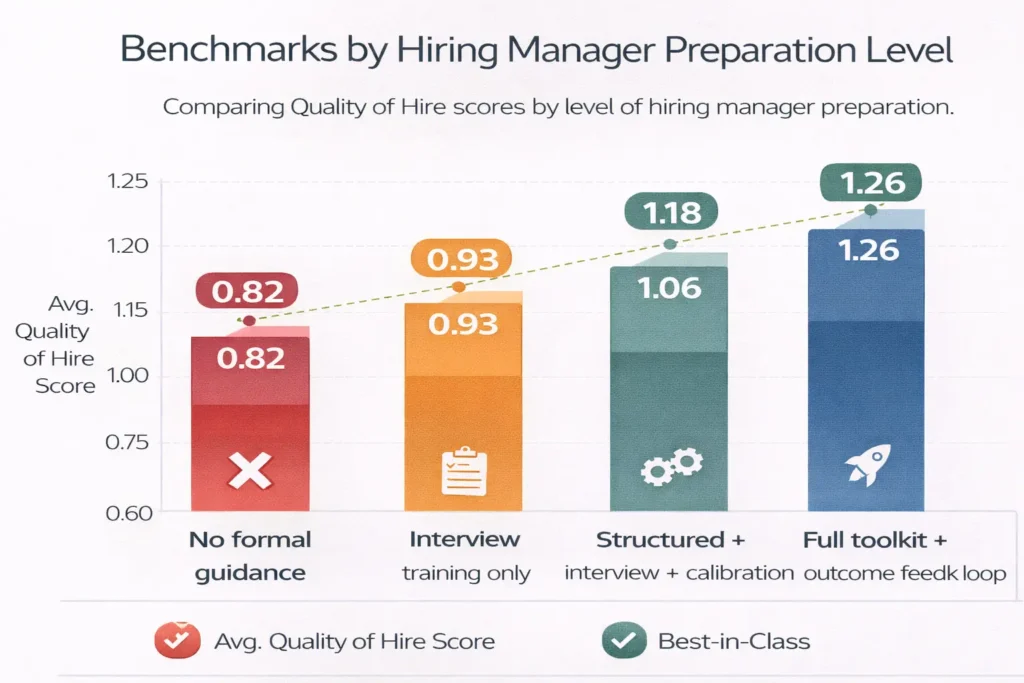
Benchmarks by Hiring Manager Preparation Level
| Preparation Level | Avg. Quality of Hire Score | Best-in-Class |
|---|---|---|
| No formal guidance | 0.82 | 0.91 |
| Interview training only | 0.93 | 1.02 |
| Structured interview + calibration | 1.06 | 1.18 |
| Full toolkit + outcome feedback loop | 1.14 | 1.26 |
Key Strategies for Improving Hiring Manager Effectiveness
How Can AI and Automation Support Hiring Managers?
AI-Generated Interview Guides
Natural language AI tools can generate role-specific, competency-mapped interview guides from a brief description of the role requirements — saving the recruiter the time of building from scratch and ensuring that every hiring manager receives a structured guide rather than going into interviews without a framework.
Automated Candidate Summaries
Before a hiring manager interview, AI systems can provide a structured, standardized candidate summary — highlighting relevant experience, flagging potential fit questions, and presenting evaluation criteria — that prepares the hiring manager more efficiently and consistently than manual review of the full application.
Interview Scheduling Automation
AI-powered scheduling tools eliminate the email back-and-forth that consumes disproportionate recruiter and hiring manager time in the interview coordination phase, freeing both parties for the substantive work of evaluation.
Post-Interview Feedback Analysis
AI systems can analyze hiring manager interview notes and evaluation form completions for bias signals — identifying patterns of affinity bias, confirmation bias, or demographic differential scoring — and surface these signals for calibration conversations. This analytical layer is not punitive; it is a development tool that gives hiring managers visibility into their own evaluation patterns over time.
Stop Juggling
10 Job Boards.
Search One
Your next role is already here. avua pulls opportunities from across the web into a single searchable feed; filtered by role, location, salary, and remote preference.
1.5 Million+
Active Jobs
380+
Job Categories
Hiring Managers and Diversity & Inclusion
Interview as the Primary DEI Leverage Point
The hiring manager interview is the stage where the majority of demographic attrition in hiring processes occurs. Organizations that track representation at every stage of the hiring funnel consistently find that diverse candidate pools that reach the hiring manager interview stage convert to offers at lower rates than their representation would predict, and the gap is concentrated in the unstructured elements of the hiring manager’s evaluation.
Inclusive Interview Practice
Inclusive hiring manager practice is not primarily about awareness — it is about structure. Hiring managers who use consistent question sets across all candidates, evaluate against explicit criteria, and participate in calibration conversations with other interviewers produce more demographically equitable hiring outcomes than those who rely on interview intuition, regardless of their individual DEI commitment or training completion.
Avoiding the “Culture Fit” Trap
“Culture fit” is the most commonly cited reason for hiring manager rejection of diverse candidates, and it is the rejection reason most resistant to challenge because it is vague. TA leaders and HR business partners should work with hiring managers to replace “culture fit” assessments with “culture contribution” criteria — defining specifically what cultural elements they are assessing for, and ensuring those elements are competency-based rather than based on personal resemblance.
Common Challenges and Solutions
| Challenge | Solution |
|---|---|
| Hiring manager delays slowing down the process | Set explicit SLAs for hiring manager responses at each stage; build review timelines into the intake kick-off |
| Inconsistent evaluation standards across hiring managers | Implement structured evaluation rubrics and shared debrief formats; require written evaluations before calibration conversations |
| Hiring manager over-weighting a single impressive interview performance | Use multi-stage, multi-evaluator processes for all roles above a defined seniority threshold |
Real-World Case Studies
Case Study 1: The Fintech Scale-Up
A 400-person fintech company with a consistently declining Quality of Hire metric conducted a hiring process audit and found that 80% of their hiring manager interviews were entirely unstructured — hiring managers asking ad hoc questions and evaluating based on post-interview “gut feel.” They built a structured interview toolkit covering the ten role families that accounted for 90% of their hiring volume, trained 34 hiring managers in a 90-minute session, and required written evaluation form completion within two hours of each interview. Quality of Hire score (measured as performance rating at 12 months versus company average) improved from 0.84 to 1.07 over two hiring cycles.
Case Study 2: The Healthcare Network
A regional healthcare network identified that their clinical department hiring managers had significantly longer time-to-fill than non-clinical departments (67 days versus 41 days). Investigation found that clinical hiring managers were conducting an average of 4.3 interviews before making an offer decision, compared to 2.6 for non-clinical. The TA team introduced a structured two-stage interview protocol with explicit criteria for advancement and offer decision, reducing average interview count to 2.8. Clinical time-to-fill fell to 48 days.
Case Study 3: The Technology Company
A technology company implemented mobile-first interview feedback tools that allowed hiring managers to complete evaluation forms on their phones immediately after each interview rather than on desktop later in the day. Evaluation completion rate rose from 68% (desktop forms, end of day) to 94% (mobile forms, immediate). Calibration conversation quality improved measurably, and hiring manager interview-to-offer rate (a proxy for evaluation precision) improved from 1-in-7 to 1-in-4.2.
Building a Hiring Manager Performance Dashboard: What to Track?
Hiring Managers Across the Candidate Lifecycle
Awareness and Role Definition Stage
The hiring manager’s influence on the candidate journey begins before the first application. The quality of the job description — which the hiring manager provides the inputs for — determines the quality of inbound candidate targeting. Vague, internally-focused role descriptions produce mismatched applications and wasted screening time. Specific, candidate-facing descriptions that communicate what the role genuinely involves and what success looks like attract better-fitting candidates.
Interview and Evaluation Stage
This is the hiring manager’s core contribution to the hiring process: substantive evaluation of candidate fit. The quality of the evaluation depends on preparation (structured guide), execution (consistent question application), and reflection (written evaluation before calibration). All three require organizational investment that most companies have not yet made systematically.
Offer Stage
The hiring manager plays a critical role in the offer stage that is frequently underutilized: personal conviction communication. Candidates on the margin between accepting and declining are most influenced by the hiring manager’s direct expression of genuine interest — a personal call, a message from the team, a clear articulation of why this candidate specifically was chosen. Organizations where offers are delivered exclusively through HR/legal mechanisms without hiring manager involvement consistently show lower acceptance rates on competitive offers.
Onboarding and Integration
The hiring manager’s accountability does not end at the signed offer letter. The first 90 days — the period most predictive of long-term retention and performance — are primarily shaped by the quality of the hiring manager’s onboarding approach. Managers who invest in structured onboarding, regular check-ins, and clear expectation-setting produce new hire success rates that diverge significantly from those who treat onboarding as HR’s problem.
The Real Cost of Hiring Manager Underinvestment
| Scenario | HM Preparation Level | Bad Hire Rate | Annual Cost (50 hires/year) |
|---|---|---|---|
| No guidance (current state) | None | 22% | $275,000 |
| Interview training | Basic | 15% | $187,500 |
| Structured + calibration | Developed | 9% | $112,500 |
| Full toolkit + feedback loop | Expert | 5% | $62,500 |
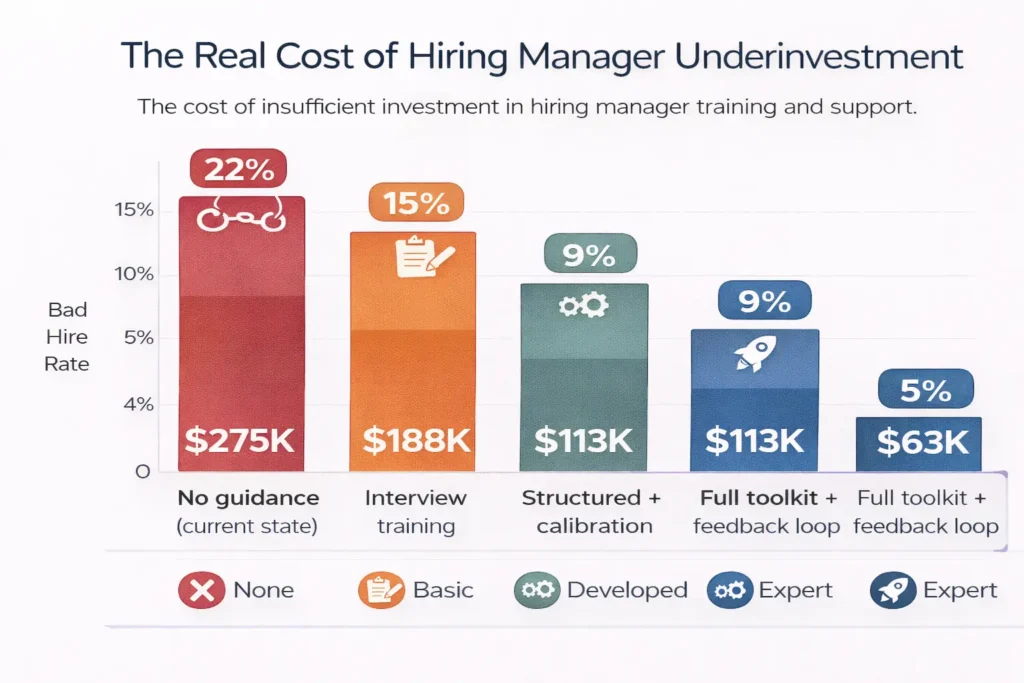
Bad hire cost assumed at $25,000 per instance (replacement cost + productivity loss).
Related Terms
| Term | Definition |
|---|---|
| Quality of Hire | A composite metric measuring the value a new hire delivers relative to organizational expectations |
| Structured Interview | An interview format using predefined, consistently applied questions evaluated against explicit criteria |
| Intake Meeting | A pre-search conversation between recruiter and hiring manager to align on role requirements and search strategy |
| Affinity Bias | The tendency to favor candidates who share characteristics with the evaluator |
| Hiring Committee | A panel of two or more evaluators who share the evaluation and decision responsibility for a hire |
Frequently Asked Questions
What is the difference between a hiring manager and a recruiter?
The recruiter manages the hiring process — sourcing, screening, scheduling, and communicating. The hiring manager makes the hiring decision. Both roles are essential, but they are accountable for different things: the recruiter is accountable for process quality and pipeline efficiency, while the hiring manager is accountable for the quality of the people selected.
How many interviews should a hiring manager conduct before deciding?
Research on interviewer reliability consistently finds that three to four well-structured interviews with different competency focuses produce more accurate and defensible hiring decisions than seven or more loosely structured ones. Diminishing returns on prediction accuracy set in quickly after the third interview; additional interviews typically reflect decision uncertainty rather than genuine evaluation value.
Does AI replace the hiring manager’s role?
No, AI improves what reaches the hiring manager and removes administrative burden from the evaluation process, but the substantive judgment of whether a specific person will thrive in a specific team under a specific manager remains irreducibly human. AI raises the floor; hiring manager judgment determines the outcome.
Can poor hiring manager practices be identified early?
Yes. Quality of Hire score tracked at the hiring manager level, combined with early attrition rate and offer acceptance rate, provides a clear leading indicator of systematic hiring judgment issues. Organizations that track these metrics at the manager level and invest in capability development for managers showing patterns of underperformance see measurable improvement within two to four hiring cycles.
How do you handle a hiring manager who rushes the process?
This is one of the most common TA friction points. The most effective approach is a pre-search SLA conversation that establishes explicit time commitments at each stage and then treats those commitments as bilateral, with the recruiter committing to their timelines in exchange for the hiring manager committing to theirs. Unilateral SLA pressure without reciprocal commitment produces resentment, not compliance.
Conclusion
The hiring manager is the most consequential and least invested-in link in the talent acquisition chain.
Organizations that treat hiring manager capability as infrastructure, building structured interview tools, running calibration processes, closing the outcome feedback loop, and protecting hiring manager time for high-judgment evaluation, produce consistently better hiring outcomes than those that invest exclusively in the process layer around the decision-maker while leaving the decision-maker to improvise.
The hire is the product. The hiring manager is the production quality control. Invest accordingly.