Before the HRIS era, HR relied on paper files, clunky spreadsheets, and the institutional memory of a few key veterans. If the person who knew the specific bonus cycles or the location of the parental leave forms went on vacation, operations ground to a halt. The HRIS was built to solve this by centralizing data, though for some organizations, it simply traded physical folders for digital clutter. When managed correctly, it transforms that friction into a seamless employee experience.
An HRIS is the integrated software backbone that centralizes payroll, benefits, and employee onboarding. It serves as the official system of record for the entire employee lifecycle, from the initial contract to the final exit interview. It is the essential infrastructure layer where administrative tasks meet operational efficiency.
In the age of AI, the Human Resource Information System has become an intelligence platform that powers sophisticated HR analytics. The quality of your data is now the primary factor in your AI success: companies with structured records can deploy predictive models and skill gap tools that remain out of reach for those with fragmented systems.
The core metric governing Human Resource Information System health is Data Completeness Rate: the proportion of employee records with all required fields populated accurately.
Data Completeness Rate (%) = (Fully Populated Employee Records ÷ Total Active Employee Records) × 100
Best-in-class HRIS implementations maintain Data Completeness Rates above 96%. The industry average is considerably lower — research suggests 71–78% across mid-market organizations. The gap directly affects every downstream analytics and reporting capability built on the HRIS data layer.
What is an HRIS?
An HRIS is a centralized digital system that stores, manages, and processes an organization’s people data and automates core HR administrative processes, serving as the single source of truth for employee records, workforce reporting, and HR workflow management.
The defining characteristic of an HRIS is its function as a system of record, the authoritative source for employee data that all other HR and business systems reference. When an employee changes their address, updates their tax withholding, or receives a promotion, the HRIS is the system where that change is recorded and from which it propagates to payroll, benefits, facilities, and other dependent systems.
Is Your HRIS an Asset or a Data Liability?
The HRIS is marketed as the bedrock of modern HR operations. For many organizations, it delivers on that promise. However, for a surprising number of companies, it has devolved into what one CHRO famously described as “the most expensive spreadsheet the company has ever built.”
The “Expensive Spreadsheet” Trap
The software itself is rarely the culprit. Modern platforms like Workday, SAP SuccessFactors, and HiBob are well-engineered products. The real failure lies in the data quality that decays over time and the organizational habits that allow it to happen. An HRIS is only as powerful as the information it holds, yet many companies systematically underinvest in the processes that maintain that accuracy.
Where the Data Rot Starts?
Data gaps often begin at the very start of the employee onboarding process and widen over time. Common issues include:
- Stale Profiles: Employee records are rarely updated after internal role changes.
- Inconsistent Tagging: Job families and grade levels are applied differently across departments.
- One-and-Done Skills: Skills data is collected during hiring but never revisited, rendering it useless for internal mobility.
- Patchy History: Compensation data is often complete for new hires but missing for long-term veterans.
The Hidden Tax on AI
Poor data quality is not just an administrative annoyance; it is a direct barrier to HR analytics and AI. When leadership attempts to build predictive models for the attrition rate, they find tenure data riddled with holes. When teams try to implement data-driven recruiting, they discover their skills taxonomy is too fragmented to be actionable.
According to Deloitte, organizations with low data quality spend 23% more time on workforce reporting. This isn’t because the reports are harder to run, but because the data requires massive manual cleaning before it can be used. For a ten-person HR team, that is equivalent to losing over two full-time employees to tedious data remediation.
The ROI of Data Hygiene
Investing in data governance is a high-yield strategy for any future-ready workplace. A mid-size organization that spends $40,000 annually on data standards and regular audits typically recovers that cost through time savings within just six months. Beyond the hours saved, the true value lies in the AI capabilities and strategic insights that finally become possible when your foundation is solid.
Your Resume Isn’t Getting Read
Let’s Get That Fixed!
75% of resumes get auto-rejected. avua’s AI Resume Builder optimizes formatting, keywords, and scoring in under 3 minutes, so you land in the “yes” pile.
The Psychology Behind HRIS Adoption and Resistance
Implementing a Human Resource Information System is rarely a technical hurdle; it is a psychological puzzle centered on overcoming ingrained habits and deep-seated change fatigue. To drive real adoption, organizations must navigate the friction between individual privacy concerns and the collective power of data-driven efficiency.
Complexity Aversion and Workaround Culture
Human Resource Information System adoption fails most often not at the executive sponsorship level but at the individual employee and manager level, where the system feels more complex than the behavior it replaced. Employees who find it faster to email HR directly than to update their own Human Resource Information System profile develop workarounds that become habitual, gradually degrading system data quality from the edges. The fix is not training; it is design. Human Resource Information System processes that are simpler than their non-system alternatives get used; those that are more complex get avoided.
Change Fatigue in Multi-System Organizations
Organizations that have implemented, replaced, or upgraded Human Resource Information System platforms multiple times in a five-year period develop specific change fatigue among their workforce. This is a generalized skepticism toward new system investments combined with accumulated expertise in working around rather than within official systems. New Human Resource Information System implementations in these environments consistently underperform adoption targets unless specifically designed to address legacy workaround behaviors.
Data Ownership and Privacy Psychology
Employees have a complicated relationship with organizational data systems: they simultaneously want the benefits of data-driven HR, such as fair compensation benchmarking, objective performance evaluation, and targeted development, and the privacy protection of limited organizational data access to their personal and professional information. Human Resource Information System implementations that fail to address this tension, which feel like surveillance infrastructure rather than administrative efficiency tools, produce the minimal-compliance data entry behavior that degrades system quality.
HRIS vs. Related HR Technology Systems
| System | Primary Function | Key Data | Key Difference from HRIS |
|---|---|---|---|
| HRIS | Centralized employee records and HR workflows | Employee master data; org structure | System of record for all HR data |
| ATS (Applicant Tracking System) | Recruitment process management | Candidate data; pipeline status | Pre-hire; integrates with Human Resource Information System at hire |
| HRMS (HR Management System) | Broader HCM including HRIS capabilities | All HR data plus analytics | Often used interchangeably with HRIS; typically implies broader scope |
| HCM (Human Capital Management) | Full talent lifecycle from hire to exit | Workforce + strategic planning data | Superset of Human Resource Information System; includes strategic analytics |
| Payroll System | Compensation calculation and payment | Compensation; tax; deductions | Financial execution; typically fed by Human Resource Information System |
| LMS (Learning Management System) | Training and development tracking | Learning history; certifications | Development-focused; integrates with Human Resource Information System |
What the Experts Say?
The HRIS is not an HR system. It’s a business system that happens to live in HR. The organizations that treat it that way — with the same data governance rigor they apply to their financial systems, are the ones that actually get value from their workforce analytics investments.
– Josh Bersin
How to Measure and Improve HRIS Health?
Formula
Data Completeness Rate (%) = (Fully Populated Records ÷ Total Active Records) × 100
System Adoption Rate (%) = (Active Users in Period ÷ Total Eligible Users) × 100
Benchmarks by Organization Size
| Organization Size | Avg. Data Completeness Rate | Best-in-Class |
|---|---|---|
| < 250 employees | 74% | 91% |
| 250–1,000 employees | 71% | 94% |
| 1,000–5,000 employees | 76% | 96% |
| 5,000+ employees | 79% | 98% |
Key Strategies for HRIS Optimization
How Can AI and Automation Improve HRIS Value?
Automated Data Enrichment
AI tools can enrich existing Human Resource Information System records by cross-referencing against external data sources, professional network data, certification databases, market compensation benchmarks, to fill gaps and flag inconsistencies that manual data entry misses. Automated enrichment significantly reduces the cost of maintaining data quality in large employee populations.
Predictive Analytics on HRIS Data
Machine learning models trained on Human Resource Information System data can predict attrition risk, flight risk by role and tenure, compensation equity gaps, and succession readiness, surfacing workforce intelligence that would require weeks of analyst time to produce manually. This is the highest-value use case for clean HRIS data, and the primary argument for investing in data quality.
Natural Language Reporting Interfaces
Modern HRIS platforms increasingly include conversational AI interfaces that allow HR leaders and business managers to query workforce data in natural language (“How many people in the engineering department have been in role for more than 18 months?” “What’s the average tenure for sales roles that have turned over in the past 12 months?”) without requiring technical reporting skills. This democratizes workforce analytics beyond the HR team.
Automated Compliance Monitoring
AI-powered compliance tools integrated with HRIS data can monitor for regulatory violations in real time, identifying employees approaching overtime thresholds, tracking mandatory training completion against deadlines, flagging compensation equity outliers, and generating alerts before violations occur rather than after audits discover them.
Human Resource Information System and Diversity & Inclusion
Demographic Data and Analytics Equity
An HRIS that captures voluntary demographic data with appropriate employee consent and privacy protections enables the kind of representation analytics that are foundational to DEI accountability. Organizations without demographic data in their Human Resource Information System cannot measure representation, track progress against DEI commitments, or identify the specific stages in the employee lifecycle where demographic attrition is concentrated.
Pay Equity Analysis
HRIS data is the primary source for pay equity analysis, identifying compensation gaps by gender, race, and other protected characteristics that persist even after controlling for role, level, tenure, and performance. Pay equity analysis without Human Resource Information System data is not possible at organizational scale; pay equity analysis with incomplete or inconsistent HRIS data produces unreliable findings that undermine rather than support DEI accountability.
Accessibility and Inclusive Design
HRIS platforms serve all employees, including those with disabilities, those for whom the primary language is not English, and those with limited digital literacy. Human Resource Information System implementations that have not been designed with these users in mind create access barriers that disproportionately affect specific employee populations and degrade the quality of HR service delivery for those groups.
Common Challenges and Solutions
| Challenge | Solution |
|---|---|
| Legacy data from pre-HRIS records is inconsistent and incomplete | Prioritize data migration quality over migration speed; allocate dedicated data cleansing resource before go-live |
| Managers bypass the Human Resource Information System for change requests, creating data lag | Automate manager approval workflows so that process compliance requires Human Resource Information System interaction; remove email-based alternatives |
| Multiple Human Resource Information System systems across geographies or business units | Define a master data architecture with clear system-of-record designation; implement integration middleware rather than manual reconciliation |
Stop Juggling
10 Job Boards.
Search One
Your next role is already here. avua pulls opportunities from across the web into a single searchable feed; filtered by role, location, salary, and remote preference.
1.5 Million+
Active Jobs
380+
Job Categories
Real-World Case Studies
Case Study 1: The Manufacturing Conglomerate
A 3,500-employee manufacturing conglomerate with four business units, each running a different Human Resources Information System (HRIS), undertook a consolidation to a single platform. The consolidation revealed that the four systems’ data could not be merged without significant remediation. Job titles were unstandardized, the same role had 23 different titles across units, and tenure data was calculated differently in each system. Furthermore, comprehensive skills data existed in only one of the four units.
A 12-week data harmonization project preceding the technical consolidation cost $180,000 but enabled advanced HR analytics capabilities. The CHRO valued these capabilities at approximately $600,000 annually, primarily through improved attrition rate prediction and succession planning that had previously required manual analysis.
Case Study 2: The Financial Services Firm
A 900-employee financial services firm identified that pay equity analysis conducted from their Human Resources Information System (HRIS) data was producing inconsistent results quarter-to-quarter. Investigation found that the compensation fields included base salary, bonus, and commission in inconsistent formats across departments, some entered total compensation, while others entered base only.
A compensation data standards project standardized all entries and built automated validation rules that rejected non-compliant entries at the point of submission. Subsequent pay equity analysis produced consistent, auditable results for the first time, enabling the firm to identify and address four compensation gaps that had been invisible in prior analyses.
Case Study 3: The Tech Company
A 600-person technology company redesigned their Human Resources Information System (HRIS) employee-facing interface for mobile access. They discovered that 68% of employee interactions; such as address updates, benefit selections, and tax form submissions, occurred on mobile devices, yet their legacy interface was desktop-only.
The mobile redesign significantly improved the overall employee experience, increasing self-service completion rates from 54% to 89%. This shift reduced the HR team’s administrative workload by approximately 12 hours per week, allowing them to focus on more strategic initiatives.
Building an HRIS Health Dashboard: What to Track?
HRIS Across the Employee Lifecycle
Recruiting and Pre-Boarding
Modern HRIS platforms integrate with ATS systems to create a seamless transition from candidate to employee. When an offer is accepted, the candidate record in the ATS should flow automatically into a new employee record in the HRIS, triggering pre-boarding workflows, IT provisioning, and manager notifications without manual data re-entry. Organizations where this integration is not in place absorb significant administrative friction at every hire.
Active Employment: The Core HRIS Period
The majority of HRIS value is delivered during active employment, maintaining the employee record, processing payroll and benefits changes, tracking performance and development, managing time and attendance, and generating the reporting that informs workforce decisions. The quality of HRIS data during this period is the primary determinant of HR analytics capability.
Career Transitions and Internal Mobility
Internal promotions, lateral moves, and project assignments generate HRIS updates that, if not captured accurately, degrade the integrity of tenure, career progression, and skills data. Organizations with active internal mobility programs need particularly rigorous HRIS change management processes to ensure that the system of record reflects the organizational reality.
Offboarding and Alumni Data
The offboarding process is where HRIS data quality problems most visibly accumulate, departure reasons are often recorded inconsistently, final compensation data is sometimes incomplete, and skills and performance history is not always preserved in accessible formats. Rigorous offboarding HRIS processes preserve the data that informs attrition analysis and informs future hiring planning.
The Real Cost of Poor HRIS Data Quality
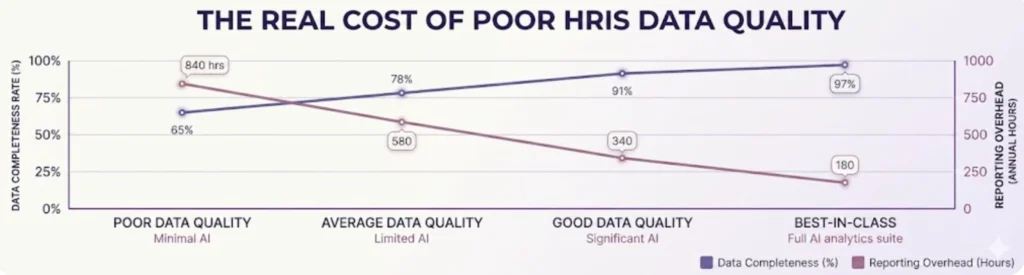
| Scenario | Data Completeness Rate | Reporting Overhead (Annual) | AI Capability Available |
|---|---|---|---|
| Poor data quality | 65% | 840 hours | Minimal |
| Average data quality | 78% | 580 hours | Limited |
| Good data quality | 91% | 340 hours | Significant |
| Best-in-class | 97% | 180 hours | Full AI analytics suite |
Reporting overhead reflects analyst time on data cleaning and validation before reporting use.
Related Terms
| Term | Definition |
|---|---|
| ATS (Applicant Tracking System) | A software platform for managing the recruitment process from application to hire |
| HCM (Human Capital Management) | A broader category of HR technology encompassing HRIS capabilities plus strategic talent management |
| People Analytics | The discipline of applying data analysis to workforce data to inform HR and business decisions |
| System of Record | The authoritative data source for a specific domain, whose data is trusted for business decisions |
| Data Governance | The framework of policies and responsibilities that ensure data quality and integrity across an organization |
Frequently Asked Questions
What is the difference between an HRIS and an HCM?
HRIS typically refers to the core administrative data management layer, employee records, payroll integration, compliance tracking. HCM (Human Capital Management) encompasses HRIS functionality plus strategic talent management capabilities including performance management, succession planning, learning management, and workforce analytics. In practice, the terms are often used interchangeably, with “HCM” typically implying broader functionality.
How do you choose between HRIS providers?
Key selection criteria: organization size fit (some platforms are built for specific scales), integration compatibility with existing payroll and ATS systems, configuration flexibility versus out-of-the-box standardization, total cost of ownership including implementation and ongoing administration, and the vendor’s development roadmap for AI and analytics capabilities.
How long does HRIS implementation take?
For organizations under 500 employees, typical implementation timelines are 3–6 months. For organizations of 1,000–5,000 employees, 6–12 months. Above 5,000 employees, 12–24 months is common, particularly if the implementation involves data migration from multiple legacy systems. The most common cause of implementation delays is data quality issues discovered during migration planning.
Can an HRIS integrate with AI hiring tools?
Yes, and this integration is increasingly the primary value driver for HRIS investment. Modern HRIS platforms expose APIs that allow AI hiring tools, workforce analytics platforms, and ATS systems to both read from and write to the HRIS data layer. The quality and consistency of this integration determines how effectively the AI tools can operate.
What is the most common HRIS implementation failure?
Data migration quality. Organizations consistently underestimate the time and cost required to clean, standardize, and validate legacy data before migration. Systems that go live with poor-quality migrated data inherit the problems of the systems they replaced, often amplified by the increased visibility that comes with a new, modern interface.
Conclusion
An HRIS is infrastructure, not software. Like any infrastructure, its value is invisible when it works well and catastrophically apparent when it doesn’t.
The organizations investing in HRIS data quality, not as an IT project but as a people analytics enabler, are building the foundation for every AI-powered workforce capability that matters in the next three years: predictive attrition, skill gap analytics, pay equity, succession planning, and hiring intelligence.
The organizations treating their HRIS as a compliance tool to store records are going to find themselves analytically outgunned in a hiring market where the information advantage belongs to those who can actually use their data.