If recruiting has a home base, LinkedIn is it.
With over a billion members and a professional identity layer that no other platform comes close to matching, it has become the default hunting ground for talent across virtually every industry and seniority level. And sitting at the centre of that ecosystem is LinkedIn Recruiter, the platform’s dedicated sourcing and outreach tool built specifically for hiring teams who need more than a basic profile search.
For teams running active sourcing strategies, LinkedIn Recruiter is often the first tool opened in the morning and the last checked before close of day. It gives recruiters advanced search filters, candidate tracking, and direct messaging capabilities that go well beyond what a standard account offers.
Building and maintaining a healthy candidate pipeline is where LinkedIn Recruiter genuinely earns its keep. The platform supports boolean search at scale, letting recruiters get highly specific about who they are looking for without trawling through irrelevant profiles manually.
Where it really separates itself from generic sourcing tools is in candidate engagement. InMail, saved searches, and project folders mean recruiters can run structured outreach campaigns rather than firing off cold messages and hoping for the best.
This guide covers what LinkedIn Recruiter actually offers, who it is built for, and how hiring teams can get the most out of it.
The core metric governing LinkedIn Recruiter effectiveness is InMail Response Rate: the proportion of InMail messages sent that generate a response from the recipient.
InMail Response Rate (%) = (InMail Responses Received / InMails Sent) x 100
Top-performing LinkedIn Recruiter users maintain InMail Response Rates above 35%. Platform average sits around 20 to 22%. The gap is almost entirely explained by personalization quality, message relevance, and the recruiter’s profile credibility, not by which platform features are used.
What is LinkedIn Recruiter?
LinkedIn Recruiter is a subscription-based talent acquisition tool built on the LinkedIn platform that enables recruiters and talent acquisition professionals to conduct advanced candidate searches, view full profiles across the entire LinkedIn member base, send InMail messages to candidates outside their network, track candidate progress across searches, and collaborate with team members on shared pipelines. It is the dominant professional sourcing platform for mid-level to senior role recruitment globally, used across in-house recruiting teams, executive search firms, and staffing agencies alike.
The key distinction between LinkedIn Recruiter and standard LinkedIn access is not visibility alone; it is scale and precision. A standard LinkedIn user can see profiles within their network and conduct basic searches. LinkedIn Recruiter provides boolean search depth, filter combinations across hundreds of criteria, saved search alerts, candidate recommendation algorithms, and the InMail credit system that enables direct outreach to any LinkedIn member regardless of network connection.
Why LinkedIn Recruiter Is a Strategic Priority for Modern Talent Teams?
The question that surfaces in every TA budget review is whether LinkedIn Recruiter remains worth its cost in a market flooded with alternative sourcing tools. The honest answer is yes, but the justification has shifted from access to execution. Five years ago, LinkedIn Recruiter’s value was primarily informational: it gave recruiters visibility into candidates they could not otherwise find. Today, with LinkedIn’s member base exceeding one billion professionals, the information advantage is table stakes. What separates LinkedIn Recruiter’s ROI from its alternatives is how it is used, not merely that it is used.
The business case for LinkedIn Recruiter as a strategic investment is grounded in sourcing economics. Research published by the Society for Human Resource Management indicates that passive candidates sourced through professional networks accept offers at rates 26% higher than active applicants from job board applications, and remain in role 31% longer at the 18-month mark. For any organization making more than 50 hires per year in professional roles, the talent quality argument for passive candidate sourcing is structurally sound, and LinkedIn Recruiter remains the most efficient platform for passive candidate identification at scale.
The misuse case is equally well-documented. Organizations that deploy LinkedIn Recruiter as a bulk message tool, sending high-volume, low-personalization InMails to large candidate pools, achieve response rates in the 8 to 12% range, well below the platform average. This approach creates the impression that LinkedIn Recruiter is an ineffective tool, when it is actually an effective tool being used with a mass-outreach strategy that is structurally incompatible with the platform’s candidate base. Senior professionals on LinkedIn have become highly calibrated at identifying templated InMails, and their response to generic outreach is predictable: silence.
The calculation that changes behavior is straightforward. If a recruiter sends 200 InMails at a 10% response rate, they receive 20 conversations. If they invest three times the message preparation effort and send 80 highly personalized InMails at a 35% response rate, they receive 28 conversations. That is 40% more conversations from 60% fewer messages, with a candidate pipeline that is self-selecting for genuine interest rather than passive curiosity. The ROI of message quality over message volume is not marginal; it is structural.
For TA leaders, the practical implication is that LinkedIn Recruiter ROI is primarily a function of recruiter capability development, not license management. Organizations that invest in InMail quality training, profile optimization, search strategy development, and data-driven recruiting analytics see LinkedIn Recruiter response rates two to three times higher than those that treat the license as self-evident value.
Your Resume Isn’t Getting Read
Let’s Get That Fixed!
75% of resumes get auto-rejected. avua’s AI Resume Builder optimizes formatting, keywords, and scoring in under 3 minutes, so you land in the “yes” pile.
The Psychology Behind LinkedIn Recruiter Outreach
Social Proof and Platform Trust Signals
LinkedIn’s professional context creates a trust foundation that cold email and phone outreach do not have. A recruiter InMail arrives in a professional space where the recipient’s identity and credibility are public, which elevates the perceived legitimacy of the approach. Candidates who would not respond to an identical message via email frequently do respond via LinkedIn InMail because the platform context signals professionalism on both sides. This trust signal is a platform-level asset that individual recruiter behavior can enhance or undermine. Recruiter profiles with complete information, client endorsements, and a history of thoughtful engagement consistently generate higher response rates than thin or neglected profiles.
Selective Attention and the Crowded InMail Problem
Senior professionals on LinkedIn receive an average of 12 to 18 recruiter InMails per month according to LinkedIn’s own platform research. In this crowded environment, selective attention filters determine whether a message is read or archived within the first five seconds. The subject line and the first sentence are the entirety of the opportunity. Messages that open with evidence of genuine research about the recipient’s specific background consistently outperform those that open with a role description. Behavioral economics research on attention in high-volume message environments shows that specificity is the primary signal that a message is worth reading; genericity signals noise.
Reciprocity and the Research-First Approach
The most effective LinkedIn Recruiter users build micro-reciprocity before sending outreach by engaging with a candidate’s content through reactions, comments, and shares before sending an InMail. This pre-engagement creates a context of familiarity that shifts the InMail from cold outreach to warm follow-up. The candidate has already registered the recruiter’s name from the engagement notification before the message arrives, reducing the unknown sender friction that is the primary obstacle to response. This approach is more time-intensive than bulk messaging but produces response rate improvements of 15 to 25 percentage points for the candidates where it is applied consistently.
LinkedIn Recruiter vs. Related Sourcing Tools
| Tool | Primary Function | Candidate Visibility | Outreach Mechanism | Cost Model |
|---|---|---|---|---|
| LinkedIn Recruiter | Passive candidate sourcing and pipeline management | 1B+ professional profiles | InMail (direct message) | Annual license per seat |
| Boolean Search (Free LinkedIn) | Profile search within network | Network-limited | Connection request / limited InMail | Free (with limits) |
| General Job Board | Inbound application generation | Active candidates only | Job posting / ATS | Per posting or subscription |
| Email Sourcing Tools | Contact data enrichment and outreach | Database-dependent | Direct email | Per contact or subscription |
| Executive Search Firm | Senior passive candidate approach | Relationship-based | Personal call / referral | Retained fee |
The critical distinction between LinkedIn Recruiter and a general job board is the sourcing direction. A job board generates inbound applications from active candidates. LinkedIn Recruiter enables outbound outreach to passive candidates who are not applying anywhere. For roles above a defined seniority threshold, where active applicant pools are thin and the best candidates are not looking, the outbound sourcing motion is not optional; it is the primary channel.
What the Experts Say?
LinkedIn Recruiter is not a shortcut. It is a megaphone. If you have something genuinely worth saying to a specific person, it amplifies your reach enormously. If you have nothing specific to say, it broadcasts that too, to a very large audience that will collectively and politely ignore you.
– Glen Cathey, Boolean Search Expert and Talent Acquisition Strategist
How to Measure LinkedIn Recruiter Effectiveness?
Formula
InMail Response Rate (%) = (InMail Responses Received / InMails Sent) x 100
Pipeline-to-Interview Conversion Rate (%) = (Candidates Advancing to Interview / Candidates Added to LinkedIn Recruiter Pipeline) x 100
Cost per LinkedIn-Sourced Hire = Total LinkedIn Recruiter License Cost / Hires Directly Attributed to LinkedIn Sourcing
Benchmarks by Usage Approach
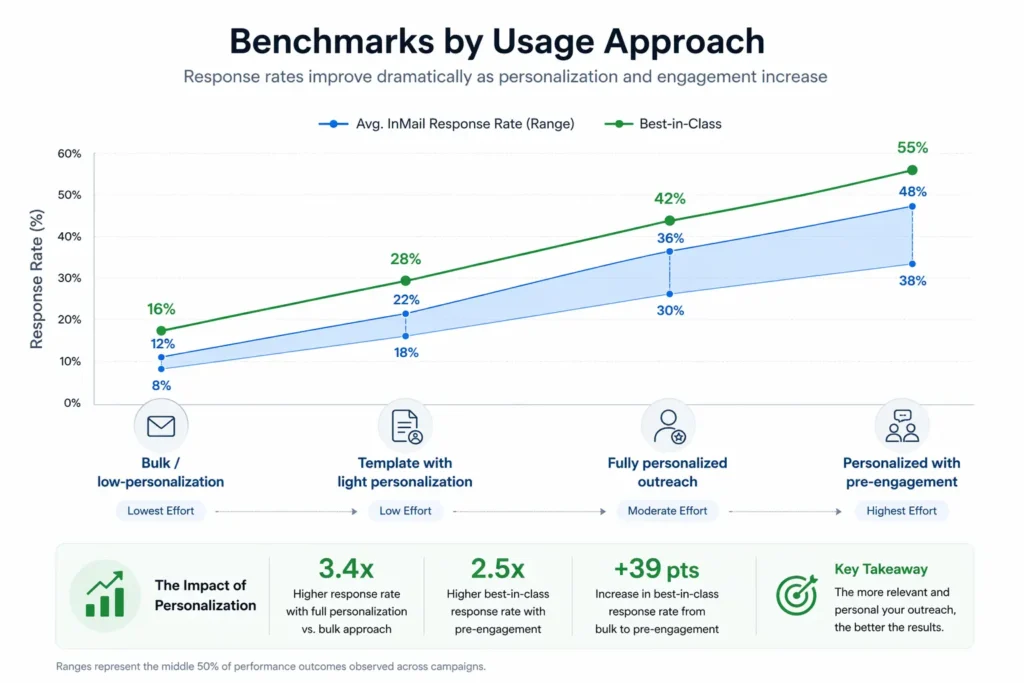
| Usage Approach | Avg. InMail Response Rate | Best-in-Class |
|---|---|---|
| Bulk / low-personalization | 8-12% | 16% |
| Template with light personalization | 18-22% | 28% |
| Fully personalized outreach | 30-36% | 42% |
| Personalized with pre-engagement | 38-48% | 55% |
Key Strategies for Effective LinkedIn Recruiter Use
How Can AI and Automation Support LinkedIn Recruiter Use?
AI-Powered Candidate Recommendations
LinkedIn Recruiter’s AI recommendation engine surfaces candidates who match the search criteria but whose profiles the recruiter may not have found through manual search, based on signal matching across skills, experience patterns, and engagement behavior. Organizations that use AI recommendations alongside manual search consistently identify a meaningful proportion of eventual hires from the recommendation layer, particularly for roles where manual search filters are difficult to define precisely.
Predictive InMail Timing
LinkedIn’s AI tools can predict the optimal time to send an InMail for a specific candidate based on their platform engagement patterns, increasing the probability that the message is read during active browsing rather than arriving in a backlog. This timing optimization alone can improve response rates by 15 to 20% for equivalent message quality, without requiring any change to the message content itself.
Automated Pipeline Nurture Communications
AI-powered CRM tools integrated with LinkedIn Recruiter can manage candidate nurturing communications for candidates in the recruiter’s pipeline who are not currently active on a specific search, maintaining engagement with long-term prospects without requiring manual recruiter touchpoints for every interaction. This automated layer is particularly valuable for talent pool management between active search cycles.
Smart Filters and Relevance Scoring
LinkedIn Recruiter’s AI-assisted search filtering provides relevance scores for candidate profiles against a defined search brief, allowing recruiters to prioritize outreach based on profile strength rather than processing every result manually. This filtering layer reduces the time cost of longlist construction by an estimated 35 to 45% for searches with large result sets and complex criteria combinations.
Stop Juggling
10 Job Boards.
Search One
Your next role is already here. avua pulls opportunities from across the web into a single searchable feed; filtered by role, location, salary, and remote preference.
1.5 Million+
Active Jobs
380+
Job Categories
LinkedIn Recruiter Through an Equity and Inclusion Lens
Keyword Bias in Search Construction
LinkedIn Recruiter’s search capabilities are powerful, but the bias of the person constructing the search is directly encoded in the search itself. Searches that specify educational institutions, company names, or job titles that are not genuinely required for role performance systematically exclude candidates from underrepresented groups who have equivalent skills acquired through non-traditional pathways. Inclusive hiring professionals who audit their LinkedIn Recruiter search filters for proxy discrimination, replacing institution-based filters with skill-based ones, consistently produce more demographically diverse longlists from the same platform and the same effort.
InMail Language and Differential Response Rates
Research on response disparities across demographic groups on LinkedIn consistently finds that certain language patterns in InMail messaging correlate with differential response rates across gender and racial lines, even when message quality and opportunity relevance are equivalent. Message language that emphasizes competitiveness, dominance, or prestige framing tends to produce lower response rates from candidates from underrepresented groups relative to language that emphasizes collaboration, growth, and impact. Recruiter teams that test message variants across demographic segments and optimize for equitable response rates produce more diverse candidate pipelines from equivalent search results.
Platform Representation Gaps and Sourcing Limitations
LinkedIn’s member base, while large, is not demographically representative of the overall talent market. Professionals from certain industries, career stages, and demographic backgrounds are significantly underrepresented on the platform relative to their share of the qualified talent pool. LinkedIn Recruiter as a primary sourcing tool will systematically under-represent these groups in candidate pipelines. Organizations pursuing diversity sourcing strategies must supplement LinkedIn Recruiter with off-platform sourcing channels to reach the talent that the platform’s demographic composition does not fully reflect.
Common Challenges and Solutions
| Challenge | Solution |
|---|---|
| Low InMail response rates despite high volume | Shift from volume-based to quality-based outreach; invest in message personalization training and pre-engagement strategy before InMail send |
| Difficulty identifying candidates in highly specialized or niche roles | Combine LinkedIn Recruiter boolean search with alternative sourcing channels, professional association databases, and conference speaker or publication lists |
| Candidate pipeline deteriorating during extended search processes | Implement a structured candidate nurture protocol for all active pipeline candidates using Recruiter’s messaging features and external CRM integration |
Real-World Case Studies
Case Study 1: The Technology Scale-Up
A 300-person technology scale-up was using LinkedIn Recruiter for engineering sourcing with an average InMail response rate of 11%. An audit of the team’s outreach messages found that 80% followed an identical template describing the company’s product and the role requirements, with no candidate-specific personalization. The team rebuilt its InMail approach using a research-first framework requiring three candidate-specific observations before any role description. Response rate improved from 11% to 31% within one quarter. Time-to-shortlist for engineering roles fell from 28 days to 17 days without any change to the search criteria or platform usage pattern.
Case Study 2: The Healthcare Recruitment Firm
A specialist healthcare recruitment firm using LinkedIn Recruiter for clinical leadership roles found that its most experienced consultants consistently outperformed less experienced ones on response rate, despite using similar message templates. Analysis revealed that experienced consultants had significantly higher profile view volumes and more frequent content engagement on the platform, generating pre-message familiarity with candidates before the InMail arrived. The firm introduced a 90-day LinkedIn profile development program for junior consultants, including structured content engagement and connection-building protocols. Junior consultant InMail response rates improved from 14% to 26% over the program period.
Case Study 3: The Financial Services Organization
A financial services firm found that its LinkedIn Recruiter usage was generating a candidate pool that was 78% male for senior finance roles, despite the available talent market being approximately 62% male at the relevant experience level. Audit of the team’s search filters revealed that two filters, an MBA requirement and a specific bulge-bracket bank history requirement, were excluding a significant proportion of the qualified female candidate population with equivalent skills from non-MBA and non-bulge-bracket pathways. Removing these proxy filters and replacing them with skill and outcome-based criteria produced a shortlist for the next three searches that was 48% female, from the same platform and the same sourcing effort.
Performance Indicators That Define LinkedIn Recruiter Success
LinkedIn Recruiter Across the Talent Lifecycle
Pre-Search: Profile and Search Strategy Preparation
The highest-leverage LinkedIn Recruiter work happens before the first search is run. Defining the role’s genuine must-have criteria, translating those criteria into LinkedIn search filter equivalents, and auditing search results for representative relevance before outreach begins produces more targeted pipelines and higher response rates than jumping directly to bulk InMail outreach based on an unvalidated search definition.
Active Sourcing: Personalized Outreach and Pipeline Building
The sourcing phase is where message quality determines outcomes. Every InMail sent to a passive candidate is a first impression, and passive candidates who receive a low-quality approach are effectively removed from the organization’s talent pool for 12 to 18 months. Investment in message quality is simultaneously a sourcing tactic and an employer branding decision that affects the entire longlist population.
Candidate Management: Pipeline Tracking and Engagement
LinkedIn Recruiter’s pipeline management features allow recruiters to track candidate status, note interaction history, and share pipeline visibility with hiring managers. Organizations that use these features systematically rather than as an afterthought produce more consistent candidate experiences and lose fewer interested candidates to poor process communication between sourcing and interview stages.
Post-Search: Performance Data and Continuous Optimization
The most underutilized LinkedIn Recruiter feature is its analytics suite. Response rate data by search, message, and recruiter provides the raw material for continuous optimization of sourcing strategy. Organizations that review this data quarterly and adjust their approach based on what it shows see compound improvement in sourcing efficiency over time, building a compounding sourcing advantage over teams that treat each search as starting from scratch.
The Real Cost of Ineffective LinkedIn Recruiter Use
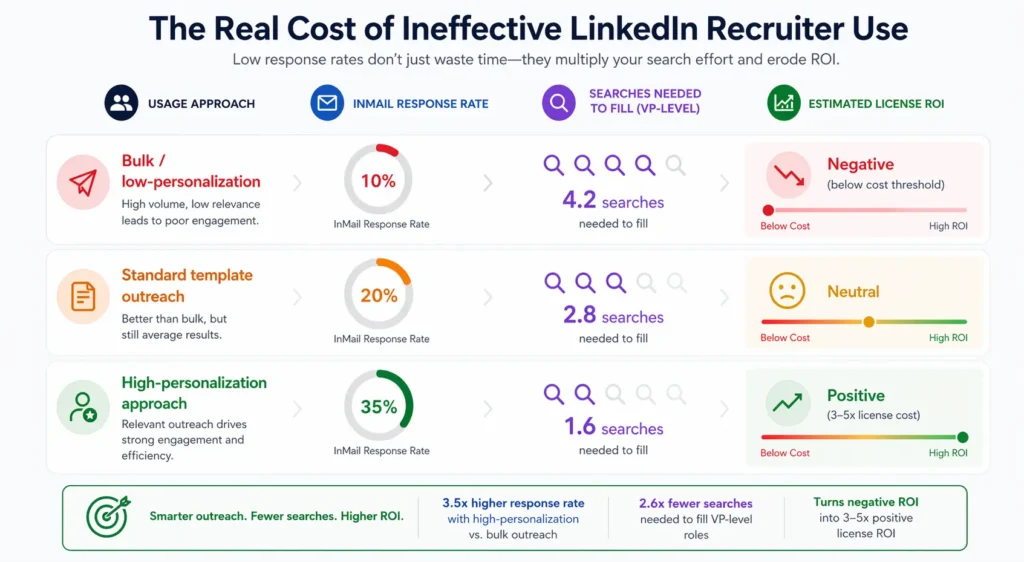
| Usage Approach | InMail Response Rate | Searches Needed to Fill (VP-Level) | Estimated License ROI |
|---|---|---|---|
| Bulk / low-personalization | 10% | 4.2 searches | Negative (below cost threshold) |
| Standard template outreach | 20% | 2.8 searches | Neutral |
| High-personalization approach | 35% | 1.6 searches | Positive (3-5x license cost) |
Assumes average VP-level hire salary of $180,000, retained fee equivalent of 28%, and sourcing attribution to LinkedIn for 60% of roles. ROI calculation excludes productivity and onboarding costs.
Related Terms
| Term | Definition |
|---|---|
| InMail | LinkedIn’s direct messaging system that allows users to contact other LinkedIn members outside their immediate network |
| Boolean Search | A structured search technique using logical operators to refine candidate identification across professional databases and platforms |
| Passive Candidate | A professional who is not actively seeking employment but may be open to the right opportunity |
| Talent Pipeline | The pool of potential candidates at various stages of engagement for current or anticipated roles |
| Sourcing | The proactive identification and initial outreach to potential candidates before the formal application and screening process begins |
Frequently Asked Questions
What is LinkedIn Recruiter and how does it differ from a regular LinkedIn account?
LinkedIn Recruiter is a premium talent sourcing platform with advanced search filters, expanded candidate visibility across all LinkedIn members, InMail messaging to anyone on the platform, and candidate pipeline management tools. A regular LinkedIn account provides basic search within your network and limited outreach. LinkedIn Recruiter is designed specifically for professional talent acquisition workflows at scale.
How much does LinkedIn Recruiter cost?
LinkedIn Recruiter pricing varies by tier and market. LinkedIn Recruiter Lite is available for smaller teams, while LinkedIn Recruiter full tier is designed for enterprise talent acquisition teams at a significantly higher price point. Current pricing is available directly from LinkedIn and is often negotiated at volume. Budget holders should request a sourcing ROI projection before committing to a license tier.
What is a good InMail response rate on LinkedIn Recruiter?
The platform average InMail response rate is approximately 20 to 22%. High-performing recruiters using personalized, research-based outreach consistently achieve 35% or above. Response rates below 15% typically indicate a message quality or targeting issue rather than a platform limitation.
Can LinkedIn Recruiter be used for all types of roles?
LinkedIn Recruiter is most effective for professional, technical, and management roles where qualified candidates maintain active LinkedIn profiles. For hourly, trade, and early-career roles, LinkedIn’s professional network provides limited candidate coverage, and alternative sourcing channels typically produce better application volume and quality.
How many InMails does LinkedIn Recruiter include?
InMail credit allocations vary by license tier and seat count. LinkedIn Recruiter provides a monthly allocation of InMail credits that can be pooled across team members in a team license. Exact allocations should be confirmed with LinkedIn directly, as they vary by agreement and are subject to change.
Conclusion
LinkedIn Recruiter is not a hiring solution; it is the world’s largest professional network made accessible for outbound talent sourcing. Its value is entirely a function of the quality of the recruitment practice built on top of it.
Organizations that treat it as a messaging volume tool will get volume and low response rates. Those that treat it as a relationship intelligence platform, invest in message quality, build recruiter profiles worth responding to, and use the data it produces to continuously refine their approach, will find it remains the most productive sourcing investment in their talent acquisition toolkit.
The platform is not the differentiator. The discipline is.