Not every career move goes upward, and that is not a bad thing.
A lateral move is a career transition where an employee shifts into a different role at roughly the same level of seniority, swapping one set of responsibilities for another without a change in title hierarchy or a significant jump in pay. It sounds modest on paper, but the impact on both the individual and the organisation can be anything but.
For hiring managers and HR teams, lateral moves are a powerful tool within any hiring plan. They support employee retention by giving people room to grow sideways when upward paths are limited, and they strengthen employee engagement by keeping talent challenged, invested, and less likely to look elsewhere.
This guide covers what lateral moves look like in practice, when to encourage them, and how to build them into a broader talent strategy.
The core metric governing lateral move program effectiveness is the Internal Lateral Fill Rate: the proportion of open roles filled by internal lateral candidates rather than external hires.
Internal Lateral Fill Rate (%) = (Roles Filled by Internal Lateral Transfer / Total Roles Filled) x 100
High-performing organizations achieve Internal Lateral Fill Rates of 25 to 35%. Industry average sits around 11 to 14%. The gap reflects not candidate availability but program infrastructure. The organizations with strong lateral move cultures have built the visibility, incentive, and manager enablement that the others have not.
What is a Lateral Move?
A lateral move is a professional transition in which an individual moves from one role to another at an equivalent level of seniority, responsibility, or compensation, either within the same organization or to a new employer, primarily for the purpose of skill acquisition, functional exposure, or strategic repositioning rather than vertical advancement.
The lateral move is frequently mischaracterized as a sign of stalled career progress. In reality, for professionals building toward senior generalist roles, cross-functional leadership positions, or functions that require multi-domain expertise, a planned lateral move is often the fastest path to the capability that vertical progression within a single function cannot provide. What distinguishes a strategic lateral move from a sideways drift is intentionality: the lateral mover has a clear view of what the new role will build and how that capability connects to a longer-term career objective.
Why Lateral Moves Are a Strategic Priority in Modern Talent Acquisition?
The question that most TA leaders and CHROs are quietly grappling with is not whether lateral moves matter. It is why their organizations keep losing mid-career talent to competitors who offer the lateral opportunities they cannot. The answer, in most cases, is structural. Organizations that treat lateral moves as exceptions rather than pathways have inadvertently built a talent retention problem into their career architecture.
Before AI-driven workforce analytics, the business case for lateral move programs was largely anecdotal. Managers who had made lateral moves themselves tended to champion them; those who had not defaulted to vertical promotion as the only meaningful recognition of performance. The result was a talent system that rewarded depth over breadth and lost the professionals whose career goals required both.
Today, the data is unambiguous. LinkedIn’s 2025 Workforce Learning Report found that employees who make at least one internal lateral move within their first two years have a 62% higher retention rate at the three-year mark than those who only move vertically or remain in place. The interpretation is direct: lateral movement signals organizational investment in an employee’s development, and that signal is one of the strongest predictors of long-term engagement.
The ROI math is equally clear. The average cost of replacing a mid-level professional is approximately 1.2 to 1.5 times their annual salary, accounting for recruitment, onboarding, and productivity ramp. For an organization with 500 employees and an average salary of $75,000, reducing annual mid-level attrition by even 8 percentage points through a structured lateral move program saves approximately $3.6 million per year, against a program build cost that rarely exceeds $200,000 in the first year. Few talent investments return at that ratio.
The concrete failure scenario is equally instructive. A 1,200-person professional services firm notices that its voluntary attrition among 3-to-6 year tenure employees is running at 22% annually, well above the industry benchmark of 14%. Exit interview analysis shows that 41% of departing employees cite limited growth opportunities as a primary reason, yet 68% of those employees are categorized as high performers in the same period. The firm’s internal mobility data reveals that it has made fewer than 12 lateral transfers in the last 12 months across the entire organization. The connection is direct: the growth the employees were seeking was available inside the organization, but the infrastructure to access it was not.
For TA leaders, the practical imperative is straightforward. A lateral move program is not a retention initiative bolted onto an existing structure. It is a fundamental redesign of how career progression is defined, communicated, and rewarded. Organizations that make this redesign earn the compounding benefit of lower attrition, higher internal fill rates, and a workforce with the functional breadth that external hiring alone cannot build at scale.
Your Resume Isn’t Getting Read
Let’s Get That Fixed!
75% of resumes get auto-rejected. avua’s AI Resume Builder optimizes formatting, keywords, and scoring in under 3 minutes, so you land in the “yes” pile.
The Psychology Behind Lateral Moves
Identity Threat and the Status Quo Bias
The most common reason professionals resist lateral moves, even when they would benefit strategically, is that any move perceived as sideways activates identity threat. Professional identity is strongly tied to upward trajectory, particularly in cultures that equate salary and title advancement with self-worth. A lateral move can feel like a signal of inadequacy, even when it is objectively a strategic skill-building choice. Organizations that frame lateral moves in their career pathing language as capability investments rather than sideways steps see meaningfully higher lateral move acceptance rates from high-performing employees.
Manager Resistance and Talent Hoarding
Even when employees are genuinely interested in lateral moves, manager resistance is the most common structural barrier. Managers who have invested in developing a team member have a rational short-term incentive to retain them, even when lateral movement would serve the employee’s longer-term interests and the organization’s talent health. This talent hoarding behavior is not malicious. It is a predictable response to performance management systems that reward managers for team output but not for talent development. Organizations that include internal mobility rates in manager performance metrics see a significant reduction in talent hoarding within two to three performance cycles.
Risk Aversion in Career Decision-Making
Behavioral economics research on career decisions consistently shows that professionals overweight the risk of a lateral move, particularly the risk of leaving established competence for a new domain where they will be temporarily less effective, relative to the long-term benefit. The competence dip that accompanies any skill transition feels disproportionately large when experienced in real time. TA leaders and internal mobility programs that provide explicit data on lateral move outcomes, including average time to competence recovery and career trajectory of prior lateral movers in the organization, reduce this risk aversion by converting abstract fear into concrete probability.
Lateral Move vs. Related Career Transitions
| Transition Type | Direction | Primary Driver | Compensation Impact | Timeline to Benefit |
|---|---|---|---|---|
| Lateral Move | Horizontal | Skill acquisition / functional breadth | Neutral to modest increase | Medium (6-18 months) |
| Promotion | Vertical | Performance recognition | Positive (title and pay increase) | Short (immediate) |
| Demotion | Downward | Performance correction or voluntary simplification | Negative | Immediate |
| Stretch Assignment | In-role | Temporary scope expansion | Neutral | Short-term project |
| Boomerang Return | Variable | Re-engagement post-departure | Negotiated | Immediate |
| Internal Transfer | Variable | Location or team change without level change | Neutral | Immediate |
The critical distinction between a lateral move and a stretch assignment is permanence. A stretch assignment keeps the employee in their current role and adds temporary scope. A lateral move is a full role transition with a new reporting line, new team, and new core responsibilities. Organizations that substitute stretch assignments for genuine lateral moves are addressing the symptom of career stagnation without restructuring the career architecture that caused it.
What the Experts Say?
The organizations winning the talent war are not the ones with the best external recruiting. They are the ones with the best internal mobility. Lateral moves are the infrastructure of that mobility. You cannot grow the workforce you need from the outside if you are simultaneously losing the talent you already developed.
– Tomas Chamorro-Premuzic, Chief Innovation Officer, ManpowerGroup
How to Measure Lateral Move Program Effectiveness?
Formula
Internal Lateral Fill Rate (%) = (Roles Filled by Internal Lateral Transfer / Total Roles Filled) x 100
Lateral Move Retention Uplift (%) = Retention Rate of Lateral Movers minus Retention Rate of Non-Movers at Same Tenure
Time to Lateral Competence (days) = Date Employee Meets Full Role Expectations minus Date of Role Start
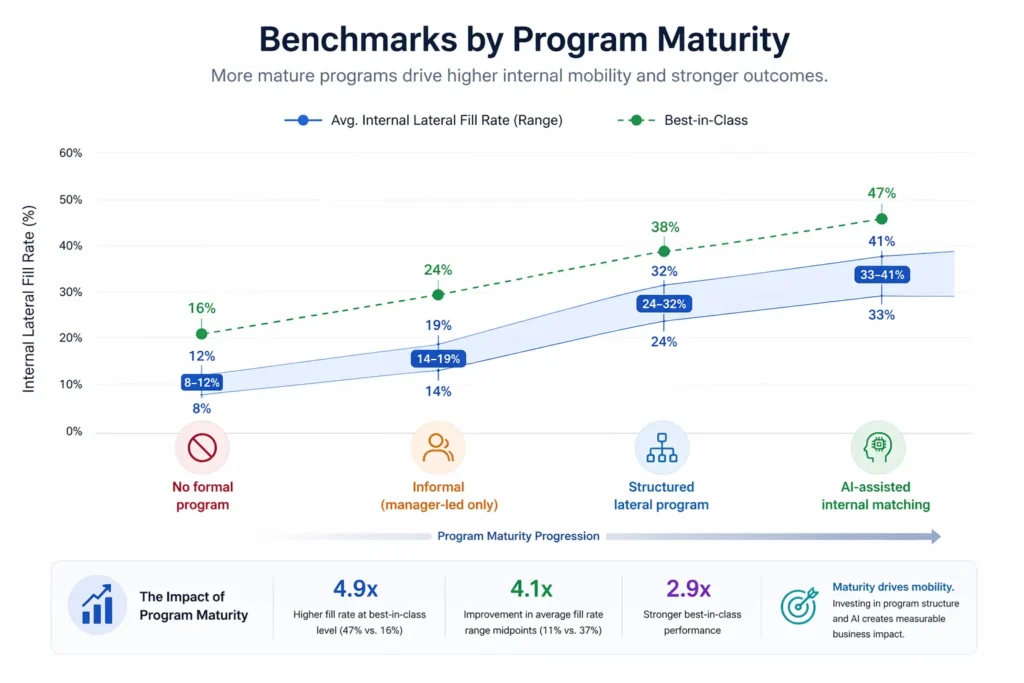
Benchmarks by Program Maturity
| Program Maturity | Avg. Internal Lateral Fill Rate | Best-in-Class |
|---|---|---|
| No formal program | 8-12% | 16% |
| Informal (manager-led only) | 14-19% | 24% |
| Structured lateral program | 24-32% | 38% |
| AI-assisted internal matching | 33-41% | 47% |
Key Strategies for Effective Lateral Move Programs
How Can AI and Automation Support Lateral Move Programs?
Skills-Based Lateral Opportunity Matching
AI-powered talent intelligence platforms can analyze employee skill profiles, career histories, and development goals against open role requirements across the organization, surfacing lateral matches that neither the employee nor the hiring manager would have identified independently. This matching capability is the primary driver of the Internal Lateral Fill Rate improvement seen in organizations with AI-assisted mobility programs.
Career Path Visualization Tools
AI-driven career pathing tools can model the likely 3-to-5-year career trajectory of employees who make specific lateral moves, providing data-driven projections that help employees evaluate lateral opportunities against the risk aversion biases that typically discourage them. These tools convert abstract career advice into probability-weighted outcomes.
Automated Lateral Opportunity Surfacing
AI-powered HR platforms can proactively surface relevant internal lateral opportunities to employees based on their skill signals, tenure patterns, and career goal declarations, removing the requirement for employees to actively search for lateral roles they may not know exist. This automated discovery layer is the single most effective intervention for increasing lateral move rates in large organizations.
Transition Timeline Modeling
Machine learning models trained on previous lateral move data can predict average time-to-competence for specific lateral transitions, helping both the receiving hiring manager and the departing manager plan handover and onboarding timelines more accurately than intuition-based estimates.
Stop Juggling
10 Job Boards.
Search One
Your next role is already here. avua pulls opportunities from across the web into a single searchable feed; filtered by role, location, salary, and remote preference.
1.5 Million+
Active Jobs
380+
Job Categories
Lateral Moves Through an Equity and Inclusion Lens
Access Asymmetry in Lateral Opportunity Visibility
Lateral move opportunities in most organizations are surfaced through informal networks, including conversations at team offsites, manager referrals, and corridor discussions. This informal channel structure systematically advantages employees who are well-networked within the organization, which tends to correlate with demographic majority groups. Employees from underrepresented groups, remote employees, and those working in less visible functions have significantly lower awareness of lateral opportunities relevant to them. Structured lateral opportunity communication, including broadcast internal postings, AI-matched suggestions, and talent marketplace tools, is the primary mechanism for correcting this access asymmetry.
Sponsorship Gaps in Lateral Move Navigation
Research on diversity hiring outcomes consistently shows that employees from underrepresented groups who make lateral moves within organizations are less likely to have had a senior sponsor who supported the transition, and more likely to navigate the process without formal organizational backing. Lateral move programs that include explicit sponsorship components, where senior leaders are accountable for actively facilitating lateral moves for high-potential employees from underrepresented groups, produce measurably more equitable lateral move participation rates.
Performance Evaluation and Post-Lateral Assessment Bias
The competence dip that accompanies lateral moves interacts badly with performance management systems that evaluate employees against role-level expectations without accounting for transition timelines. Employees in their first 6 to 9 months in a lateral role are frequently rated against standards calibrated to experienced role-holders, producing artificially low performance ratings that disproportionately affect lateral movers from underrepresented groups who are already subject to higher scrutiny. Explicit competence timeline policies, defining that lateral movers are evaluated against transition benchmarks rather than full-role expectations for the first two performance cycles, correct this structural bias.
Common Challenges and Solutions
| Challenge | Solution |
|---|---|
| Managers blocking internal lateral applications | Implement an open internal application model with manager notification rather than approval; build internal mobility rates into manager performance metrics |
| Employees unaware of lateral opportunities across the organization | Deploy AI-powered internal opportunity matching and structured internal posting protocols that reach all employees regardless of network position |
| Lateral movers performing poorly in the transition period | Implement a structured lateral onboarding protocol with explicit transition timelines and mentorship; define transition-stage evaluation criteria separately from full-role criteria |
Real-World Case Studies
Case Study 1: The Technology Company
A 2,000-person technology company identified that its mid-career attrition rate was running at 24% annually, concentrated in its 3-to-5-year tenure band. Analysis of exit interviews revealed that 53% of departing employees cited limited internal growth opportunity as a primary driver. The company implemented a formal internal lateral move program with open application, AI-powered role matching, and a two-cycle performance transition policy. Within 18 months, its internal lateral fill rate improved from 7% to 28%, its 3-to-5-year attrition dropped from 24% to 15%, and its cost per hire across the affected roles fell by an estimated 34% due to reduced external sourcing volume.
Case Study 2: The Professional Services Firm
A global professional services firm found that its senior individual contributor track had become a career endpoint for high performers who did not want people management roles. With no lateral pathway to cross-functional leadership, those employees were leaving for broader roles elsewhere. The firm built an expertise exchange lateral move framework allowing senior professionals to rotate into adjacent practices for 12-month tours. Retention among senior individual contributors improved by 18 percentage points in the first two years, and the firm credited the program with building the cross-practice client service capability that a previous external hiring initiative had failed to deliver.
Case Study 3: The Financial Services Organization
A mid-size financial services organization redesigned its talent marketplace to be fully mobile-accessible, having discovered that 64% of employees were browsing internal job postings on mobile devices but dropping out of the application process when it required desktop document uploads. The mobile-optimized lateral application process, combined with a 90-second profile-based expression of interest feature, increased internal lateral application volume by 87% within one quarter. The conversion rate from application to lateral placement also improved because more applications came from genuinely qualified internal candidates rather than being abandoned mid-process.
Performance Indicators That Define Lateral Move Program Success
Lateral Moves Across the Talent Lifecycle
Pre-Move: Career Conversation and Opportunity Identification
The most effective lateral move programs generate lateral moves before employees have started looking externally. Regular career conversations at quarterly or semi-annual cadence that explicitly include lateral options as part of the growth discussion convert lateral moves from reactive retention responses into proactive development strategies. Managers trained in structured career coaching are measurably better at identifying and facilitating lateral move conversations than those with traditional performance management training only.
Active Transition: Structured Onboarding and Competence Building
The lateral move onboarding experience should be explicitly differentiated from external new hire onboarding. Lateral movers bring organizational context, cultural fluency, and institutional knowledge that external hires do not have, but they are building domain competence from a lower starting point than an experienced external hire in the same role. Onboarding protocols calibrated to this specific profile produce faster competence ramp than generic new hire programs applied uniformly.
Post-Move: Performance Evaluation and Integration
The first performance review after a lateral move is the highest-risk moment in the program. Evaluation systems that do not account for transition timelines produce artificial underperformance ratings that discourage future lateral candidates and damage the program’s internal credibility. Building explicit transition-stage evaluation criteria that are distinct from established performer criteria protects the program and the mover’s confidence during the competence-building phase.
Long-Term: Career Trajectory and Program Advocacy
Employees who make successful lateral moves become the program’s most effective advocates. Structured alumni networks, internal case study development, and formal involvement of lateral move alumni in talent community conversations convert program participants into a self-sustaining advocacy channel that reduces the program’s ongoing communication cost significantly over time.
The Real Cost of a Lateral Move Deficit
| Scenario | Internal Lateral Fill Rate | Avg. Annual Mid-Career Attrition | Est. Annual Talent Cost (500 employees) |
|---|---|---|---|
| No lateral move program | 7-10% | 21-24% | $4.7M+ |
| Informal lateral approach | 13-18% | 16-19% | $3.1M |
| Structured lateral program | 26-33% | 11-14% | $1.8M |
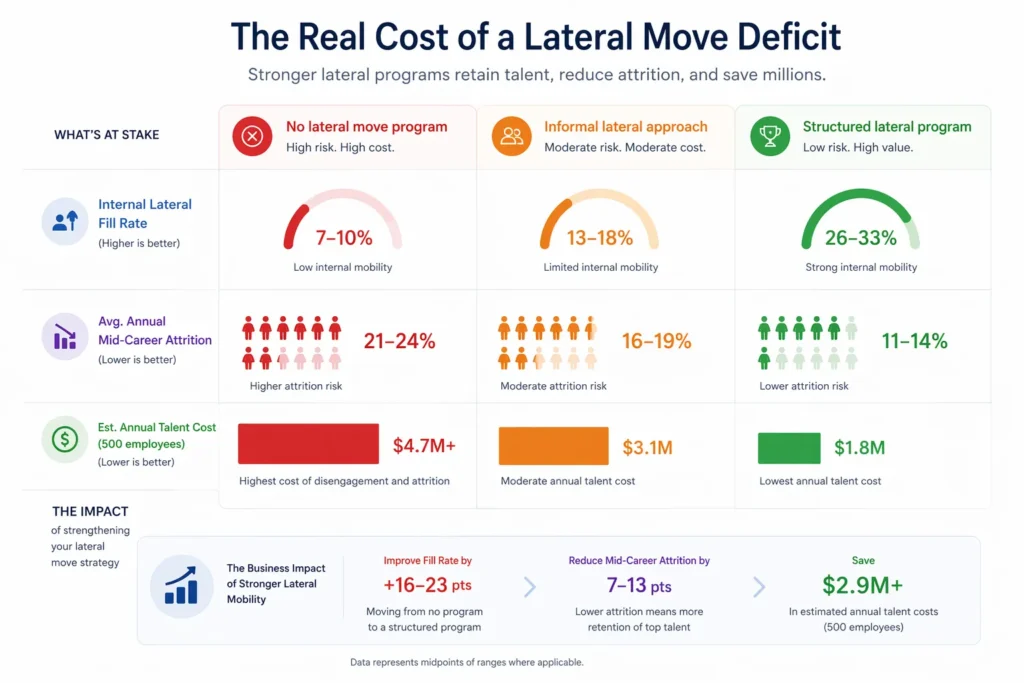
Talent cost assumes average replacement cost of 1.3x annual salary for mid-level roles. Costs include recruitment, onboarding, and productivity ramp for replacement hires.
Related Terms
| Term | Definition |
|---|---|
| Internal Mobility | The movement of employees between roles within the same organization, including lateral, vertical, and cross-functional transitions |
| Career Pathing | The process of mapping the role progression options available to an employee within an organization |
| Talent Marketplace | An internal platform that matches employees to open roles, projects, and development opportunities across an organization |
| Boomerang Employee | A former employee who returns to a previous employer after a period away |
| Skill Gap Analysis | The process of identifying the difference between an organization’s current workforce skill profile and the skills required to achieve future business objectives |
Frequently Asked Questions
Is a lateral move a good career strategy?
It depends on the goal. For professionals who need functional breadth, cross-domain expertise, or a pivot toward a higher-demand skill area, a lateral move is often the fastest path to the capability that staying in one role cannot develop. The risk is a short-term competence dip and modest compensation stagnation. The return, for the right move, significantly outweighs both in the medium term.
How do you ask for a lateral move internally?
Frame the request around organizational value, not personal preference. Identify the specific skills the lateral role would build, how those skills address a gap in the team or function you would be moving to, and what the transition would require in support from the organization. Connecting the lateral move to a business need makes it a development investment rather than a personal accommodation, which is a far easier conversation to have with a manager
Does a lateral move reset your career trajectory?
In most organizations, temporarily. Lateral movers typically experience slower compensation growth in the 12 to 18 months following the move as they build competence in the new domain. Beyond that window, research consistently shows that professionals who have made at least one strategic lateral move have higher earnings and broader leadership opportunity than equivalent peers who did not.
How common are lateral moves in high-performing organizations?
Organizations consistently ranked as top employers for development have internal lateral fill rates of 28 to 38%, compared to the industry average of 11 to 14%. The gap is entirely explained by program infrastructure and cultural framing, not by the availability of internal lateral candidates.
What is the difference between a lateral move and a transfer?
A transfer refers to a change in location, department, or team, which may or may not involve a change in role level or function. A lateral move specifically refers to a role change at the same seniority level. All lateral moves may involve a transfer element, but not all transfers are lateral moves. The distinction matters for how the transition is designed, supported, and evaluated.
Conclusion
The lateral move is not a consolation prize for professionals who were not promoted.
It is a deliberate capability-building strategy, and for the organizations that build the infrastructure to support it, it is one of the highest-return talent investments available.
The companies that will build the adaptable, cross-functional workforces required by a fast-changing skills landscape are not the ones with the largest external recruitment budgets. They are the ones that have made internal lateral movement as visible, accessible, and rewarded as vertical promotion.
Build the program, measure it, close the feedback loop, and the talent retention and capability benefits will follow reliably.