Every hiring funnel has a volume problem.
Applications come in faster than anyone can meaningfully evaluate them, and without a structured early filter, recruiters end up spending time on candidates who were never going to make it past the first conversation. Pre-screening is how organisations protect that time without sacrificing the quality of who makes it through.
Pre-screening is the process of evaluating candidates against a defined set of minimum criteria before they enter the formal interview stage. It sits between application submission and the first live interaction, acting as the first human or automated filter in the candidate journey. Done well, it narrows a large applicant pool down to the candidates most worth investing recruiter time in.
The tools vary. Some teams rely on automated screening to handle initial filtering at scale. Others use structured questionnaires, asynchronous video responses, or brief phone calls to get a early read on fit before committing to a fuller competency-based interview process.
Either way, pre-screening is not just an efficiency play. It is a direct input into candidate experience, because how quickly and respectfully candidates are moved through or out of the funnel shapes how they feel about your organisation long after the process ends.
The core metric governing pre-screening effectiveness is the Pre-Screen Pass Rate: the proportion of applicants who successfully pass the pre-screening stage and advance to recruiter review or phone screen.
Pre-Screen Pass Rate (%) = (Candidates Advancing Past Pre-Screen / Total Applicants) x 100
A Pre-Screen Pass Rate above 60-70% typically indicates screening criteria that are too loose, meaning the pre-screen is not doing meaningful filtering work. A rate below 5-10% may indicate job descriptions attracting fundamentally mismatched applicant pools, or screening criteria that are overly restrictive relative to actual role requirements. The target range for most professional roles is 15-35%, representing meaningful volume reduction with a well-qualified retained pool.
What is Pre-Screening?
Pre-screening is the structured evaluation of job applicants against a defined set of minimum qualifications and essential role requirements, conducted before recruiter review or human screening conversations begin. It uses a combination of application form design, automated qualification verification, skills testing, and AI-powered resume analysis to identify the subset of applicants who meet baseline criteria for further consideration.
Pre-screening is distinct from screening in that it operates at scale, typically without individual human review of each application, and is designed to answer a binary question: does this candidate meet the minimum requirements to proceed? The screening conversation that follows, a recruiter phone screen, a hiring manager review, or a structured interview, then answers the qualitative question: is this candidate the right choice? Pre-screening sets the floor; the rest of the process finds the ceiling.
Why Pre-Screening Determines the Quality of Every Hire That Follows?
The temptation in most recruiting functions is to treat pre-screening as a volume reduction problem: get the applicant pool down to a manageable size as efficiently as possible. This framing understates the strategic importance of what pre-screening actually does.
Pre-screening is not just a volume filter. It is a quality calibration mechanism. The criteria applied at the pre-screening stage define what “qualified” means for each role, and that definition shapes every evaluation decision that follows. If the pre-screen passes through candidates who do not genuinely meet the role’s minimum requirements, every subsequent stage carries those candidates forward at additional cost: recruiter time, hiring manager time, interview panel time, and the organizational cost of eventually identifying in a late-stage interview that a candidate who should have been filtered earlier was not. The cost of a bad pre-screening criterion is paid repeatedly through the entire hiring funnel.
The data makes this relationship concrete. Research from the Society for Human Resource Management found that organizations with structured, criteria-driven pre-screening processes reduce their overall cost-per-hire by an average of 23% compared to those relying on manual resume review at the initial stage. The saving is not in the pre-screen tool itself. It is in the downstream efficiency generated by a cleaner pipeline. A recruiter who receives 30 pre-screened, qualified candidates makes better decisions faster than one managing 200 unfiltered applications across competing searches.
The inverse risk is equally significant. Organizations that implement pre-screening criteria without rigorous validation, using keyword-matching tools set to overly restrictive parameters or application knockout questions that are not genuinely predictive of role success, create systematic exclusion at the top of the funnel. Candidates who would have been excellent hires are never seen by a recruiter, while candidates who match the screening keywords but lack underlying capability pass through into recruiter time. The pre-screen can be simultaneously too restrictive and too permissive on different criteria for the same role, a failure that is invisible without systematic outcome tracking.
A concrete scenario: a technology company conducting high-volume software engineering hiring implemented an ATS keyword pre-screen requiring candidates to have used a specific version of a programming framework in their most recent role. The criterion was proposed by a hiring manager as a “quick filter” and implemented without validation. Post-hire analysis revealed that 38% of their most successful engineers in the previous two years would have been filtered out by this criterion, because the specific version was recent enough that experienced engineers using earlier versions were excluded despite being more capable than candidates who passed through. The pre-screen was filtering for recency rather than capability.
For TA leaders, the practical conclusion is that pre-screening criteria design is a strategic function, not an administrative one. The decision of which requirements to verify at the pre-screening stage, and how to verify them, deserves the same analytical rigor applied to any high-impact talent decision. Criteria should be validated against historical hire success data, reviewed jointly by the hiring manager and a TA specialist, and revisited each time the role brief changes materially. A pre-screening framework that was accurate twelve months ago may be filtering out an entirely different candidate population today.
Your Resume Isn’t Getting Read
Let’s Get That Fixed!
75% of resumes get auto-rejected. avua’s AI Resume Builder optimizes formatting, keywords, and scoring in under 3 minutes, so you land in the “yes” pile.
The Psychology Behind Pre-Screening
The Automation Complacency Risk
One of the most significant behavioral risks in pre-screening is automation complacency: the tendency for recruiters and TA leaders to trust AI-powered pre-screening outputs without scrutinizing the criteria that generate them. Research on human-automation interaction consistently finds that operators of automated systems apply significantly less critical evaluation to outputs that appear precise and data-generated than to outputs that are explicitly approximate. A pre-screening tool that ranks candidates with two decimal places of precision appears authoritative, regardless of whether the underlying criteria are valid. The discipline of regularly auditing pre-screening output against downstream hire quality is the primary defense against this complacency taking root.
Applicant Perspective and Dropout Psychology
From the candidate’s side, the pre-screening experience determines whether they complete the application at all. Research on application completion rates in digital hiring contexts consistently finds that each additional knockout question or required field reduces completion rates by 4-8%, with the steepest dropout occurring after five minutes of form completion time. Pre-screening design must balance thoroughness, collecting enough information to make reliable filtering decisions, against friction, the risk of losing qualified candidates who abandon complex application processes. For senior roles where candidates are passive and in limited supply, excessive pre-screening friction can meaningfully reduce the addressable candidate pool before the process has properly begun.
Rejection as an Employer Brand Moment
Pre-screening rejection, the automated “we have reviewed your application and will not be proceeding” message that most applicants to large organizations receive, is one of the highest-volume employer brand touchpoints in the hiring process and one of the most consistently mismanaged. Research by the Talent Board’s Candidate Experience Awards program found that candidates who receive a timely, respectful rejection communication at the pre-screening stage rate their candidate experience 34% higher than those who receive no communication at all, and are significantly more likely to apply again, refer others, and maintain positive brand perception. The pre-screen rejection is not administrative overhead. It is reputation management at scale.
Pre-Screening vs. Related Screening Approaches
| Method | Stage | Automation Level | Human Review | Primary Output |
|---|---|---|---|---|
| Pre-Screening | Application stage | High | Minimal | Qualified applicant pool |
| Phone Screen | Post-application | Low | Full | Screened candidate pipeline |
| AI Resume Screening | Application stage | Full | None | Ranked application shortlist |
| Assessment Testing | Post-phone screen | Moderate | Review only | Skills-verified candidates |
| Blind Resume Review | Application stage | Moderate | Manual, anonymized | Bias-reduced initial pool |
The critical distinction between pre-screening and AI resume screening is scope and criteria source: pre-screening encompasses the full application-stage filtering process including knockout questions, form design, and assessment tools. AI resume screening is one specific automated input to the pre-screening stage, focused on analyzing resume content against role criteria rather than the full applicant evaluation process.
What the Experts Say?
Pre-screening is where organizational bias becomes structural. The criteria you choose to screen on before anyone sees a face or hears a voice determine the demographic shape of everything that follows. Most organizations have never audited whether their pre-screening criteria actually predict job success. That is not a small oversight.
– Dr. Tomas Chamorro-Premuzic
How to Measure Pre-Screening Effectiveness?
Formula
Pre-Screen Pass Rate (%) = (Candidates Advancing Past Pre-Screen / Total Applicants) x 100
Pre-Screen Accuracy Rate (%) = (Pre-Screened Candidates Who Also Pass Phone Screen / Total Pre-Screened Candidates) x 100
Application Abandonment Rate (%) = (Incomplete Applications / Total Application Starts) x 100
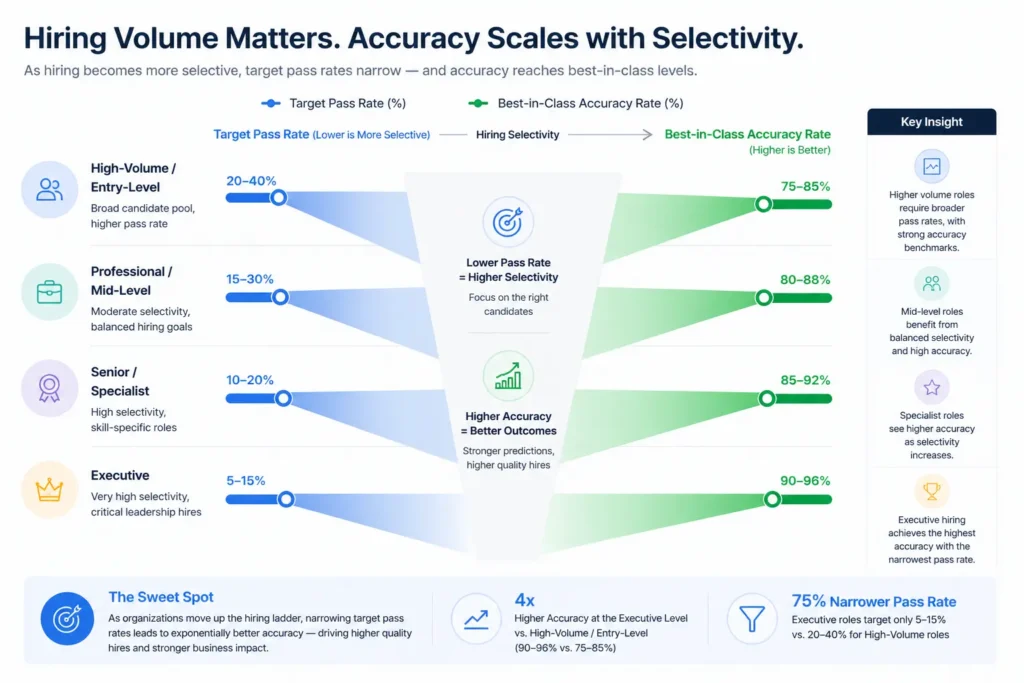
Benchmarks by Hiring Volume
| Volume Context | Target Pass Rate | Best-in-Class Accuracy Rate |
|---|---|---|
| High-Volume / Entry-Level | 20-40% | 75-85% |
| Professional / Mid-Level | 15-30% | 80-88% |
| Senior / Specialist | 10-20% | 85-92% |
| Executive | 5-15% | 90-96% |
Key Strategies for Effective Pre-Screening
How Can AI and Automation Support Pre-Screening?
AI-Powered Resume Analysis
AI resume screening tools analyze candidate resumes against defined role criteria, including experience level, skills, education, career progression patterns, and tenure signals, to produce ranked shortlists that reflect defined qualification standards rather than keyword presence alone. The best systems are trained on role-specific success criteria rather than generic matching algorithms, producing accuracy rates significantly above simple keyword screening tools and reducing both false positives and false negatives in the initial filter.
Automated Knockout Question Processing
ATS-integrated knockout question systems can automatically advance or reject candidates based on their responses to defined binary qualification questions, covering role-specific licenses, geographic availability, right-to-work status, and minimum experience thresholds, without requiring recruiter review of each individual response. This automation handles the most mechanical layer of pre-screening at zero marginal recruiter time per application, while maintaining a consistent, auditable record of decisions.
Skills Assessment Integration
Pre-screening platforms increasingly integrate with third-party skills assessment tools, including coding challenges, language proficiency tests, and situational judgment assessments, that verify specific capabilities before a human recruiter touches the application. Candidates who pass the skills threshold proceed to recruiter review; those who do not receive an automated communication. This layer adds predictive validity to the pre-screen that resume review and application forms alone cannot match for skills-dependent roles.
Predictive Applicant Scoring
Machine learning models trained on historical hire data can produce applicant fit scores that incorporate signals beyond explicit qualifications: career progression velocity, tenure patterns, skill adjacency, and career trajectory alignment with the role. These predictive scores give recruiters a ranked view of the qualified applicant pool rather than a binary pass or fail list, enabling better prioritization of recruiter review time within the pre-screened pool.
Stop Juggling
10 Job Boards.
Search One
Your next role is already here. avua pulls opportunities from across the web into a single searchable feed; filtered by role, location, salary, and remote preference.
1.5 Million+
Active Jobs
380+
Job Categories
Pre-Screening and Equitable Hiring Practices
Keyword Bias and the Excluded Middle
The most pervasive equity risk in automated pre-screening is keyword and credential bias: the tendency for AI screening tools trained on historical hire data to reproduce the demographic characteristics of past hires by learning to favor the educational institutions, previous employers, and vocabulary patterns associated with historically hired candidates. Organizations where past hires have been demographically homogeneous generate training data that systematically advantages candidates from similar backgrounds. A blind resume review protocol at the pre-screening stage, where demographic indicators are removed from applications before AI scoring or recruiter review, is one primary tool for interrupting this self-reinforcing cycle.
Credential Inflation and Access Inequity
Pre-screening criteria that require specific educational credentials for roles where those credentials are not genuinely predictive of performance create systematic access inequity. Research by the Burning Glass Institute found that degree requirements are frequently imposed on roles where degree holders perform no better than non-degree holders, a pre-screening criterion that reduces candidate diversity without improving hire quality. Auditing educational requirements at the pre-screening stage against actual performance data from current employees in equivalent roles is among the highest-impact equity interventions available to TA leaders, and one of the most frequently overlooked.
Accessibility in Digital Pre-Screening
Application forms and online pre-screening tools must be accessible to candidates with disabilities, including those using screen readers, keyboard-only navigation, and alternative input devices. Pre-screening systems that are not accessibility-compliant create legal exposure and exclude candidates with disabilities from the earliest stage of the process. WCAG 2.1 AA compliance is the baseline accessibility standard for pre-screening tools in most jurisdictions. Regular accessibility auditing of pre-screening technology is a legal obligation in many markets, not an optional enhancement that can be deferred.
Common Challenges and Solutions
| Challenge | Solution |
|---|---|
| Pre-screen pass rate too high, generating unmanageable recruiter review volume | Review and tighten knockout criteria; introduce a scored assessment layer for high-volume roles |
| Qualified candidates self-selecting out due to application friction | Audit abandonment rates by form stage; reduce to essential knockout questions only; introduce mobile-optimized application format |
| AI pre-screening flagging strong candidates as unqualified | Audit screening criteria against recent successful hire profiles; recalibrate minimum requirements against actual role performance data rather than historical job descriptions |
| Inconsistent pre-screening criteria across hiring managers for similar roles | Implement role-family level standardized criteria reviewed by TA leadership before each search opens; prevent ad hoc criterion additions during active searches |
Real-World Case Studies
Case Study 1: The Insurance Group
A national insurance group receiving 800 or more applications per month for customer-facing roles was using manual resume review for initial screening, a process consuming approximately 1.2 recruiter hours per hire at the pre-screen stage. They implemented an AI-powered pre-screening tool with defined knockout criteria and a skills assessment integration, reducing average pre-screen time per hire from 1.2 hours to 12 minutes. The recruiter time freed by this automation was redirected to candidate relationship management and hiring manager support, reducing overall time-to-fill from 41 days to 27 days across the affected role family.
Case Study 2: The Technology Startup
A Series B technology startup discovered through a post-hire analysis that their pre-screening keyword matching was filtering out candidates who used different but equivalent terminology for required skills. The ATS was screening for “ML engineer” as the specific phrase and excluding equally qualified “machine learning engineer” applicants. The terminology mismatch was estimated to have excluded approximately 22% of qualified applicants over a six-month period. They replaced keyword matching with a competency-based scoring tool trained on successful hire profiles, immediately improving pre-screen accuracy and expanding the qualified candidate pool by 31%.
Case Study 3: The Retail Chain
A national retail organization redesigned its pre-screening process to be fully mobile-first after data showed that 74% of their applicant pool was applying on mobile devices, but their application form required desktop functionality for completion. By reducing the pre-screening form to five mobile-optimized questions plus an availability check, they increased application completion rates by 52% and reached their seasonal hiring targets three weeks earlier than the previous cycle, without changing the qualification criteria applied.
Tracking What Matters: Key Metrics to Monitor
Pre-Screening Across the Hiring Lifecycle
Pre-Search: Criteria Design and Validation
Pre-screening criteria should be designed before the job description is published, not retroactively, once applications reveal a mismatch between the applicant pool and the role requirements. The pre-screening design process should involve the recruiter, the hiring manager, and a review of historical hire profiles for equivalent roles. For roles with a track record, validating proposed criteria against the profile of successful current employees in equivalent positions is the most reliable calibration method available and the one most frequently skipped.
Application Stage: Automated Filter Execution
At the application stage, pre-screening operates as an automated system, executing defined criteria, processing responses, and categorizing applicants without requiring recruiter involvement for each individual. The recruiter’s role at this stage is oversight: monitoring pass rates, reviewing edge cases flagged by the system, and ensuring that the criteria are performing as designed rather than producing unexpected demographic or qualification patterns in the passing or rejected pool.
Recruiter Review: Qualified Pool Management
After pre-screening, the recruiter receives a qualified applicant pool rather than raw application volume. This qualified pool should be small enough to review thoroughly and qualified enough to make that review time productive. The recruiter’s task is not to re-screen for the criteria already applied, but to assess the pool for signals the pre-screen cannot capture: quality of written communication, specificity of experience description, career narrative coherence, and evidence of genuine interest in the specific role rather than a generic job category.
Post-Hire: Outcome Validation and Criteria Refinement
The most valuable input to next-cycle pre-screening design is the outcome of current-cycle hires. Tracking which pre-screened candidates ultimately became high performers, and which did not, provides the dataset needed to validate and refine screening criteria continuously. Organizations that build this outcome tracking into their ATS or HRIS generate screening criteria that improve with each hiring cycle; those that treat each search as independent reproduce the same screening errors indefinitely.
The Real Cost of Poor Pre-Screening Design
| Scenario | Pre-Screen Quality | Wasted Recruiter Hours (per 100 hires) | Estimated Annual Cost |
|---|---|---|---|
| Unstructured manual review | Very Low | 380 hrs | $57,000 |
| Basic ATS keyword filter | Low-Moderate | 210 hrs | $31,500 |
| Structured criteria and assessment | High | 95 hrs | $14,250 |
| AI-powered validation-based screening | Optimized | 45 hrs | $6,750 |
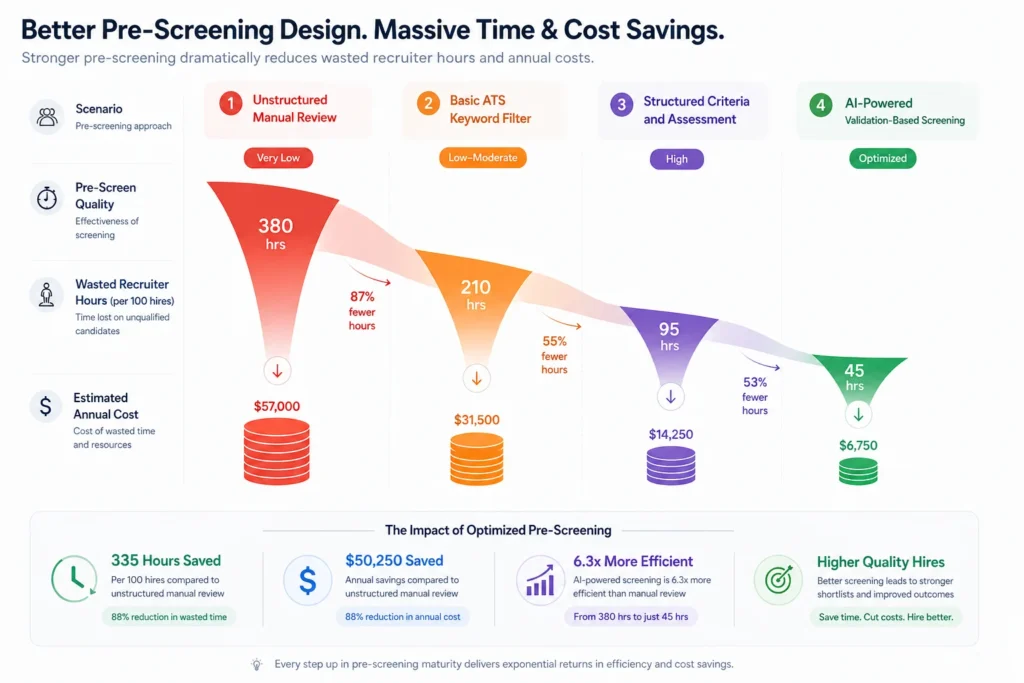
Recruiter hourly cost assumed at $75 fully loaded. Wasted hours represent recruiter time spent on candidates who do not advance past the subsequent phone screen stage.
Related Terms
| Term | Definition |
|---|---|
| Phone Screen | A brief recruiter-led conversation conducted after pre-screening to assess communication, fit, and genuine candidate interest |
| Applicant Tracking System (ATS) | Software platform managing application data, automated screening, and hiring workflow |
| Knockout Questions | Binary application questions designed to immediately disqualify candidates who do not meet essential role requirements |
| Candidate Pipeline | The pool of qualified candidates at various stages of the hiring process for current or anticipated roles |
| AI Resume Screening | Automated analysis of resume content against role criteria to produce ranked applicant shortlists |
Frequently Asked Questions
How many knockout questions should a pre-screening form include?
Research on application completion rates suggests three to five knockout questions as the optimal range for most professional roles. Each additional required field reduces completion rates by 4-8%. Questions should be limited to criteria that are genuinely predictive of role success and cannot be verified more efficiently through resume review or later-stage assessment.
Can pre-screening tools introduce bias?
Yes, significantly if not properly designed and audited. AI screening tools trained on historical hire data reproduce the demographic patterns of past hires. Keyword-based systems may disadvantage candidates from non-traditional backgrounds. Regular bias audits comparing the demographic composition of applicant pools versus pre-screened pools are essential for organizations committed to equitable hiring outcomes.
What is a reasonable pre-screen pass rate?
For most professional roles, a pre-screen pass rate of 15-35% indicates meaningful filtering with a well-qualified retained pool. Rates above 60-70% suggest criteria are too loose; rates below 5-10% may indicate a sourcing-role alignment problem or overly restrictive screening criteria that are excluding qualified candidates before any human sees them.
How quickly should pre-screened candidates hear back?
Best practice is within three to five business days of application completion, with high-performing organizations targeting 24-48 hours using automated pre-screening tools. Speed of response at the pre-screening stage correlates directly with candidate completion of subsequent process steps. Candidates who wait more than a week to hear back accept competing offers at dramatically higher rates.
Does pre-screening reduce diversity?
It can, if criteria are not validated against actual role performance data and audited for disparate impact. It can also improve diversity by removing human subjectivity at the highest-volume stage of the hiring process. The outcome depends entirely on the quality of criteria design and the rigor of ongoing outcome audit, not on whether pre-screening is used.
What is the difference between pre-screening and screening?
Pre-screening filters the full applicant pool against minimum qualifications before any substantive human evaluation occurs. Screening, typically a recruiter phone screen, is the subsequent stage where qualified candidates are evaluated for fit, communication quality, and genuine interest. Pre-screening answers “does this candidate qualify?”; screening answers “is this candidate worth the hiring team’s time?”
Conclusion
Pre-screening is the foundation on which every subsequent hiring decision is built.
Organizations that design their pre-screening criteria with rigor, validating against performance data, calibrating for both inclusivity and precision, and auditing outcomes continuously, produce cleaner pipelines, faster time-to-fill, and higher quality-of-hire than those treating the initial filter as an administrative step. The pre-screen is not where you find the right candidate; it is where you create the conditions that make finding the right candidate possible.
Invest in its design accordingly, and treat its outcome data as one of the most valuable calibration inputs available to your recruiting function.