Every hire is the end result of a process that most candidates never fully see and most hiring teams never fully map.
Leads become applicants, applicants become screened candidates, screened candidates become interviewees, and somewhere at the narrow end of that journey, one person accepts an offer. That journey has a name: the recruitment funnel, and understanding it is the difference between hiring by instinct and hiring by design.
A recruitment funnel is the structured sequence of stages that moves candidates from initial awareness of a role all the way through to a completed hire. It borrows its logic from marketing, where funnel thinking has long been used to understand how audiences move from discovery to conversion. In talent acquisition, the same framework applies, mapping drop-off points, conversion rates, and bottlenecks across every stage of the candidate journey.
For teams serious about data-driven recruiting, the recruitment funnel is the primary diagnostic tool. It shows exactly where qualified candidates are being lost, whether that is at the application completion rate stage, during automated screening, or somewhere between the final interview and the offer.
A well-managed funnel also protects candidate experience at every touchpoint, ensuring that even candidates who do not make it through feel the process was fair, timely, and worth their time. Pair that with a healthy candidate pipeline and you have the infrastructure for hiring that is both efficient and consistently human.
The core metric governing recruitment funnel performance is the Stage Conversion Rate: the proportion of candidates advancing from one funnel stage to the next.
Stage Conversion Rate (%) = (Candidates Advancing to Next Stage / Total Candidates at Current Stage) x 100
High-performing talent acquisition functions track stage conversion rates continuously across every funnel stage. Industry benchmarks suggest that for professional roles, 15 to 25 percent of applicants should advance from application to initial screen, 40 to 60 percent from screen to interview, and 20 to 30 percent from interview to offer. Organizations that lack this visibility are not managing a recruitment funnel: they are managing a recruitment lottery.
What is a Recruitment Funnel?
A recruitment funnel (also known as a talent acquisition funnel or hiring funnel) is a structured model representing the sequential stages through which candidates pass from initial exposure to a job opportunity through to employment. It applies the logic of a marketing conversion funnel to the hiring process, treating each stage as a conversion point where a proportion of candidates advance to the next evaluation level while others exit the process.
The typical recruitment funnel comprises several core stages: Awareness (candidates discover the role or organization), Attraction (candidates engage with the job posting or employer brand), Application (candidates formally express interest), Screening (candidates are assessed against minimum qualifications), Assessment (candidates complete structured evaluations), Interview (candidates participate in in-depth conversations), Offer (selected candidates receive an employment offer), and Hire (candidates accept and begin employment). The precise stage structure varies by organization and role complexity, but the underlying logic remains constant: converting the broadest possible qualified awareness into the most appropriate hire at the lowest defensible cost.
The recruitment funnel is analytically distinct from an ATS workflow in that it is a diagnostic framework rather than a process management tool. The ATS tracks where candidates currently sit; the recruitment funnel model tracks how efficiently they are moving through the process, at what rate they are converting at each stage, and where the process is generating or destroying hiring quality.
Why the Recruitment Funnel Is the Most Critical System in Talent Acquisition?
The recruitment funnel is not a hiring process metaphor. It is the mechanism through which organizational talent strategy is either executed or undermined at scale. Every decision about where to source candidates, how to qualify them, what to communicate at each stage, and how quickly to advance them is a funnel design decision, and those decisions accumulate into the quality, speed, and cost of every hire the organization makes.
The cost implications of funnel dysfunction are direct and measurable. A funnel that passes too many unqualified candidates into the interview stage generates excessive interview cost and consumes hiring manager time that cannot be recovered. A funnel that applies overly restrictive screening criteria filters out qualified candidates before a recruiter ever reviews their application, reducing hire quality while simultaneously inflating time-to-fill. A funnel that fails to communicate clearly or move quickly at the offer stage loses candidates who were ready to accept to competitors whose processes moved faster. Each of these failure modes is measurable and in most organizations remains unmeasured.
Research from LinkedIn’s Global Talent Trends report found that companies with structured, data-tracked recruitment funnels fill roles 21 percent faster than those without funnel visibility. The same research identified that funnel conversion data is among the strongest predictors of recruiter productivity, with recruiters tracking stage-level conversion rates producing higher-quality shortlists in less time than those relying on aggregate volume metrics alone. The compounding effect on organizational performance is significant: faster, higher-quality hiring reduces productivity gaps, lowers the cost-per-hire, and improves the talent quality on which organizational capability ultimately depends.
For HR and talent acquisition leaders, the strategic implication is clear: the recruitment funnel is not a recruiting operations tool. It is a talent strategy accountability system. An organization that cannot describe its funnel conversion rates by stage, role family, and sourcing channel cannot claim to be managing its talent acquisition function with the rigor that organizational performance requires. The recruitment funnel is where hiring intent meets hiring reality, and the gap between the two is measured in attrition rates, unfilled roles, and organizational capability shortfall.
Your Resume Isn’t Getting Read
Let’s Get That Fixed!
75% of resumes get auto-rejected. avua’s AI Resume Builder optimizes formatting, keywords, and scoring in under 3 minutes, so you land in the “yes” pile.
The Psychology Behind the Recruitment Funnel
Candidate Decision Fatigue and Application Dropout
Research on digital behavior consistently finds that process complexity reduces completion rates. The same mechanism operates in recruitment funnels: candidates who encounter long application forms, multi-step qualification processes, or unclear role descriptions make a rapid calculation about effort versus reward and abandon the process. Application abandonment research from the Talent Board’s Candidate Experience Awards program found that each additional minute of required application time reduces completion rates by approximately 4 to 6 percent for professional roles. Funnel design decisions at the application stage, specifically form length, mobile optimization, and clarity of role representation, directly determine how much of the qualified addressable candidate market the organization ever reaches.
The Anchoring Effect in Candidate Evaluation
At the screening and interview stages of the recruitment funnel, evaluators are subject to anchoring bias: the tendency to weight the first piece of information received about a candidate disproportionately in all subsequent judgments. A recruiter who reads a resume before conducting a phone screen arrives at the call with a preliminary impression already formed, which influences how they interpret candidate responses independent of actual content. Structured evaluation frameworks at each funnel stage, with explicit, criterion-based scoring applied independently of prior stage outcomes, reduce though do not eliminate anchoring effects across the evaluation process.
Loss Aversion and Offer Stage Attrition
Behavioral economics research consistently finds that the pain of losing something is approximately twice as powerful as the pleasure of gaining an equivalent. In recruitment funnel terms, this means candidates who receive a competing offer during a lengthy hiring process experience a loss aversion effect: declining the competing offer feels riskier than accepting it, even when the organization’s offer is objectively superior. Funnel velocity, specifically the speed at which candidates move from final interview to offer, is therefore a retention variable as well as an efficiency variable. Extended funnel timelines at the offer stage do not merely inconvenience candidates; they structurally advantage competitors whose processes move faster and communicate more clearly at every stage.
Recruitment Funnel vs. Related Hiring Frameworks
| Framework | Stage Focus | Primary Tool | Primary Output |
|---|---|---|---|
| Recruitment Funnel | End-to-end candidate journey | ATS and Analytics | Hired employees |
| Talent Pipeline | Pre-application relationship building | CRM | Warm candidate pool |
| Candidate Journey | Experience at each touchpoint | Journey mapping | Experience audit |
| Hiring Workflow | Task and stage management | ATS | Process compliance |
| Sourcing Funnel | Awareness to application conversion | Sourcing platforms | Applicant volume |
The critical distinction between a recruitment funnel and a candidate pipeline is analytical versus relational. A candidate pipeline is a relationship management asset: a pool of engaged candidates maintained for future roles. The recruitment funnel is a performance measurement framework applied to an active search. Both are necessary; organizations that conflate the two lose the diagnostic precision that makes funnel analysis actionable and the relationship depth that makes pipeline management effective.
What the Experts Say?
Most organizations know how many people they hired. Almost none know how many they lost along the way, at which stage, and why. That data exists in every ATS. The question is whether anyone is looking at it.
– Dr. John Sullivan, Professor of Management, San Francisco State University
How to Measure Recruitment Funnel Effectiveness?
Formulas
Stage Conversion Rate (%) = (Candidates Advancing to Next Stage / Total Candidates at Current Stage) x 100
Funnel Yield Ratio = Total Hires / Total Applicants
Time-in-Stage (days) = Average elapsed time candidates spend at each funnel stage before advancing or exiting
Sourcing Channel Yield (%) = (Hires from Channel / Applicants from Channel) x 100
Benchmarks by Funnel Stage
| Funnel Stage | Industry Average Conversion | High-Performing Organizations |
|---|---|---|
| Awareness to Application | 2-5% | 8-12% |
| Application to Screen | 15-25% | 30-40% |
| Screen to Interview | 40-60% | 65-75% |
| Interview to Offer | 20-30% | 35-45% |
| Offer to Acceptance | 65-75% | 85-92% |
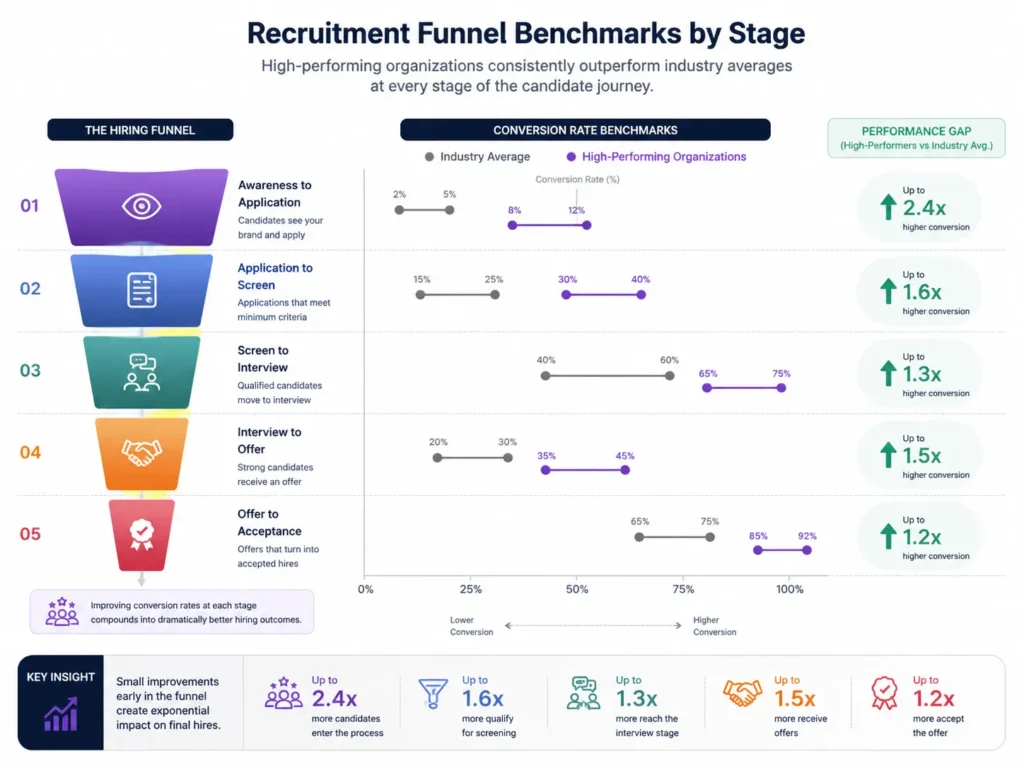
Conversion rates vary significantly by role level, sourcing channel, and industry. The benchmarks above reflect professional roles in competitive markets. High-performing rates indicate well-targeted sourcing, precisely calibrated screening criteria, and a candidate experience that builds genuine interest at every funnel stage rather than eroding it.
Key Strategies for Optimizing the Recruitment Funnel
How Can AI and Automation Support the Recruitment Funnel?
Funnel Stage Automation and Candidate Routing
AI-powered talent acquisition platforms can automate candidate routing between funnel stages based on defined qualification criteria, eliminating the manual triage work that consumes recruiter time between application receipt and initial review. Automated screening tools verify minimum qualifications at the application stage, advance qualifying candidates to the screen queue, and trigger respectful rejection communications for those who do not meet defined criteria, all without recruiter involvement per individual application. This automation compresses the top-of-funnel timeline significantly, reducing the time between application and first human contact, which is among the strongest predictors of candidate engagement downstream.
Predictive Funnel Analytics
Machine learning models trained on historical funnel data can identify which candidate attributes at the application and screen stages are most predictive of successful progression through to offer and acceptance. These predictive models produce ranked applicant shortlists that reflect validated funnel conversion predictors rather than keyword presence or resume formatting. Over time, predictive funnel analytics improve as the model accumulates more outcome data, creating a continuous improvement loop that keyword-based screening tools cannot replicate.
AI-Assisted Funnel Bottleneck Detection
Analytics platforms can monitor funnel stage conversion rates in real time, flagging deviations from baseline conversion expectations automatically rather than requiring HR leaders to run manual reports. A sudden drop in the screen-to-interview conversion rate for a specific role family triggers an alert that prompts investigation: is the sourcing channel producing lower quality applicants, have screening criteria changed, or has the hiring manager revised their expectations mid-search? Automated bottleneck detection converts funnel data from a retrospective reporting tool into a real-time intervention system.
Candidate Communication Automation
AI-powered communication tools can deliver personalized, stage-appropriate candidate communications at scale, ensuring that every candidate receives timely status updates at every funnel stage regardless of volume. Research from SHRM consistently finds that candidate satisfaction with communication frequency is among the strongest drivers of overall candidate experience ratings, and that poor communication at any stage increases offer decline risk even when the candidate advances to the next stage. Automated communication does not replace recruiter judgment; it ensures that the minimum communication standard is met for every candidate in every funnel stage.
Stop Juggling
10 Job Boards.
Search One
Your next role is already here. avua pulls opportunities from across the web into a single searchable feed; filtered by role, location, salary, and remote preference.
1.5 Million+
Active Jobs
380+
Job Categories
Recruitment Funnel Design and Equitable Hiring
Structural Bias at the Top of the Funnel
The recruitment funnel’s earliest stages carry the highest equity risk because they operate at the largest scale with the least human oversight. Keyword-based screening tools trained on historical hire data reproduce the demographic characteristics of past hires by learning to favor vocabulary patterns, educational institutions, and previous employers associated with historically hired candidates. Organizations where past hires have been demographically homogeneous generate training data that systematically advantages candidates from similar backgrounds at the top of the funnel, long before any individual recruiter or hiring manager makes a subjective judgment. Regular auditing of funnel conversion rates by demographic group is the primary tool for detecting this pattern before it compounds across multiple hiring cycles.
Stage Design and Access Equity
Funnel stage design creates access barriers that disadvantage candidates unevenly. Long, desktop-only application processes disadvantage candidates applying via mobile, who are disproportionately from lower-income backgrounds. Synchronous interview scheduling with narrow time windows disadvantages candidates with caregiving responsibilities or inflexible employment. Unpaid assessment tasks at the evaluation stage disadvantage candidates who cannot absorb the time cost. Inclusive hiring requires evaluating each funnel stage for the access barriers it creates and whether those barriers are predictive of role performance or merely correlated with prior candidate similarity.
Funnel Equity Audits and DEI Outcomes
An organization’s commitment to diversity, equity, and inclusion is measurably tested in its recruitment funnel conversion data. If candidates from underrepresented groups enter the funnel at equivalent rates to majority-group candidates but convert at lower rates at the screening or interview stage, the funnel is functioning as a structural exclusion mechanism rather than a merit-based evaluation system. Funnel equity audits, applying the same statistical methodology as pay equity analyses to stage conversion rates by demographic group, are among the most direct and underutilized tools available for identifying and correcting exclusion patterns before they reach the offer and hire stages. For more background on legal frameworks around equal opportunity in hiring, EEOC guidance on employment opportunity provides a practical reference.
Common Challenges and Solutions
| Challenge | Solution |
|---|---|
| Top-of-funnel volume is high but screen conversion is low | Audit sourcing channel quality and job description accuracy; misaligned job descriptions produce high applicant volume with poor qualification match |
| Candidates are dropping out between interview and offer stages | Reduce time-in-stage between final interview and offer; communicate timeline expectations clearly at every stage; ensure compensation is competitive before the process begins |
| Funnel conversion data varies widely across hiring managers for equivalent roles | Standardize evaluation criteria at each stage; implement calibration sessions for hiring managers reviewing the same role family |
| Funnel analytics are available but not acted upon | Assign ownership of funnel performance metrics to TA leadership with defined review cadence; connect funnel data to sourcing budget decisions |
Real-World Case Studies
Case Study 1: The Financial Services Group
A 1,200-person financial services firm was experiencing a 71 percent offer decline rate for senior professional roles. Investigation using funnel stage data revealed that the median time from final interview to offer delivery was 18 days, compared to an industry median of 6 days for equivalent roles. Candidates were accepting competing offers during the decision delay. The firm implemented a structured offer preparation protocol beginning at the penultimate interview stage, reducing time-to-offer to an average of 4 days. Offer acceptance rate improved from 29 percent to 67 percent within two hiring cycles, without any change to compensation levels.
Case Study 2: The Technology Scale-Up
A 400-person technology company redesigned its recruitment funnel after discovering that its application-to-screen conversion rate was 8 percent, well below the 15 to 25 percent benchmark for professional roles. Funnel analysis revealed that the job descriptions for engineering roles listed 14 to 18 required qualifications, many of which were preferences rather than genuine minimum requirements. Reducing each job description to 6 to 8 validated knockout criteria and rewriting requirement language to reflect actual role performance expectations increased the application-to-screen conversion rate to 22 percent. Time-to-fill reduced by 31 percent in the subsequent hiring cycle as recruiter capacity was freed from reviewing unqualified applications.
Case Study 3: The Healthcare Network
A regional healthcare network was experiencing significant variance in funnel conversion rates across its four geographic markets, with screen-to-interview conversion ranging from 28 percent to 61 percent for equivalent nursing roles. Funnel analysis identified that the variance was driven by inconsistent screening criteria applied by different recruiting teams rather than differences in applicant quality. A standardized screening guide implemented across all markets, with consistent evaluation criteria and a shared calibration session, reduced market-to-market conversion variance from 33 percentage points to 9 percentage points within one hiring cycle. Hiring manager satisfaction scores for shortlist quality improved by 38 percent.
Tracking What Matters: Key Metrics to Monitor
The Recruitment Funnel Across the Hiring Lifecycle
Pre-Search: Funnel Design and Criteria Alignment
The quality of a recruitment funnel is largely determined before the first application arrives. Funnel design decisions made at the pre-search stage, including which sourcing channels to activate, what screening criteria to apply, how many interview stages to include, and what the target time-in-stage looks like for each evaluation point, shape every conversion rate that follows. Organizations that treat funnel design as a pre-search activity rather than a reactive response to volume produce more consistent conversion data and more predictable time-to-fill outcomes across hiring cycles.
Application and Screening Stages: Volume to Quality
The funnel’s early stages convert the broadest possible qualified awareness into a manageable, qualified applicant pool for recruiter review. At the application stage, funnel design governs completion rates and the demographic breadth of the entering candidate population. At the screening stage, criteria quality governs whether the advancing pool reflects genuine qualification rather than keyword match or credential proximity. The phone screen stage sits at the midpoint of the funnel, converting a pre-screened pool into a shortlist for hiring manager evaluation, and its quality determines the efficiency of every interview stage that follows.
Interview and Assessment Stages: Quality Signal Generation
The funnel’s middle stages are where the most expensive evaluation resources, hiring manager time, structured interviews, and technical assessments, are deployed. The investment is justified only if the earlier funnel stages have done their filtering work correctly. An interview stage that regularly reviews candidates who are not genuinely qualified represents an earlier screening stage failure, not an interview stage failure. Funnel analytics that track interview-to-offer conversion rates by interviewer, role, and sourcing channel surface these earlier-stage failures in the data that interview-stage review alone cannot reveal.
Offer and Hire Stage: Conversion Completion
The offer stage is where funnel investment is either recovered or lost. Candidates who reach the offer stage represent the full cost of every prior funnel stage, and a declined offer means that investment generates no return. Offer stage conversion is driven by three variables that the earlier funnel stages influence: compensation alignment (established at the sourcing and screening stages), candidate engagement quality (built across the interview and candidate experience stages), and process speed (determined by time-in-stage decisions across the entire funnel). Organizations that manage offer acceptance rate in isolation from earlier funnel stage decisions consistently fail to improve it.
The Real Cost of a Poorly Optimized Recruitment Funnel
| Scenario | Funnel Quality | Avg. Time-to-Fill (days) | Annual Recruitment Cost (100 hires) |
|---|---|---|---|
| No funnel tracking, unstructured | Very Poor | 58 | $920,000 |
| Basic ATS tracking, limited analysis | Moderate | 44 | $680,000 |
| Structured funnel with stage metrics | Good | 32 | $490,000 |
| AI-assisted, continuously optimized funnel | Best-in-Class | 22 | $310,000 |
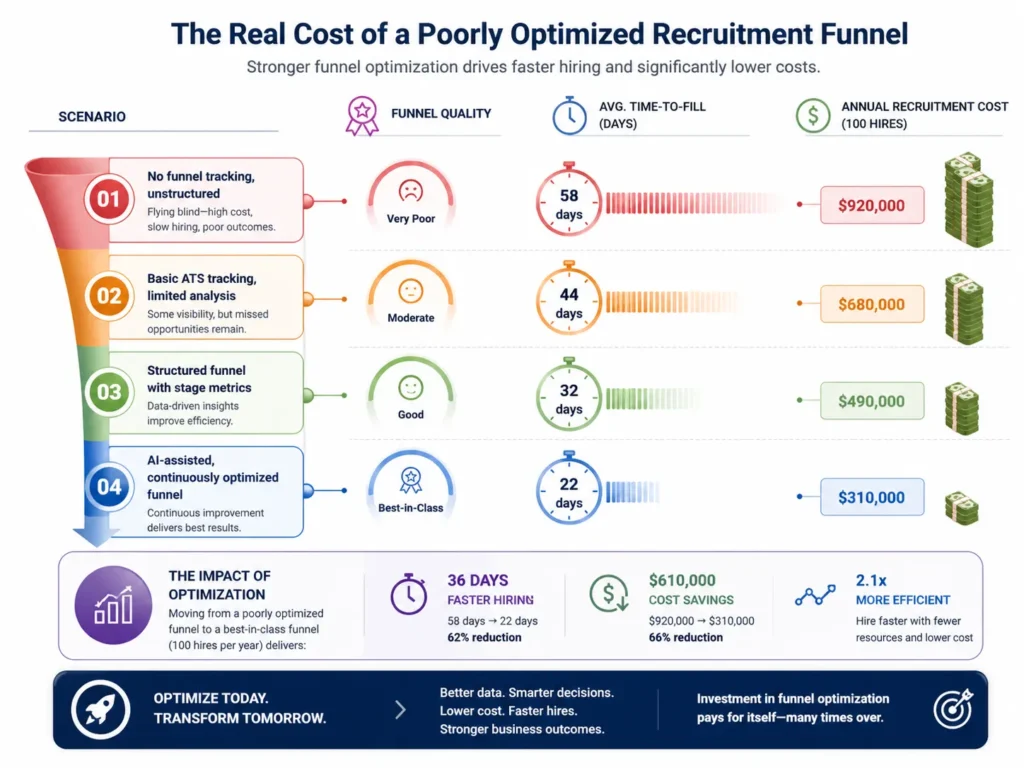
Cost model assumes fully-loaded recruiter cost of $85 per hour, average of 40 recruiter hours per hire, and additional cost savings from reduced time-to-fill productivity gaps. Time-to-fill benchmarks drawn from LinkedIn Talent Solutions and SHRM workforce research data.
Related Terms
| Term | Definition |
|---|---|
| Applicant Tracking System (ATS) | Software platform managing candidate data, application workflows, and hiring stage progression |
| Stage Conversion Rate | The proportion of candidates advancing from one funnel stage to the next, the primary diagnostic metric of funnel performance |
| Sourcing Channel | The origin point through which candidates enter the recruitment funnel, including job boards, referrals, direct sourcing, and social media |
| Candidate Experience | The quality of a candidate’s interactions with the organization across all recruitment funnel touchpoints |
| Talent Pipeline | A managed pool of pre-qualified candidates maintained for future role openings, distinct from the active recruitment funnel |
| Time-to-Fill | The elapsed time from job requisition opening to accepted offer, a composite measure of recruitment funnel velocity |
| Funnel Yield Ratio | The aggregate efficiency metric of the recruitment funnel, calculated as total hires divided by total applicants |
Frequently Asked Questions
What are the main stages of a recruitment funnel?
The core stages are Awareness, Attraction, Application, Screening, Assessment, Interview, Offer, and Hire. The exact structure varies by organization and role complexity, but every stage represents a conversion point where a defined proportion of candidates advance while others exit the process.
What is a good recruitment funnel conversion rate?
Benchmarks vary by stage and role level. For professional roles, a 15 to 25 percent application-to-screen conversion indicates well-targeted sourcing and accurate job descriptions. A 40 to 60 percent screen-to-interview conversion indicates precise screening criteria. An 85 to 92 percent offer-to-acceptance conversion reflects strong candidate experience and compensation alignment throughout the process.
How is a recruitment funnel different from an ATS workflow?
An ATS workflow is a process management tool tracking where individual candidates are located in the hiring process. A recruitment funnel is an analytical framework measuring how efficiently candidates move between stages, at what conversion rates, and at what cost. The ATS generates the data; the recruitment funnel model provides the analytical structure that makes that data actionable.
How do you identify a bottleneck in the recruitment funnel?
Track time-in-stage and conversion rate at every funnel stage and compare against role-type benchmarks. A stage with a significantly below-benchmark conversion rate or above-benchmark time-in-stage is a bottleneck. The next step is diagnosing whether the bottleneck reflects a sourcing problem, a criteria calibration problem, a process design problem, or a decision-making delay at the hiring manager level.
Can the recruitment funnel reduce hiring bias?
Yes, when designed with that objective. Standardized criteria at each funnel stage, structured evaluation frameworks, and regular funnel equity audits comparing stage conversion rates by demographic group all reduce the influence of individual evaluator subjectivity. However, automated funnel tools trained on biased historical data can also amplify bias at scale, which is why criteria validation and demographic conversion auditing are essential components of equitable funnel design.
Conclusion
The recruitment funnel is not a process diagram that sits in a talent acquisition strategy deck. It is the operating system through which every hiring decision the organization makes is either supported or undermined. Organizations that design their funnels deliberately, track conversion data at every stage, and use that data to make sourcing, screening, and process velocity decisions consistently outperform those that manage hiring by gut feel and aggregate volume.
The most significant shift in recruitment funnel management over the last decade is the move from retrospective reporting to real-time diagnosis. AI-powered analytics platforms now make it possible to monitor funnel conversion rates continuously, detect bottlenecks before they compound into missed hiring targets, and audit equity outcomes before they accumulate into structural exclusion. The technology exists. The question is whether the organizational will to treat funnel data as a strategic input, rather than an HR operations metric, exists alongside it.
Treat the recruitment funnel as the precision instrument it is. Define its stages with rigor, measure its performance with discipline, audit its equity outcomes with consistency, and invest in its optimization with the same seriousness applied to any other system on which organizational performance materially depends.