The best candidates in any market have options. They are not just evaluating your job posting, they are evaluating your organisation, your culture, your reputation, and whether working for you sounds like a step forward or a lateral drift into the unknown.
Recruitment marketing is how organisations take control of that narrative before a single application is submitted.
Recruitment marketing is the practice of applying marketing principles and strategies to attract, engage, and convert the right candidates, treating talent acquisition less like a transactional process and more like a sustained campaign. It shapes how your organisation shows up to passive and active candidates alike, long before they ever interact with your candidate journey.
Strong recruitment marketing builds the kind of employer presence that makes candidate engagement easier at every stage. It improves the quality of your applicant pool by attracting people who already understand and align with what your organisation stands for, which in turn strengthens employee retention by reducing the gap between expectation and reality once someone joins.
The core metric governing Recruitment Marketing effectiveness is the Candidate Conversion Rate: the proportion of career site visitors who complete an application, measured alongside cost per application across sourcing channels.
Candidate Conversion Rate (%) = (Completed Applications / Total Career Site Visitors) x 100
High-performing Recruitment Marketing programs maintain candidate conversion rates of 8 to 14% on branded career sites. Organizations without a structured Recruitment Marketing function typically convert between 2 and 4% of career site visitors into applicants. The gap is explained almost entirely by the quality of content strategy, employer brand clarity, and candidate experience infrastructure, not by the roles themselves.
What is Recruitment Marketing?
Recruitment Marketing is the practice of applying marketing strategies, channels, and technologies to attract, engage, and nurture potential candidates before they submit a formal application, treating the talent acquisition function as a demand generation operation that builds employer awareness, candidate preference, and application intent across the full pre-hire journey. It encompasses employer branding, content strategy, programmatic job advertising, talent community management, candidate relationship management technology, and campaign performance analytics.
The defining characteristic of Recruitment Marketing is that it activates before the job posting goes live. Traditional recruiting begins at the application stage; Recruitment Marketing begins at the awareness stage, building familiarity and preference in potential candidates who may not yet be actively searching.
According to LinkedIn’s Global Talent Trends research, more than 70% of the global workforce consists of passive candidates who are not actively seeking new roles but would consider a compelling opportunity if presented through the right channel at the right moment. Recruitment Marketing is the function that ensures those presentations happen systematically, not by chance.
How Recruitment Marketing Shapes Talent Strategy and Business Performance?
Organizations that rely exclusively on reactive job posting consistently face the same structural problem: they compete for candidates who are already looking, which is the most expensive and contested segment of the talent market. According to SHRM’s talent acquisition benchmarking research, organizations without structured Recruitment Marketing programs spend an average of 37% more per hire than those with mature employer brand and content strategies, because they depend on high-cost job boards, agency fees, and last-minute sourcing to fill a gap that proactive candidate engagement would have addressed at a fraction of the cost.
The employer brand dimension of Recruitment Marketing carries compounding financial implications that extend beyond cost per hire. Glassdoor research consistently shows that organizations with strong employer brands receive 50% more qualified applications and spend approximately $5,000 less per hire than peers with weak or undefined employer brands. For a company making 60 hires annually, the difference between strong and weak employer brand investment represents $300,000 in annual recruitment cost reduction, before accounting for the quality differential in the candidate pools each approach attracts.
The less examined dimension of Recruitment Marketing is its impact on early-tenure retention. Candidates who discover and apply through authentic employer brand content arrive with calibrated expectations. Research from the Talent Board’s Candidate Experience benchmarking program shows that candidates who had a positive pre-application brand experience are 38% less likely to leave within the first six months than those sourced through transactional job board postings. Recruitment Marketing does not just reduce the cost of acquiring candidates; it improves the longevity and quality of what those candidates become after hire.
The ROI case for Recruitment Marketing investment is straightforward to model. A technology company making 60 hires per year at an average cost per hire of $9,200, driven primarily by agency fees and reactive job board spend, implements a structured Recruitment Marketing program involving employer brand content, a talent community, and programmatic advertising. Within two hiring cycles, agency dependency falls by 40%, cost per hire declines to $5,400, and time-to-shortlist drops from 19 days to 9 days. The program investment of approximately $140,000 annually delivers cost savings exceeding $228,000, before accounting for quality and retention improvements.
For TA leaders, the practical conclusion is that Recruitment Marketing should be positioned as a pipeline-building investment, not a communications expense. Every employer brand asset produced, every talent community subscriber added, and every piece of careers content published is a compounding recruitment asset. Organizations that make this shift report shorter time-to-shortlist, lower cost-per-application, and measurably higher candidate experience scores across every stage of the hiring process.
Your Resume Isn’t Getting Read
Let’s Get That Fixed!
75% of resumes get auto-rejected. avua’s AI Resume Builder optimizes formatting, keywords, and scoring in under 3 minutes, so you land in the “yes” pile.
The Psychology Behind Recruitment Marketing
Attention Economics and the Employer Brand Signal
Candidates process employer information through the same attention filters they apply to consumer brand decisions: trust signals, social proof, and narrative coherence. An organization whose careers messaging is generic, inconsistent, or disconnected from what employees actually report about working there creates cognitive dissonance that sophisticated candidates read as an authenticity signal. Research on employer brand perception consistently shows that candidates weight employee-generated content significantly higher than company-produced messaging, making employee advocacy the most credible and highest-leverage Recruitment Marketing channel available to most organizations.
The Passive Candidate Consideration Window
Passive candidates do not make career decisions in response to a single content exposure. They build employer familiarity over repeated touchpoints, including employer content, peer recommendations, industry reputation, and social media presence, before an opportunity becomes compelling enough to act on. This consideration window can span weeks to years, and the organizations present throughout it with consistent, relevant, values-aligned content are those that convert passive interest into active applications when a relevant role opens. Recruitment Marketing is the infrastructure that maintains organizational presence throughout this window, not just at the moment of an open requisition.
The Expectation Calibration Effect
One of the underappreciated functions of Recruitment Marketing is expectation calibration: the process by which authentic employer content helps candidates self-select into or out of consideration based on realistic understanding of the role, culture, and working environment. Organizations that deploy realistic job previews, employee story content, and values-specific messaging see lower application volumes but higher application quality, because candidates who apply through authentically framed content are doing so because the reality resonates, not because the marketing was optimized to maximize click-through rates regardless of fit.
Recruitment Marketing vs. Related Talent Acquisition Strategies
| Strategy | Primary Focus | Audience | Timing | Outcome Measured |
|---|---|---|---|---|
| Recruitment Marketing | Attract and engage candidates before application | Passive and active candidates | Pre-application | Conversion rate, cost per application |
| Traditional Recruiting | Source and screen active applicants | Active candidates only | Post-application | Time-to-fill, offer acceptance rate |
| Employer Branding | Build long-term employer reputation | Broad talent market | Ongoing | Brand awareness, NPS, perception score |
| Candidate Nurturing | Maintain engagement with opted-in talent community | Passive talent pipeline | Ongoing | Re-engagement rate, pipeline conversion |
| Programmatic Advertising | Automate job ad distribution and bid optimization | Active and passive audiences | Campaign-based | Cost per click, cost per application |
The critical distinction between Recruitment Marketing and traditional recruiting is the timing of engagement. Traditional recruiting activates when a role is open. Recruitment Marketing builds relationships with potential candidates continuously, so that when a role opens, the talent pipeline already contains warm, qualified, brand-aware prospects who have been developing interest over time. The pipeline is the strategic asset; the job posting is simply the activation trigger.
What the Experts Say?
The organizations winning the talent competition are not the ones with the biggest recruiting budgets. They are the ones who have invested in building authentic employer brands that candidates trust and seek out. Recruitment Marketing done well makes the best people come to you.
– Lori Sylvia, Founder and CEO, Rally Recruitment Marketing
How to Measure Recruitment Marketing Effectiveness?
Formula
Candidate Conversion Rate (%) = (Completed Applications / Career Site Visitors) x 100
Cost per Application ($) = Total Recruitment Marketing Spend / Total Applications Received
Talent Community Growth Rate (%) = (New Subscribers in Period / Previous Subscriber Total) x 100
Sourcing Channel Quality Score = Quality of Hire Score by Channel benchmarked against organizational average
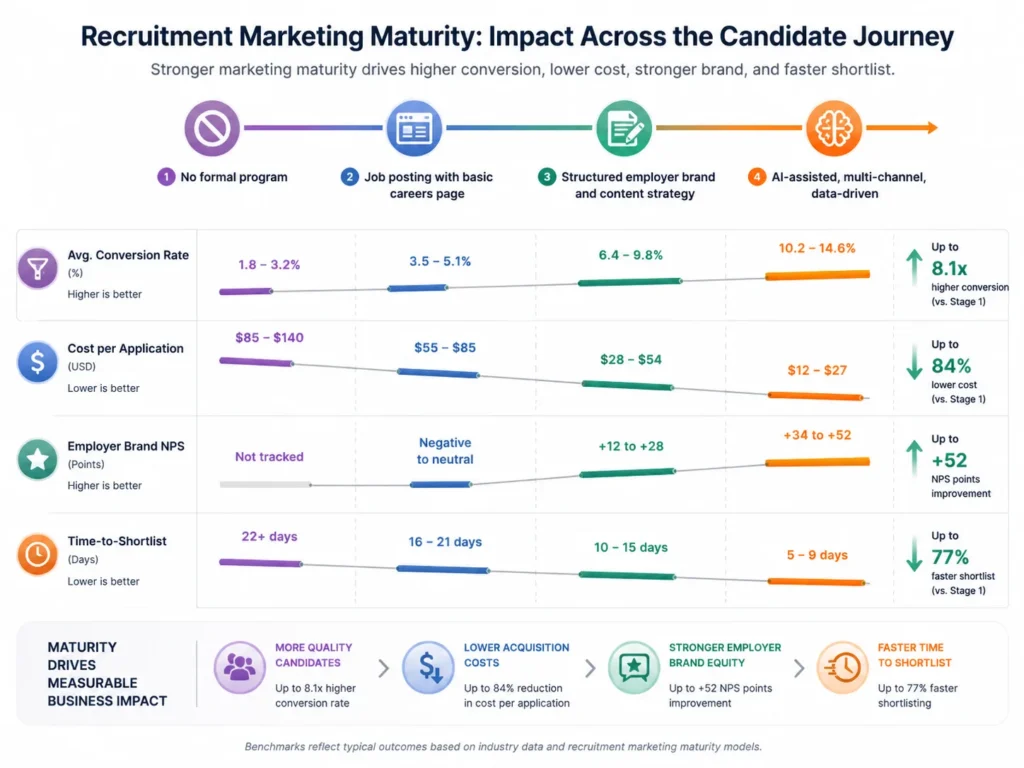
Benchmarks by Recruitment Marketing Maturity
| Maturity Level | Avg. Conversion Rate | Cost per Application | Employer Brand NPS | Time-to-Shortlist |
|---|---|---|---|---|
| No formal program | 1.8-3.2% | $85-$140 | Not tracked | 22+ days |
| Job posting with basic careers page | 3.5-5.1% | $55-$85 | Negative to neutral | 16-21 days |
| Structured employer brand and content strategy | 6.4-9.8% | $28-$54 | +12 to +28 | 10-15 days |
| AI-assisted, multi-channel, data-driven | 10.2-14.6% | $12-$27 | +34 to +52 | 5-9 days |
Key Strategies for Effective Recruitment Marketing
How Can AI and Automation Support Recruitment Marketing?
AI-Powered Audience Segmentation
AI platforms can analyze behavioral data from career site visitors, talent community subscribers, and social media audiences to build segmented candidate audience profiles, identifying the content topics, channels, and messaging approaches that resonate most strongly with each segment. This segmentation enables Recruitment Marketing teams to deliver personalized content experiences at the scale that manual segmentation cannot support, significantly improving engagement rates and application conversion across diverse candidate populations.
Automated Content Personalization
Machine learning models can dynamically adjust the content, messaging, and calls to action presented to different candidate audiences based on their profile characteristics, browsing behavior, and engagement history. A candidate who has visited the engineering careers page three times and subscribed to a technical newsletter receives materially different content from one visiting the general careers page for the first time, and that personalization improves conversion probability significantly without requiring manual intervention at each touchpoint.
Predictive Channel Attribution
AI-powered attribution modeling can analyze the multi-touch candidate journey, identifying which combinations of content exposures, channel interactions, and messaging sequences most reliably produce both application conversions and quality hire outcomes. This predictive attribution capability moves Recruitment Marketing measurement beyond last-click models to a full-funnel approach that accurately reflects where budget is generating value and where it is being absorbed without return on downstream hire quality.
Programmatic Job Advertising Optimization
Programmatic advertising platforms powered by AI automatically allocate job advertising spend across dozens of channels in real time, adjusting bids based on conversion performance, audience quality signals, and role-specific hiring urgency. Organizations implementing programmatic advertising consistently report 30 to 50% reductions in cost per application compared to manual job board management, with simultaneous improvements in application quality because spend concentrates on audiences generating the strongest candidate profiles rather than simply the highest traffic volume.
Stop Juggling
10 Job Boards.
Search One
Your next role is already here. avua pulls opportunities from across the web into a single searchable feed; filtered by role, location, salary, and remote preference.
1.5 Million+
Active Jobs
380+
Job Categories
Recruitment Marketing Through a Fair and Inclusive Lens
Employer brand content that reflects only a narrow slice of the existing workforce will attract a narrow slice of the available talent market. The visual representation of employees in Recruitment Marketing materials, the voices featured in employee stories, and the values emphasized in careers content all signal to prospective candidates whether their background, identity, and working style are welcome within the organization. Organizations whose Recruitment Marketing reflects genuine workforce diversity attract broader candidate pools; those whose content defaults to the most visible demographic of their workforce systematically narrow their own talent pipeline before a single application is received.
Programmatic advertising algorithms optimize for historical conversion data, which means they can replicate and amplify the demographic patterns of previous successful applicants if left uncalibrated. A programmatic campaign optimized purely on historical conversion data will systematically underserve candidates from underrepresented groups if those groups were underrepresented in previous applicant cohorts. Inclusive hiring requires explicit algorithmic calibration for audience diversity alongside conversion efficiency, not an assumption that optimizing for one produces the other.
The accessibility of Recruitment Marketing content carries equity implications that most programs do not explicitly audit. Career site navigation optimized for desktop users disadvantages mobile-primary candidates. Video content without captions excludes hearing-impaired candidates. Application processes requiring extended uninterrupted time disadvantage candidates with caregiving responsibilities. Audit-driven Recruitment Marketing programs that test conversion pathways across different candidate demographics and device environments produce both higher conversion rates and more equitable application outcomes, because the barriers that reduce conversion from underrepresented groups frequently reduce conversion from all candidates.
Common Challenges and Solutions
| Challenge | Solution |
|---|---|
| Employer brand content does not reflect actual employee experience | Conduct structured employee listening sessions before developing content; feature authentic, unscripted employee voices rather than brand-managed messaging |
| Recruitment Marketing ROI is not connected to hire quality | Implement channel-level Quality of Hire tracking that follows candidate source through to 12-month performance; report channel ROI in outcome terms, not volume terms |
| Talent community grows but does not convert to applications | Develop a structured nurture sequence for talent community subscribers with role-specific content, hiring event invitations, and timely alerts when relevant roles open |
| Programmatic advertising budget concentrates on high-volume, low-quality channels | Implement quality score weighting in programmatic algorithms; reallocate spend based on downstream hire quality, not upstream application volume |
Real-World Case Studies
Case Study 1: The Technology Scale-Up
A 600-person technology company facing intense competition for software engineers implemented a structured Recruitment Marketing program after discovering its careers page converted at 2.1% and 84% of engineering hires came from expensive agency channels. The program included role-specific landing pages with engineer-authored content, a structured employee advocacy program reaching 14,000 social followers, and a talent community of 3,200 opted-in engineering candidates. Within two hiring cycles, career site conversion improved to 8.7%, agency dependency for engineering roles fell from 84% to 31%, and cost per engineering hire declined by 44%, with Quality of Hire scores improving 11 points at the 12-month mark.
Case Study 2: The Healthcare Network
A regional healthcare network struggling to fill clinical roles in a competitive local market developed a values-driven Recruitment Marketing program centered on authentic patient impact stories and nurse-authored career content. The program produced a 62% increase in direct applicant volume within six months, a 28-point improvement in employer brand awareness score among the target nurse candidate population, and a reduction in agency-sourced nursing staff from 38% to 19% of total hires. Early-tenure retention among candidates sourced through the content program was 19 percentage points higher than the agency-sourced cohort in the same period, confirming that the expectation calibration function of authentic content delivered measurable retention value.
Case Study 3: The Financial Services Group
A mid-market financial services firm with low employer brand awareness among the target analyst population implemented a targeted Recruitment Marketing program using programmatic advertising, a structured LinkedIn content strategy, and a redesigned careers site featuring day-in-the-life content and structured employee profiles. The firm tracked sourcing channel quality at the 12-month performance level and discovered that LinkedIn organic content produced Quality of Hire scores averaging 79, while job board applicants averaged 61. The program redirected 40% of recruitment advertising spend from high-volume, low-quality channels to content and targeted social channels, reducing cost per quality hire by 38% within 18 months.
Key Performance Signals Every Recruitment Marketing Program Should Track
Recruitment Marketing Across the Talent Lifecycle
Awareness and Employer Brand Building
The foundation of Recruitment Marketing is built during periods when no specific role is open. Employer brand content, social media presence, industry reputation, and employee advocacy cultivate familiarity and preference among potential candidates who are not yet actively looking. Organizations that invest consistently in this phase enter every active search with a pre-warmed audience. Those that invest only when roles are open compete for the most expensive and contested segment of the market and depend on spend to compensate for the absence of organic brand equity.
Consideration and Candidate Nurturing
The consideration phase is where potential candidates evaluate whether the employer’s reality matches the brand promise. Structured talent communities, role-specific content sequences, and personalized career content convert passive brand awareness into active consideration and, eventually, application intent. This phase requires consistent investment in content quality, candidate engagement cadence, and CRM technology that enables personalized communication at scale without manual effort for each interaction.
Decision and Conversion
The decision phase is where career site design, application experience, and role-specific content convert consideration into completed applications. Friction in this phase, including complex application processes, mobile-unfriendly design, and generic job descriptions disconnected from candidate motivations, represents significant and measurable conversion loss. Organizations with optimized conversion pathways achieve candidate conversion rates 3 to 5 times higher than those treating the application process as a compliance step rather than a candidate experience investment.
Post-Hire and Alumni Advocacy
The Recruitment Marketing lifecycle does not end at hire. Employee experience from day one is employer brand content in formation. Employees who have positive onboarding and early-tenure experiences become authentic employer brand advocates, contributing to the employee-generated content pipeline that feeds the next candidate generation. Alumni networks of positive former employees are underutilized Recruitment Marketing assets that most organizations fail to cultivate deliberately, despite representing a uniquely credible and cost-effective advocacy channel.
The Real Cost of Ignoring Recruitment Marketing
| Scenario | Conversion Rate | Cost per Hire | Employer Brand Score | Time-to-Shortlist |
|---|---|---|---|---|
| No Recruitment Marketing program | 1.8-2.9% | $7,200-$11,400 | Not tracked | 22+ days |
| Basic job posting, no employer brand | 3.1-4.8% | $5,100-$7,800 | Negative to neutral | 17-21 days |
| Structured employer brand and content | 6.2-9.4% | $2,800-$4,600 | +14 to +29 | 11-15 days |
| AI-assisted, multi-channel, optimized | 10.8-14.2% | $1,100-$2,400 | +36 to +54 | 4-8 days |
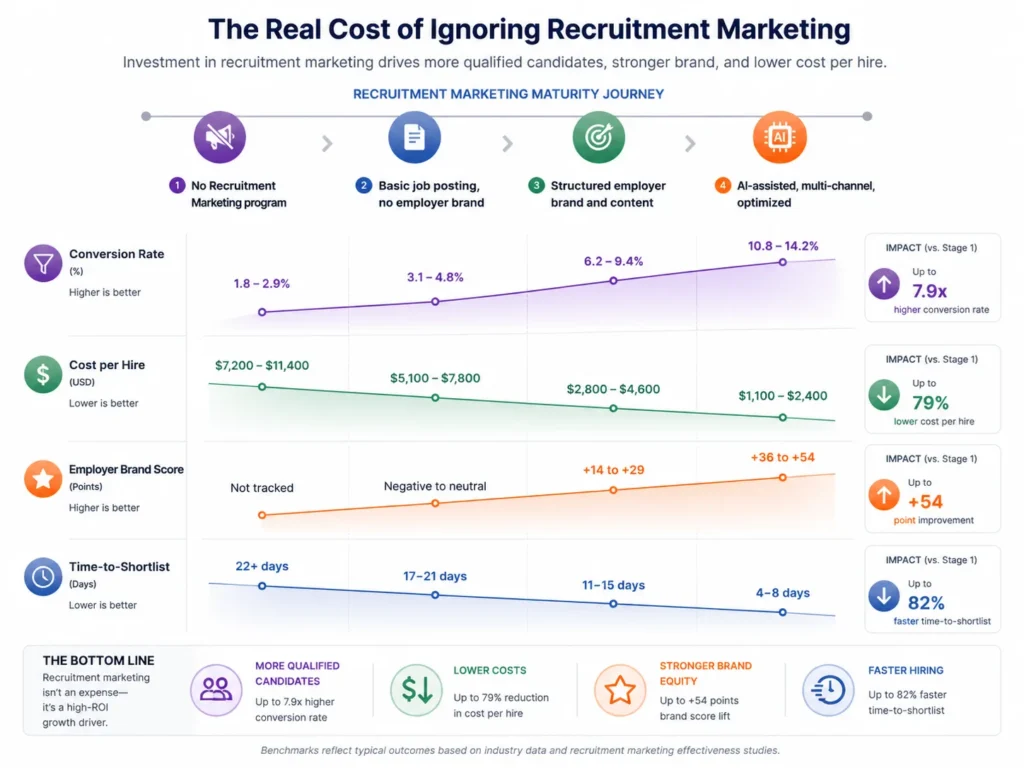
Cost per hire includes sourcing, advertising, agency fees, and internal recruiter time. Conversion rates reflect career site visitor-to-application completion across all inbound channels.
Related Terms
| Term | Definition |
|---|---|
| Employer Branding | The strategic management of an organization’s reputation as an employer, encompassing culture, values, and the employee value proposition communicated to potential and current employees |
| Candidate Persona | A research-based profile of the ideal candidate for a specific role or function, including motivations, career priorities, and information-seeking behaviors used to guide content and channel strategy |
| Talent Community | A managed network of opted-in potential candidates who have expressed interest in an organization but have not yet applied to a specific role, maintained through structured content and communication |
| Programmatic Advertising | Automated job advertisement distribution and budget optimization using algorithmic bidding across multiple job board and social media channels based on real-time performance data |
| Conversion Rate | The proportion of career site visitors, talent community subscribers, or advertising audience members who complete a defined candidate action such as submitting an application or joining a talent community |
| Passive Candidate | A qualified potential employee who is not actively seeking a new role but may consider a compelling opportunity if presented through the right channel with relevant, trust-building employer content |
Frequently Asked Questions
What is the difference between Recruitment Marketing and employer branding?
Employer branding defines what an organization stands for as an employer: its culture, values, and employee value proposition. Recruitment Marketing is the operational practice of communicating that brand through specific channels, content formats, and campaigns to attract and engage target candidate audiences. Employer branding is the strategy; Recruitment Marketing is the execution mechanism that brings it to the candidate audience.
How long does it take to see results from a Recruitment Marketing program?
Most organizations see measurable improvement in conversion rates and cost-per-application within one to two quarters of implementing structured Recruitment Marketing. Employer brand awareness improvements take longer, typically two to four quarters, to register in candidate perception data. Talent community pipeline value compounds over time and becomes most visible at the 12-month mark, when warm pipeline candidates begin to materially reduce time-to-shortlist for repeat role types.
Is Recruitment Marketing only relevant for large organizations?
No. Small and mid-size organizations often see proportionally larger ROI from Recruitment Marketing investment than large enterprises, because they are starting from a lower baseline employer brand awareness and competing against larger organizations with significantly bigger recruitment budgets. Authentic employee story content, deliberate social media presence, and a well-designed careers page are accessible at any scale and produce measurable competitive advantage in local or niche talent markets.
What technology does Recruitment Marketing require?
At minimum, a structured program requires a candidate relationship management platform to manage the talent community, a careers site with conversion tracking, and analytics integration that connects sourcing channels to application outcomes. More mature programs add programmatic advertising platforms, AI-powered content personalization, and employer brand measurement tools. The technology investment scales with program maturity; the foundational layer is accessible to most TA functions at moderate cost.
How is Recruitment Marketing performance measured?
The primary performance metrics are candidate conversion rate, cost per application, time-to-shortlist, talent community growth and engagement rate, and sourcing channel Quality of Hire score. Organizations at the most mature level of Recruitment Marketing connect pre-hire channel data to post-hire performance outcomes, measuring not just whether the channel produced applicants but whether those applicants became successful, long-tenured employees.
Can Recruitment Marketing reduce reliance on external agencies?
Yes, and agency cost reduction is one of the most quantifiable ROI measures for Recruitment Marketing investment. Organizations with mature employer brand and talent community infrastructure consistently report 30 to 60% reductions in agency dependency for regularly hired role types, as warm pipeline candidates replace cold agency-sourced candidates for a significant proportion of searches. The financial case for Recruitment Marketing is frequently most compelling when modeled directly against current agency spend.
Conclusion
Recruitment Marketing is not a communications function bolted onto the side of talent acquisition. It is the upstream investment that determines the quality, cost, and speed of everything downstream.
Organizations that build systematic Recruitment Marketing infrastructure, rooted in authentic employer branding, candidate persona-driven content, multi-channel engagement, and outcome-connected measurement, consistently outperform those relying on reactive sourcing across every talent acquisition metric that matters to the business.
The candidates you want most are being cultivated by organizations that started building their Recruitment Marketing program before today’s roles were open. The competitive question is not whether to invest in Recruitment Marketing. It is how much ground has already been ceded to those who started earlier.