Not every role belongs on a general job board.
When you are hiring for something specific, whether that is a nuclear engineer, a compliance specialist, or a senior data scientist, posting to a platform built for everyone often means being seen by almost no one relevant.
That is the problem niche job boards solve.
A niche job board is a specialised hiring platform focused on a specific industry, skill set, or candidate demographic, designed to connect employers with a more targeted applicant pool than general platforms can offer. For recruiters running active sourcing strategies in competitive or specialist fields, they are often the difference between a flooded inbox and a genuinely useful candidate pipeline.
Used well, niche job boards also improve candidate experience by putting opportunities in front of people who are already looking within that specific space. This guide covers how they work, when to use them, and how to get the most out of them.
The core metric governing niche job board performance is the Application-to-Interview Conversion Rate: the proportion of applications received from a specific board that advance to the interview stage, measuring the signal-to-noise quality of each sourcing channel.
Application-to-Interview Conversion Rate (%) = (Applications Advancing to Interview / Total Applications Received from Board) x 100
High-performing niche board deployments achieve Application-to-Interview Conversion Rates of 28-40%. General board averages typically sit at 8-14% for comparable specialist roles. The difference is not in the number of applications, niche boards typically produce fewer, but in the proportion of applications worth a recruiter’s time and evaluation capacity.
What is a Niche Job Board?
A niche job board is a recruitment platform whose design, audience, content, and community focus is built around a specific professional segment, whether defined by industry (healthcare, finance, technology), function (data science, legal, creative), career stage (executive, entry-level, freelance), demographic (veterans, diverse professionals), or geography (regional professional markets). The defining feature is audience specificity: the candidates who use a niche board do so because they identify with the community the board represents, not because they are doing broad job market reconnaissance.
The practical implication of this audience specificity is that niche board applicants arrive with a higher baseline of role-relevant context than general board applicants. A registered nurse applying through a healthcare-specific platform already understands the culture, credentialing requirements, and career expectations of their field in a way that makes their application more efficiently evaluable. A financial analyst applying through a finance-focused board has self-selected into a professional peer community that constitutes a meaningful quality signal before the resume is opened. This pre-qualification is the niche board’s core value proposition: not volume, but vertical alignment between posting context and applicant professional identity.
Why Niche Job Boards Deserve More Strategic Attention Than They Get?
Most TA teams treat job board selection as a sourcing checkbox: post to a major general board, post to LinkedIn, done. Niche boards appear in sourcing strategies occasionally, usually when someone has had a poor experience with the general board volume, but rarely as a deliberate strategic allocation backed by data. This default is expensive, and the evidence against it is both clear and widely ignored in most recruiting budget conversations.
The application volume economics are stark. A standard engineering role posted on a major general job board in a competitive market will receive an average of 180-250 applications within the first two weeks. Research from iCIMS found that 72% of general board applicants for technical roles do not meet the basic stated requirements of the job.
That means a recruiter investing time in initial screening is spending the vast majority of their effort on candidates who should never have applied, in a process that can consume 15-20 hours of skilled recruiter time to identify 8-10 genuinely viable candidates. The same role posted on a relevant niche board typically generates 30-60 applications with qualification rates above 55-65%. The recruiter who screens 45 applications and advances 28 is not doing less work than the recruiter who screens 220 and advances 18. They are doing better work, faster, on candidates who are worth the investment.
The less visible value of niche boards is their passive-candidate-adjacent reach. General boards almost exclusively attract active candidates, people who are actively looking for a job. Niche boards function as professional communities where practitioners browse for market intelligence, track industry opportunities, and maintain professional engagement even when they are not actively searching.
A cybersecurity professional reading industry content on a specialist platform is not a job seeker in the traditional sense; they are a community member who also happens to see relevant roles in their peripheral vision. This passive-adjacent audience is meaningfully different from the active-only population on general boards, and it is accessible through community participation rather than just job posting volume.
The ROI case for strategic niche board investment is direct. Consider a financial services firm making 40 specialist hires per year at an average cost-per-hire of $9,200. If shifting 30% of specialist postings from general to niche boards reduces average time-to-fill by 11 days for those roles, a conservative estimate based on higher application quality rates, the annual vacancy cost saving at $320 per role per day is approximately $42,240.
Against a niche board posting cost of $12,000 for the year, the net return exceeds 3:1, and that calculation does not include the recruiter time savings from screening fewer unqualified applications or the quality-of-hire improvement that higher applicant qualification rates consistently produce.
For TA leaders, the practical framework is a source-of-hire quality audit by board type for the previous twelve months. The findings in most organizations are consistent: niche board applicants convert to hired candidates at two to three times the rate of general board applicants for specialist roles, at lower screening cost per advanced candidate.
The data consistently supports a strategic shift from volume-maximizing general board dominance to targeted niche board investment for roles above a defined specialization threshold. Failing to make that shift is not a neutral default; it is an active decision to spend more time and money for lower-quality outcomes than the alternative sourcing strategy would produce.
Your Resume Isn’t Getting Read
Let’s Get That Fixed!
75% of resumes get auto-rejected. avua’s AI Resume Builder optimizes formatting, keywords, and scoring in under 3 minutes, so you land in the “yes” pile.
The Psychology Behind Niche Job Boards
Platform Signal as Professional Identity
The choice of job board is itself a signal. A candidate who uses a specialist platform to manage their job search is communicating something about their professional identity: they identify with the field strongly enough to participate in its dedicated community. This identity signal is distinct from the act of applying to a job, and it carries real information about the candidate’s level of professional engagement. Employers who post on niche boards are reaching candidates who have already self-selected into a professional category, which compresses the early-stage qualification work that general board applicants require and shifts the focus of initial screening toward genuine fit evaluation.
Community Trust and In-Group Credibility
Niche job boards function not just as listing platforms but as community spaces. They carry editorial content, industry news, salary data, and professional discussion that their audiences trust as peer-sourced. When a job posting appears in this community context, it inherits some of that trust. The employer posting on a healthcare-focused platform is implicitly positioning themselves as a community participant, not just a buyer of labor. This community credibility makes candidates more likely to engage with the posting, more likely to complete applications, and more likely to arrive at interviews with genuine enthusiasm rather than hedged interest based on applying speculatively to every opening in a category.
Reduced Noise and Decision Clarity
For candidates, the niche board experience is qualitatively different from the general board experience. General boards present an overwhelming volume of loosely relevant opportunities that produce decision fatigue and shallow engagement. Niche boards present a curated set of opportunities that are immediately recognizable as field-relevant, enabling candidates to evaluate them with more care and apply with more intention. This decision clarity translates into higher application completion rates, better-quality application materials, and more motivated candidate pipelines than general boards produce for the same types of specialist roles.
Niche Job Board vs. Related Sourcing Channels
| Source | Audience | Volume | Application Quality | Cost | Best For |
|---|---|---|---|---|---|
| Niche Job Board | Specialist, semi-passive | Low-Medium | High | Medium | Specialist and mid-senior roles |
| General Job Board | Broad active candidates | High | Low-Medium | Low | Volume and entry-level hiring |
| Professional Network (LinkedIn) | Semi-passive, broad | Medium | Medium-High | High | Senior and managerial roles |
| Employee Referral Program | Warm, curated | Low | Very High | Low | Culture-fit-critical roles |
| Campus Recruiting | Entry-level, targeted | Medium | Variable | Medium | Graduate and early career hiring |
What the Experts Say?
The best talent is not on the best-known platform. It is on the platform that serves their professional community. Posting to general boards and expecting specialist talent is like opening a general store and expecting specialty customers. You get browsers, not buyers.
– Lou Adler, CEO, The Adler Group; Author, Hire With Your Head
How to Measure Niche Job Board Effectiveness?
Formula
Application-to-Interview Conversion Rate (%) = (Applications Advancing to Interview / Total Applications from Board) x 100
Source Quality Score (%) = (Hires from Board Meeting 12-Month Performance Benchmark / Total Hires from Board) x 100
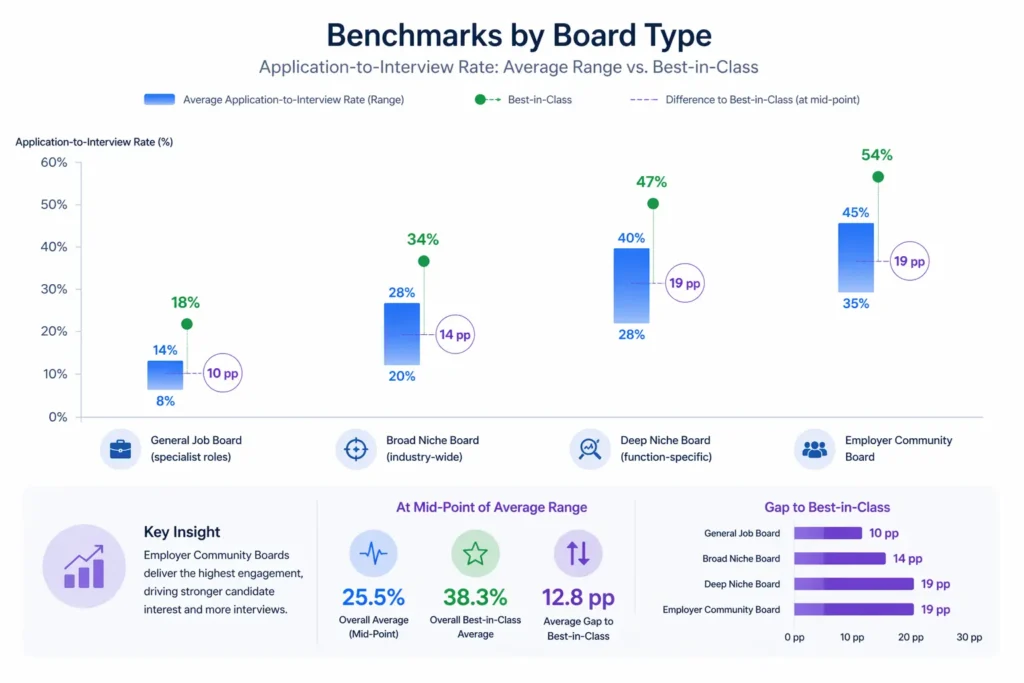
Benchmarks by Board Type
| Board Type | Avg. Application-to-Interview Rate | Best-in-Class |
|---|---|---|
| General Job Board (specialist roles) | 8-14% | 18% |
| Broad Niche Board (industry-wide) | 20-28% | 34% |
| Deep Niche Board (function-specific) | 28-40% | 47% |
| Employer Community Board | 35-45% | 54% |
Key Strategies for Effective Niche Job Board Deployment
How Can AI and Automation Support Niche Job Board Strategy?
AI-Powered Platform Selection and Targeting
AI tools can analyze the professional profiles of past successful hires to identify which platforms they were most likely to be discoverable on, cross-referencing role requirements with community data to recommend the most relevant niche boards for each role type. This data-driven platform selection is substantially more precise than manual research into board options and removes the guesswork from niche board strategy, replacing preference-based decisions with evidence-based sourcing channel allocation.
Automated Multi-Board Distribution and Performance Tracking
Programmatic job advertising platforms can distribute postings across a curated set of niche boards simultaneously, track performance in real time by source, and automatically reallocate budget from underperforming boards to high-performing ones. This automation makes multi-board strategies operationally manageable for TA teams without large sourcing resource pools and produces continuous source-quality learning that informs future allocation decisions without manual reporting overhead.
Niche Community Intelligence and Passive Candidate Identification
AI-powered sourcing tools can analyze professional community platforms, including niche job boards’ content and engagement layers, to identify passive candidates who are professionally active without being on the active job market. This community signal, the engineer who comments on technical articles or the nurse who participates in professional forum discussions, is a meaningful indicator of professional engagement that complements formal application data and opens access to candidate populations otherwise invisible to standard ATS-driven sourcing.
Source Attribution and Quality Analytics
AI analytics platforms can connect hiring outcomes back to sourcing channels across the full candidate journey, producing source-of-hire quality data at the twelve-month performance level rather than just the placement level. This attribution analysis is the foundation of an evidence-based niche board strategy: one that allocates budget based on which sources produce the strongest performers, not the highest application volumes, and builds a compounding competitive advantage in the specialist talent markets that matter most to the business.
Stop Juggling
10 Job Boards.
Search One
Your next role is already here. avua pulls opportunities from across the web into a single searchable feed; filtered by role, location, salary, and remote preference.
1.5 Million+
Active Jobs
380+
Job Categories
Niche Job Boards and Equitable Hiring Practices
Niche Boards as Targeted Diversity Sourcing Channels
Many of the most effective diversity sourcing channels operate as niche job boards: platforms focused on historically underrepresented professional communities, HBCUs, veteran employment networks, and disability inclusion recruitment platforms. For organizations with specific DEI sourcing goals, niche boards built around underrepresented professional communities are often more effective than diversity initiatives layered onto broad-reach general platforms, because they reach candidates who have self-identified with communities the organization is specifically trying to connect with.
Language and Representation in Specialist Postings
Niche boards attract specialist audiences who evaluate postings with professional expertise, which means exclusive or unnecessarily narrow language in job descriptions is quickly identified and actively discourages strong candidates. Specialist candidates on niche boards can assess whether a job description reflects genuine understanding of their field or is a generic template with technical vocabulary inserted. Organizations that invest in expert-reviewed, community-appropriate job descriptions for niche board postings achieve significantly higher application completion rates from the audiences those boards serve, compared to organizations posting repurposed general board content.
Platform Diversity and the Risk of Homophily
Restricting niche board strategy to the same two or three dominant platforms in a given specialty reproduces the demographic composition of those platforms’ user bases. Actively diversifying the niche boards in a sourcing strategy, including platforms that serve professional communities the dominant platforms underserve, is the sourcing-level intervention for building more diverse specialist pipelines. This requires deliberate research into which communities are underserved by dominant platforms, but the investment pays dividends in both pipeline quality and demographic representation that purely volume-driven sourcing strategies consistently fail to achieve.
Common Challenges and Solutions
| Challenge | Solution |
|---|---|
| Insufficient application volume on niche boards for time-sensitive hires | Supplement niche board postings with targeted sourcing from the board’s resume database; combine passive outreach with active posting for volume-constrained timelines |
| Difficulty identifying the right niche board for an unfamiliar role type | Survey recent hires in similar roles about their platform preferences; consult specialized recruiting communities for board recommendations by function and geography |
| Niche board investment difficult to justify against general board volume metrics | Shift performance reporting to quality metrics such as Application-to-Interview Rate and Quality of Hire by source; model the recruiter time savings from higher application qualification rates |
Real-World Case Studies
Case Study 1: The Cybersecurity Firm
A 300-person cybersecurity company had relied exclusively on LinkedIn and general technology job boards for all hiring. After conducting a source-of-hire audit, they discovered their Application-to-Interview Conversion Rate on general boards for security engineering roles was 9%, compared to 38% on two specialist security job boards in their market.
They shifted 65% of security engineering sourcing budget to niche boards while maintaining general board presence for non-specialist roles. Average screening time per role fell from 34 recruiter-hours to 14. Time-to-fill for security engineering fell from 58 days to 39 days, and Quality of Hire scores at twelve months were 18% higher for niche board sourced candidates than for general board sourced candidates in the same role family.
Case Study 2: The Environmental Nonprofit
A national environmental nonprofit was struggling to fill ten specialized policy analyst roles, receiving high volumes of applications from general boards with very low qualification rates. Switching their posting strategy to two environment-sector specialist boards and one sustainability-focused professional community platform cut application volume by 70% while increasing the proportion of applications meeting basic qualifications from 14% to 61%.
All ten roles were filled within 45 days at an average cost-per-hire 22% below the organization’s general board average, including the niche board posting fees and the community content investment that accompanied the platform shift.
Case Study 3: The Rural Healthcare System
A healthcare system serving a rural geographic market found that its traditional job board strategy, optimized for urban markets, produced near-zero results for rural clinical roles. After identifying three regional healthcare-specific job boards and two community health professional networks, the team rebuilt their posting strategy around these platforms.
Combined with employer community content investment over six months, the niche board strategy produced a pipeline of 67 qualified nurses for positions that had been vacant for an average of eight months. Thirty-two positions were filled within the first quarter of the new strategy, the highest quarterly fill rate in the organization’s history for clinical roles.
Measuring Niche Job Board Success: Key Performance Indicators
Niche Job Boards Across the Recruitment Lifecycle
Sourcing Strategy and Platform Selection Stage
Effective niche board use begins in the sourcing strategy phase, before a job is posted. The right question is not “which boards do we use?” but “where does our ideal candidate’s professional community live online?” Answering this question for each significant role family in the hiring plan and building a board portfolio that reflects those community maps is the foundational planning work that separates strategic niche board deployment from reactive posting decisions made in the week a requisition opens.
Job Posting Optimization Stage
Posting on a niche board requires different content strategy than posting on a general board. Specialist audiences evaluate postings for evidence of genuine field understanding. They can identify boilerplate technical language immediately and discount it. Job postings on niche boards that demonstrate cultural authenticity, specific technical fluency, and genuine community engagement outperform generic postings by significant margins. This requires hiring manager input into the posting and periodic review of how postings perform relative to community content on each specific platform.
Application Management and Screening Stage
The screening stage on niche boards should be calibrated to their higher baseline qualification rates. Applying general-board screening protocols, wide initial filtering and long initial review sequences, to niche board applications is inefficient and risks alienating engaged specialist candidates with slow process responses. Niche board applications typically benefit from faster initial screening decisions and more direct recruiter engagement, reflecting the higher baseline intent and qualification of the candidate pool that self-selected into the specialist community.
Offer and Placement Stage
Candidates sourced through niche boards tend to be more informed about market compensation and career alternatives than general board applicants, because they participate in professional communities that discuss these topics actively. This market awareness makes the offer stage more competitive: niche board candidates are more likely to be evaluating multiple opportunities, more likely to have current market data, and more likely to push back on below-market offers. Compensation data inputs to the offer stage should reflect the specialist market the niche board serves, not general market averages that may not reflect the specific community’s compensation benchmarks.
The Real Cost of Ignoring Niche Board Strategy
| Scenario | Board Strategy | Avg. Application-to-Interview Rate | Recruiter Time per Hire (specialist roles) |
|---|---|---|---|
| General boards only | Broad reach, undifferentiated | 9-12% | 28-34 recruiter-hours |
| Mixed strategy | General and selective niche | 18-22% | 18-22 recruiter-hours |
| Niche-primary strategy | Niche board led, general supplemental | 30-40% | 12-16 recruiter-hours |
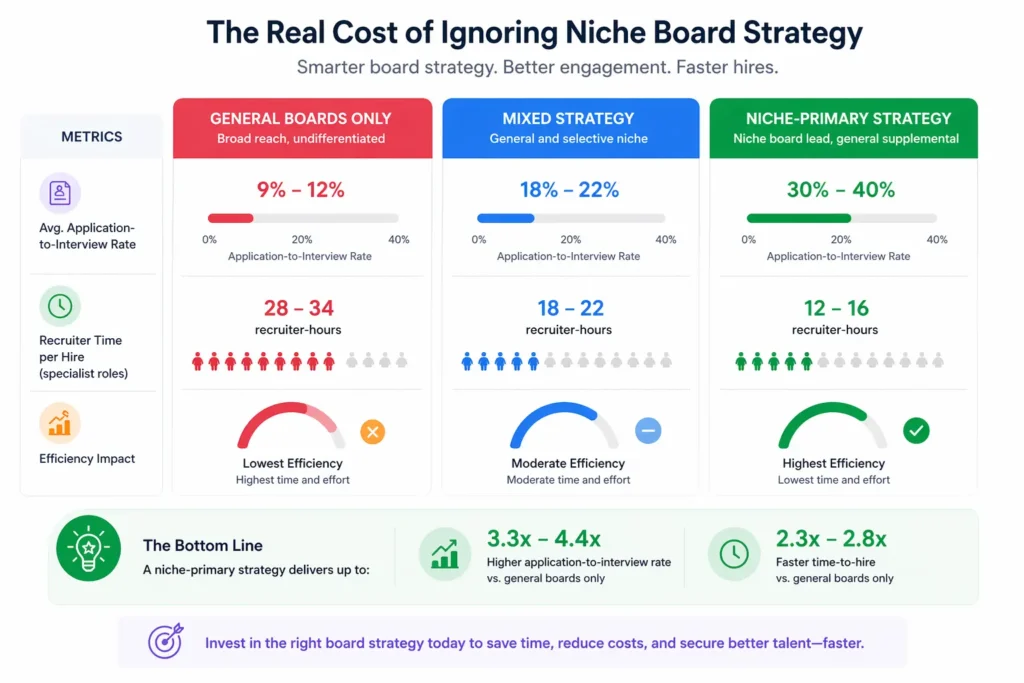
Recruiter time includes initial screening, communication, and pipeline management per role through to shortlist delivery. Savings on specialist roles scale directly with the degree of niche board adoption in the sourcing mix.
Related Terms
| Term | Definition |
|---|---|
| Job Board | An online platform listing employment opportunities where employers post roles and candidates submit applications |
| Candidate Pipeline | The pool of potential candidates at various stages of engagement who could fill current or future roles |
| Active Sourcing | The proactive identification and outreach to potential candidates rather than waiting for inbound applications |
| Employer Branding | The practice of managing and communicating an organization’s reputation and value proposition as an employer to prospective candidates |
| Candidate Persona | A research-based profile of the ideal candidate for a role, including professional background, motivations, platform preferences, and career goals |
Frequently Asked Questions
What is a niche job board?
A niche job board is a specialized recruitment platform focused on a specific industry, profession, function, or professional community, designed to attract a targeted audience of candidates with relevant professional characteristics. Examples include boards for healthcare professionals, cybersecurity specialists, legal professionals, environmental sector roles, and underrepresented professional communities.
When should a company use a niche job board versus a general job board?
Niche job boards are typically the better choice for roles requiring specialist skills, domain-specific experience, or professional credentialing. General job boards are more appropriate for volume hiring, broad functional roles, and positions where the candidate pool is large relative to the number of vacancies. Most organizations benefit from a mixed strategy calibrated to role type rather than defaulting uniformly to either approach.
Are niche job boards worth the additional cost?
For specialist roles, the answer is consistently yes when evaluated on quality metrics rather than volume metrics. The higher cost-per-posting on niche boards is offset by lower cost-per-advanced-candidate, lower recruiter screening time, and higher Quality of Hire scores for the candidates they produce. The ROI is most evident in roles where general board qualification rates fall below 15%.
How do you find the right niche job board for your role?
Start by surveying recent hires in similar roles about where they found the position and which platforms they use for professional development. Supplement with research into professional associations and communities in the target field, as most have associated job boards or career resources that represent the community’s preferred job search channel. LinkedIn Talent Blog and ERE Media publish regular analyses of sourcing channel performance by function that can also inform the selection process.
Do niche job boards improve diversity hiring?
They can, if selected deliberately. Many effective diversity sourcing channels operate as niche boards, including platforms focused on specific underrepresented professional communities, HBCUs, veteran networks, and inclusion-focused professional associations. The DEI impact of niche board strategy depends on which boards are included in the sourcing mix, not on the niche board format itself.
Conclusion
The niche job board is not a secondary sourcing channel.
It is the primary sourcing channel for any role where professional specialization is a genuine requirement. The evidence is consistent: higher qualification rates, lower screening cost per advanced candidate, better Quality of Hire scores, and access to the passive-adjacent professional communities that general boards cannot reach.
The organizations that treat niche board strategy as a deliberate allocation decision, mapping role types to platform communities, tracking quality metrics by source, and investing in community presence rather than just job postings, consistently outperform those still defaulting to volume-first general board strategies for roles that do not reward undifferentiated volume.