Pay is personal. And when employees suspect that someone doing the same job is earning more for reasons that have nothing to do with performance, the damage to trust, morale, and retention is swift and rarely recoverable.
Equity pay is not just an HR principle, it is a business imperative that organisations are increasingly being held accountable for, both internally and publicly.
Equity pay refers to the practice of ensuring employees are compensated fairly and consistently based on objective factors such as role, experience, and performance, free from bias related to gender, ethnicity, or background. It sits at the intersection of base salary strategy and DEI commitment, and it requires more than good intentions to get right.
For HR teams, equity pay connects directly to employee retention. Compensation inequity is one of the leading drivers of voluntary attrition, particularly among high performers who have the market options to act on their dissatisfaction. Tracking and addressing pay gaps also feeds into broader HR analytics work that links compensation data to workforce health over time.
This guide covers what equity pay means in practice, how to audit for gaps, and how to build a compensation framework that holds up to scrutiny.
The core metric governing pay equity analysis is the Adjusted Pay Gap: the unexplained difference in compensation between demographic groups after controlling for legitimate variables such as role, level, tenure, geography, and performance rating.
Adjusted Pay Gap (%) = ((Avg. Compensation of Group A - Avg. Compensation of Group B) / Avg. Compensation of Group A) x 100
Organizations with robust pay equity programs maintain adjusted gaps below 2%. The industry median adjusted pay gap, after controlling for role and level, sits between 5% and 8% for gender and between 6% and 11% for racial and ethnic groups in the United States, according to Payscale’s Compensation Best Practices Report.
What is Pay Equity?
A performance review (also called a performance appraisal, performance evaluation, or performance assessment) is a structured, periodic process through which a manager formally evaluates an employee’s performance against pre-defined expectations, goals, and competencies, documents the assessment, provides feedback, and uses the findings to inform decisions about compensation, promotion, development, and in some cases continued employment.
Pay equity is the organizational practice of ensuring that all employees receive compensation that is fair, consistent, and free from bias based on protected characteristics, for work of equal or comparable value. It distinguishes between equal pay (identical compensation for identical roles) and equitable pay (fair compensation for roles of comparable worth, assessed against objective criteria of skill, responsibility, and effort).
Pay equity is both a legal requirement and a strategic discipline. Legal frameworks including the Equal Pay Act of 1963, Title VII of the Civil Rights Act, and a growing body of state-level pay equity legislation establish minimum compliance obligations. The strategic discipline extends beyond compliance: organizations that achieve genuine pay equity report measurably better retention rates, higher employee engagement scores, and stronger employer brand performance than those operating with unexplained pay disparities.
Why Pay Equity Is a Business-Critical Function, Not Just an HR Metric?
The framing of pay equity as a compliance or HR function systematically underestimates its strategic and financial consequences. When pay inequity becomes visible, the costs are not confined to legal exposure. They extend to talent loss, brand damage, and the compounding organizational cost of replacing the employees who discover they are being underpaid and leave.
The research on pay equity’s organizational impact is unambiguous. A Glassdoor Economic Research study found that 60% of employees who discover they are paid below market or below internal equity benchmarks begin active job searching within six months of that discovery. For the median professional role with a replacement cost of 1.5 to 2 times annual salary, the attrition cost of unaddressed pay inequity is straightforwardly calculable and consistently exceeds the cost of remediation.
The regulatory environment has intensified this calculus considerably. As of 2026, 23 U.S. states have enacted pay equity legislation that goes beyond federal baseline requirements, including mandatory pay range disclosure in job postings, prohibition on salary history inquiries, and in some jurisdictions, mandatory pay equity audit reporting. Organizations operating across multiple states face a compliance landscape that makes ad hoc pay management legally untenable. A pay equity audit that identifies and corrects disparities proactively is categorically less expensive than litigation that identifies and publicizes them after the fact.
The ROI math for proactive pay equity investment is direct. A mid-size organization of 500 employees conducting a comprehensive pay equity audit and remediation at a cost of approximately $80,000 in consulting, analytics, and remediation budget can expect to recover that investment within 18 months through reduced attrition alone, if the remediation retains even two or three senior employees who would otherwise have left. The organizational value of those retained employees, measured against their replacement cost, typically exceeds the remediation investment by a ratio of 3:1 to 6:1.
For HR and compensation leaders, the practical conclusion is clear: pay equity analysis should be a scheduled, recurring organizational practice, not a one-time compliance exercise. Organizations that treat pay equity as an annual audit rather than a continuous monitoring discipline consistently find that disparities re-emerge between audit cycles due to inconsistent offer-making, promotion decision variability, and manager discretion in performance-based pay allocation.
Your Resume Isn’t Getting Read
Let’s Get That Fixed!
75% of resumes get auto-rejected. avua’s AI Resume Builder optimizes formatting, keywords, and scoring in under 3 minutes, so you land in the “yes” pile.
The Psychology Behind Pay Equity
Perceived Fairness and the Motivation-Pay Relationship
Equity theory, originally developed by psychologist John Stacey Adams, establishes that employee motivation is directly tied to their perception of fairness in the exchange relationship with their employer. When employees perceive their compensation as inequitable relative to colleagues performing comparable work, they respond with predictable behavioral adjustments: reduced effort, reduced engagement, and ultimately, departure. The critical insight is that perceived pay inequity, even when the underlying data does not confirm actual inequity, produces the same behavioral response as actual inequity. Transparency and communication about how pay decisions are made is therefore as important as the accuracy of the pay decisions themselves.
Pay Transparency and Social Comparison Effects
Pay transparency initiatives, now legally mandated in many jurisdictions and voluntarily adopted by a growing number of organizations, have introduced a social comparison dynamic that did not previously exist at scale. When employees can see the pay ranges for their roles and adjacent roles, they apply social comparison processes automatically and continuously. Organizations that have conducted pay equity remediation before implementing transparency find the transition significantly less disruptive than those that implement transparency before addressing existing disparities. The sequence matters: equity first, then transparency, produces collaborative trust. Transparency first, equity second, produces grievances.
Anchoring and the Salary History Trap
The single most documented mechanism through which historical pay inequity perpetuates is salary history anchoring: the practice of setting new hire compensation as a percentage increase over prior compensation, regardless of the market rate or internal equity implications. Because prior compensation frequently reflects historical discrimination rather than market value, salary history anchoring compounds inequity with each job change. The jurisdictions that have banned salary history inquiries have produced measurable pay gap reductions within three to five years of the ban taking effect, confirming that anchoring is a primary mechanism of perpetuation, not just a correlated variable.
Pay Equity vs. Related Compensation Concepts
| Concept | Definition | Scope | Legal Basis | Primary Tool |
|---|---|---|---|---|
| Equal Pay | Same pay for identical work | Role-specific | Equal Pay Act 1963 | Role comparison |
| Pay Equity | Fair pay for comparable work | Cross-role | Title VII and state laws | Job evaluation system |
| Pay Transparency | Disclosure of pay ranges and criteria | Organization-wide | State pay disclosure laws | Communication policy |
| Pay Parity | Elimination of all demographic pay gaps | Demographic | Voluntary and regulatory | Statistical audit |
| Market Pricing | Compensation set against external benchmarks | Role and level | None (voluntary) | Salary surveys |
The critical distinction between equal pay and pay equity is scope. Equal pay addresses the narrow case of two people in the same role being paid differently. Pay equity addresses the broader case of roles that are different but comparable in value being compensated inequitably across demographic lines, which is where the largest and most persistent pay gaps reside.
What the Experts Say?
Closing the gender pay gap requires more than good intentions. It requires organizations to examine the structures, processes, and norms that silently generate unequal outcomes, and to redesign those structures with the same rigor they would apply to any other business performance problem.
– Claudia Goldin, Nobel Laureate in Economic Sciences, Harvard University
How to Measure Pay Equity?
Formulas
Adjusted Pay Gap (%) = ((Avg. Pay Group A - Avg. Pay Group B) / Avg. Pay Group A) x 100
Unadjusted Pay Gap (%) = ((Median Pay Group A - Median Pay Group B) / Median Pay Group A) x 100
Compa-Ratio = (Employee's Actual Salary / Midpoint of Salary Range) x 100
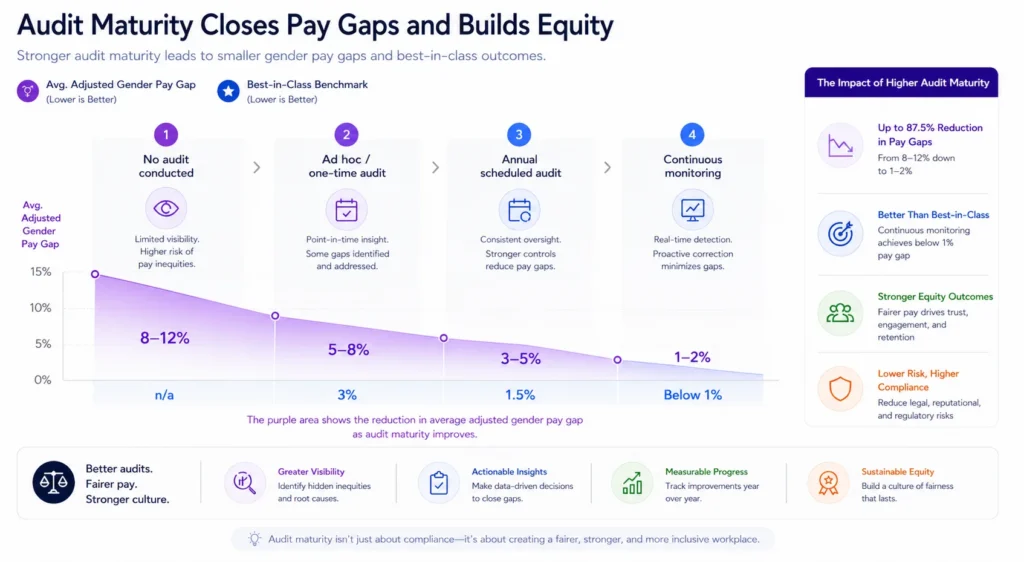
Benchmarks by Audit Maturity
| Audit Maturity | Avg. Adjusted Gender Pay Gap | Best-in-Class |
|---|---|---|
| No audit conducted | 8-12% | n/a |
| Ad hoc / one-time audit | 5-8% | 3% |
| Annual scheduled audit | 3-5% | 1.5% |
| Continuous monitoring | 1-2% | Below 1% |
Key Strategies for Achieving Pay Equity
How Can AI and Automation Support Pay Equity?
Real-Time Compensation Benchmarking
AI-powered compensation intelligence platforms aggregate real-time salary data from job postings, compensation surveys, and market transactions to provide role-level pay benchmarks that are continuously updated rather than annually refreshed. This eliminates the 12 to 18-month lag between market movement and compensation adjustment that characterizes survey-based benchmarking, and reduces the frequency with which organizations find themselves below-market before they know it.
Automated Pay Equity Audit and Gap Detection
Machine learning models can analyze an organization’s full compensation dataset, controlling for legitimate pay variables including role, level, geography, tenure, and performance rating, to identify statistically significant disparities across demographic groups. This automated analysis, which previously required weeks of consultant time, can now be completed in hours, enabling pay equity audits to run quarterly or continuously rather than annually.
Offer Equity Screening
AI-powered offer management tools can flag offers that would create internal equity anomalies before the offer is extended, surfacing cases where a new hire’s proposed compensation would exceed that of an existing employee in a comparable role with more tenure. This pre-offer equity check converts a reactive audit function into a proactive compensation governance tool.
Predictive Pay Risk Modelling
Predictive analytics can identify which employees are most at risk of discovering pay inequity and departing, based on their compensation positioning relative to internal peers and external market rates, combined with engagement and tenure signals. This allows compensation leaders to prioritize remediation sequences based on flight risk rather than treating all identified disparities as equally urgent.
Stop Juggling
10 Job Boards.
Search One
Your next role is already here. avua pulls opportunities from across the web into a single searchable feed; filtered by role, location, salary, and remote preference.
1.5 Million+
Active Jobs
380+
Job Categories
Pay Equity, Equity, and the Ethics of People Decisions
Structural vs. Individual Bias in Compensation
Pay inequity in most organizations is not primarily the product of individual managers making consciously discriminatory pay decisions. It is the product of structural processes: salary history anchoring, inconsistent job evaluation, manager discretion in performance pay allocation, and offer variability not governed by equity criteria, that produce inequitable outcomes without requiring discriminatory intent. This distinction matters because individual bias interventions (training, awareness) do not fix structural process problems. Structural fixes, including standardized offer processes, consistent performance pay criteria, and regular equity audits, are required to address structurally generated inequity.
Pay Transparency and Psychological Safety
Pay transparency initiatives only achieve their equity potential if employees feel psychologically safe to raise concerns about their compensation without fear of professional consequence. Organizations that implement transparency in environments of low psychological safety find that the transparency surfaces awareness of inequity without providing a mechanism for addressing it, which produces grievances rather than resolution. Transparency paired with a clear, accessible, and non-retaliatory process for raising compensation concerns is the combination that produces genuine equity improvement.
Intersectionality in Pay Gap Analysis
Standard pay equity audits analyze gender and race as independent variables. Intersectional analysis, which examines pay gaps at the intersection of multiple demographic characteristics such as Black women, women over 50, or women with disabilities, consistently reveals larger and more persistent gaps than single-variable analysis. Organizations committed to genuine pay equity should conduct intersectional analysis as part of their audit methodology, even though it requires larger datasets and more sophisticated statistical modelling. EEO compliance provides the legal framework; intersectional equity extends well beyond it.
Common Challenges and Solutions
| Challenge | Solution |
|---|---|
| Compensation data is siloed across systems and difficult to aggregate | Invest in a centralized compensation data infrastructure before attempting audit; this is the prerequisite for any meaningful analysis |
| Business leaders resist remediation costs in tight budget environments | Model the cost of inaction: attrition cost, litigation risk, employer brand impact; frame remediation as ROI-positive over 18 to 24 months |
| Pay bands exist but are applied inconsistently across managers | Audit placement decisions within bands, not just band ranges; inconsistent placement is where manager discretion reintroduces inequity |
Real-World Case Studies
Case Study 1: The Technology Company
A 1,200-person technology company conducted its first pay equity audit following a state-mandated pay transparency requirement in its primary operating state. The audit identified an adjusted gender pay gap of 6.8% after controlling for role, level, and tenure, concentrated in senior engineering and product management roles. The company implemented a phased remediation over two salary cycles, prioritizing the highest individual gaps and the roles with the greatest flight risk. By the end of the second cycle, the adjusted gap had declined to 1.4%. Voluntary attrition among women in the affected cohort fell 31% in the 18 months following the first remediation round.
Case Study 2: The Financial Services Organization
A regional financial services firm discovered during an M&A due diligence process that the target company carried significant pay equity risk: an unadjusted gender pay gap of 22% and an adjusted gap of 9.4%. The acquirer negotiated a remediation reserve into the transaction structure and conducted a full compensation reset for the acquired organization within 90 days of close. The proactive remediation, communicated transparently to the combined workforce, was cited as a significant factor in the above-average retention rate of target company employees in the 12 months post-acquisition.
Case Study 3: The Retail Organization
A national retail chain implemented AI-powered continuous pay equity monitoring across its 8,000-employee workforce after two consecutive years of pay equity litigation from former employees. The monitoring system flagged offer-stage anomalies in real time, identifying 34 offers in the first six months that would have created internal equity violations if extended as proposed. Managers were notified before offers were made and adjusted 29 of the 34. The cost of the monitoring system in year one was $42,000. The legal cost of the two preceding pay equity cases had been $380,000.
Pay Equity Metrics That Drive Actionable Decisions: What to Track
Pay Equity Across the Employee Lifecycle
Attraction and Offer Stage
The offer stage is the highest-risk compensation decision point in the employee lifecycle. Offers made without reference to internal equity positioning or structured market benchmarking introduce individual pay disparities that persist and compound throughout the employee’s tenure. Organizations that implement offer equity review as a standard governance step reduce their audit finding volume substantially, because they are catching disparities at the point of creation rather than discovering them retrospectively.
Performance and Promotion Cycles
Performance-based pay allocation is the primary mechanism through which post-hire pay inequities are generated and amplified. When performance ratings are themselves subject to bias, and research consistently shows they are particularly for women and employees from underrepresented racial groups, and those ratings drive pay decisions, the compensation impact of rating bias compounds across every performance cycle. Addressing pay equity without addressing performance review equity addresses the symptom without the cause.
Retention and Exit
Pay inequity is a leading driver of voluntary attrition among high-performing employees who have sufficient external options to act on their dissatisfaction. The employees most likely to discover and respond to pay inequity are also the employees most likely to be recruited by competitors who can offer market-rate compensation. This selection effect means that unaddressed pay inequity disproportionately drives out the employees whose retention is most valuable to the organization.
Exit Analysis and Equity Signal
Exit interview data, properly analyzed for pay-related departure reasons and cross-referenced against the departing employee’s compensation positioning, provides a leading indicator of pay equity risk before it surfaces in audit data or litigation. Organizations that systematically analyze pay-related exit signals and route them to compensation leadership for review can identify structural equity problems earlier and more cheaply than those that rely on periodic audits alone.
The Real Cost of Pay Inequity
| Scenario | Audit Approach | Adjusted Pay Gap | Annual Attrition Cost (500 employees) |
|---|---|---|---|
| No audit conducted | None | 8-12% | $420,000+ |
| Annual audit, partial remediation | Reactive | 5-7% | $245,000 |
| Annual audit, full remediation | Structured | 2-4% | $110,000 |
| Continuous monitoring | Proactive | Below 2% | $48,000 |
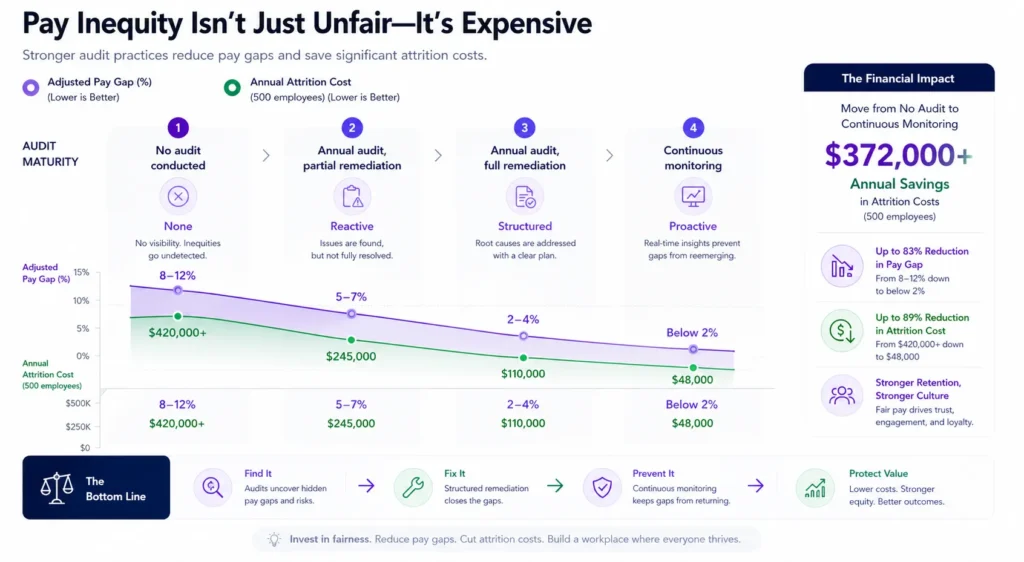
Attrition cost assumes 8% annual voluntary attrition in the affected demographic group, average replacement cost of $35,000 per employee, with pay inequity driving 25% of that attrition.
Related Terms
| Term | Definition |
|---|---|
| Equal Pay | The requirement to pay employees in identical roles the same compensation regardless of protected characteristics |
| Pay Transparency | The organizational practice of disclosing salary ranges, pay criteria, and compensation structures to employees and candidates |
| Compensation Band | A defined range of pay for a role or role family, used to structure and govern pay decisions |
| Pay Gap | The difference in compensation between two groups, either unadjusted (raw median) or adjusted after controlling for role variables |
| Job Evaluation | A systematic process for determining the relative value of roles within an organization, used as the foundation for equitable pay structures |
Frequently Asked Questions
What is the difference between pay equity and pay equality?
Pay equality means paying the same amount for the same job. Pay equity is broader, addressing whether roles of comparable value, even if different in title or function, are compensated fairly across the organization and across demographic groups.
How often should organizations conduct pay equity audits?
Annual audits are the minimum standard for organizations with more than 100 employees. Organizations operating in jurisdictions with active pay equity legislation, or those with more than 500 employees, should implement continuous monitoring with quarterly review of flagged disparities.
Does pay transparency improve pay equity?
Pay transparency is positively correlated with reduced pay gaps, but only when implemented after organizations have already addressed existing disparities. Transparency without prior remediation surfaces existing inequities without immediately resolving them, which can damage trust before improvements are in place.
Can AI fully automate pay equity analysis?
AI can automate the data aggregation, statistical analysis, and anomaly flagging components of pay equity work. It cannot replace the human judgment required to determine whether an identified disparity reflects genuine inequity or a legitimate pay variable not captured in the data model. The combination of AI analysis and human review produces the most reliable audit outcomes.
What legal risks does pay inequity create?
Pay inequity creates exposure under the Equal Pay Act, Title VII, the Age Discrimination in Employment Act, and applicable state equivalents. In jurisdictions with mandatory pay equity audit requirements, failure to conduct and remediate documented disparities creates additional regulatory exposure. According to EEOC enforcement data, class action settlements in pay equity cases average $2.7 million, making proactive remediation the more defensible financial choice.
Conclusion
Pay equity is not a compliance checkbox or an HR project. It is a foundational element of organizational trust, and an organization’s trust with its employees is the most durable competitive advantage it holds in the talent market.
The organizations that have moved from aspiration to architecture on pay equity, building audit cycles, offer governance, and continuous monitoring into their compensation infrastructure, are consistently outperforming their peers on retention, employer brand, and quality of hire. The cost of achieving pay equity is always less than the cost of litigating, re-recruiting for, and reputationally managing pay inequity after it surfaces.
Treat pay equity as a continuous organizational discipline, not a periodic remediation, and the business case will sustain itself.