Most HR decisions are made looking backwards.
Who left last quarter, which roles took longest to fill, where engagement dropped before someone resigned. Predictive analytics flips that entirely, giving HR and hiring teams the ability to anticipate what is likely to happen next rather than simply explaining what already did.
Predictive analytics in HR is the use of historical data, statistical modelling, and machine learning to forecast future workforce outcomes, from flight risk and performance trajectories to hiring success rates and headcount needs. It transforms HR analytics from a reporting function into a genuine strategic capability, one that informs decisions before problems surface rather than after they cost the business.
The applications are wide-ranging. Predictive models can identify which employees are most likely to leave before they hand in notice, giving HR teams a window to act on employee retention before attrition becomes a pattern. In recruitment, the same logic applies to data-driven recruiting, helping teams prioritise candidates most likely to convert, perform, and stay.
For organisations serious about employee engagement and workforce planning, predictive analytics is quickly moving from competitive advantage to operational expectation.
The core metric governing predictive analytics effectiveness in HR contexts is the Predictive Model Accuracy Rate: the correlation between model-generated predictions and actual observed outcomes, measured retrospectively across a defined population and time window.
Predictive Model Accuracy Rate (%) = (Correct Predictions / Total Predictions Made) x 100
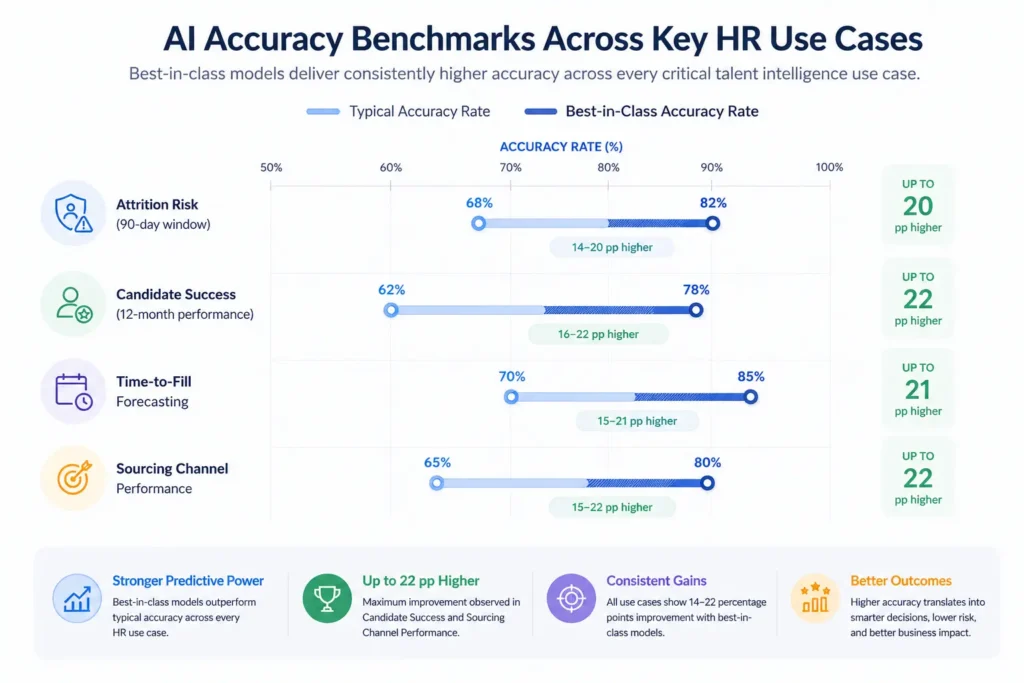
For attrition prediction models at the individual employee level, accuracy rates above 75% are considered strong. For hiring success prediction models forecasting whether a candidate will be in role and performing above threshold at 12 months, accuracy rates of 65-80% represent best-in-class performance across current commercial platforms. Rates below 55% indicate a model providing marginal value over random selection and should be recalibrated or replaced before further decisions are built upon its output.
What is Predictive Analytics in HR?
Predictive analytics in HR is the use of statistical algorithms, machine learning models, and structured historical workforce data to generate quantified forecasts of future talent-related outcomes, including individual candidate success probability, employee flight risk, workforce supply projections, time-to-fill modeling, and optimal sourcing channel prediction. It enables HR and talent acquisition leaders to make proactive, data-informed decisions rather than reactive, intuition-based ones.
The distinguishing feature of predictive analytics relative to descriptive analytics is directionality: descriptive analytics explains the past (average time-to-fill was 44 days last quarter); predictive analytics forecasts the future (this role will take 52 days to fill given current market conditions and pipeline state). That directional shift, from understanding history to anticipating outcomes, is what gives predictive analytics its strategic value in workforce planning and talent acquisition contexts.
Why Predictive Analytics Is Redefining How Organizations Plan for Talent?
The case for predictive analytics in HR is not primarily about technology sophistication. It is about the scale of the decisions that HR and talent acquisition functions make, and the cost of making those decisions poorly.
Consider the decision architecture of a mid-sized organization making 200 hires per year. Each hire involves a sourcing investment, a screening investment, an interview investment, an offer, and a 90-day onboarding period. Each bad hire costs an estimated 30-150% of first-year salary in replacement and productivity loss. Each month a critical role sits vacant costs the organization in reduced output, team overload, and delayed project execution. Each mis-sourced search, targeting the wrong talent pool, using the wrong channels, or advertising in the wrong market at the wrong salary, wastes recruiting investment that could have been directed toward searches that move faster.
Predictive analytics enters each of these decision points and makes the decision cheaper, faster, or better, ideally all three. A predictive model that accurately identifies candidates with high flight risk in the first 90 days saves the organization the full cost of those early attrition events. A market supply model that accurately forecasts time-to-fill for a specific role in a specific city at a specific compensation point saves the TA team from planning assumptions that produce inevitable schedule misses. An attrition prediction model that identifies which employees are likely to leave in the next six months gives the organization time to intervene, not just react.
The ROI math is clearer than for most HR investments. A 2024 Deloitte study of organizations using predictive attrition modeling found that companies acting on model alerts reduced targeted attrition by 18-24% within 12 months. For an organization with 1,000 employees, an average fully-loaded replacement cost of $25,000 per employee, and a baseline attrition rate of 14%, a 20% reduction in attrition represents 28 fewer departures annually, saving $700,000 in replacement costs against a predictive analytics implementation cost that typically runs $80,000-$200,000 per year including technology and internal analyst time. The arithmetic is direct.
For TA leaders, the strategic implication extends beyond individual model ROI. Predictive analytics changes the conversation between talent acquisition and business leadership from a backward-looking report (“here is how many people we hired last quarter”) to a forward-looking advisory (“here is what the talent market looks like for the roles you are planning to open next quarter, here is the risk in your current workforce, and here is what we recommend doing about both”).
That shift from function reporting to strategic advisory is what makes predictive analytics one of the most significant capability investments available to modern HR functions, and one of the most consequential differentiators between TA teams operating at an administrative level and those operating as genuine business partners.
Your Resume Isn’t Getting Read
Let’s Get That Fixed!
75% of resumes get auto-rejected. avua’s AI Resume Builder optimizes formatting, keywords, and scoring in under 3 minutes, so you land in the “yes” pile.
The Psychology Behind Predictive Analytics Adoption
Algorithm Aversion and the Trust Problem
One of the most reliably documented barriers to predictive analytics adoption in HR is algorithm aversion: the tendency for decision-makers to distrust and underweight algorithmic recommendations relative to human judgment, even when the algorithm demonstrably outperforms the human. Research by Dietvorst et al. at the University of Pennsylvania found that people lose confidence in algorithmic forecasts after seeing them make a single error, while maintaining confidence in human judgment despite equivalent error rates. In HR contexts, this means predictive models must be introduced alongside transparency about their accuracy and error rates, framed as decision support rather than decision replacement, to reduce the psychological resistance that prevents adoption from taking hold.
Overconfidence in Human Judgment
The counterpart to algorithm aversion is the well-documented tendency of experienced HR professionals and hiring managers to be overconfident in their own predictive judgment, specifically their ability to predict which candidates will succeed based on interview performance alone. Meta-analyses of structured versus unstructured interview validity consistently find that unstructured interviews predict job performance at correlation levels of 0.20-0.38, while trained hiring managers believe their accuracy is significantly higher. This calibration gap is precisely where predictive analytics adds value: not by replacing human judgment, but by providing a validated reference point against which the quality of that judgment can be assessed and refined over time.
Anchoring on Historical Patterns
Predictive models in HR are trained on historical data, which means they are implicitly anchored on patterns from the past. In a stable environment, this is a strength: the patterns that predicted success yesterday are likely to predict success tomorrow. In a rapidly changing environment, driven by a new business model, team structure, or market expansion, models trained on historical patterns may anchor on criteria that no longer predict success in the new context. HR leaders deploying predictive analytics need to understand the training data behind the models they use and recognize when organizational change may have invalidated those historical patterns, requiring model recalibration rather than continued reliance on stale predictions.
Predictive Analytics vs. Related HR Data Approaches
| Approach | Time Orientation | Primary Question | Output | Decision Type |
|---|---|---|---|---|
| Descriptive Analytics | Past | What happened? | Historical reports | Retrospective |
| Diagnostic Analytics | Past | Why did it happen? | Root cause analysis | Explanatory |
| Predictive Analytics | Future | What will happen? | Probability forecasts | Anticipatory |
| Prescriptive Analytics | Future | What should we do? | Recommended actions | Strategic |
| Workforce Planning | Future | What do we need? | Headcount models | Strategic |
The distinction between predictive and prescriptive analytics is particularly relevant for HR applications: predictive models tell you what is likely to happen (this employee has a 78% probability of leaving in the next 90 days); prescriptive models go further and recommend what action to take (offer a development conversation, a title adjustment, or a compensation review). The most sophisticated HR analytics implementations combine both layers. Prediction identifies the risk; prescription specifies the response.
What the Experts Say?
The organizations winning on talent in five years will be those that made the investment in predictive people data today. Not because prediction is perfect, it never is, but because 70% accuracy at scale and in advance is categorically better than 60% accuracy in real time, one decision at a time.
– Dave Ulrich, Professor, University of Michigan Ross School of Business; Author of The Why of Work
How to Measure Predictive Analytics Effectiveness in HR?
Formula
Model Accuracy Rate (%) = (Correct Predictions / Total Predictions) x 100
Attrition Prediction Recall (%) = (Correctly Predicted Leavers / All Actual Leavers) x 100
Hiring Success Prediction Lift = Model Success Rate / Baseline Success Rate Without Model
Benchmarks by Use Case
| Use Case | Typical Accuracy Rate | Best-in-Class |
|---|---|---|
| Attrition Risk (90-day window) | 68-75% | 82-88% |
| Candidate Success (12-month performance) | 62-72% | 78-84% |
| Time-to-Fill Forecasting | 70-78% | 85-91% |
| Sourcing Channel Performance | 65-74% | 80-87% |
Key Strategies for Effective Predictive Analytics in HR
How Can AI and Automation Support Predictive HR Analytics?
Machine Learning-Driven Attrition Modeling
Machine learning attrition models analyze combinations of employee data signals, including tenure, performance trajectory, engagement survey responses, compensation positioning relative to market, promotion timing, manager change frequency, and external job market conditions, to produce individual-level flight risk scores updated on a defined cadence. These models identify at-risk employees weeks or months before voluntary departure, giving HR business partners time to intervene with targeted retention actions. The most effective implementations integrate attrition risk alerts directly into the HRIS manager dashboard, making the data visible to managers who can act on it.
AI-Powered Candidate Success Prediction
AI candidate scoring models trained on historical hire data analyze applicant profiles, including not just qualifications but career progression patterns, tenure signals, skill trajectory, and role change behavior, to produce a predicted performance probability for each candidate. These models allow recruiters to prioritize review within large applicant pools and give hiring managers a data point alongside their interview assessment. The value is not in replacing hiring manager judgment but in providing a validated reference point that reduces the influence of individual interview bias on advancement decisions.
Workforce Supply Forecasting
AI-powered talent intelligence tools can model the external supply of qualified candidates for specific roles in specific markets at specific compensation points, drawing on labor market data, job posting volumes, compensation benchmarking, and candidate availability signals. This supply forecasting gives TA leaders the ability to set time-to-fill expectations that reflect market reality rather than organizational aspiration, and to identify roles where external market conditions will make the planned hiring timeline unachievable before sourcing has even begun.
Natural Language Processing for Sentiment and Engagement
NLP tools applied to employee survey responses, exit interview text, internal communication patterns, and performance review content can identify sentiment signals that predict engagement decline and attrition risk before they manifest in measurable performance data. These signals, expressed in language rather than structured data, complement quantitative attrition models with qualitative early warning indicators that structured data alone does not capture, giving HR teams a more complete risk picture for each at-risk employee segment.
Stop Juggling
10 Job Boards.
Search One
Your next role is already here. avua pulls opportunities from across the web into a single searchable feed; filtered by role, location, salary, and remote preference.
1.5 Million+
Active Jobs
380+
Job Categories
Predictive Analytics and Equitable Hiring Practices
Bias Amplification in Predictive Models
The most significant equity risk in predictive HR analytics is bias amplification: the tendency of models trained on historical hiring data to learn and reproduce the demographic biases embedded in that data. If an organization’s historical hiring decisions have systematically favored candidates from specific educational institutions, demographic groups, or career backgrounds, a model trained to predict success based on those historical patterns will score similar candidates more favorably, not because those candidates are better, but because they resemble who has been hired before. Data-driven recruiting conducted without bias audit is not objective selection. It is data-laundered reproduction of past patterns, including past inequities.
Disparate Impact Testing for Predictive Tools
Before deploying any predictive scoring model in the hiring process, organizations should conduct disparate impact testing: analyzing whether model outputs produce significantly different pass rates across demographic groups. A predictive model with 80% overall accuracy that produces 90% pass rates for one demographic group and 55% for another is not a neutral tool. It is a systematic barrier. The four-fifths rule provides a standard reference for adverse impact assessment in US hiring contexts. EEOC guidance on employment selection procedures is the authoritative source for compliance requirements when algorithmic tools inform employment decisions.
Transparency and Candidate Rights
As predictive analytics tools become more embedded in hiring decisions, regulatory frameworks governing their use are expanding rapidly. New York City’s Local Law 144 on automated employment decision tools and equivalent emerging legislation in other jurisdictions impose transparency, audit, and notice requirements on organizations using algorithmic tools to make or inform employment decisions. HR leaders deploying predictive tools should work with legal counsel to ensure compliance with applicable requirements in each jurisdiction where the tools are used, and should establish candidate notification processes where required rather than treating this as an optional governance step.
Common Challenges and Solutions
| Challenge | Solution |
|---|---|
| HR team lacks data science capability to build or interpret predictive models | Start with vendor-built predictive tools embedded in existing ATS or HRIS platforms; build internal literacy through analyst partnerships before investing in custom model development |
| Predictive model accuracy declining over time without detection | Implement automated model accuracy tracking comparing predictions to outcomes on a quarterly basis; establish a defined accuracy threshold below which model recalibration is triggered automatically |
| Hiring managers dismissing predictive scores as a “black box” | Provide explainability outputs alongside predictions showing the key factors driving each score, so managers understand the basis for the recommendation and can integrate it with their own assessment |
| Predictive model reflects historical bias in hiring outcomes | Conduct bias audit before deployment; retrain model on performance outcomes rather than selection decisions; implement disparate impact monitoring as an ongoing operational requirement rather than a launch-only check |
Real-World Case Studies
Case Study 1: The Financial Services Firm
A global financial services firm with 8,000 employees implemented a machine learning attrition prediction model across its front-office functions, where voluntary attrition was running at 19% annually and replacement cost per departing employee averaged $42,000. The model achieved 74% accuracy in identifying employees who would leave within 90 days, giving HR business partners an average 60-day advance warning of departure risk. Targeted retention actions, including structured career conversations, compensation reviews, and development planning, were activated for high-risk employees. Within 12 months, front-office attrition fell from 19% to 14%, representing 40 fewer departures and a saving of $1.68M against a model implementation cost of $180,000.
Case Study 2: The Healthcare Network
A regional healthcare network used predictive time-to-fill modeling to reset its annual hiring plan assumptions for nursing roles. Historical planning had assumed a 35-day TTF for registered nurse positions; predictive market supply analysis indicated that current conditions would produce TTFs of 58-65 days for the specific specializations required. The hiring plan was revised to begin sourcing 30 days earlier than previous cycles. The network met its annual nursing staffing targets for the first time in three years, avoiding an estimated $890,000 in agency staffing costs used in previous years to cover late-arriving permanent hires.
Case Study 3: The Technology Company
A 1,200-person technology company implemented AI-powered candidate success prediction integrated into their ATS, scoring applicants on predicted 12-month performance based on career progression patterns, tenure signals, and skill trajectory data. After two hiring cycles, post-hire analysis showed that candidates scoring in the top quartile of the model’s predictions performed at 1.31x the 12-month performance rating average for equivalent roles, validating the model’s predictive accuracy. Time-to-hire also decreased by 11 days on average, attributed to faster hiring manager confidence in advancement decisions for high-scoring candidates where the model and the interview assessment aligned.
Tracking What Matters: Key Metrics to Monitor
Predictive Analytics Across the Talent Lifecycle
Talent Acquisition: From Reactive Sourcing to Proactive Planning
The earliest and highest-impact application of predictive analytics in the talent lifecycle is transforming talent acquisition from a reactive function, filling roles after they open, to a proactive one, building candidate pipelines before roles open based on predicted attrition and forecast business growth. Predictive attrition modeling identifies which roles are likely to open through voluntary departure before resignation notices land; market supply modeling tells the TA team how long it will take to fill those roles in current market conditions. Together, they enable a sourcing lead time that dramatically reduces time-to-fill for the roles that matter most to business continuity.
Performance Management: Identifying Development Risk Early
Predictive performance models applied to existing employees identify which individuals are on trajectories predicting performance challenges before those challenges manifest in formal reviews. Early identification creates a window for manager intervention, development support, or role adjustment that does not exist if the prediction is made retroactively. The most effective implementations link predictive performance risk signals to manager coaching recommendations rather than just alerts, so the system identifies the risk and suggests a structured response rather than leaving managers to determine intervention approaches independently.
Retention: Acting Before the Exit Interview
The employee retention application of predictive analytics is arguably its highest-ROI use case in most organizations: identifying at-risk employees while there is still time to act on the risk rather than document its outcome. The value is not in the prediction itself but in the organizational response infrastructure it enables. The HR business partner who receives an attrition risk alert and can activate a career conversation, the manager who sees a flight risk flag and adjusts their engagement approach, the compensation team that can conduct a proactive market review rather than reacting to a competing offer already in hand, these are the outcomes that convert a predictive alert into a retained employee.
Workforce Planning: From Headcount Lists to Dynamic Models
At the strategic level, predictive analytics transforms workforce planning from an annual headcount budgeting exercise into a dynamic, continuously updated model of where the organization’s workforce is likely to be in 12-18 months. This dynamic model incorporates predicted attrition, internal mobility patterns, business growth forecasts, and talent market conditions, providing planning inputs that are forward-looking rather than operationally reactive. HR analytics functions that have made this transition report significantly greater influence in business planning conversations than those still operating primarily as historical reporting functions.
The Real Cost of Operating Without Predictive Analytics
| Scenario | Decision Quality | Annual Attrition Impact | TA Planning Accuracy | Est. Annual Cost |
|---|---|---|---|---|
| Intuition-only HR decisions | Reactive | High, unmanaged | Low | $890,000+ |
| Descriptive analytics only | Retrospective | Moderate, post-event | Moderate | $540,000 |
| Predictive analytics, standard | Anticipatory | Managed, 15-20% reduction | High | $310,000 |
| Predictive and prescriptive, advanced | Proactive | Managed, 25-30% reduction | Very High | $180,000 |
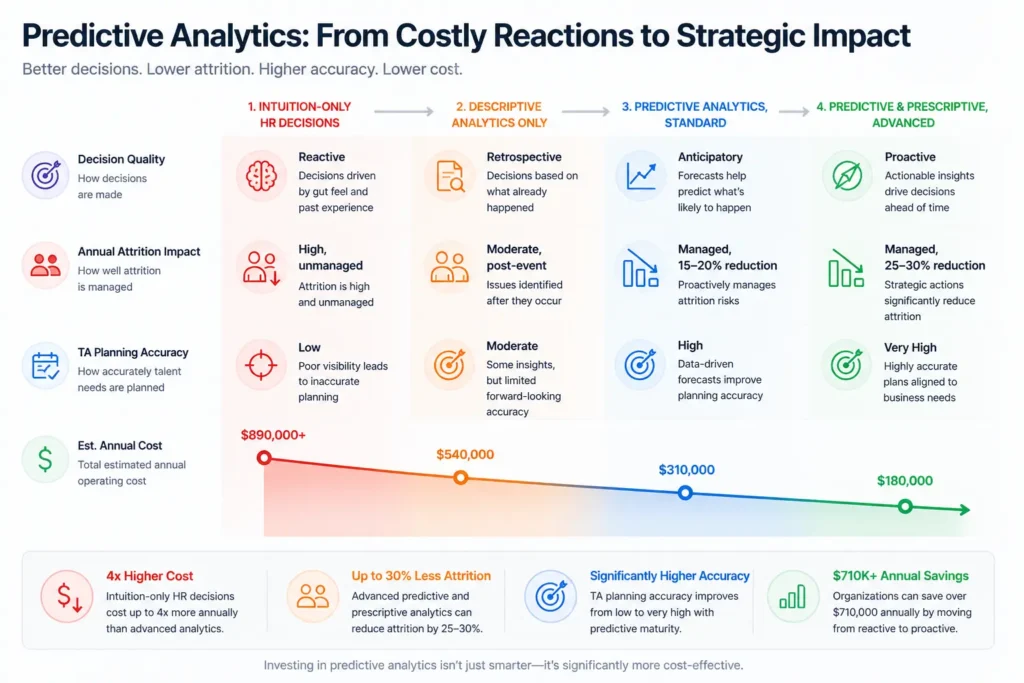
Cost estimates for a 500-employee organization. Includes attrition replacement costs, vacancy productivity loss, and recruiting investment inefficiency. Predictive analytics costs include platform and internal analyst time at a mid-market implementation scale.
Related Terms
| Term | Definition |
|---|---|
| HR Analytics | The systematic collection and analysis of workforce data to support evidence-based HR decision-making |
| Attrition Rate | The proportion of employees who leave an organization over a defined period, expressed as a percentage of total headcount |
| Workforce Planning | Strategic analysis of current and future workforce needs against organizational capability and business objectives |
| Machine Learning | A category of artificial intelligence in which models learn patterns from historical data and improve their predictions over time without explicit reprogramming |
| Data-Driven Recruiting | A recruiting approach in which sourcing, screening, and selection decisions are guided by structured data and outcome analytics rather than intuition alone |
Frequently Asked Questions
How accurate are predictive HR models?
Accuracy varies significantly by use case and model quality. Attrition prediction models from leading vendors achieve 70-85% accuracy for 90-day risk windows. Candidate success prediction models achieve 65-78% accuracy for 12-month performance outcomes. Accuracy should always be validated against actual outcomes in the organization’s own context rather than relying solely on vendor claims made against different organizational datasets.
What data is needed for HR predictive analytics?
Requirements vary by use case. Attrition models typically require tenure, performance ratings, compensation history, promotion timing, and engagement survey data. Candidate success models require historical hire data with linked performance outcomes. The quality and completeness of historical data matters more than volume: four years of complete, consistently recorded data outperforms ten years of incomplete or inconsistently recorded information.
Is predictive analytics in hiring legal?
It depends on jurisdiction and implementation. Several jurisdictions require disclosure to candidates when automated decision-making tools are used in hiring, and mandate bias audits of those tools. The EU AI Act classifies AI hiring tools in a high-risk category requiring specific compliance obligations. Organizations should work with legal counsel to assess applicable requirements before deploying predictive tools in any hiring context.
Can small organizations benefit from predictive HR analytics?
Yes, though the ROI threshold and appropriate approach vary. Organizations with fewer than 200 employees may find that the data volume required to train reliable custom models is insufficient. Vendor-built models embedded in ATS or HRIS platforms offer access to models trained on larger cross-customer datasets, often providing meaningful predictive value for organizations too small to build proprietary models from their own hire history alone.
What is the difference between predictive and prescriptive analytics?
Predictive analytics forecasts what is likely to happen, for example that a specific employee has a 74% attrition probability in the next 90 days. Prescriptive analytics recommends what to do about it, such as scheduling a career development conversation and reviewing compensation positioning against the current market. Advanced HR analytics implementations combine both layers: prediction identifies the risk, prescription specifies the recommended response for the HR professional to act on.
What is predictive analytics in HR?
Predictive analytics in HR uses statistical models and historical workforce data to forecast future talent outcomes, including who is likely to leave, which candidates are likely to succeed, and how long a specific role will take to fill. It converts workforce data from historical reporting into forward-looking decision support that enables proactive rather than reactive management.
Conclusion
Predictive analytics is not a future capability for HR functions. It is a present-tense competitive requirement for organizations that make significant talent decisions at scale. The functions that are already using it are making faster, more accurate, and more equitable workforce decisions than those relying on intuition and historical pattern recognition alone.
The entry cost is lower than it has ever been, the evidence base is stronger than it has ever been, and the cost of operating without it, in attrition that was not seen coming, in searches that took twice as long as planned, in hires that looked right and underperformed, is higher than the analytics investment by a wide margin.
The data already exists in most organizations. The question is whether it is being used to look forward or only to explain what already happened.