No job posting. No external search. No new headcount.
Quiet hiring is the talent strategy that has been happening in organisations for years but only recently got a name, and in a climate where budgets are tight and hiring freezes are common, it is becoming one of the more quietly powerful tools in an HR team’s arsenal.
Quiet hiring refers to the practice of acquiring new skills and filling capability gaps without bringing in new permanent employees. That might mean stretching existing team members into new responsibilities, leaning on contingency recruiting for short-term specialist needs, or restructuring workflows so that critical work gets done without a single new hire being made.
For employees, quiet hiring can be an opportunity for visibility and growth, or it can quietly tip into burnout if it is not managed with intention. The line between developing talent and exploiting it comes down to how well the organisation tracks employee engagement and invests in genuine employee experience alongside the added expectations.
This guide covers what quiet hiring looks like in practice, why organisations are turning to it, and how to implement it in a way that works for the business without wearing out the people inside it.
The core metric governing Quiet Hiring effectiveness is the Internal Fill Rate: the proportion of open roles filled through internal redeployment, upskilling, or promotion rather than external recruitment.
Internal Fill Rate (%) = (Roles Filled Internally / Total Roles Filled) x 100
High-performing organizations with mature internal mobility programs maintain Internal Fill Rates of 40 to 50%. The industry average sits closer to 28%. The gap is driven primarily by investment in internal talent visibility systems and career development infrastructure, not by the availability of internal talent.
What is Quiet Hiring?
Quiet Hiring is the organizational strategy of filling skill and capability gaps without initiating traditional external recruitment, achieved by redeploying existing employees into new or expanded roles, investing in targeted upskilling or reskilling programs, and supplementing internal capacity with contract, gig, or fractional workers as needed. It is distinguished from standard internal hiring by its broader scope: Quiet Hiring encompasses not just formal internal transfers but the full range of workforce flexibility strategies that allow an organization to adapt its capabilities without adding permanent headcount.
The defining characteristic of Quiet Hiring is that it treats the existing workforce as a dynamic capability portfolio, not a fixed organizational structure. Rather than assuming that new skills require new employees, Quiet Hiring asks first whether those skills exist within the current team, could be developed in a reasonable timeframe, or could be acquired on a non-permanent basis. The answer to each of those questions has become more frequently affirmative as workforce analytics, learning technology, and gig market infrastructure have matured.
Why Is Quiet Hiring Reshaping Workforce Strategy in Modern Organizations?
Gartner designated Quiet Hiring as one of the top nine future-of-work trends for 2023, and its prominence has grown considerably since. The reason is structural: external hiring has become simultaneously more expensive, more time-consuming, and less reliable than it was a decade ago. Average time-to-fill in the US market stands at 44 days for most roles; for specialized technical positions, it exceeds 60 days.
The cost of a single external hire, accounting for sourcing, assessment, onboarding, and ramp-up time, ranges from $4,000 for entry-level roles to more than $28,000 for senior professional positions. In that context, the question of whether an existing employee with adjacent skills could be developed into the role is not an idealistic preference; it is a rational cost calculation that more TA leaders are being asked to make explicitly.
The retention mathematics amplify the argument further. Research from the Wharton School found that internal promotions produce retention rates 19% higher than external hires in equivalent roles, and that performance ramp time is approximately 40% shorter because internal candidates already understand the organization’s culture, systems, and strategic context. For a role with a $110,000 base salary, the difference between an internal redeployment and an external hire represents roughly $47,000 in combined sourcing, onboarding, and ramp-time cost, before accounting for the retention differential. The financial case for Quiet Hiring, done with genuine investment in employee development, is not marginal. It is decisive.
The risk in framing this purely as an economic argument is that it obscures the employee dimension. Quiet Hiring works as a strategy when employees experience it as an investment in their growth, providing access to new challenges, new skills, and new career possibilities within an organization that values their potential. It fails when employees experience it as workload expansion without recognition or compensation. Harvard Business Review research on internal mobility satisfaction consistently shows that the difference between these two outcomes is almost entirely attributable to how the redeployment is communicated, structured, and rewarded, not to the strategy itself.
The ROI case for strategic Quiet Hiring is straightforward to model. A technology company with 400 employees and a 15-role annual hiring plan discovers through skills gap analysis that eight of those roles can be filled through internal redeployment with targeted upskilling. If each external hire costs an average of $19,000 (including sourcing, fees, and ramp-up), replacing eight external hires with internal redeployments saves $152,000 in direct recruitment cost, plus approximately $64,000 in productivity preservation by avoiding 40 days of ramp-up time per role.
That is a combined $216,000 in annual savings against an upskilling investment of $40,000, representing a better than 5:1 return. The compounding is significant: employees who are developed internally stay longer and perform better, reducing future recruitment demand in a self-reinforcing cycle.
For TA leaders, the practical implication of Quiet Hiring is not that external recruitment should be minimized; it is that every open role should be assessed against the internal workforce before a requisition goes to market. The attrition rate context matters critically here: organizations with high voluntary attrition often find that the same employees who are leaving for growth opportunities externally would have accepted those opportunities internally if they had been visible and accessible.
Your Resume Isn’t Getting Read
Let’s Get That Fixed!
75% of resumes get auto-rejected. avua’s AI Resume Builder optimizes formatting, keywords, and scoring in under 3 minutes, so you land in the “yes” pile.
The Psychology Behind Quiet Hiring
Psychological Safety and the Fear of Role Expansion
Employees asked to take on new responsibilities under the banner of Quiet Hiring face a psychological calculation that is not always in the organization’s favor: the risk of taking on unfamiliar scope and potentially failing in a visible way, while the reward (recognition, compensation, and career advancement) remains uncertain. Without explicit clarity on how expanded responsibilities will be recognized, compensation-adjusted, or developed over time, many employees interpret Quiet Hiring invitations as temporary assignments with no career upside, and respond accordingly by either declining or performing minimally to avoid establishing a permanently higher output expectation.
The Hidden Opportunity Effect in Internal Redeployment
Research on career decision-making consistently shows that employees weight opportunity visibility highly because they cannot pursue opportunities they cannot see. A significant proportion of voluntary attrition is driven not by dissatisfaction with the current role but by the absence of visible growth paths within the organization. Internal redeployment programs that systematically surface opportunities through internal job boards, manager-initiated conversations, and career development platforms convert what would have been external job searches into internal mobility decisions. The opportunity was always there; the visibility was not, and closing that gap is the highest-leverage Quiet Hiring intervention available.
Fairness Perception and the Trust Equation
The most significant psychological risk in Quiet Hiring is the fairness perception gap between how the organization frames the strategy and how employees experience it. Organizations that implement Quiet Hiring as a cost-reduction tool, expanding scope without expanding compensation and redeploying employees into demanding roles under the framing of development opportunity, rapidly erode the trust that employee engagement depends on. The organizations that sustain Quiet Hiring as a genuine workforce strategy are those that structure it with clear compensation review triggers, explicit career advancement pathways, and honest communication about what the organization is asking for and what it is offering in return.
Quiet Hiring vs. Related Workforce Strategies
| Strategy | What It Does | Duration | Employee Experience | Cost Relative to External Hire |
| Quiet Hiring | Fills gaps via redeployment, upskilling, or gig augmentation | Varies | Development or overload depending on execution | Approximately 1/6th to 1/3rd |
| Traditional External Hiring | Recruits new permanent employees through open search | 44+ days to fill | Standard onboarding ramp | Baseline (100%) |
| Headcount Reduction | Eliminates roles, redistributes remaining work | Permanent | High stress, significant morale risk | Negative short-term savings |
| Succession Planning | Develops internal candidates for specific future roles | 1-3 years | Structured, long-horizon development | Long-term investment |
| Contract or Gig Staffing | Temporary skill augmentation for defined needs | Project-based | Variable by engagement quality | 20-40% cost premium per hour |
The critical distinction between Quiet Hiring and succession planning is timeline and scope: succession planning develops specific employees for specific future leadership roles over years. Quiet Hiring addresses near-term skill gaps across a broader population with a much shorter horizon. Both are forms of internal talent development; they operate at different time scales and organizational levels.
What the Experts Say?
ThQuiet hiring is not a cost-cutting measure dressed up in talent development language, or it should not be. The organizations doing it well are genuinely building workforce agility by investing in people’s growth. The ones doing it badly are simply asking more of the same people for the same pay, and wondering why attrition accelerates six months later.
– Emily Rose McRae, Senior Director, Gartner HR Research
How to Measure Quiet Hiring Effectiveness?
Formula
Internal Fill Rate (%) = (Roles Filled Internally / Total Roles Filled) x 100
Skill Gap Closure Rate (%) = (Skill Gaps Addressed Through Internal Development / Total Identified Skill Gaps) x 100
Internal Mobility Satisfaction Score = Avg. Employee Rating of Internal Move Experience (scale of 1-10)
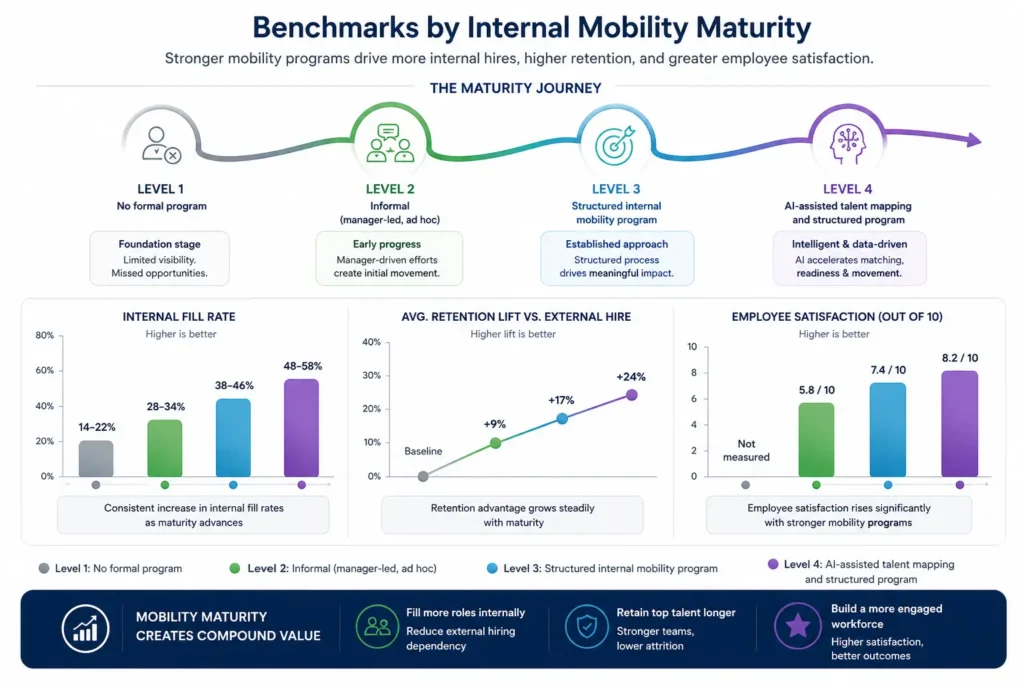
Benchmarks by Internal Mobility Maturity
| Internal Mobility Maturity Level | Internal Fill Rate | Avg. Retention Lift vs. External Hire | Employee Satisfaction |
| No formal program | 14-22% | Baseline | Not measured |
| Informal (manager-led, ad hoc) | 28-34% | +9% | 5.8 / 10 |
| Structured internal mobility program | 38-46% | +17% | 7.4 / 10 |
| AI-assisted talent mapping and structured program | 48-58% | +24% | 8.2 / 10 |
Key Strategies for Effective Quiet Hiring
How Can AI and Automation Support Quiet Hiring?
AI-Powered Skills Graph Mapping
AI platforms can construct a comprehensive skills graph of the current workforce by analyzing role histories, project contributions, learning completions, performance review themes, and self-reported skills, creating a dynamic map of what the organization can do and where its internal capability frontier lies. This map is the foundation that makes strategic Quiet Hiring possible rather than accidental, enabling proactive redeployment based on data rather than manager intuition or network proximity.
Predictive Internal Candidate Identification
Machine learning models trained on career transition data can identify which employees are most likely to succeed in a redeployment, based on skills adjacency, learning velocity, performance trajectory, and expressed career interests, before any manager makes a subjective judgment. This predictive layer surfaces internal candidates who would not have been considered through informal manager nomination, and is particularly valuable for identifying talent from underrepresented groups whose potential may be less visible through traditional organizational networks.
Automated Learning Path Generation
Once an internal candidate is identified for redeployment, AI-powered learning management tools can generate a personalized upskilling path, identifying the specific skill gaps between their current profile and the target role profile, and sequencing the most efficient combination of formal learning, on-the-job exposure, and mentorship to close those gaps within the required timeline. Automated path generation removes the manual planning burden from HR teams and ensures that every internal move is accompanied by a credible development plan.
Real-Time Workforce Gap Intelligence
AI-powered workforce analytics can monitor organizational skill gaps in real time, flagging emerging capability shortfalls before they become critical, modeling the build-versus-buy decision for each gap, and recommending the Quiet Hiring or external recruitment path based on current market conditions and internal capacity data. Organizations using this intelligence make workforce decisions based on forecasts rather than reactions, substantially reducing the emergency hiring cycles that drive up cost and reduce quality.
Stop Juggling
10 Job Boards.
Search One
Your next role is already here. avua pulls opportunities from across the web into a single searchable feed; filtered by role, location, salary, and remote preference.
1.5 Million+
Active Jobs
380+
Job Categories
Quiet Hiring Through the Lens of Equity and Inclusion
Visibility Gaps in Internal Opportunity Access
The structural DEI risk in Quiet Hiring is that internal opportunities, particularly informal ones driven by manager relationships and organizational visibility, are not equally accessible to all employees. Research on internal mobility consistently shows that employees in underrepresented groups are less likely to be nominated for internal development opportunities by their managers, less likely to learn about open internal roles through informal networks, and less likely to be considered for stretch assignments outside their immediate function. Quiet Hiring programs that rely on manager nomination rather than transparent, self-service opportunity access systematically reproduce the visibility inequities of the external hiring market inside the organization itself.
Scope Expansion and the Unpaid Labor Pattern
A well-documented pattern in DEI research is that employees from underrepresented groups, particularly women and employees of color, are disproportionately asked to absorb additional responsibilities informally, without title changes, compensation adjustments, or formal recognition. Quiet Hiring without governance can replicate and amplify this pattern at scale: the employees most culturally conditioned to comply with organizational requests absorb more work, while the formal recognition that would make the redeployment a genuine career opportunity is delayed or withheld. Explicit compensation review triggers and formal role reclassification processes are the mechanisms that prevent Quiet Hiring from becoming a structured inequity.
Development Investment and Representation at Senior Levels
Quiet Hiring, done well, is one of the most powerful tools available for improving representation at senior organizational levels, because it surfaces internal candidates who would not have been found through external search, develops them in context, and promotes them with full cultural and organizational fluency. For this to work as a DEI strategy, the development investment must be explicitly directed toward underrepresented high-potential employees, not just toward the employees already most visible to leadership. AI-powered internal talent identification is particularly valuable here, because it surfaces candidates based on skill data rather than network proximity or manager familiarity.
Common Challenges and Solutions
| Challenge | Solution |
| Employees resist internal moves due to unclear career implications | Define role reclassification criteria, compensation review timelines, and title change triggers before announcing the opportunity to candidates |
| Managers hoard talent rather than supporting internal mobility | Implement organizational norms and manager performance metrics that reward contribution to internal mobility, not just team-level retention |
| Quiet Hiring perceived by employees as workload exploitation | Conduct explicit capacity assessments before adding responsibilities; pair expanded scope with visible investment in support and development |
| Internal candidates lack the specific technical skills required | Use AI-generated upskilling paths to address skill gaps within the required timeline; be realistic about the development investment required |
Real-World Case Studies
Case Study 1: The Technology Platform Company
A 500-person technology platform company facing a hiring freeze while simultaneously experiencing rapid product expansion implemented a structured Quiet Hiring program. Using an AI-powered skills mapping tool, they identified 23 employees with adjacent skills to their highest-priority open roles. Of those 23, 14 expressed interest in a structured internal move. Within three months, 11 of those internal transitions were completed with formal role changes, salary adjustments, and a 90-day upskilling program. The program avoided $209,000 in external recruitment costs, and 12-month retention for the internally transitioned employees was 91%, versus 73% for the external hires made in the same period.
Case Study 2: The Financial Services Group
A financial services group responding to rapid digital transformation identified a 40-role capability gap in data engineering and AI operations skills. External market research indicated that hiring for these roles would take an average of 67 days at significant cost premium. Internal skills analysis identified 28 employees in adjacent roles, including data analysts, quantitative researchers, and systems engineers, who met the threshold for a structured reskilling program.
The group invested $380,000 in a six-month upskilling cohort covering 24 employees who successfully transitioned to the new role type. The external hiring need was reduced from 40 roles to 16, saving approximately $672,000 in external recruitment cost. The reskilled employees showed a 22% higher performance rating at 12 months than the externally hired employees in the same roles.
Case Study 3: The Retail Organization
A national retail organization used a hybrid Quiet Hiring approach during a period of operational restructuring: internal employees were offered structured lateral moves with formal development support for roles where internal capability existed, while contract workers were brought in for specialized technical roles where a 60-plus-day external hire timeline was unacceptable.
The result: 34% of that year’s capability gap was filled internally, versus 18% in the prior year; 22% was filled through contract augmentation, versus 9% previously; and the external permanent hire proportion fell from 73% to 44%. Total workforce cost per capability unit acquired fell by 29%, and voluntary attrition among employees who made internal moves was 8%, versus 19% for those who did not.
Performance Signals Every Quiet Hiring Initiative Should Monitor
Quiet Hiring Across the Talent Lifecycle
Workforce Planning: Identifying Gaps Before They Become Crises
Effective Quiet Hiring begins not with a vacancy but with proactive workforce planning, continuously mapping the organization’s current skill inventory against projected business requirements and identifying emerging gaps before they become urgent. AI-powered workforce analytics now support this continuous gap identification at the role and function level, enabling organizations to plan internal redeployment timelines that are realistic rather than reactive. The candidate pipeline for internal roles can be warm and qualified before the formal gap is even announced to the broader organization.
Internal Candidate Identification and Engagement
The activation phase of Quiet Hiring, surfacing internal candidates, having development conversations, and securing genuine buy-in, requires deliberate investment of time and care. Employees asked to consider an internal move need honest information about what the role involves, what the development support looks like, and what the career pathway beyond the initial transition might be. Organizations that treat this as a brief HR conversation produce lower internal move success rates than those that structure it as a career development dialogue with appropriate time, transparency, and organizational support.
Skill Development and Role Transition
The development and transition phase is where Quiet Hiring programs most frequently underinvest. The assumption that an employee with adjacent skills can simply figure it out in the new role is responsible for a significant proportion of internal move failures. Structured upskilling plans with specific milestones and defined support resources reduce internal move failure rates substantially. Organizations should budget development investment for every internal redeployment as a standard program cost, not as an exceptional circumstance that requires special justification.
Performance Monitoring and Retention Assurance
The 30 to 90-day period in a new internal role is the highest-risk window for internal move abandonment, the point at which an employee who has moved too quickly or without sufficient support decides that an external search is preferable to persisting in an underprepared transition. Structured check-ins, clear performance expectations during the ramp period, and readily available support resources during this window are the primary predictors of internal move success. The employee engagement investment during this phase pays dividends in retention and performance outcomes that compound across the employee’s subsequent tenure.
The Real Cost of Mismanaged Quiet Hiring
| Scenario | Internal Fill Rate | Avg. Development Investment Per Move | Voluntary Attrition of Internally Moved Employees |
| No program (default to external) | 14% | Not applicable | Not applicable |
| Informal, unstructured (manager-led) | 28% | $4,200 | 21% in 12 months |
| Structured with development support | 44% | $12,500 | 9% in 12 months |
| AI-assisted, structured, with governance | 54% | $15,800 | 6% in 12 months |
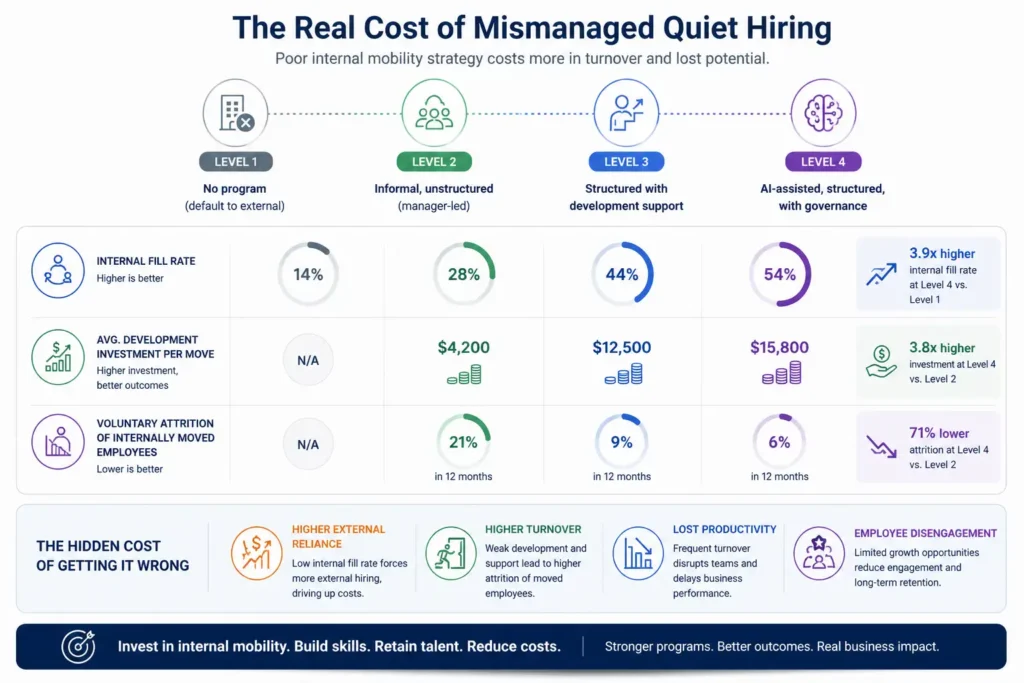
Development investment includes upskilling costs, mentor time, and ramp-up productivity adjustment. Attrition figures reflect the internally moved employee population only.
Related Terms
| Term | Definition |
| Internal Mobility | The movement of employees across roles, functions, or geographies within a single organization without external recruitment |
| Upskilling | The process of developing new skills in existing employees to meet emerging business requirements within their current career trajectory |
| Reskilling | Training existing employees in entirely new skill domains to transition them into fundamentally different role types |
| Skills-Based Hiring | An approach to talent acquisition and internal mobility that prioritizes demonstrated skills over credentials, titles, or pedigree |
| Talent Marketplace | An internal platform that surfaces open roles, projects, and development opportunities to all employees, enabling self-directed internal mobility |
Frequently Asked Questions
What is the difference between quiet hiring and internal promotion?
Quiet Hiring is broader than internal promotion. It includes lateral moves, scope expansions, redeployment to entirely new functions, and augmentation with gig or contract workers, not just vertical advancement. Internal promotion is one subset of Quiet Hiring; the practice also encompasses horizontal and functional transitions that would not be classified as promotions by traditional HR terminology but that deliver significant capability value to the organization.
Is quiet hiring ethical?
It depends entirely on execution. Quiet Hiring is ethical when employees are given genuine choice, when expanded responsibilities are accompanied by fair compensation and development support, and when the career benefit to the employee is real and transparent. It is problematic when it is used to extract additional output without recognition, or when employees experience it as an obligation rather than an opportunity. The ethics are determined by the structure and honesty of the communication, not by the strategy itself.
How does quiet hiring affect employee morale?
Research shows a clear bifurcation: employees who experience internal moves as genuine development opportunities show significantly higher engagement scores than those who did not move. Employees who experience scope expansion without compensation or title recognition show engagement scores 18 to 23 points lower than the organizational average. The impact on morale is determined almost entirely by whether the organization treats the redeployment as a development investment or as a cost-saving measure with development language applied as cover.
Can small organizations benefit from quiet hiring?
Yes, often more than large ones. Small organizations typically have higher informal visibility of employee skills and greater flexibility to restructure roles quickly, making the intelligence-gathering phase of Quiet Hiring lower-cost and the execution phase faster. The governance principles (transparent opportunities, fair compensation, development support) apply regardless of organizational size, and the financial return from avoiding even a handful of external hires is proportionally significant for smaller companies.
How should quiet hiring be communicated to employees?
Directly and honestly. Employees should be told that the organization is investing in internal talent development as a strategic priority, that specific opportunities will be surfaced proactively, and that internal moves will be accompanied by clear terms including compensation review criteria, development support, and career pathway transparency. Organizations that frame Quiet Hiring as a cost-cutting measure lose employee trust quickly; those that frame it accurately as a workforce development investment build the engagement that makes the strategy sustainable over multiple cycles.
Conclusion
Quiet Hiring is not a temporary response to a constrained environment.
It is a permanent feature of agile workforce management in organizations that have learned to treat their existing talent as a dynamic asset rather than a fixed cost. The organizations that build the infrastructure for strategic internal mobility, invest genuinely in employee development, and apply AI-powered skills intelligence to the redeployment decision are not just reducing their external recruitment costs.
They are building organizations where employees grow, stay, and perform at higher levels than those hired from the outside. The ones that use the language of development while delivering the reality of workload expansion will find that Quiet Hiring is not quiet at all, because the attrition signal is audible within two quarters.
Invest in the people you already have, and the talent acquisition challenge becomes significantly more manageable.