Most job advertising is still done the way it has always been done: pick a platform, set a budget, post the role, and hope the right people see it.
Programmatic job advertising replaces that guesswork with data, automating where your job listings appear, who sees them, and how much you spend, in real time, based on actual performance signals rather than assumptions.
Programmatic job advertising is the automated buying and placement of job ads across multiple platforms simultaneously, using algorithms to optimise distribution based on conversion rate data, audience targeting, and budget efficiency. For recruiting teams managing high-volume hiring, it is the difference between a scattergun approach and a genuinely intelligent candidate pipeline strategy.
The impact shows up across multiple metrics. Better targeting improves application completion rate by putting roles in front of candidates who are actually relevant rather than broadly available. Smarter spend directly reduces cost per hire by eliminating wasted budget on placements that were never going to convert.
For teams running data-driven recruiting strategies, programmatic advertising is not a separate channel. It is the infrastructure that makes every job board and paid placement work harder, smarter, and more accountably than manual buying ever could.
The core metric governing programmatic job advertising effectiveness is Cost-per-Qualified-Apply (CPQA): the total advertising spend divided by the number of applications that meet the role’s minimum qualifications.
Cost-per-Qualified-Apply (CPQA) = Total Ad Spend / Number of Qualified Applications Received
Best-in-class programmatic campaigns achieve CPQA figures below $18. Industry average for unoptimized programmatic sits between $34 and $52. The gap between those numbers represents the difference between a system that is learning and optimizing in real time and one that is spending equally across all channels regardless of which ones are actually producing results.
What is Programmatic Job Advertising?
Programmatic job advertising is the automated purchase, placement, and real-time optimization of job advertisements across multiple digital channels using algorithmic bidding, audience targeting, and performance data, designed to distribute the right job ad to the right candidate segment at the optimal cost, replacing the manual, flat-fee job posting model with a continuously self-adjusting advertising system.
The distinction between programmatic and traditional job advertising is not merely a technology difference; it is a logic difference. Traditional job advertising is a publishing decision: you choose where to place the ad and pay whether it works or not. Programmatic job advertising is a performance decision: you define what a conversion looks like, set a budget, and let the system allocate spend across channels based on which placements are actually producing the conversions you want.
Is Programmatic Job Advertising Actually Worth the Investment?
The honest answer, which most vendors will not give you directly, is: it depends almost entirely on how you implement it. A poorly configured programmatic campaign, with no negative audience targeting, no conversion rate benchmarks by channel, and no creative testing, will spend the same budget faster than a manual approach without improving outcomes. A well-configured campaign, with clear quality-application definitions, channel-level attribution, and a regular optimization cadence, will typically reduce Cost-per-Qualified-Apply by 35 to 55 percent versus manual distribution within 90 days. The technology is not the advantage; the operational discipline around the technology is.
The case against programmatic job advertising is almost always an implementation argument, not a capability argument. A 2025 Appcast recruitment media benchmarks study found that organizations running programmatic with active weekly optimizations achieved a 47 percent lower Cost-per-Apply than those running programmatic on a set-and-forget basis. The difference is not the tool; it is the attention paid to the tool’s outputs.
The math behind the case for programmatic is worth working through concretely. Consider a healthcare organization with 80 open roles at any given time, distributing job ads manually across four job boards at an average monthly spend of $900 per role. Total monthly advertising spend: $72,000. With no channel-level performance tracking, budget is distributed evenly regardless of which boards are producing qualified applicants and which are producing high application volume with low quality.
When the organization implements programmatic distribution with quality-application tracking, the same $72,000 budget reallocates automatically: boards producing high-CPQA results receive reduced spend; boards producing low-CPQA results receive increased spend. Within 60 days, the same $72,000 produces 34 percent more qualified applications. No additional budget. No additional sourcing channels. The improvement is entirely explained by intelligent budget allocation.
The ROI model extends further when you factor in time-to-fill. Roles that fill faster carry lower vacancy costs. If a 20-day reduction in time-to-fill across 80 open roles, achieved by better-targeted advertising driving faster qualified application volume, saves $200 per role per day in vacancy productivity cost, the downstream value is $320,000 per month in recovered productivity. The programmatic platform that enabled the improvement costs a fraction of that figure. For TA leaders building the business case for programmatic investment, the strongest argument is not the advertising efficiency improvement in isolation; it is the time-to-fill compression and vacancy cost reduction that intelligent advertising produces downstream.
The realistic implementation risk is configuration complexity. Programmatic platforms require thoughtful setup: quality-application definitions that the system can optimize toward, exclusion lists to prevent wasted spend on geographic or demographic segments that are structurally unable to apply, and regular creative testing to ensure the ad copy driving clicks is aligned with the role actually being advertised. Organizations that treat programmatic as a plug-and-play solution without this configuration discipline will see improved volume and degraded quality, which is the specific outcome most TA leaders are trying to avoid.
For TA leaders, the practical conclusion is clear: programmatic job advertising should be segmented by role type and hiring volume. High-volume, repeatable hiring categories, including clinical, logistics, retail, and technology roles, generate the data volume required for algorithmic optimization and produce the strongest CPQA improvements. Low-volume executive roles, where the candidate universe is narrow and relationship-driven, benefit less from programmatic reach and more from targeted direct sourcing approaches. Treating all hiring categories as programmatic candidates is as much of a mistake as treating none of them that way.
Your Resume Isn’t Getting Read
Let’s Get That Fixed!
75% of resumes get auto-rejected. avua’s AI Resume Builder optimizes formatting, keywords, and scoring in under 3 minutes, so you land in the “yes” pile.
The Psychology Behind Programmatic Job Advertising
Relevance Signaling and Passive Candidate Attention
Programmatic job advertising reaches candidates in the context of other content they are consuming, rather than in the deliberate search context of a job board visit. This changes the psychology of the interaction significantly. A candidate browsing a professional news feed is in content consumption mode, not job search mode, when a programmatically placed role appears. The ad must earn attention rather than expect it.
Research on programmatic display advertising response rates consistently finds that relevance is the primary predictor of engagement: ads that match demonstrated interest signals such as browsing history, professional profile keywords, and geographic data produce click-through rates four to seven times higher than demographically targeted ads without behavioral data. The implication for job advertising is that the candidate who clicks a programmatically targeted role ad represents a more intentional signal than the candidate who applies from a general job board search.
Decision Architecture and Application Friction
The journey from a programmatic ad impression to a completed application involves more friction points than a direct job board search, which means that application design has an outsized effect on programmatic campaign outcomes. Candidates who click a programmatic ad and encounter a five-minute, mobile-optimized application convert at dramatically higher rates than those who click and are directed to a desktop-required ATS with fifteen required fields.
Research from Appcast’s 2025 apply flow benchmarks found that every additional required field in a mobile application reduces apply rate by approximately 4.5 percent. For programmatic campaigns where the majority of clicks occur on mobile devices, application friction is the single largest lever available to improve CPQA without touching the advertising configuration at all.
Social Proof and Brand Encounter Frequency
Programmatic job advertising creates repeated brand exposures that influence candidate behavior beyond the single click event. A candidate who sees the same employer’s job ad across three different platforms in a one-week period, without clicking any of them, is measurably more likely to respond positively to a recruiter outreach during that period than a candidate with no prior exposure.
This brand encounter frequency effect, well-documented in consumer advertising research, operates in job advertising contexts as well. Programmatic campaigns designed for reach as well as conversion, deliberately building brand familiarity across passive candidate segments, produce compounding returns as those passive candidates are later approached through direct sourcing, referral, or active sourcing channels.
Programmatic Job Advertising vs. Related Recruitment Advertising Methods
| Method | Budget Model | Optimization | Channel Scope | Candidate Targeting |
|---|---|---|---|---|
| Programmatic Job Advertising | Performance-based (CPC/CPA) | Automated, real-time | Multi-channel | Behavioral and demographic |
| Traditional Job Posting | Flat fee | None | Single channel | Self-selected (applicant visits) |
| Sponsored Job Posts | Flat fee or CPC | Manual | Single platform | Keyword and location |
| Recruitment Marketing Campaigns | Campaign budget | Manual | Multi-channel | Demographic |
| Social Media Job Ads | CPC or CPM | Platform-native | Single platform | Demographic and interest |
| Job Distribution Tools | Per-post or subscription | None | Multi-channel | None (broadcast only) |
The critical distinction between programmatic job advertising and sponsored job posts on a single platform is the optimization layer. A sponsored post on a major job board improves visibility within that platform but does not shift budget toward better-performing placements across platforms. Programmatic advertising treats all channels as inputs to a unified performance model and reallocates spend continuously based on where the best-cost qualified applications are being generated, regardless of which specific channel is producing them.
What the Experts Say?
Programmatic is not a job board. It is an optimization engine. Organizations that treat it like a smarter job board will be disappointed. Organizations that treat it like a performance marketing capability and invest in the measurement infrastructure to support it will see returns that are difficult to achieve through any other advertising mechanism.
– Chris Forman
How to Measure Programmatic Job Advertising Effectiveness?
Formulas
Cost-per-Qualified-Apply (CPQA) = Total Ad Spend / Number of Qualified Applications Received
Apply Rate (%) = (Number of Applications / Number of Ad Clicks) x 100
Channel Return on Ad Spend (ROAS) = (Value of Hires Attributed to Channel / Channel Ad Spend) x 100
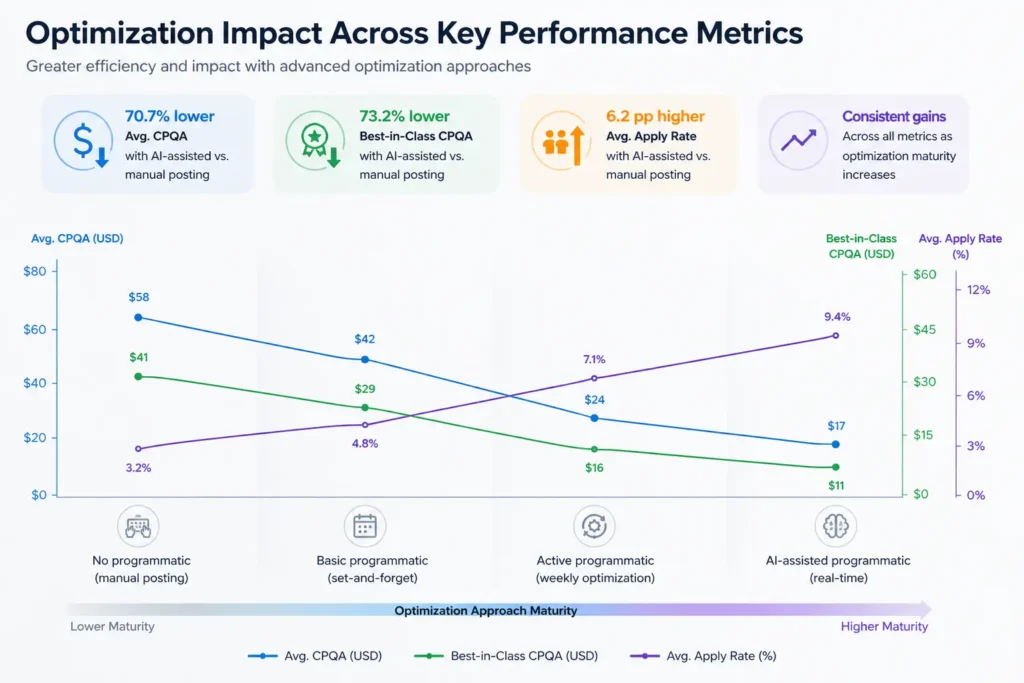
Benchmarks by Optimization Approach
| Optimization Approach | Avg. CPQA | Best-in-Class CPQA | Avg. Apply Rate |
|---|---|---|---|
| No programmatic (manual posting) | $58 | $41 | 3.2% |
| Basic programmatic (set-and-forget) | $42 | $29 | 4.8% |
| Active programmatic (weekly optimization) | $24 | $16 | 7.1% |
| AI-assisted programmatic (real-time) | $17 | $11 | 9.4% |
Key Strategies for Effective Programmatic Job Advertising
How Can AI and Automation Support Programmatic Job Advertising?
Real-Time Bid Optimization
AI-powered bidding engines analyze performance signals at the impression level, adjusting bids in real time to maintain target CPQA across all active channels. These systems process thousands of data points per minute, including time of day, device type, candidate location, job category, and historical conversion rates by source, to determine the optimal bid for each individual ad placement opportunity. The optimization speed and granularity available to AI-driven bidding systems is not replicable by human campaign managers, which is why AI-assisted programmatic consistently outperforms manually managed campaigns on CPQA regardless of the human manager’s experience level.
Predictive Budget Allocation
Machine learning models trained on historical campaign performance data can predict, at the start of a new campaign, which channel mix and budget distribution is likely to produce the best CPQA for a given role type, seniority level, and geography. This predictive allocation replaces the common practice of distributing budget evenly across channels at campaign launch and waiting two weeks for performance data before optimizing. For high-priority roles where a two-week delay in optimization represents significant vacancy cost, predictive allocation at launch meaningfully accelerates time-to-qualified-applicant.
Audience Segmentation and Retargeting
AI-powered audience segmentation tools can build lookalike audiences based on the profiles of previously successful hires, targeting programmatic advertising to candidates whose behavioral and professional profiles match historical quality-application patterns. Retargeting, the practice of serving job ads to candidates who have previously visited the career site without applying, is also AI-manageable at scale. Retargeted candidates convert at two to three times the rate of cold programmatic audiences, making retargeting one of the highest-ROI applications of AI in the programmatic job advertising stack.
Performance Attribution Modeling
Traditional programmatic attribution assigns credit for a hire to the last advertising touchpoint before application, which systematically undervalues awareness-stage channels that influenced the candidate’s decision earlier in the journey. AI-powered multi-touch attribution models distribute credit across all advertising interactions in the candidate’s journey, giving campaign managers accurate information about which channels are building awareness versus driving conversion. This accurate attribution is what allows budget allocation decisions to reflect the true contribution of each channel, rather than rewarding the last click and defunding everything that preceded it.
Stop Juggling
10 Job Boards.
Search One
Your next role is already here. avua pulls opportunities from across the web into a single searchable feed; filtered by role, location, salary, and remote preference.
1.5 Million+
Active Jobs
380+
Job Categories
Programmatic Advertising and Equitable Candidate Reach
Algorithmic Amplification of Existing Hiring Biases
Programmatic platforms optimize toward historical performance data. If the historical performance data used to train the platform’s targeting algorithms reflects a candidate population that is demographically skewed, because the organization’s previous successful applicants were skewed, the system will optimize toward replicating that skew. This is not intentional discrimination; it is mathematical pattern matching on biased inputs.
The result is a self-reinforcing loop: the platform serves ads most heavily to candidates who look like past applicants, which produces an applicant pool that resembles past hires, which reinforces the algorithm’s targeting bias going forward. Organizations using programmatic advertising without explicit audit of audience targeting demographics are frequently producing this effect without knowing it. Connecting programmatic audit practices to broader bias in hiring frameworks is the most reliable corrective approach available to TA leaders.
Inclusive Audience Targeting and Diverse Channel Networks
Programmatic networks that draw exclusively from mainstream job board and professional network inventory will systematically under-serve candidate populations whose digital activity is concentrated in other channels. Diverse candidate audiences, including candidates from underrepresented communities, first-generation professionals, and career changers, often have distinct digital behaviors that are not captured by standard programmatic targeting parameters.
Intentional programmatic campaigns that include diversity-focused publisher networks, HBCU career portals, veteran employment platforms, and community organization digital channels alongside mainstream inventory produce materially broader candidate reach than campaigns that default to standard network sources. This inclusive network design should be specified in the campaign brief, not left to platform default settings.
Transparency and Control in Automated Targeting Decisions
The black-box nature of some programmatic platforms creates a compliance and governance risk that organizations rarely address proactively. When a programmatic system makes a targeting decision that excludes a demographic group from seeing a job ad, that decision may constitute unlawful employment discrimination under EEOC guidelines, regardless of whether the exclusion was intentional.
Organizations running programmatic campaigns should require source-level transparency reporting from their programmatic vendors, conduct quarterly audience reach audits across protected class categories, and build explicit inclusion parameters into campaign configurations that override pure performance optimization where demographic reach falls below defined thresholds. This governance layer is not optional for organizations with EEOC compliance obligations; it is a legal requirement that programmatic adoption has not yet forced into standard industry practice.
Common Challenges and Solutions
| Challenge | Solution |
|---|---|
| High click volume with low application quality | Implement source-level exclusion lists based on click-to-apply and qualification pass rates; optimize toward quality-application events rather than raw submission volume |
| Budget exhausted on high-volume roles before priority roles receive spend | Set per-role budget caps and priority tiers; implement pacing rules that prevent single roles from consuming disproportionate campaign share |
| Difficulty attributing hires to specific programmatic channels | Implement UTM parameter tracking across all programmatic placements; use multi-touch attribution modeling rather than last-click attribution |
| Programmatic performance declines mid-campaign without obvious cause | Schedule bi-weekly creative refreshes; audit exclusion lists for over-restriction; review bidding strategy against current market supply signals |
Real-World Case Studies
Case Study 1: The Logistics Company
A national logistics company with 300 open driver and warehouse roles at any given time was spending $180,000 per quarter on flat-fee postings across four job boards. With no channel-level performance data, budget was allocated equally regardless of which boards were producing hires. They implemented programmatic distribution with quality-application tracking, defined as applications passing the initial license and availability screening.
Within 45 days, the system identified that one of the four boards was producing 61 percent of qualified applications at 28 percent of the total spend. Budget reallocated automatically. By the end of the quarter, the same $180,000 produced 42 percent more qualified applications. Time-to-fill across the driver role family fell from 38 days to 24 days, with no increase in advertising spend.
Case Study 2: The University Health System
A large university health system running programmatic campaigns for nursing and clinical roles discovered through a quarterly audience audit that their targeting was reaching a candidate audience that was 78 percent female and 82 percent white, despite a candidate market where qualified nursing candidates were significantly more demographically diverse. Investigation revealed that the platform’s lookalike targeting was replicating the demographic composition of the health system’s existing nursing workforce rather than the broader qualified candidate market.
They reset targeting parameters to exclude demographic lookalike optimization for clinical roles and added eight diversity-focused publisher networks to their programmatic channel mix. Within two quarters, longlist demographic diversity improved by 34 percent with no change in qualification pass rates.
Case Study 3: The Technology Recruitment Agency
A specialist technology recruitment agency managing programmatic campaigns across 40 client accounts redesigned their campaign structure to be mobile-first after discovering that 74 percent of programmatic ad clicks for technology roles were occurring on mobile devices but only 19 percent of applications were being completed on mobile.
The gap was explained by desktop-only ATS application flows. The agency negotiated mobile-optimized apply pathways for all clients, reduced required application fields from an average of 14 to 6 for mobile paths, and implemented one-click apply where the client’s ATS supported it. Mobile apply completion rates rose from 19 percent to 61 percent across the client portfolio. Portfolio-wide CPQA fell by 38 percent in the subsequent quarter.
Programmatic Job Advertising Performance Dashboard: Metrics That Matter
Programmatic Job Advertising Across the Campaign Lifecycle
Pre-Campaign: Strategy and Setup
The configuration decisions made before a programmatic campaign launches determine the ceiling on what that campaign can achieve. Quality-application definitions, budget parameters, exclusion lists, creative variants, and attribution tracking must all be established before the first dollar of bid spend is committed. Organizations that skip this setup phase in the interest of launching quickly consistently produce campaigns that spend efficiently toward the wrong outcomes.
A well-configured programmatic campaign for a complex role family requires two to three days of upfront setup work; that investment is recovered within the first week of optimized spend. This pre-campaign stage should also connect to the broader data-driven recruiting framework to ensure advertising goals align with overall talent acquisition objectives.
Active Campaign: Management and Monitoring
Once live, programmatic campaigns require structured monitoring cadences to capture performance signals before they result in significant wasted spend. Weekly performance reviews covering CPQA by source, apply rate by creative, and budget pacing against plan are the minimum standard for any campaign generating meaningful spend. Roles in the highest-priority tier should be reviewed more frequently, at mid-week and end-of-week intervals. The monitoring discipline is where most programmatic implementations fail: campaigns are launched with good configuration and then left unattended for the duration of the campaign period, during which the initial configuration drifts out of alignment with the evolving candidate market.
Mid-Flight: Optimization and Reallocation
The optimization phase, typically beginning at the end of the campaign’s first week once sufficient data has accumulated, involves active budget reallocation across sources based on performance data, creative rotation based on apply rate signals, and exclusion list updates based on source-level qualification pass rates. This is the highest-value activity in programmatic campaign management and the one most frequently deprioritized in under-resourced recruiting teams. Organizations that build structured optimization workflows and assign explicit ownership of optimization decisions consistently outperform those that rely on platform auto-optimization without human oversight.
Post-Campaign: Analysis and Planning
Post-campaign analysis closes the optimization loop and feeds learning back into the next campaign’s setup. The most valuable post-campaign analyses trace the full funnel from impression to hire, attributing each hire to the channel mix that produced the application, and calculating a true cost-per-hire that can be compared across programmatic and non-programmatic sourcing channels. According to SHRM research on sourcing effectiveness, organizations that build this analytical discipline accumulate a compounding advantage in programmatic efficiency over hiring cycles, improving CPQA by an average of 12 percent per campaign cycle as platform configuration becomes increasingly calibrated to actual role requirements.
The Real Cost of Unoptimized Job Advertising
| Scenario | Advertising Approach | Avg. CPQA | Annual Advertising Cost (80 roles/year) | Estimated Vacancy Cost Impact |
|---|---|---|---|---|
| Unmanaged manual posting | Flat-fee, no optimization | $58 | $224,000 | $420,000+ |
| Basic programmatic | Set-and-forget automation | $38 | $147,000 | $290,000 |
| Active programmatic | Weekly human optimization | $22 | $85,000 | $180,000 |
| AI-assisted programmatic | Real-time algorithmic optimization | $15 | $58,000 | $120,000 |
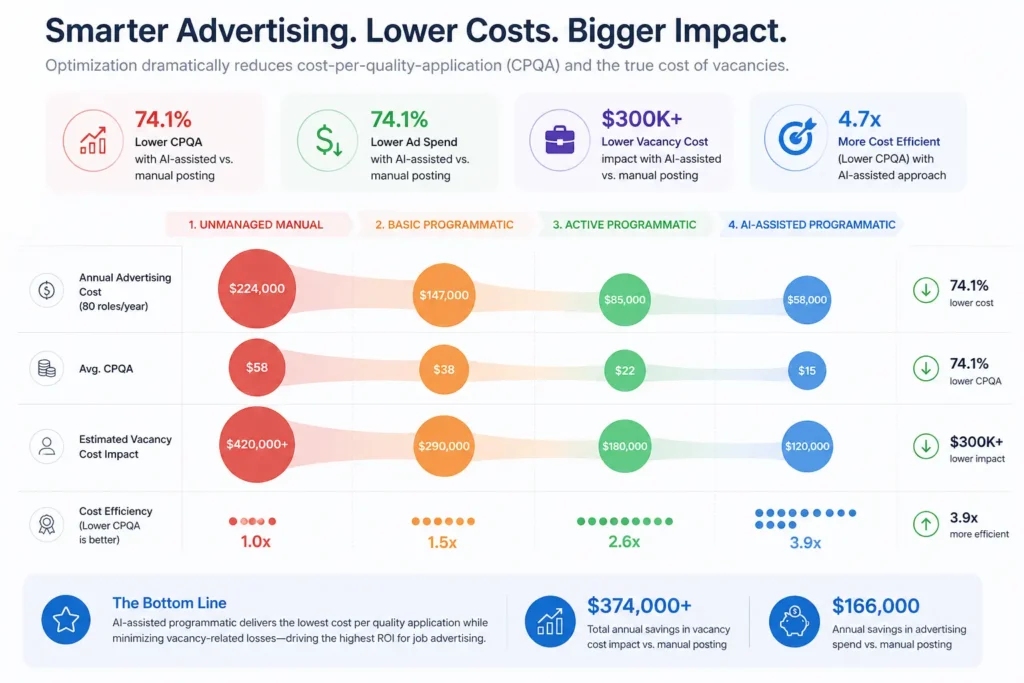
Vacancy cost estimated at $250 per role per day; assumes 80 roles per year with average time-to-fill differential between approaches based on qualified application flow rates.
Related Terms
| Term | Definition |
|---|---|
| Cost-per-Apply (CPA) | The total advertising spend divided by the total number of applications received, regardless of candidate qualification level |
| Recruitment Marketing | The practice of applying marketing principles and technology to attract, engage, and convert candidates across the hiring funnel |
| Real-Time Bidding (RTB) | An auction-based mechanism for buying and selling digital advertising inventory at the individual impression level, in milliseconds |
| Job Distribution | The process of publishing a job listing across multiple platforms and channels simultaneously, either manually or through automated technology |
| Attribution Modeling | The methodology for assigning credit to specific advertising channels or touchpoints in the candidate journey that contributed to a hire |
| Talent Network | A curated pool of candidates who have opted in to receive communications from an employer about current or future opportunities |
Frequently Asked Questions
How much budget do you need to run programmatic job advertising effectively?
Most programmatic platforms operate effectively with minimum monthly budgets between $2,000 and $5,000 per active role. Below this threshold, the algorithm does not accumulate sufficient data to optimize meaningfully. Organizations running programmatic at high volume, with 20 or more concurrent roles, benefit from budget pooling, which allows the system to allocate dynamically based on role-level performance rather than fixed per-role budgets.
Can programmatic job advertising replace other sourcing channels?
No. Programmatic is most effective as a component of a diversified sourcing strategy, not a replacement for it. It performs best for roles where a qualified candidate population is actively browsing digital channels. For senior executive roles, highly specialized technical positions, or passive candidates with low digital footprint, programmatic advertising should be supplemented with direct sourcing, headhunting, and referral programs rather than treated as the primary sourcing mechanism.
How do you track whether programmatic job advertising is actually producing hires?
Through source tracking at the application stage using UTM parameters or ATS source codes assigned to each programmatic channel, linked to hire outcome data in the ATS. The combination of source-level application data and hire data enables a true cost-per-hire calculation by channel. Most modern ATS platforms support this source-to-hire attribution natively; the gap is usually in the programmatic campaign configuration that generates the source tags, not in the ATS reporting capability.
How long does it take for a programmatic campaign to optimize?
Most programmatic platforms require seven to fourteen days of spend data before the optimization algorithm has sufficient signal to make meaningful bid and budget allocation decisions. During this ramp period, CPQA is typically higher than the campaign’s eventual steady state. Organizations that evaluate programmatic performance in the first week and make broad configuration changes before the algorithm has ramp data frequently interrupt the optimization cycle and extend the time to efficient performance.
What is the biggest mistake organizations make with programmatic job advertising?
Defining success as application volume rather than qualified application volume. Programmatic platforms are extraordinarily good at generating the metric you optimize toward. If that metric is total applications, the system will produce total applications, many of them from candidates who do not meet basic role requirements. Defining and tracking qualified applications as the primary success metric from the outset is the single configuration decision with the greatest impact on programmatic ROI.
What is the difference between programmatic job advertising and posting on a job board?
A job board posting places a single ad on a single platform for a flat fee, with no optimization beyond application volume. Programmatic job advertising distributes ads across multiple channels simultaneously, adjusts spend in real time based on which channels are producing qualified applications, and optimizes continuously toward a defined cost-per-qualified-apply target. The economic model is fundamentally different: you pay for performance rather than for placement.
Conclusion
Programmatic job advertising is not a job board with better targeting. It is a fundamentally different model for connecting advertising investment to hiring outcomes: performance-based, multi-channel, continuously optimizing, and increasingly AI-driven. The organizations that have implemented it with operational discipline, including clear quality-application definitions, active optimization cadences, and full-funnel attribution, are running recruitment advertising at a structural cost advantage over those still operating on flat-fee, single-channel posting models.
The technology is accessible and the implementation barrier is lower than most TA leaders assume. The competitive gap between organizations that treat job advertising as a measurable performance investment and those that treat it as a fixed-cost posting line item will continue to widen as AI optimization capabilities improve. Treat every dollar of job advertising as a performance marketing investment, measure it accordingly, and the returns will follow.