Few announcements travel faster through an office than “we’re implementing a hiring freeze.” It is more than just a pause; it is a loud signal that the organization is recalibrating its strategy. In 2026, these freezes are no longer blunt instruments that stop all progress. By leveraging HR analytics, companies can now perform surgical pauses in specific cost centers while still fueling high-priority areas.
This nuanced approach is a staple of HR strategies for a future-ready workplace. However, a freeze brings unique challenges. You must monitor your attrition rate closely, as backfilling departing employees is often restricted. To protect your employer brand, effective candidate nurturing is essential for those currently in the pipeline. Understanding the “why” behind the freeze helps teams navigate the shift without losing their competitive edge.
The core metric governing hiring freeze management is the Freeze Impact Rate: the proportion of priority roles affected by the freeze that subsequently cannot be filled as planned when the freeze is lifted, due to candidate pipeline deterioration or competitive hiring loss.
Freeze Impact Rate (%) = (Roles Lost to Freeze Attrition ÷ Total Roles Frozen) × 100
A poorly managed freeze with no candidate pipeline maintenance produces Freeze Impact Rates of 45–60%. A managed freeze with active pipeline preservation produces rates below 15%. The difference is almost entirely operational, what you do with your talent pipeline while the requisitions are paused.
What is Hiring Freeze?
A hiring freeze is a formal or informal directive to pause the recruitment and onboarding of new employees, typically in response to financial headwinds, budget uncertainty, strategic restructuring, or external market conditions, implemented either across an entire organization or within defined departments, job families, or seniority bands.
The key word in that definition is “temporary.” A hiring freeze is not a workforce reduction, it is a recruitment pause. It does not eliminate the organization’s hiring need; it defers it. The roles that were needed before the freeze are still needed after it lifts. The difference is that after the freeze lifts, the talent pipeline that existed before the pause has often significantly deteriorated; candidates have taken other offers, recruiter relationships have cooled, and the internal momentum that drove sourcing activity has dissipated.
What Does a Hiring Freeze Actually Cost You?
The common framing of a hiring freeze is as a cost-saving measure. Pause hiring, reduce salary expense, preserve cash. On a single-quarter basis, the math appears straightforward: paused requisitions equal foregone salary commitments.
The less examined math is what the freeze costs after it ends.
Consider a mid-size technology company that implements a six-month hiring freeze across its go-to-market and product functions in response to a funding delay. At the time of the freeze, the company had 34 open requisitions at various stages of the recruitment process. During the six-month freeze, 22 of those roles’ candidates either accepted other offers, withdrew from consideration, or went cold.
When the freeze was lifted, the effective pipeline for those 22 roles was essentially zero, meaning the sourcing investment, interview hours, and recruiter time spent building those pipelines before the freeze were entirely written off. The average cost-to-source across those roles, including recruiter time, sourcing tools, and advertising, was approximately $4,200 per role. The total cost write-off: approximately $92,000; not counting the additional sourcing investment required to rebuild pipelines from scratch once hiring resumed.
The talent pipeline loss from a poorly managed freeze is a hidden cost that rarely appears on the P&L that justified the freeze in the first place.
More concretely: industry benchmarks suggest that 58% of candidates who are in active pipeline when a hiring freeze is implemented will be unavailable when the freeze lifts, if no active maintenance is done during the pause. For a company with 30 open roles at an average time-to-fill of 45 days, losing 58% of the pipeline means absorbing roughly 26 days of additional time-to-fill per role when hiring resumes, during exactly the period when the organization is trying to move quickly after a period of constraint.
The freeze is a budget decision, but the cost of the freeze is primarily a talent decision. How you manage your candidate relationships, your employer brand, and your internal readiness to move quickly when the freeze lifts will determine whether the organization spends six weeks or six months recovering hiring capacity.
The ROI of active pipeline maintenance during a freeze is straightforward to model. If maintaining candidate pipeline relationships during a four-month freeze costs approximately $15,000 in recruiter time and communication tooling, and preserving that pipeline reduces post-freeze time-to-fill by 20 days per role across 30 roles (saving approximately 600 hiring days at a conservative $200/day vacancy cost), the return on that $15,000 investment is $120,000; an 8:1 return. The organizations that model this calculation before implementing a freeze almost always choose active pipeline management. The ones that don’t discover the cost six months later.
Your Resume Isn’t Getting Read
Let’s Get That Fixed!
75% of resumes get auto-rejected. avua’s AI Resume Builder optimizes formatting, keywords, and scoring in under 3 minutes, so you land in the “yes” pile.
The Psychology Behind a Hiring Freeze
Uncertainty Amplification and Signal Overinterpretation
A hiring freeze announcement activates uncertainty in ways that extend well beyond the immediate recruitment impact. Existing employees interpret the freeze as a signal about organizational health, and because the actual reasons are rarely communicated in full, individuals fill the information gap with their own threat assessments.
Research on organizational uncertainty consistently finds that information gaps are filled with worst-case interpretations, not charitable ones. A freeze announced without context typically produces attrition in existing employees, particularly high performers who have external options, at a rate that partially offsets the payroll savings the freeze was intended to generate.
Loss Aversion in Candidate Relationships
Candidates in active pipeline at the point of a freeze experience the pause as a loss rather than a neutral delay. Behavioral economics research on hiring decisions shows that candidates assign disproportionate negative weight to process disruption relative to equivalent positive outcomes, meaning a hiring freeze that adds four weeks to a process feels worse to a candidate than a four-week faster process feels good. Organizations that communicate freeze status to active pipeline candidates proactively, with specific timeline information and genuine relationship maintenance, retain significantly more of their pipeline than those that go quiet.
Sunk Cost and Freeze Persistence
One of the behavioral traps in freeze management is the tendency to extend a freeze beyond its original rationale because the sunk cost of having already frozen feels like a reason to maintain the freeze rather than act on changed circumstances. TA leaders frequently report that the approval process to lift a freeze is substantially harder than the decision to implement one, partly because the financial model that justified the freeze is still visible, and partly because the talent cost of continuing the freeze is less visible (being distributed across time-to-fill and pipeline rebuild costs) than the salary savings of maintaining it.
Hiring Freeze vs. Related Workforce Management Actions
| Action | What It Does | Duration | Reversal Cost | Key Difference from Hiring Freeze |
|---|---|---|---|---|
| Hiring Freeze | Pauses new recruitment | Weeks to months | Medium (pipeline rebuild) | Does not reduce headcount |
| Headcount Reduction | Eliminates existing roles | Permanent | High (rehiring + severance) | Reduces current workforce, not just future hiring |
| Role Backlog | Delays approval of new roles | Variable | Low | Structural, not financial; no active pipeline impact |
| Hiring Slowdown | Reduces hiring pace without full stop | Ongoing | Low | Partial hiring continues; maintains pipeline activity |
| Hiring Moratorium | Freeze with indefinite timeline | Indefinite | Very high | No committed lift date; maximum pipeline deterioration |
What the Experts Say?
Organizations that manage hiring freezes well treat them as inventory management problems, not shutdown decisions. You pause new production, but you never stop maintaining the supply chain. The talent pipeline is the supply chain.
– Josh Bersin, Global HR Analyst
How to Measure Hiring Freeze Impact?
Formula
Freeze Impact Rate (%) = (Roles Lost to Freeze Attrition ÷ Total Roles Frozen) × 100
Pipeline Preservation Rate (%) = (Active Pipeline Candidates at Freeze Lift ÷ Active Pipeline Candidates at Freeze Start) × 100
Post-Freeze Time-to-Fill Premium (days) = Avg. TTF Post-Freeze − Avg. TTF Pre-Freeze
Benchmarks by Freeze Management Approach
| Freeze Management | Pipeline Preservation Rate | Post-Freeze TTF Premium |
|---|---|---|
| No active management | 38–45% | +28 days |
| Passive maintenance (periodic comms) | 62–70% | +14 days |
| Active pipeline management | 82–88% | +5 days |
| AI-assisted pipeline management | 90–94% | +2 days |
Key Strategies for Managing a Hiring Freeze
How Can AI and Automation Help During a Hiring Freeze?
Automated Pipeline Nurture
AI-powered CRM tools can maintain personalized communication with pipeline candidates during a freeze at scale, sending contextually relevant content, checking in on career progress, and maintaining engagement without requiring active recruiter time on every interaction. This automated nurture preserves pipeline temperature at a fraction of the cost of manual maintenance.
Predictive Lift Readiness Modeling
Machine learning models can analyze pipeline health metrics during a freeze, candidate engagement rates, response rates, competitive hiring signals, and predict the state of the pipeline at various lift-date scenarios. This allows TA leaders to advise business stakeholders on the talent cost of extending a freeze, with data rather than intuition.
Internal Mobility Matching
AI platforms can map frozen external role requirements against the current internal workforce’s skills and development trajectories, identifying internal candidates who could fill frozen roles temporarily or permanently. This converts a freeze into an internal development opportunity rather than a pure pause.
Real-Time Market Intelligence
AI-powered talent intelligence tools can monitor competitive hiring activity, salary movement, and candidate availability in target talent pools during a freeze, ensuring that when hiring resumes, the team is operating on current market intelligence rather than the assumptions they held six months earlier.
Stop Juggling
10 Job Boards.
Search One
Your next role is already here. avua pulls opportunities from across the web into a single searchable feed; filtered by role, location, salary, and remote preference.
1.5 Million+
Active Jobs
380+
Job Categories
Hiring Freeze and Diversity & Inclusion
Freeze Timing and DEI Pipeline Disproportionality
Hiring freezes interact badly with DEI pipeline strategies that are still being built. If an organization has recently invested in building more diverse candidate pipelines, establishing new sourcing relationships with community organizations, HBCUs, or professional associations for underrepresented groups, a hiring freeze during the pipeline maturation phase can destroy that investment before it produces outcomes. When freezes are implemented, DEI pipeline preservation should be specifically addressed in the maintenance strategy.
Freeze Communication and Trust Erosion
In organizations where underrepresented employees have reason to be more sensitive to organizational signals, due to prior experience of DE&I being the first priority dropped under financial pressure, a hiring freeze can disproportionately erode trust. Communications about freeze rationale and lift timelines should be designed with this in mind.
Backfill Freeze and Representation Impact
When a hiring freeze extends to backfill positions (replacing employees who leave), the demographic impact can be asymmetric. If underrepresented employees, particularly those in mid-level or specialist roles, leave during the freeze period and their roles are not backfilled, the organization’s representation metrics deteriorate during a period when no new diverse hiring can offset the attrition. This makes backfill scope one of the most consequential DEI decisions in hiring freeze design.
Common Challenges and Solutions
| Challenge | Solution |
|---|---|
| Active pipeline candidates accepting competing offers during freeze | Implement a structured pipeline nurture protocol within the first week of freeze announcement; assign ownership to specific recruiters |
| Internal business stakeholders pressing for exceptions to the freeze | Create a formal exception process with defined criteria (revenue-critical, safety-related, regulatory-required); exceptions that don’t meet criteria are declined uniformly |
| Recruiter disengagement and knowledge loss during extended freeze | Maintain team structure, redirect recruiter effort to employer brand, internal mobility, and pipeline maintenance during the freeze |
Real-World Case Studies
Case Study 1: The Software Company
A 600-person SaaS company implemented a company-wide hiring freeze following a valuation write-down. At freeze onset they had 41 open roles. The TA team implemented a three-tier pipeline triage within 72 hours: 12 roles classified as Priority (product, engineering), 19 as Maintain, 10 as Pause.
Priority and Maintain candidates received personal calls from recruiters explaining the situation, a genuine timeline estimate, and monthly touchpoints. When the freeze lifted at month five, 78% of Priority and Maintain pipeline candidates were still available and engaged. Post-freeze time-to-fill was 6 days longer than pre-freeze, versus an industry average premium of 28 days for unmanaged freezes.
Case Study 2: The Healthcare System
A regional healthcare network implemented a hiring freeze on non-clinical roles only, maintaining clinical hiring throughout. The TA team used the freeze period to build an internal mobility program that had been planned but never resourced. Thirty-one frozen non-clinical positions were mapped against current employees whose role responsibilities had contracted following a system consolidation.
Fourteen internal transfers were facilitated during the freeze, meaning 14 roles did not need to be re-sourced when the freeze lifted. The internal transfer program was retained post-freeze as a standing process.
Case Study 3: The Retail Group
A retail organization froze hiring company-wide in Q4 but used AI-powered pipeline management tools to maintain candidate communication and track engagement signals throughout. When the freeze lifted in week ten, the TA team ran their standard hiring process on roles that had maintained pipeline; roles without active pipeline were reprioritized for fresh sourcing.
Time-to-fill across all roles post-freeze averaged 34 days, 11 days faster than their historical average following previous hiring pauses, which the team attributed directly to the pipeline preservation during the freeze.
Building a Hiring Freeze Management Dashboard: What to Track?
Hiring Freeze Across the Talent Lifecycle
Pre-Freeze: Build Pipeline Resilience
The best defense against freeze impact is the quality of your talent pipeline before the freeze hits. Organizations with maintained talent communities, warm candidate databases, and strong employer brand have substantially lower post-freeze rebuilding costs than those with transactional pipelines. Investing in pipeline quality during good hiring conditions is the primary insurance against freeze damage.
During Freeze: Maintain, Don’t Abandon
The freeze period is not a time to stop talent-related activity; it is a time to redirect it. Employer brand, talent community management, internal mobility, and market intelligence work should continue, ideally with the recruiter time freed from active requisition management directed toward these activities.
Post-Freeze: Move Fast and Selectively
The first 30 days after a freeze lifts are the highest-leverage hiring period, the pipeline is still partially warm, the organization has pent-up demand, and hiring velocity is expected. Organizations that move fast and selectively in this window, prioritizing their most critical roles and best-preserved pipelines, recover hiring capacity dramatically faster than those that treat the lift date as a new hiring cycle starting from zero.
Offer Stage: Expect Compressed Decision Windows
Candidates who have been held in pipeline through a freeze typically have active competing processes by the time the freeze lifts. Organizations making offers post-freeze should expect compressed candidate decision windows and plan their offer stage accordingly: faster approvals, personal offer presentations, and proactive handling of counter-offer risk.
The Real Cost of a Poorly Managed Freeze
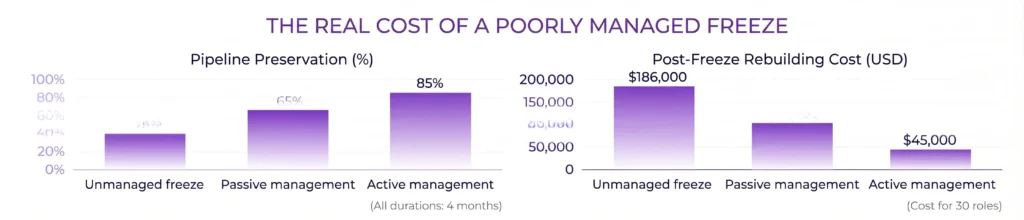
| Scenario | Freeze Duration | Pipeline Preservation | Post-Freeze Rebuilding Cost (30 roles) |
|---|---|---|---|
| Unmanaged freeze | 4 months | 38% | $186,000 |
| Passive management | 4 months | 65% | $97,000 |
| Active management | 4 months | 85% | $45,000 |
Rebuilding cost assumes average cost-per-hire of $4,800 for re-sourced roles, applied to the proportion of the pipeline requiring rebuilding.
Related Terms
| Term | Definition |
|---|---|
| Headcount Planning | The process of determining how many and what type of employees an organization needs to achieve its business objectives |
| Workforce Planning | Strategic analysis of current and future workforce needs against organizational goals |
| Talent Pipeline | The pool of potential candidates at various stages of engagement who could fill current or future roles |
| Backfill | The process of recruiting to replace an employee who has left an existing role |
| Requisition | A formal request to recruit for a specific position, typically requiring budget and HR approval |
Frequently Asked Questions
How long does a typical hiring freeze last?
Most hiring freezes last between 60 and 180 days, with the median around 90 days. Freezes triggered by specific events (funding delays, acquisition integration) tend to have defined lift dates. Freezes triggered by broader financial deterioration often have longer and less predictable durations.
Should candidates be told about a hiring freeze?
Yes, promptly and specifically. Candidates in active pipeline deserve to know that the process has paused, with as much clarity as the organization can provide about expected duration. The reputational cost of ghosting active pipeline candidates during a freeze, particularly at senior levels, consistently outweighs any communication discomfort.
Do hiring freezes affect employer brand scores?
Significantly, if managed poorly. Glassdoor and comparable employer brand surveys consistently show that hiring freeze experiences are the second-most-cited negative experience type in reviews from job applicants, after outright rejection without feedback. Well-communicated and respectfully managed freezes produce markedly better employer brand outcomes.
Can AI tools help maintain pipeline quality during a freeze?
Yes, this is one of the clearest ROI cases for AI-powered talent management platforms. Automated nurture, engagement tracking, and competitive intelligence tools can maintain pipeline quality at a fraction of the manual recruiter time required for equivalent human-managed maintenance.
Does a hiring freeze hurt employee morale?
It depends almost entirely on how it is communicated. Freezes announced with clear rationale, honest timeline expectations, and visible leadership commitment to resuming hiring typically produce modest morale impact. Freezes announced abruptly, without context, or extended indefinitely without communication produce significantly larger morale and retention impacts, particularly among high-performing employees with ready external options.
Conclusion
A hiring freeze is not a hiring failure, it is a response to business conditions, and organizations that manage it skillfully emerge with their talent capacity largely intact and their employer brand protected. The ones that treat a freeze as a recruitment shutdown rather than a talent management challenge bear a hidden cost that takes quarters to fully recover from.
The organizations treating hiring freeze management as a strategic discipline, with defined pipeline preservation protocols, honest candidate communication, and AI-powered maintenance tools, are the ones that hire their way back to full capacity in weeks, not months.
Treat the freeze as a pause, not a stop, and your talent pipeline will still be running when the music starts again.