First impressions in recruitment get a lot of attention. First impressions as an employee, not nearly enough. The period between a signed offer and a confident, productive new hire is where organisations quietly win or lose the talent they worked hard to secure, and for most companies, that period is still held together by spreadsheets, manual emails, and good intentions.
Onboarding automation is the application of technology to systematise and personalise the employee onboarding process, replacing repetitive manual tasks with triggered workflows that run in the background while HR teams focus on the human side of welcoming someone new.
The business case is straightforward. Structured onboarding directly improves employee retention and accelerates time-to-productivity, two metrics that HR analytics teams are increasingly held accountable for. When onboarding fails, it shows up in early attrition numbers and employee engagement scores long before anyone connects it back to a broken process.
This guide covers what onboarding automation looks like in practice, what to prioritise first, and how to implement it without losing the personal touch that actually makes new hires feel at home.
The core metric governing onboarding automation effectiveness is Onboarding Completion Rate: the proportion of required onboarding tasks completed by new hires within the defined onboarding period.
Onboarding Completion Rate (%) = (Completed Onboarding Tasks / Total Required Onboarding Tasks) x 100
Organizations with manual onboarding processes average completion rates of 58-65%. Organizations with fully automated onboarding workflows average 88-94%. The gap is not explained by content quality but by the consistency of delivery and the reduction of completion friction.
What is Onboarding Automation?
Onboarding automation is the systematic application of technology to replace manual, paper-based, or inconsistently managed steps in the new hire integration process with digitized, triggered, and trackable workflows. It encompasses everything from the first pre-boarding communication sent before the employee’s start date to the completion of compliance training modules, manager introduction protocols, equipment provisioning checklists, and 30-60-90 day check-in frameworks.
The term covers a broad range of technology implementations. At its simplest, onboarding automation means replacing paper offer documents and physical verification forms with digital equivalents. At its most sophisticated, it means AI-powered adaptive learning paths that adjust onboarding content and pacing based on the new hire’s role, geography, seniority, and prior experience, alongside automated task assignment to managers, IT teams, and department heads triggered by each new hire’s confirmed start date.
What distinguishes onboarding automation from simply having an HRIS is intentionality. Many organizations have the technology infrastructure required to automate onboarding but have not built the workflows, content, and trigger logic to make it operational. Onboarding automation is a process design discipline as much as a technology procurement decision.
Why Onboarding Automation Is the Most Underestimated Investment in Modern Hiring?
The typical framing of onboarding automation is as an efficiency play: reduce HR admin time, eliminate paper, speed up the paperwork. This framing, while accurate, dramatically understates the strategic value. The real case for onboarding automation is a retention case, not an efficiency case.
According to SHRM research, employees who experience a structured onboarding program are 58% more likely to still be with the organization three years later than those who do not. For an organization hiring 200 people per year at an average cost-per-hire of $6,000, improving three-year retention by 10 percentage points represents 20 additional retained employees and $120,000 in avoided replacement costs per annual cohort. Compounded across three years of hiring, the retention value of strong onboarding automation dwarfs its implementation cost in virtually every organization at scale.
The cost of poor onboarding is also measurable in time-to-productivity. New hires who complete structured onboarding programs reach full productivity an average of 60 days earlier than those who experience unstructured, inconsistent onboarding, according to Aberdeen Group analysis. For revenue-generating roles, a 60-day acceleration in productivity represents material financial impact. For a sales hire with a $250,000 annual quota, 60 days of additional productive time is worth approximately $40,000 in incremental revenue contribution.
The internal cost rarely quantified is manager time. In organizations without onboarding automation, the new hire’s manager is frequently the primary onboarding resource, fielding an average of 4-6 hours of onboarding-related questions per new hire in their first two weeks. For a manager with three new hires in a quarter, that is 12-18 hours of management capacity consumed by information delivery that automated systems could handle. Gallup’s research shows that managers burdened by onboarding administration are 27% less likely to provide the relationship-building investment that actually drives new hire engagement.
For TA and HR leaders, the strategic framing shifts the conversation from “how do we reduce paperwork?” to “how do we protect our hiring investment?” Every dollar spent on sourcing and selection is at risk in the first 90 days. Onboarding automation is the mechanism for protecting it.
Your Resume Isn’t Getting Read
Let’s Get That Fixed!
75% of resumes get auto-rejected. avua’s AI Resume Builder optimizes formatting, keywords, and scoring in under 3 minutes, so you land in the “yes” pile.
The Psychology Behind Onboarding Automation
First Impressions and Cognitive Load Management
New hire experience in the first week is disproportionately shaped by cognitive load. Starting a new job involves processing an enormous volume of unfamiliar information simultaneously: new faces, new systems, new norms, new expectations. Manual onboarding processes that front-load this cognitive demand through lengthy orientation sessions, physical document packets, and unstructured first days consistently produce new hires who report feeling overwhelmed rather than welcomed. Automated onboarding that staggers information delivery across pre-boarding and the first 30 days, providing the right information at the right moment rather than all information at once, significantly reduces first-week overwhelm and improves information retention.
Belonging and Connection Architecture
The sense of belonging is the single strongest predictor of 90-day retention in new hire experience research. Employees who feel connected to their team and clear on their organizational purpose within the first month are dramatically more likely to reach the 12-month mark. Onboarding automation that delivers personal manager introductions, team context, and organizational purpose materials on day one, before the new hire is consumed by technical setup and compliance tasks, creates the relational foundation that manual onboarding frequently neglects.
Progress Visualization and Completion Psychology
Behavioral completion psychology demonstrates that individuals are significantly more likely to complete task sequences when their progress is visible. Onboarding platforms that display checklist completion, progress bars, and milestone acknowledgments engage the same intrinsic motivation mechanisms as well-designed gamification. New hires who can see themselves progressing through onboarding complete more tasks, complete them faster, and report higher satisfaction with the process than those working through unstructured requirements without visibility into their progress.
Onboarding Automation vs. Related HR Processes
| Approach | Admin Time Required | Consistency | Scalability | New Hire Experience |
|---|---|---|---|---|
| Manual onboarding | High (8-12 hrs per hire) | Low | Very low | Inconsistent |
| Partially digitized | Medium (4-6 hrs per hire) | Moderate | Moderate | Moderately consistent |
| Fully automated | Low (1-2 hrs per hire) | High | Very high | Consistent |
| AI-personalized automation | Minimal (under 1 hr per hire) | Very high | Enterprise-scale | Highly personalized |
What the Experts Say?
Organizations that invest in onboarding automation are not solving an HR problem. They are solving a revenue problem. Every day a new hire is confused, underequipped, or not yet connected to their team is a day of productivity the organization paid to acquire and is not receiving.
– Josh Bersin, Global HR Analyst, The Josh Bersin Company
How to Measure Onboarding Automation Effectiveness?
Formulas
Onboarding Completion Rate (%) = (Completed Tasks / Total Required Tasks) x 100
Time-to-Productivity (days) = Date Full Productivity Achieved - Start Date
90-Day Retention Rate (%) = (Hires Retained at 90 Days / Total New Hires) x 100
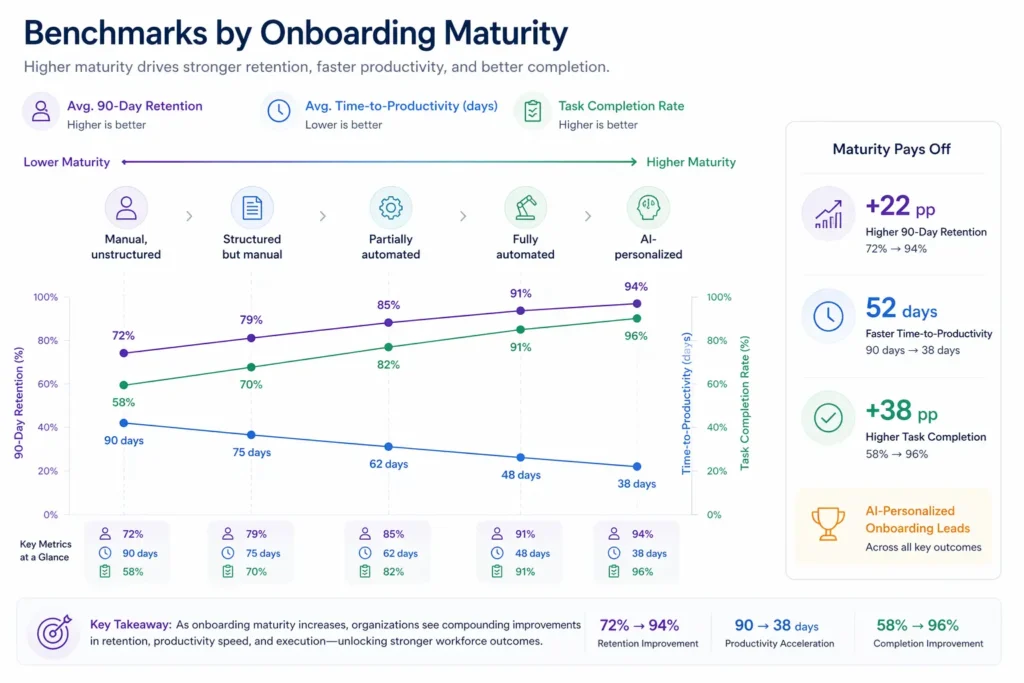
Benchmarks by Onboarding Maturity
| Onboarding Approach | Avg. 90-Day Retention | Avg. Time-to-Productivity | Task Completion Rate |
|---|---|---|---|
| Manual, unstructured | 72% | 90 days | 58% |
| Structured but manual | 79% | 75 days | 70% |
| Partially automated | 85% | 62 days | 82% |
| Fully automated | 91% | 48 days | 91% |
| AI-personalized | 94% | 38 days | 96% |
Key Strategies for Effective Onboarding Automation
How Can AI and Automation Support Onboarding?
Adaptive Learning Path Generation
AI-powered learning management systems can generate personalized onboarding learning paths based on each new hire’s role, prior experience, skill assessment results, and department context, ensuring that onboarding content is relevant and appropriately paced rather than generic. A new hire with 10 years of industry experience does not need the same foundational content as someone entering the field for the first time; adaptive systems recognize this distinction and adjust automatically.
Intelligent Task Assignment and Escalation
Automated workflow engines can assign onboarding tasks to relevant parties, including IT, facilities, payroll, and department heads, triggered by the new hire confirmation, with escalation alerts when tasks are not completed within defined windows. This removes the HR team from the role of manual task tracking and follow-up, which is among the most time-consuming elements of manual onboarding administration.
Sentiment Analysis and Early Warning Detection
AI tools integrated into onboarding platforms can analyze new hire survey responses, login patterns, and platform engagement signals to identify new hires who are disengaging before the 90-day retention risk window opens. This early warning capability allows HR and managers to intervene proactively rather than discovering a flight risk after resignation. Organizations using sentiment-driven early intervention report 90-day retention improvements of 15-22 percentage points compared to those relying on scheduled check-ins alone.
Compliance Automation and Audit Trails
Regulatory compliance requirements in onboarding, including employment eligibility verification, state-specific training requirements, and role-specific certification checks, are highly automatable and high-risk if missed. AI-powered compliance engines track jurisdiction-specific requirements, ensure correct documentation is collected, and maintain audit trails that satisfy regulatory review requirements without manual record-keeping.
Stop Juggling
10 Job Boards.
Search One
Your next role is already here. avua pulls opportunities from across the web into a single searchable feed; filtered by role, location, salary, and remote preference.
1.5 Million+
Active Jobs
380+
Job Categories
Onboarding Automation and Inclusive Talent Practices
Consistency as an Equity Mechanism
Manual onboarding is inherently inequitable because its quality is determined by the manager, HR partner, and team context the new hire lands in. New hires whose managers prioritize onboarding receive meaningfully better experiences than those whose managers deprioritize it, and this variance correlates with existing organizational inequities. Onboarding automation creates a baseline of structured, consistent experience that is independent of managerial capacity or inclination, ensuring that every new hire, regardless of department or manager, receives equivalent foundational support. This is particularly important for new hires from underrepresented groups who may have less access to the informal networks that compensate for poor formal onboarding.
Accessibility and Language Inclusivity
AI-powered onboarding platforms that deliver content in multiple languages, support screen reader compatibility, and offer multiple content formats including text, video, and audio serve a more diverse workforce than platforms designed around a single modality. Organizations hiring internationally or from diverse linguistic communities should evaluate onboarding automation platforms specifically for their accessibility and localization capabilities, not only their workflow sophistication. Explore how this connects to broader inclusive hiring strategy.
Removing the Informal Network Dependency
New hires who arrive with existing relationships in the organization, through personal networks or internal referrals, have access to informal onboarding support that new hires without these connections lack. Automated structured onboarding that delivers equivalent context, introductions, and organizational knowledge to all new hires reduces the advantage conferred by pre-existing organizational relationships. This is especially relevant for diversity hiring initiatives where candidates are being sourced from communities that have historically had less representation in the organization.
Common Challenges and Solutions
| Challenge | Solution |
|---|---|
| Low new hire engagement with automated onboarding content | Audit content length and format; replace text-heavy modules with video and interactive elements; ensure full mobile compatibility across all devices |
| Manager task completion rate below 50% | Implement automated escalation to the manager’s manager when critical tasks are incomplete; frame manager onboarding tasks as part of performance expectations |
| Automation triggers failing due to incomplete HRIS data | Implement a data validation checkpoint between offer acceptance and onboarding trigger; assign ownership for data quality to a specific named HR role |
Real-World Case Studies
Case Study 1: The Technology Company
A 500-person SaaS company with a manual onboarding process and a 90-day retention rate of 74% implemented a fully automated pre-boarding and onboarding workflow covering 140 discrete tasks across HR, IT, and department functions. The automation included role-specific learning paths for their four primary hiring functions: engineering, sales, customer success, and operations. Within two onboarding cohorts, 90-day retention improved to 91%. Manager-reported onboarding administration time fell by 71%. The company calculated the annual retention improvement as equivalent to retaining 34 additional employees per year, representing approximately $680,000 in avoided replacement costs.
Case Study 2: The Healthcare Network
A regional healthcare network with 1,200 annual hires across 14 locations had significant onboarding consistency problems driven by dependency on location-specific HR coordinators. Compliance training completion rates varied from 62% to 89% across locations, creating regulatory exposure. The network implemented a centralized automated onboarding platform with location-specific compliance modules triggered by the new hire’s assigned facility. Compliance completion rates reached 96% network-wide within the first three automated cohorts. HR coordinator time spent on onboarding administration fell by 55%, freeing capacity for strategic workforce projects.
Case Study 3: The Retail Chain
A national retail chain implementing automated onboarding for its 4,000 annual store-level hires found that mobile delivery was critical: 84% of new hires were completing onboarding tasks on mobile devices. The chain’s previous platform was not mobile-optimized, producing completion rates of 48%. After migrating to a mobile-first onboarding automation platform with a maximum module duration of eight minutes, completion rates rose to 89%. Time-to-productivity for store associates fell from an average of 23 days to 14 days, a 39% improvement with direct impact on customer service quality metrics
Performance Metrics Every TA Leader Should Monitor
Onboarding Automation Across the Employee Lifecycle
Pre-Boarding: Engagement Before Day One
The period between offer acceptance and start date is an underutilized onboarding opportunity. Automated pre-boarding workflows that deliver welcome messages from the hiring manager, team introductions, role context materials, and required document completion in the one to two weeks before the start date consistently improve day-one readiness and reduce first-week cognitive load. According to Glassdoor data, new hires who experience strong pre-boarding are 23% less likely to express second thoughts about their decision in the first week.
First 30 Days: Foundation Building
Automation should deliver the highest-density onboarding content in the first 30 days, when new hire attention and motivation for onboarding engagement is highest. Structured check-ins at day 7, day 14, and day 30, automated but with manager facilitation prompts, create the feedback loop that enables early course correction before small concerns become resignation decisions. The quality of the employee experience in this window is the single strongest predictor of 12-month retention.
Days 31-90: Integration and Performance Clarity
The second onboarding phase shifts from foundation-building to performance integration. Automated workflows should deliver 60 and 90-day goal-setting prompts to both the new hire and their manager, role-specific skill development content, and introduction facilitation to cross-functional partners the new hire will work with regularly. The 90-day mark is the standard first evaluation checkpoint and the primary early-attrition risk window.
Post-90 Days: Connecting Onboarding to Continuous Development
Effective onboarding automation connects seamlessly to continuous development systems, ensuring that the learning and goal-setting habits established during onboarding extend into the employee’s ongoing tenure. Organizations that design onboarding automation as the entry point to a continuous learning platform, rather than a standalone onboarding event, report 30% higher employee engagement at 12 months.
The Real Cost of Manual Onboarding vs. Automation
| Scenario | 90-Day Retention Rate | Avg. Time-to-Productivity | Annual Replacement Cost (200 hires/year) |
|---|---|---|---|
| Manual, unstructured onboarding | 72% | 90 days | $672,000 |
| Partially automated onboarding | 83% | 65 days | $402,000 |
| Fully automated onboarding | 91% | 48 days | $216,000 |
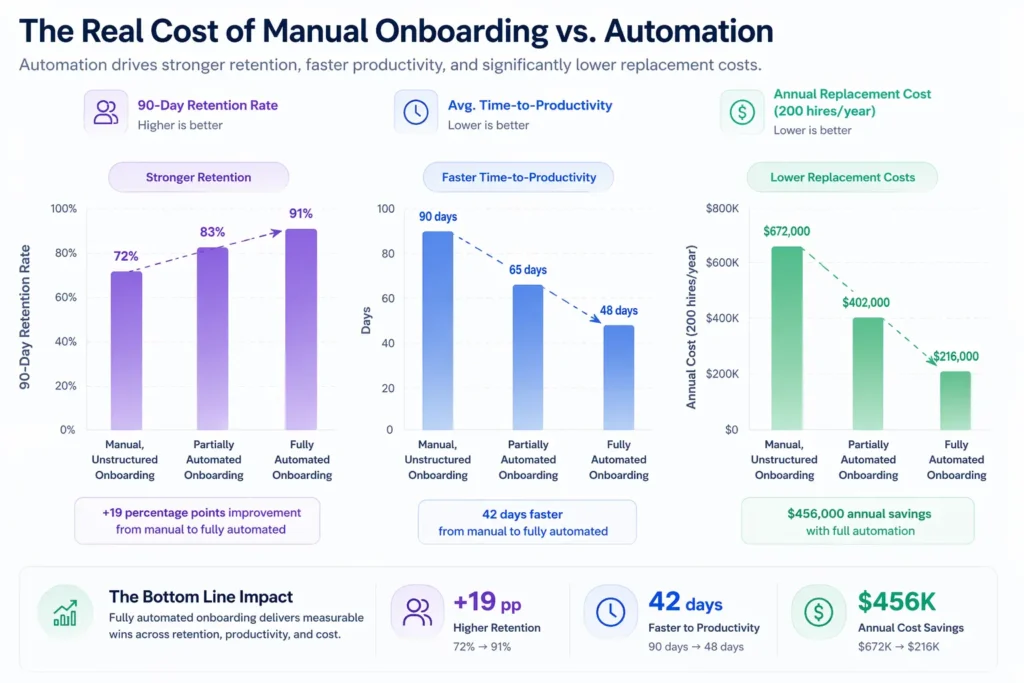
Replacement cost assumed at $6,000 per replaced hire. Annual costs represent total replacement cost for hires lost within 90 days.
Related Terms
| Term | Definition |
|---|---|
| Onboarding | The process of integrating a new employee into the organization, covering culture, systems, relationships, and role expectations |
| HRIS | Human Resource Information System; the platform managing core employee data and typically the trigger source for automated onboarding workflows |
| Pre-Boarding | The period between offer acceptance and start date during which automated engagement and document completion can occur |
| Time-to-Productivity | The elapsed time between a new hire’s start date and the date they reach full independent contribution |
| Employee Retention | The organizational practice of keeping employees engaged and employed, directly impacted by onboarding quality in the first 90 days |
Frequently Asked Questions
How does onboarding automation improve retention?
Automated onboarding creates consistent, well-timed experiences for all new hires regardless of their manager’s capacity or department. SHRM research shows that employees who experience structured onboarding are 58% more likely to remain at the three-year mark. Consistency is the core mechanism: automated systems ensure no new hire falls through the cracks during the most critical period of their tenure.
What onboarding tasks can be automated?
Document collection and e-signature, verification workflows, IT provisioning requests, compliance training assignment and tracking, manager introduction facilitation, 30-60-90 day check-in scheduling, and role-specific learning path delivery can all be automated. The tasks that cannot and should not be automated are the relationship-building conversations between managers and new hires that determine long-term engagement.
How does onboarding automation integrate with existing HR systems?
Most modern onboarding automation platforms integrate with the organization’s HRIS, ATS, and learning management system through API connections, triggering onboarding workflows automatically when a new hire record is created. Integration quality is one of the most important evaluation criteria when selecting a platform.
Does onboarding automation work for remote and hybrid teams?
Yes, and it is particularly valuable for remote and hybrid environments where informal in-person onboarding support does not exist. Automated pre-boarding, virtual team introductions, and digital milestone check-ins replace many of the organic connections that office environments facilitate, providing structure that remote new hires would otherwise lack entirely.
Conclusion
Onboarding automation is the infrastructure that protects the organization’s hiring investment. Every sourcing dollar, every interview hour, and every offer letter delivered to the right candidate is at risk in the first 90 days if the onboarding experience is inconsistent, overwhelming, or disconnected from what the candidate was promised during the hiring process. Organizations that build automated, structured, and personalized onboarding systems convert new hires into retained, productive, engaged employees faster than those relying on manual processes. The automation is not the destination; it is the vehicle. What it delivers, consistently and at scale, is the experience of a well-organized, prepared, and welcoming employer, at every location, for every new hire, without exception.