Your next hire is probably scrolling through a social platform right now.
They are not on a job board, they are not actively searching, and they have not updated their resume in months. But they are reachable, and organisations that have figured out social recruiting are already in their feed while everyone else is waiting for applications to arrive.
Social recruiting is the practice of using social media platforms to attract, engage, and convert both active and passive candidates into applicants, building employer presence and talent relationships in the spaces where people actually spend their time. It extends the reach of traditional sourcing well beyond job boards and professional networks, turning everyday content and conversation into a candidate pipeline strategy.
The overlap with recruitment marketing is significant. Social recruiting is often where employer brand lives and breathes in practice, shaping how candidates perceive an organisation long before a role ever goes live. What gets posted, how it is framed, and how consistently it reflects real culture directly influences candidate engagement at scale.
For teams tracking data-driven recruiting metrics, social recruiting is also one of the more measurable sourcing channels available. Reach, engagement, application source tracking, and conversion rate data all combine to give a clearer picture of which platforms and content types are actually driving hiring outcomes.
The core metric governing social recruiting effectiveness is the Social Sourcing Yield Rate: the proportion of social-channel candidates who convert to hires, relative to total candidates engaged through social channels. Organizations with mature social recruiting functions achieve Social Sourcing Yield Rates of 18 to 28%, substantially higher than the 6 to 10% average for traditional job board channels.
Social Sourcing Yield Rate (%) = (Hires from Social Channels / Total Candidates Engaged via Social) x 100
Top-performing organizations generating 30 to 40% of hires through social channels invest in both functions – employer brand content and active social sourcing – with defined strategies for each. Organizations that treat social recruiting as a job-posting activity, simply syndicating job descriptions to social platforms, consistently achieve yield rates below 4%, which explains the persistent skepticism about social recruiting’s ROI among teams that have never invested in it properly.
What is Social Recruiting?
Social recruiting is the use of social media platforms, professional networks, and online communities to proactively identify, attract, and engage candidates for open or anticipated roles – combining content-based employer brand building with direct sourcing outreach and community management to create a multi-touchpoint talent attraction system that operates continuously, not only when requisitions are open.
The distinction between social recruiting and simply posting jobs on social platforms is the difference between a billboard and a conversation. Social recruiting at its most effective involves understanding which platforms host the professional communities relevant to your role types, building authentic presence on those platforms before hiring needs arise, and using both content engagement and direct outreach to create candidate interest that is warmer and more informed than any cold job board application. Recruitment marketing and social recruiting are increasingly inseparable: the brand signals that social recruiting amplifies determine the quality and volume of candidates that recruitment marketing can convert.
Why Social Recruiting Is a Proven Competitive Advantage for Modern Organizations?
The business case for social recruiting has moved beyond adoption and into optimization. The question organizations are now asking is not whether social recruiting works but which platforms, content strategies, and outreach approaches produce the strongest yield for their specific talent segments.
The foundational data point: according to Glassdoor’s research on candidate behavior, 84% of job seekers use social media in their job search, and 60% of professionals use it to research employers before ever applying. This means the candidate journey for most hires begins on social platforms, often weeks or months before a formal application. Organizations with no meaningful social presence are invisible during the highest-influence stage of the candidate decision process – the awareness and consideration stages where employer brand impressions are formed. By the time a candidate reaches a job board, the organizations they will seriously consider are largely already determined.
The cost-per-hire advantage of social recruiting is significant. Glassdoor benchmarks consistently show that hires sourced through social channels carry 44% lower average cost-per-hire than those sourced through traditional job boards, driven primarily by the elimination of per-posting fees, the compounding return on employer brand content investment, and the higher candidate quality that warm social engagement produces relative to cold board applications.
For a company making 100 hires per year at an average traditional cost-per-hire of $7,500, a 35% shift to social-channel sourcing achieving a 44% cost reduction on those roles saves approximately $116,000 annually – not counting the quality-of-hire improvements associated with candidates who have researched the employer through social content before applying.
The passive candidate access argument is the strategic advantage that no job board can replicate. According to LinkedIn’s Global Talent Trends data, 70% of the global workforce is not actively seeking a new role at any given moment. Job boards reach the 30% who are looking. Social recruiting reaches the 70% who are not – through employer brand content that builds awareness in their social feeds, through community engagement that keeps your organization in their professional consciousness, and through direct sourcing outreach that arrives when they are scrolling rather than searching. That access differential is why organizations competing for specialized or senior talent cannot rely on job boards alone.
The ROI calculation is straightforward: a social recruiting investment of $40,000 annually in content, tools, and dedicated recruiter time that shifts 30% of hires to social channels, reduces cost-per-hire by 40% on those hires, and improves offer acceptance rate by 12% (through better-informed candidates who have already formed a positive employer impression) returns a value well in excess of its cost. The organizations that have built and measured this are not treating social recruiting as a nice-to-have employer brand activity. They are treating it as core sourcing infrastructure.
Your Resume Isn’t Getting Read
Let’s Get That Fixed!
75% of resumes get auto-rejected. avua’s AI Resume Builder optimizes formatting, keywords, and scoring in under 3 minutes, so you land in the “yes” pile.
The Psychology Behind Social Recruiting
Social Proof and Employer Validation
Social proof operates powerfully in candidate decision-making. Before a professional decides whether an organization is worth their time and career risk, they look for signals that others like them have made the choice and found it worthwhile: employee testimonials, culture content, leadership communication style, how the organization responds to public feedback. Social recruiting that surfaces authentic employee voices, celebrates team milestones, and demonstrates organizational values through real content rather than polished corporate messaging consistently produces higher candidate consideration rates than organizations that restrict their social presence to job postings and press releases.
Parasocial Familiarity and Brand Trust
Candidates who follow an organization’s social presence over weeks or months before a direct recruitment contact arrive at that contact with a level of brand familiarity that cold outreach cannot manufacture. This parasocial relationship – the one-sided familiarity that develops through consuming an organization’s content without direct interaction – functions as a trust accelerant. When a recruiter reaches out to a candidate who has been following the company’s engineering blog or watching leadership videos on LinkedIn, the outreach is received as a continuation of an existing relationship rather than an unsolicited cold approach. This familiarity effect measurably improves response rates on direct social sourcing outreach.
Network Contagion and Organic Reach
Social platforms amplify content through network effects that no paid channel can fully replicate. When an employee shares a company post, their professional network sees it – and that network is populated with other professionals in the same field, at similar career stages, with similar skill profiles. This organic network contagion means that a single piece of authentic employer content can reach qualified passive candidates who have no direct connection to the organization, through second and third-degree connections that would cost significant budget to reach through paid advertising. Employee advocacy programs that systematically activate this organic reach are among the highest-ROI investments in a social recruiting strategy.
Social Recruiting vs. Related Recruitment Approaches
| Approach | Candidate State | Reach | Cost Structure | Brand Building Value |
|---|---|---|---|---|
| Social Recruiting | Passive and active | Broad and targeted | Platform + content investment | High, continuous |
| Traditional Job Boards | Active applicants | High volume, lower quality | Per-posting fees | Low |
| Niche Job Boards | Active, specialist | Targeted by sector | Per-posting or subscription | Low |
| Employee Referral Programs | Passive, trusted | Network-constrained | Incentive-based | Moderate |
| Headhunting | Passive, senior | Narrow and high-value | Retained fee | Moderate |
| Campus Recruiting | Early career, active | Campus-specific | Event and travel costs | High for target cohort |
The critical distinction between social recruiting and job board approaches is the directionality of candidate engagement. Job boards are pull mechanisms: they reach candidates who are already actively searching. Social recruiting is a push-and-pull system: it builds passive candidate awareness through content (push) and converts that awareness into applications or sourcing conversations (pull). This dual-direction engagement model is why social recruiting consistently outperforms job boards on candidate quality metrics even when it underperforms on raw application volume.
What the Experts Say?
The organizations winning the talent competition on social are not the ones posting the most jobs. They are the ones that have made their company worth following – where the content is good enough that professionals in their target talent pool actually want to see it. That audience is an asset that compounds over time and no competitor can buy overnight.
– Lars Schmidt, Founder, Amplify and Host, Redefining HR Podcast
How to Measure Social Recruiting Effectiveness?
Formula
Social Sourcing Yield Rate (%) = (Hires via Social Channels / Total Social-Channel Candidates) x 100
Engagement-to-Application Rate (%) = (Applications Generated / Total Social Content Engagements) x 100
Social Cost-per-Hire ($) = Total Social Recruiting Investment / Hires Sourced from Social Channels
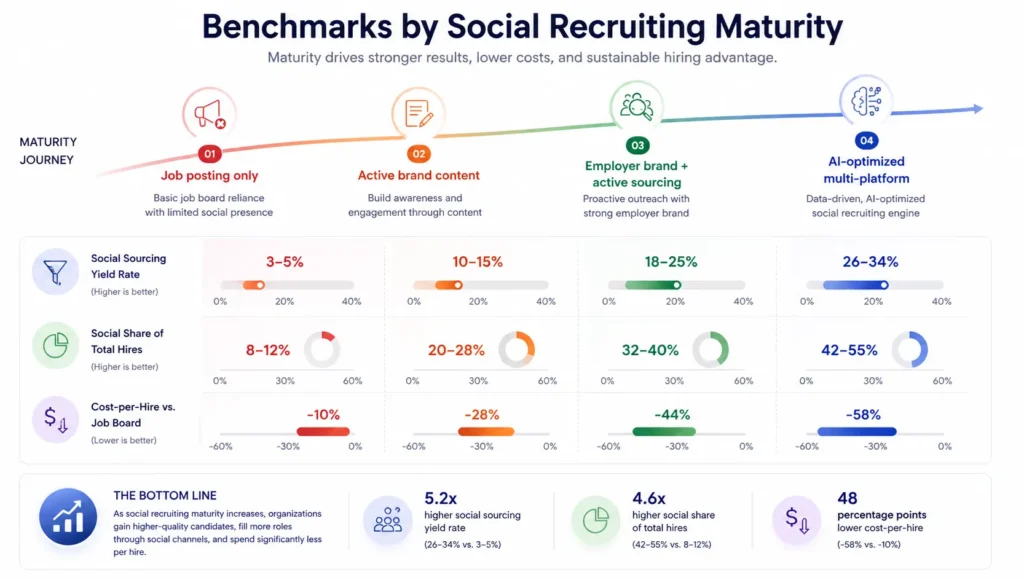
Benchmarks by Social Recruiting Maturity
| Maturity Level | Social Sourcing Yield Rate | Social Share of Total Hires | Cost-per-Hire vs. Job Board |
|---|---|---|---|
| Job posting only | 3-5% | 8-12% | -10% |
| Active brand content | 10-15% | 20-28% | -28% |
| Employer brand + active sourcing | 18-25% | 32-40% | -44% |
| AI-optimized multi-platform | 26-34% | 42-55% | -58% |
Key Strategies for Effective Social Recruiting
How Can AI and Automation Support Social Recruiting?
Social Listening and Talent Intelligence
AI-powered social listening tools monitor conversations across professional networks and online communities to identify signals of career change consideration, professional frustration, skill development activity, and competitive employer dissatisfaction. These signals allow talent acquisition teams to time outreach to passive candidates at the moments of maximum receptivity, rather than cold-approaching the full talent market randomly. Social listening converts the noise of professional social media into structured talent intelligence that informs both sourcing targeting and employer brand content strategy.
AI-Powered Content Optimization
Content optimization AI analyzes engagement data across social platforms to identify which types of employer brand content (culture stories, career development narratives, technical challenge posts, leadership videos, team spotlights) generate the highest engagement from target talent audiences on each platform. This intelligence allows social recruiting content teams to allocate production effort toward the content formats that build candidate pipeline most efficiently, moving beyond instinct-based content strategy to data-informed content investment decisions.
Automated Multi-Channel Outreach
AI-powered CRM tools can manage personalized social outreach sequences across multiple platforms simultaneously, tracking message delivery, response rates, and engagement signals at a scale no manual recruiter workflow can sustain. This automation concentrates recruiter time on the conversations that require human relationship capability – the response to genuine interest, the opportunity qualification discussion, the candidate experience question – rather than on the administrative labor of outreach scheduling and follow-up tracking.
Predictive Audience Targeting
Programmatic social advertising platforms with AI targeting capabilities can identify and reach the specific professional demographic profiles most likely to convert to applicants for each role type, based on skills, career stage, engagement behavior, and competitive employer signal data. This precision targeting produces significantly higher engagement-to-application rates than broad audience social advertising, and it extends the reach of social recruiting beyond the organization’s existing follower base to qualified professionals who have not yet encountered the employer brand.
Stop Juggling
10 Job Boards.
Search One
Your next role is already here. avua pulls opportunities from across the web into a single searchable feed; filtered by role, location, salary, and remote preference.
1.5 Million+
Active Jobs
380+
Job Categories
Social Recruiting and Building an Equitable Talent Pipeline
Platform Demographics and Representation Gaps
Social recruiting strategies built exclusively around LinkedIn systematically underrepresent certain demographic groups. LinkedIn’s user base skews toward white-collar, college-educated professionals and overrepresents industries with historically lower diversity rates. Organizations that rely solely on LinkedIn for social sourcing are inheriting LinkedIn’s demographic composition, not accessing the full diversity of the available skilled workforce. Platform diversification – adding Twitter, Instagram, TikTok, and sector-specific communities to the social recruiting mix – materially expands the demographic reach of sourcing activity without requiring separate diversity programs.
Content Accessibility and Inclusive Representation
Employer brand content that features only certain demographic profiles in leadership and technical roles sends implicit signals about who belongs in those roles that passive candidates from underrepresented backgrounds receive clearly. Inclusive social recruiting requires intentional representation in content: diverse employee voices, varied career path stories, and authentic depictions of the team environment. This is not just an equity consideration – research on candidate decision-making shows that underrepresented candidates are significantly more influenced by social representation signals in employer content than by diversity statements in job descriptions.
Sourcing Beyond the Dominant Professional Network
Active social sourcing through diversity sourcing channels – professional associations for underrepresented groups, HBCU alumni networks, community-specific LinkedIn groups, and sector-specific diversity communities – reaches qualified candidates who are underrepresented on mainstream platforms but fully active in their own professional networks. Building sourcing relationships with these communities, rather than simply posting into them when hiring needs arise, produces the warm candidate relationships that convert to hires at rates comparable to mainstream sourcing channels.
Common Challenges and Solutions
| Challenge | Solution |
|---|---|
| Difficulty attributing hires to specific social channels | Implement UTM tracking on all social job links and source-of-hire tagging in ATS from the first candidate touchpoint |
| Platform algorithm changes reducing organic content reach | Diversify across four or more platforms; build direct community relationships (LinkedIn newsletters, Discord servers, industry Slacks) that are algorithm-independent |
| Recruiter time consumed by unqualified social outreach responses | Use AI-powered initial response tools to qualify social-channel responses before routing to recruiter conversation; define clear qualification criteria for social sourcing |
Real-World Case Studies
Case Study 1: The Technology Company
A mid-market SaaS company built a systematic LinkedIn employer brand program – publishing three pieces of employee-authored content weekly, activating 40 employees as content advocates, and running targeted InMail outreach to passive candidates identified through LinkedIn Talent Insights. Over twelve months, the program produced a 340% increase in follower growth, a 28% reduction in time-to-fill for engineering roles (attributed to warmer candidate awareness at first recruiter contact), and a 51% improvement in InMail response rates compared to generic outreach messages. Social channels grew to represent 38% of total hires by month ten.
Case Study 2: The Retail Chain
A national retail group facing early-career hiring challenges launched a TikTok employer brand account featuring employee-created content showing real day-in-the-life experiences, store team culture, and career progression stories from team members who had grown into management. The account reached 180,000 followers within eight months through entirely organic content. Applications from the 18 to 24 age demographic increased by 112% in markets where the TikTok program was active. The cost-per-hire for hourly roles in those markets fell by 34%, driven by the reduction in paid job board spend required to achieve target application volumes.
Case Study 3: The Healthcare Network
A regional healthcare network struggling to source clinical support staff in competitive labor markets shifted 40% of its social recruiting budget to Facebook community group engagement and local professional group management, where a significant proportion of allied health professionals in the region were active. Recruiters joined, contributed to, and built presence in twelve relevant community groups over six months before any direct hiring outreach.
When sourcing campaigns launched, response rates from group members were 4.2 times higher than cold LinkedIn outreach to equivalent profiles. The healthcare network filled 34 of 40 target clinical support roles through community group sourcing, at 61% of the cost-per-hire of their previous job board-primary approach.
Proven Social Recruiting Metrics Every Talent Leader Must Monitor
Social Recruiting Across the Talent Lifecycle
Awareness and Employer Brand Building
Social recruiting begins well before any requisition opens. The employer brand content published in the months and years before a candidate becomes a target shapes how that candidate perceives the organization when the recruitment conversation starts. Organizations that invest in consistent, authentic social employer brand building maintain a warm audience of future candidates who already understand the culture, the leadership, the career opportunities, and the work environment – dramatically reducing the education burden at the application and interview stages of the hiring process.
Active Sourcing and Direct Outreach
When hiring needs are active, social platforms become sourcing channels where recruiters identify passive candidates through profile analysis, community participation, and published content signals. The candidate experience of social-channel sourcing is determined almost entirely by how personalized and relevant the initial outreach message is – generic LinkedIn InMails consistently achieve response rates below 15%, while messages that reference a specific piece of candidate work, comment, or professional achievement achieve response rates above 40% from equivalent candidate populations.
Application and Conversion
Social recruiting produces candidates who arrive at the application stage with more employer information, clearer role understanding, and stronger initial organizational affinity than candidates from cold job board applications. This informed arrival improves application completion rates, reduces early-stage candidate drop-off, and produces higher offer acceptance rates because the candidate’s pre-application research has already resolved many of the concerns that typically emerge late in the hiring process.
Post-Hire Social Advocacy
The highest-leverage social recruiting content is produced by employees who genuinely love working at the organization. Post-hire onboarding that activates new employees as social advocates – by encouraging authentic content sharing, providing simple tools for workplace storytelling, and creating experiences worth sharing – compounds the employer brand investment made before hire. Every new employee who becomes an authentic social advocate multiplies the organization’s social recruiting reach through their professional network, creating a self-reinforcing recruitment advantage that scales with headcount.
The Real Cost of Underinvesting in Social Recruiting
| Scenario | Social Recruiting Maturity | Social Share of Hires | Annual Cost Savings (100 hires) |
|---|---|---|---|
| Job board reliant | None | 8% | Baseline |
| Basic social presence | Posting only | 15% | $38,000 |
| Active brand + sourcing | Structured program | 35% | $116,000 |
| AI-optimized multi-platform | Full deployment | 50% | $166,000 |
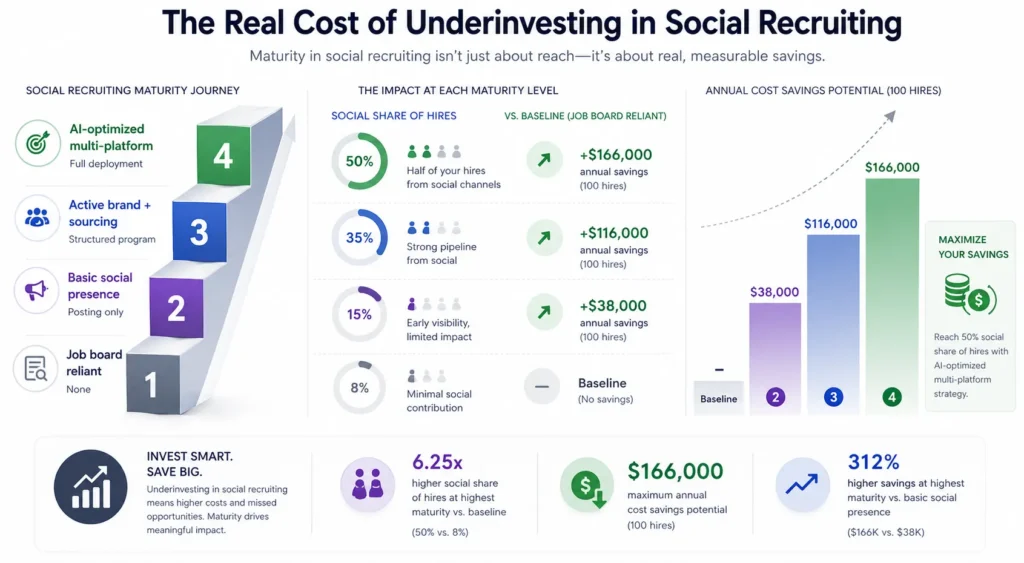
Cost savings calculated against traditional job board cost-per-hire of $7,500, with social channel cost-per-hire 44% lower. Assumes 100 hires per year.
Related Terms
| Term | Definition |
|---|---|
| Employer Brand | The reputation and perception of an organization as an employer, shaped by culture, values, and employee experience signals |
| Passive Candidate | A professional who is not actively seeking employment but may be open to the right opportunity if approached correctly |
| Recruitment Marketing | The application of marketing principles to talent attraction, including content strategy, audience targeting, and conversion optimization |
| Employee Advocacy | A program that activates current employees to share organizational content and promote the employer brand through their personal networks |
| Talent Community | A managed group of potential candidates who have expressed interest in the organization and are maintained in relationship through regular communication |
Frequently Asked Questions
What is social recruiting and how does it differ from posting jobs on social media?
Social recruiting is a comprehensive strategy using social platforms for talent attraction, employer brand building, and active candidate sourcing. Posting jobs on social media is one tactic within social recruiting. The full social recruiting system includes employer brand content, employee advocacy, passive candidate sourcing through direct outreach, and community engagement, rather than just syndicating job descriptions to social channels.
Which social platforms are most effective for recruiting?
The best platforms depend on the talent segment. LinkedIn is most effective for professional and senior roles. GitHub and Stack Overflow are valuable for technical talent. TikTok and Instagram perform strongly for early-career and creative roles. Facebook community groups are highly effective for healthcare, trades, and regional hiring. A mature social recruiting strategy operates across multiple platforms with distinct content and sourcing strategies for each.
How do you measure the ROI of social recruiting?
Measure social recruiting ROI through three primary metrics: Social Sourcing Yield Rate (hires generated per social-channel candidate), cost-per-hire from social versus traditional channels, and Quality of Hire score for social-sourced candidates. Organizations with mature social recruiting programs consistently report 40 to 58% lower cost-per-hire from social channels compared to job boards, making the ROI case straightforward once measurement infrastructure is in place.
How long does it take for social recruiting to produce results?
Social recruiting produces results on two different timescales. Active sourcing outreach on social platforms can produce candidate conversations within days. Employer brand content investment typically requires three to six months of consistent publishing before measurable impact on candidate pipeline quality and volume is visible. Organizations expecting immediate hire volume from new social programs consistently underestimate the time required to build audience awareness and trust.
Does social recruiting replace job boards?
No. Social recruiting complements job boards by accessing the passive candidate population that job boards cannot reach and building employer brand awareness that improves the conversion of job board applicants. Most high-performing talent acquisition functions use social recruiting for passive candidate sourcing and employer brand, while maintaining job board presence for active candidate volume. The strategic shift is in budget allocation: organizations with strong social recruiting programs invest less per hire in job board fees and more in content and platform capabilities.
Conclusion
Social recruiting is the talent acquisition function’s most powerful long-duration asset: the employer brand and candidate community built through consistent social investment that compounds in value with every month of sustained activity. The organizations that have built genuine social recruiting capability – with platform-specific strategies, authentic employer brand content, active sourcing outreach, and AI-optimized targeting – are reaching candidate populations that no job board can access and building candidate familiarity that no cold outreach can replicate.
Those still treating social media as a job distribution channel are using a broadcast medium for a relationship strategy. The investment required to do social recruiting well is measurable. The cost of not doing it well shows up in longer time-to-fill, higher cost-per-hire, and a passive candidate market that your best competitors are working while you are waiting for applications.
Build the social presence before you need the hire, and the hire will be waiting when you do.