Hiring is getting harder, but not always for the reasons organisations assume.
Budgets are available, roles are open, and applications are coming in. The problem is that the skills required to do the work and the skills candidates actually bring to the table are increasingly out of sync. That gap has a name, and closing it has become one of the most pressing challenges in modern workforce planning.
A skills gap is the measurable difference between the capabilities an organisation needs to operate and grow, and the capabilities currently available within its workforce or the broader talent market. It shows up in longer time-to-fill, declining quality of hire, and a hiring plan that keeps getting revised because the right candidates simply do not exist in sufficient numbers.
For HR teams, skills gaps are rarely a surprise when the data is being read properly. People analytics and HR analytics functions that track workforce capability over time can surface emerging gaps before they become critical, giving organisations a window to respond through targeted hiring, internal development, or structured internal mobility programmes.
Understanding where skills gaps exist, why they form, and how to address them strategically is no longer optional for organisations competing for specialist talent. It is the foundation of a workforce plan that actually holds up under pressure.
The core metric governing skills gap management is the Skills Gap Closure Rate: the proportion of identified skill gaps that an organization successfully closes within a defined period through hiring, upskilling, reskilling, or internal mobility.
Skills Gap Closure Rate (%) = (Skill Gaps Closed Within Period / Total Identified Skill Gaps) x 100
High-performing organizations achieve Skills Gap Closure Rates of 70 to 85% annually. Industry average sits closer to 42%. The gap between best-in-class and average is explained almost entirely by planning quality and the organization’s ability to act on skills intelligence before gaps become crises.
What is a Skills Gap?
A skills gap is the quantifiable difference between the skills, competencies, and capabilities that exist within an organization’s current workforce and those required to deliver on strategic objectives, fill open roles effectively, or maintain operational performance at a defined standard. Skills gaps can be technical, involving specific tools, technologies, or domain expertise; functional, involving process or cross-discipline capabilities; or behavioral, involving leadership, communication, or adaptive thinking competencies that are increasingly critical in fast-changing environments.
The skills gap is distinct from a headcount shortage. An organization can have sufficient people and a severe skills gap simultaneously; it can also have a genuine headcount need that is itself a symptom of an underlying skills gap. Treating a skills gap as a simple hiring problem, rather than a capability problem requiring a portfolio of responses, is the most expensive mistake organizations make in workforce planning.
Why Skills Gap Analysis Is a Competitive Advantage in Modern Organizations?
The skills gap has existed as long as industries have evolved faster than workforces could adapt. What has changed in the current era is the velocity of that evolution and the precision with which organizations can now measure and respond to the resulting capability shortfalls.
The scale of the problem is documented and significant. The World Economic Forum’s Future of Jobs Report 2023 estimated that 44% of workers’ core skills will be disrupted within five years, driven by automation, AI adoption, and the green economy transition. For TA leaders, that statistic is not an abstract macro trend; it is a live operational problem. Every open role a team struggles to fill, every project delayed by a capability shortfall, and every external hire made at a premium because internal skill development was neglected is a manifestation of a skills gap that could have been anticipated and managed.
The ROI of proactive skills gap analysis is easier to calculate than most organizations realize. Consider a 300-person technology company that identifies, through a formal skills gap assessment, that its engineering team lacks proficiency in three cloud infrastructure technologies that its product roadmap requires in 18 months.
The organization has two primary responses: hire externally for those skills, at an average cost-per-hire of $12,000 per role plus a 25 to 40% salary premium for candidates with rare technical credentials; or invest in targeted upskilling of existing engineers, at an average training investment of $3,500 per person. For a gap affecting twelve engineers, the cost difference is approximately $102,000 in favour of the upskilling path, before accounting for the shorter time-to-productivity of internal development versus external onboarding.
The organizations that identify skills gaps early enough to have both options available consistently outperform those that discover the gap at the point of crisis, when external hiring at any cost becomes the only viable path. A formal hiring plan that incorporates skills gap analysis as a primary input converts reactive, premium-cost hiring into a deliberate portfolio of build, buy, and borrow decisions, each calibrated to the specific timeline, cost, and risk profile of the gap it addresses.
A concrete data point: McKinsey’s research on workforce skill transitions found that organizations with structured skills gap identification processes make external hiring decisions that are 31% more precise in targeting than those hiring without documented gap analysis, measured by 12-month role performance against defined skill requirements. The precision comes not from hiring better people but from hiring for the right skills because the organization knew, before the search began, exactly which skills the hire needed to provide.
For TA leaders, the competitive advantage of skills gap analysis is not just about individual hire quality. It is about the organization’s ability to respond to market change faster than competitors, to sequence workforce investment rationally rather than reactively, and to build the internal capability that reduces long-term dependence on an increasingly expensive and competitive external talent market.
Your Resume Isn’t Getting Read
Let’s Get That Fixed!
75% of resumes get auto-rejected. avua’s AI Resume Builder optimizes formatting, keywords, and scoring in under 3 minutes, so you land in the “yes” pile.
The Psychology Behind Skills Gap Identification
Optimism Bias in Capability Assessment
Organizations systematically overestimate the skill levels of their current workforce, particularly for capabilities that are adjacent to existing expertise. Managers rating their teams’ capabilities against emerging skill requirements tend to anchor on demonstrated performance in current tasks rather than assessed readiness for future demands. This optimism bias means that internal skills gap assessments based on manager self-report consistently understate the true depth of the gap. Objective skill assessments, using validated tools rather than manager ratings, typically reveal skills gaps that are 20 to 35% larger than manager-reported estimates suggest.
The Visibility Gap Between Technical and Behavioral Skills
Technical skills gaps are far easier to identify than behavioral and adaptive skills gaps, yet behavioral skills gaps increasingly drive the most costly hiring and performance failures. A team can measure its Python proficiency; it is far harder to measure its capacity for cross-functional influence, ambiguity tolerance, or learning agility. This visibility asymmetry means that most skills gap analyses heavily weight technical capabilities and systematically underweight the behavioral and cognitive skills that predict performance in complex, fast-changing roles. Effective skills gap analysis requires explicit methodologies for surfacing both skill dimensions.
Sunk Cost and the Legacy Skill Trap
Once an organization has invested heavily in developing a specific skill set within its workforce, it faces a powerful psychological resistance to acknowledging that the skill set is becoming less strategically relevant. The sunk cost of past training investment makes it difficult to objectively assess whether the current workforce’s dominant capabilities align with where the business is going rather than where it has been. Skills gap analysis conducted by external practitioners or supported by objective data consistently produces more accurate gap identification than analysis conducted entirely by the managers who authorized the original skill development investment.
Skills Gap vs. Related Workforce Challenges
| Challenge | Core Definition | Primary Cause | Resolution Approach | Time Horizon |
|---|---|---|---|---|
| Skills Gap | Mismatch between current capabilities and required capabilities | Industry evolution, technology change, strategic shift | Hire, upskill, reskill, restructure | Medium to long-term |
| Talent Shortage | Insufficient supply of qualified candidates in the market | Demographics, education pipeline, geography | Sourcing strategy, compensation, relocation | Short to medium-term |
| Skills Mismatch | Right skills present but deployed in wrong roles | Poor job design, internal mobility gaps | Internal mobility, role redesign | Short-term |
| Capability Debt | Accumulated underinvestment in workforce development | Budget prioritization, L&D neglect | Structured learning investment | Long-term |
| Knowledge Gap | Lack of institutional or domain-specific knowledge | Attrition, rapid growth | Knowledge management, mentoring | Short to medium-term |
The critical distinction between a skills gap and a talent shortage is that a talent shortage is a market supply problem while a skills gap is a workforce capability problem. Both can produce identical symptoms, such as unfilled roles and project delays, but they require fundamentally different responses. Misdiagnosing a skills gap as a talent shortage leads organizations to spend heavily on sourcing and compensation premiums when the real investment should be in workforce development or role redesign.
What the Experts Say?
The organizations winning the talent war in the next decade will not be those that hired the most people. They will be the ones that understood what skills they needed before they needed them, and built deliberate strategies for acquiring and developing those skills. Skills gap analysis is not an HR function. It is a strategic planning function.
– Josh Bersin, Global HR Analyst and Founder, The Josh Bersin Company.
How to Measure Skills Gap Severity and Progress?
Formula
Skills Gap Closure Rate (%) = (Skill Gaps Closed Within Period / Total Identified Skill Gaps) x 100
Skills Gap Severity Index = Average (Required Proficiency Level - Current Proficiency Level) across all assessed skill areas
Internal Fill Rate for Gap Roles (%) = (Roles Filled Internally / Total Roles Opened Due to Skills Gap) x 100
Time-to-Skill-Readiness (days) = Date Employee Reaches Required Proficiency - Date Training or Development Commenced
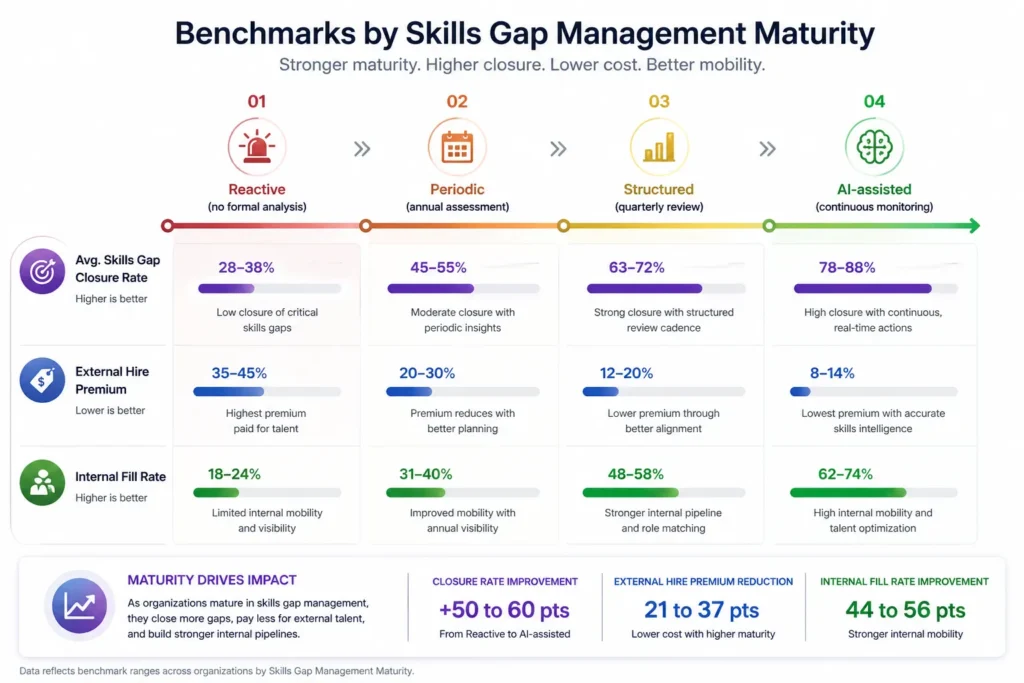
Benchmarks by Skills Gap Management Maturity
| Management Maturity | Avg. Skills Gap Closure Rate | External Hire Premium | Internal Fill Rate |
|---|---|---|---|
| Reactive (no formal analysis) | 28-38% | 35-45% above market | 18-24% |
| Periodic (annual assessment) | 45-55% | 20-30% above market | 31-40% |
| Structured (quarterly review) | 63-72% | 12-20% above market | 48-58% |
| AI-assisted (continuous monitoring) | 78-88% | 8-14% above market | 62-74% |
Key Strategies for Managing Skills Gaps Effectively
How Can AI and Automation Support Skills Gap Management?
Real-Time Workforce Skills Mapping
AI-powered workforce analytics platforms can construct a continuous, real-time skills map of the entire organization, aggregating data from performance systems, project histories, training records, and role profiles to produce a dynamic capability inventory. This continuous mapping converts skills gap analysis from a periodic exercise requiring weeks of manual data collection into an always-current intelligence layer that TA and L&D leaders can act on immediately. People analytics capabilities at this level were previously the exclusive domain of organizations with large, dedicated analytics teams.
Predictive Skills Demand Modeling
Machine learning models can analyze industry trend data, job posting signals, technology adoption curves, and business strategy inputs to forecast which skill demands will emerge in a defined timeframe. This predictive layer allows organizations to begin closing skills gaps before the gap becomes operationally critical, converting reactive hiring at premium cost into planned development or sourcing at standard cost. Predictive analytics applied to skills demand modeling is one of the highest-ROI applications of AI in talent management.
Skills-Based Candidate Matching
AI sourcing tools can match job requisitions to candidates based on documented skill profiles rather than keyword-matched job titles or credential lists, producing candidate shortlists that are genuinely calibrated to the specific capabilities the organization needs to close a defined gap. This skills-based matching approach reduces mis-hire rates for gap-targeted roles by 25 to 40% compared to traditional title-and-credential sourcing, because the matching criteria reflect actual capability requirements rather than proxy indicators.
Internal Skills Gap Identification and Mobility Matching
AI platforms can identify employees whose current role underutilizes a skill that another team urgently needs, flagging internal mobility opportunities that close skills gaps without any external hiring cost. This internal gap-matching capability addresses one of the most persistent inefficiencies in large organizations: skills that exist within the workforce but are invisible to the teams that need them because there is no systematic mechanism for surfacing them.
Stop Juggling
10 Job Boards.
Search One
Your next role is already here. avua pulls opportunities from across the web into a single searchable feed; filtered by role, location, salary, and remote preference.
1.5 Million+
Active Jobs
380+
Job Categories
Skills Gap as an Equity Tool: Beyond Compliance
Access to Skills Development and Structural Inequality
The distribution of skills development opportunity within organizations is rarely equitable, and the resulting skills gaps often fall disproportionately on employees from underrepresented groups. Employees in lower-seniority, lower-visibility, or geographically dispersed roles consistently receive less access to the training, mentoring, and stretch assignments that build the capabilities organizations most need.
A skills gap analysis that accurately maps the distribution of skill levels across the workforce frequently reveals that the gap is not evenly distributed, and that closing it requires targeted investment in populations that have historically been underdeveloped rather than simply hiring externally for capabilities the organization already has in underutilized form.
Skills-Based Hiring and Credential Bias
Reorienting hiring toward skills-based criteria rather than credential and pedigree requirements is both an equity intervention and a skills gap management strategy. Many organizations maintain degree requirements, institutional pedigree preferences, or linear career path expectations that exclude candidates with the right skills but non-traditional backgrounds. SHRM research consistently shows that inclusive hiring practices that eliminate unnecessary credential requirements and assess candidates against demonstrated skills expand the qualified candidate pool substantially, often in exactly the skill areas where the organization’s gap is most acute.
Reskilling Investment and Representation Impact
When organizations respond to skills gaps through reskilling programs rather than exclusively through external hiring, the equity implications of who is selected for reskilling investment are significant. Organizations that target reskilling investment at high-visibility, high-potential employees, who are disproportionately represented by majority demographic groups in most industries, reproduce existing representation imbalances through their development strategy. Intentional reskilling design that includes explicit access criteria for employees from underrepresented groups converts skills gap management from a technically neutral process into an active equity lever.
Common Challenges and Solutions
| Challenge | Solution |
|---|---|
| Skills gap analysis produces a list too large to act on | Prioritize gaps by business impact and urgency using a 2×2 matrix of strategic criticality versus time-to-need; address top quadrant only in first cycle |
| Managers resist skills assessments, citing team morale concerns | Frame assessments as development planning tools, not performance evaluations; keep individual results confidential and share only aggregated gap data with leadership |
| Gap identified in analysis is closed by hire who underperforms on the specific skill | Tighten skill assessment criteria in the hiring process; require demonstrated evidence rather than claimed proficiency for gap-targeted roles |
| Skills gap analysis becomes a one-time exercise rather than a continuous process | Assign formal ownership of quarterly gap reviews to a specific TA or People Analytics role; integrate gap review into the quarterly business planning cycle |
Real-World Case Studies
Case Study 1: The Financial Services Firm
A 1,200-person financial services firm conducting its annual workforce review identified a critical skills gap in data engineering and cloud infrastructure that threatened its digital transformation roadmap. Previous attempts to close the gap through external hiring had produced 22 open roles with an average time-to-fill of 68 days and a salary premium of 38% above their standard band.
The firm commissioned a formal skills gap analysis of its existing 340-person technology team and discovered that 47 engineers had adjacent skills in legacy data systems that mapped closely to the cloud infrastructure capabilities required. A targeted six-month reskilling program closed 31 of the 22 prioritized roles through internal development, reducing external hiring needs by 58% and saving approximately $890,000 in recruitment and salary premium costs against the original external-hire-only plan.
Case Study 2: The Manufacturing Group
A national manufacturing group implemented a continuous skills gap monitoring program using AI-powered workforce analytics integrated with its production planning system. The system flagged an emerging gap in automated machinery maintenance skills 14 months before the gap would become critical, based on the organization’s planned equipment upgrade cycle and the current proficiency distribution of its maintenance workforce.
This 14-month lead time allowed the group to build a structured apprenticeship program with a technical college partner rather than competing on the open market for scarce specialist technicians at the point of need. The program produced 28 certified technicians at a total cost of $210,000, compared to an estimated external hiring cost of $490,000 for equivalent specialist talent at market rates.
Case Study 3: The Technology Scale-Up
A Series C technology company identified through a skills gap assessment that its go-to-market team lacked the enterprise sales and solution consulting capabilities needed for its move upmarket. Rather than building a parallel external hiring process alongside internal development, the company used skills-based job postings on Avua’s platform, explicitly describing the capability profile rather than a standard job title, to attract candidates from adjacent industries with transferable skills.
This approach expanded the effective candidate pool by 340% compared to a traditional title-matched search and reduced average time-to-fill for the go-to-market roles by 22 days, because the skills-matched candidates required significantly less brief-specific qualification time.
Tracking What Matters: Your Skills Gap Tracking Framework
Skills Gap Across the Hiring and Talent Lifecycle
Pre-Planning: Strategic Skills Intelligence Gathering
The most valuable skills gap work happens well before any requisition is opened. Effective skills gap management begins with translating business strategy into specific capability requirements, mapping those requirements against the current workforce profile, and identifying the gaps that are most consequential to business outcomes. This translation work requires TA and People Analytics teams to be active participants in strategic planning conversations, using data-driven recruiting intelligence and workforce analytics to connect business decisions to talent implications months before those implications become urgent.
Active Hiring: Skills-Based Sourcing and Assessment
When a skills gap is addressed through external hiring, the sourcing and assessment design should be explicitly calibrated to the gap. Job requirements should be written around the specific skill capabilities needed rather than credential proxies. Assessment processes should include direct measurement of gap-relevant skills, through technical assessments, work samples, or structured capability interviews, rather than relying on title and experience as proxies for capability. The attrition rate of gap-targeted hires at 12 months is the ultimate test of whether the skills assessment accurately identified genuine capability.
Onboarding and Development: Gap Closure Verification
The period immediately following a hire made to close a documented skills gap is the highest-leverage moment for validating that the gap is actually closing. Structured 30, 60, and 90-day skill proficiency checkpoints, using the same assessment criteria applied in the hiring process, confirm whether the hire is delivering the capability the organization needed. Organizations that build these checkpoints into onboarding consistently identify fit issues earlier and intervene more effectively than those that wait for annual performance reviews to discover that a gap-targeted hire has not delivered the required capability.
Long-Term: Continuous Skills Landscape Monitoring
Skills gaps are not static, and a gap that is closed today can reopen as technology, strategy, or market requirements shift. Effective long-term skills gap management requires continuous landscape monitoring: tracking industry skill demand signals, technology adoption curves, competitive talent market movements, and internal role evolution. Organizations that treat skills gap analysis as a continuous intelligence function rather than a periodic project build a compounding capability advantage over those that revisit the question only when a crisis makes it impossible to ignore.
The Real Cost of Ignoring Skills Gaps
| Scenario | Gap Management Approach | Annual External Hire Premium | Avg. Time-to-Fill (Gap Roles) | Estimated Annual Cost (50 gap roles) |
|---|---|---|---|---|
| Reactive (no gap analysis) | Ad hoc, crisis-driven hiring | 38-45% above band | 72 days | $540,000+ |
| Periodic (annual review) | Planned but not continuous | 22-30% above band | 54 days | $360,000 |
| Structured (quarterly review) | Proactive, balanced portfolio | 12-18% above band | 41 days | $210,000 |
| AI-assisted (continuous) | Predictive, skills-based sourcing | 8-12% above band | 32 days | $138,000 |
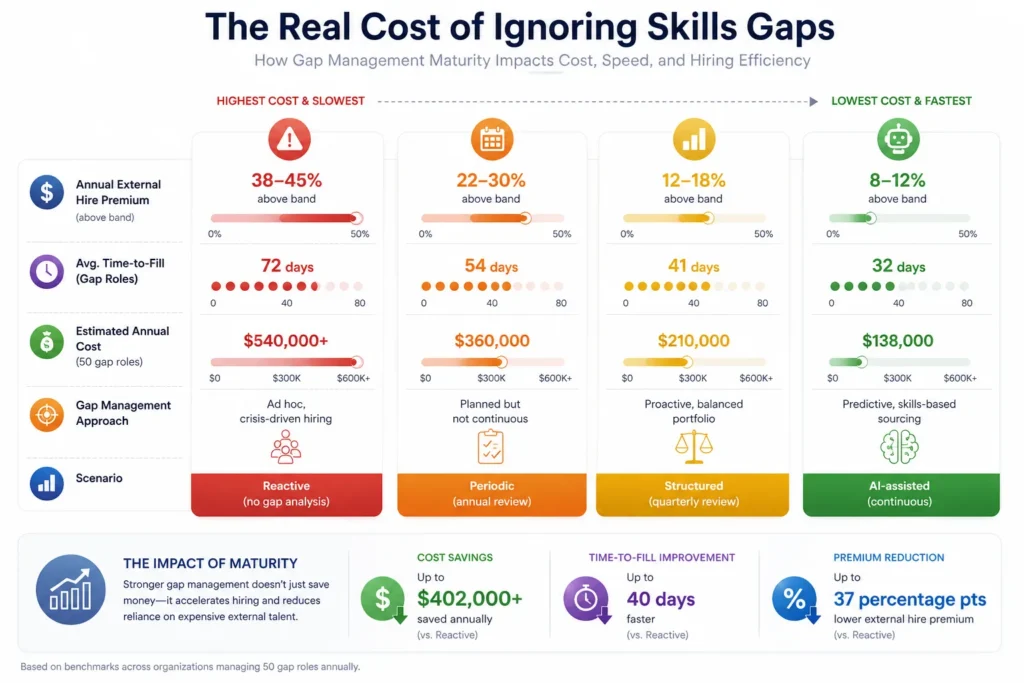
Cost estimates include salary premium above standard band, extended vacancy productivity loss at $300 per day per role, and sourcing investment. Assumes 50 roles opened annually due to skills gap-driven hiring need.
Related Terms
| Term | Definition |
|---|---|
| Skills Assessment | A structured evaluation of an individual’s or team’s current proficiency against defined skill requirements |
| Upskilling | Developing an employee’s existing skill set to a higher proficiency level within their current role domain |
| Reskilling | Training an employee in a substantially different skill set to prepare them for a new role or function |
| Workforce Planning | Strategic analysis of current and future organizational capability needs against business objectives |
| Skills Inventory | A structured catalogue of the skills and proficiency levels present within the current workforce |
| Talent Pipeline | The pool of potential candidates at various engagement stages who could fill current or future roles |
| Internal Mobility | The movement of employees between roles, teams, or functions within the same organization |
Frequently Asked Questions
What is a skills gap, and why does it matter for hiring?
A skills gap is the difference between the skills an organization needs and the skills its current workforce has. It matters for hiring because unidentified skills gaps lead to sourcing for the wrong capabilities, resulting in hires that look qualified on paper but underperform against the actual role requirements. Organizations that identify skills gaps before opening roles hire more precisely and at lower cost.
How do you conduct a skills gap analysis?
A skills gap analysis has four steps: define the skills required for each role or strategic initiative at a specific proficiency level; assess the current workforce against those requirements using validated tools rather than manager estimates alone; calculate the gap between required and current proficiency for each skill area; and prioritize gaps by strategic impact and urgency to determine whether the response should be to hire, develop, or restructure.
What is the difference between a skills gap and a talent shortage?
A talent shortage is a market supply problem: the skills exist in the labor market but there are not enough available candidates. A skills gap is a workforce capability problem: the organization’s current people do not have the skills required, regardless of market supply. Both can cause the same symptoms but require different responses. Treating a skills gap as a talent shortage leads to expensive sourcing investment that does not address the real problem.
Can upskilling fully replace external hiring for skills gaps?
Not entirely, but it closes a larger proportion of gaps than most organizations attempt. Research consistently shows that 40 to 60% of skills gaps can be addressed through internal development if the gap is identified early enough to allow meaningful development time. Gaps that are time-critical, technically deep, or in areas where no internal adjacency exists typically require external hiring. The key is identifying gaps early enough to have both options available.
How long does it take to close a skills gap through training?
It depends on the depth of the gap and the complexity of the skill. Proficiency gaps in adjacent technical skills typically close within three to six months of targeted development. Gaps in substantially new skill domains typically require nine to eighteen months of structured development to reach operational proficiency. Behavioral and leadership skills gaps can take two to three years to close meaningfully, which is why these gaps are best identified and addressed years before they become operationally critical.
Conclusion
The skills gap is not a problem that organizations can hire their way out of indefinitely.
External talent markets are increasingly competitive, increasingly expensive, and increasingly unable to supply all the specific capabilities that organizations need at the speed they need them.
The organizations building genuine competitive advantage in workforce capability are treating skills gap analysis as a continuous strategic function rather than a periodic diagnostic exercise: mapping capability requirements against business strategy, monitoring current workforce skill profiles in real time, and deploying a deliberate portfolio of hire, build, and borrow responses calibrated to each gap’s specific timeline and cost profile.
The organizations that do this consistently find that they are hiring with more precision, developing their people with more purpose, and spending less on reactive, premium-cost external sourcing than their competitors who discover skills gaps only when the operational damage is already done. Identify the gap before it becomes a crisis.
Then choose the response that closes it at the best combination of speed, cost, and workforce development value.