Five jobs in seven years. A decade ago, that résumé would have raised eyebrows in any hiring room. Today, it barely warrants a second glance. Job hopping, the pattern of moving between employers relatively quickly rather than building long tenure at a single organisation, has gone from a red flag to a genuinely complex signal that modern recruiters have to interpret rather than simply judge.
For hiring managers and HR analytics teams, job hopping sits at the intersection of candidate experience, employee retention, and broader workforce trends. Understanding why people hop, and what it actually predicts about future performance, is now a core part of building a smarter, bias-aware hiring plan.
This guide unpacks what job hopping really means, how to evaluate it fairly, and what it signals about the modern workforce.
The core metric relevant to job hopping assessment is Role Tenure Predictive Validity: the correlation between a candidate’s average previous job tenure and their performance and retention outcomes in the hiring organization.
Tenure Predictive Validity = Pearson Correlation (Avg. Previous Tenure, Performance/Retention Outcome)
Across published research, this correlation is consistently weak: approximately 0.12–0.18 for performance and 0.19–0.26 for same-organization retention. For comparison, structured competency-based interviews predict performance at 0.45–0.56. Tenure data is a weak signal, and organizations making it a primary screening criterion are filtering on noise.
What is Job Hopping?
Job hopping is a career pattern characterized by multiple employer changes within compressed timeframes, commonly defined as an average tenure below 18–24 months across two or more consecutive roles, reflecting either a deliberate career acceleration strategy, structural industry norms, personal professional circumstances, or some combination of all three, and evaluated by prospective employers with widely varying interpretations ranging from a disqualifying signal to a valued marker of adaptability.
The definition is descriptive, not normative. Job hopping describes a pattern of movement; it does not, in itself, explain the movement or predict future behavior. That distinction matters practically: the evaluation of a candidate with a job-hopping pattern should be an inquiry into the reasons and trajectory, not an automated filter.
Is Job Hopping a Red Flag, or Is Your Screening Process Out of Date?
The honest answer is: it depends what you are looking for, and most organizations that screen for it haven’t answered that question rigorously.
The case against job hopping, as traditionally made, rests on two premises: that frequent movers have lower organizational commitment and will leave quickly, and that the costs of a short-tenure hire, onboarding, ramp time, eventual replacement, make them economically inferior to long-tenure candidates. Both premises have some basis in population-level data. Both also fail to hold at the individual level in ways that make blanket tenure screening a poor proxy for either commitment or economic value.
The employment market data from the past decade has fundamentally complicated the tenure calculus. The median job tenure for workers aged 25–34 in the US is now 2.7 years, down from 3.4 years in 2014. In technology, media, and professional services, the modal career advancement path now involves organization-to-organization movement precisely because internal promotion rates and salary growth have not kept pace with external market movement. A candidate in these fields with consistent three-year tenure across five roles is not demonstrating commitment failure, they are demonstrating rational response to labor market incentives.
The more important data point is what job hopping does and does not predict. Research by the Cornell Center for Advanced Human Resource Studies found that previous tenure predicted future tenure with the same employer at a correlation of only 0.22, meaning that roughly 95% of the variance in whether a new hire stays is explained by factors other than how long they stayed at previous employers. Those factors include quality of the role match, manager quality, compensation competitiveness, growth opportunity, and cultural fit, all of which are within the hiring organization’s control.
A concrete scenario: a software company implements a minimum 2-year average tenure screening criterion in their ATS and eliminates all candidates with shorter average tenures from consideration. Over two years, this filter removes 34% of applicants. A post-hoc analysis finds that the filtered-out candidates’ profiles, assessed by technical skill and relevant experience, were indistinguishable from the hired cohort’s profiles. The hired cohort’s 18-month attrition rate: 21%. The analysis provides no data on what the rejected cohort’s attrition rate would have been, but the correlation data suggests it would not have been significantly different. The tenure filter had screened out a third of the qualified pool without improving retention outcomes.
For TA leaders, the practical implication is replacing blunt tenure thresholds with contextual trajectory assessment. The relevant questions are not “how long did they stay?” but “why did they leave, and does the trajectory show consistent skill development and contribution?” These questions require judgment, they cannot be delegated to an ATS filter, but they produce materially more accurate candidate assessment.
Your Resume Isn’t Getting Read
Let’s Get That Fixed!
75% of resumes get auto-rejected. avua’s AI Resume Builder optimizes formatting, keywords, and scoring in under 3 minutes, so you land in the “yes” pile.
The Psychology Behind Job Hopping Bias
Stability Heuristic and Prototype Matching
Hiring managers who are evaluating candidates tend to compare them against a mental prototype of the ideal candidate, and for many roles, that prototype includes long-tenure stability, because the evaluator’s own career or the careers of successful people they know have included long tenure. Candidates whose profiles deviate from the prototype are evaluated through a deficit lens. The stability heuristic operates even in industries where long tenure is not actually common or correlated with performance, because the prototype is built from exemplars rather than from population-level data.
Attribution Asymmetry in Departure Interpretation
When evaluators learn that a candidate has left a role after a short tenure, they tend to attribute the departure to internal candidate characteristics (lack of commitment, difficulty fitting in, performance issues) rather than external organizational factors (poor management, organizational dysfunction, role misrepresentation). This fundamental attribution error operates asymmetrically, the same behavior in the evaluator’s own career is typically explained externally (“the culture was bad,” “there was no opportunity to grow”), while the same behavior in a candidate’s history is explained internally (“they’re a flight risk”). Awareness of this asymmetry does not reliably correct it; structural evaluation criteria do.
Sunk Cost and Hiring Decision Protection
Hiring managers who have invested significantly in developing an employee have an additional motivation to view job hopping negatively: they are protecting the implicit value of their own long-tenure investment decisions. If frequent movers perform as well as long-tenure hires, the years of patient organizational development start to look like something other than a choice. The bias against job hopping is partly a rationalization of the opportunity cost of staying.
Job Hopping vs. Related Workforce Concepts
| Concept | Definition | Voluntary? | Evaluative Framing | Key Difference from Job Hopping |
|---|---|---|---|---|
| Job Hopping | Frequent employer changes (< 2 years average tenure) | Usually | Often negative | Pattern of external movement |
| Internal Mobility | Movement between roles within same organization | Usually | Positive | Stays within one organization |
| Career Break | Intentional period away from employment | Yes | Neutral to positive | Not job-to-job; a pause |
| Layoff History | Involuntary departures due to org restructuring | No | Neutral (structural) | Employer-initiated, not candidate-initiated |
| Contractor Career | Project-based employment with multiple employers | Yes | Neutral to positive | Structurally different engagement model |
| Portfolio Career | Multiple simultaneous or sequential engagements | Yes | Positive in creative/consulting | Deliberate non-linear model |
What the Experts Say?
We’ve built hiring systems that penalize people for responding rationally to labor market incentives. The candidates with a job-hopping profile are often the ones who have been most accurate about the value of their time. The question is whether your organization is worth their next two years, not whether they were wrong to leave their last one.
– Hung Lee, Curator, Recruiting Brainfood
How to Assess Job Hopping Candidates Fairly?
Framework for Contextual Tenure Assessment
Rather than a binary tenure threshold, apply a contextual assessment that asks: Is there a coherent skill-building narrative across the role changes? Do departure reasons, where knowable, reflect external structural factors rather than performance or cultural exits? Is the trajectory progressing, in responsibility, impact, and skill development, rather than lateral or regressive? And is the tenure pattern consistent with norms for the industry and role type in question?
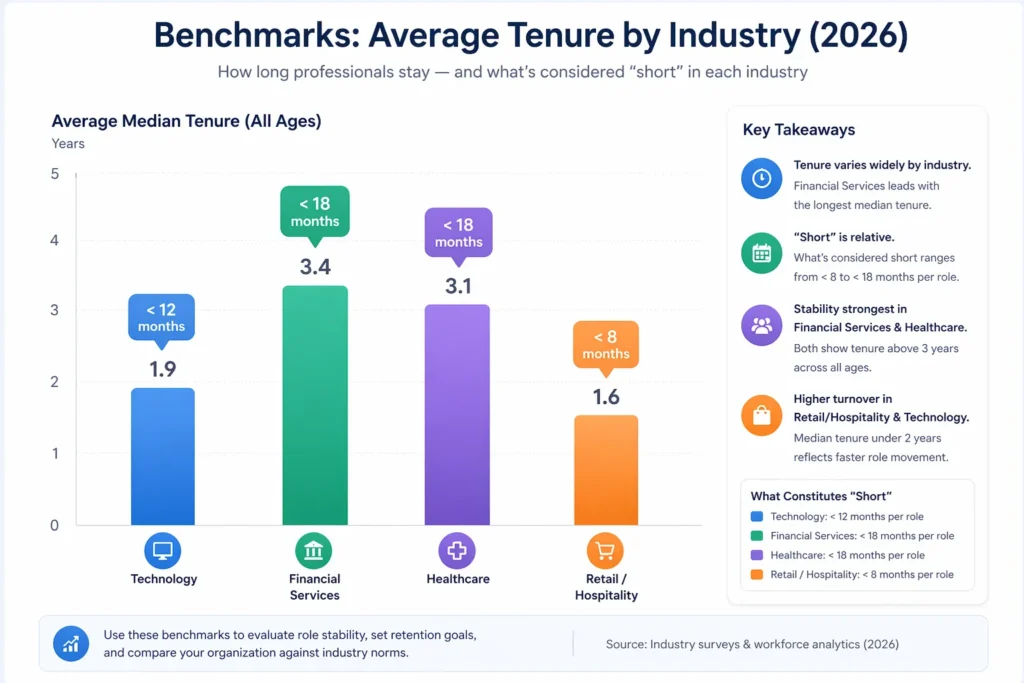
Benchmarks: Average Tenure by Industry (2026)
| Industry | Avg. Median Tenure (All Ages) | What Constitutes “Short” |
|---|---|---|
| Technology | 1.9 years | < 12 months per role |
| Financial Services | 3.4 years | < 18 months per role |
| Healthcare | 3.1 years | < 18 months per role |
| Retail / Hospitality | 1.6 years | < 8 months per role |
Key Strategies for Evaluating Career Trajectory
How Can AI and Automation Support Better Job Hopper Assessment?
Skills-Based Screening Over Tenure Filtering
AI-powered screening tools that evaluate candidates on demonstrated skill competencies, work output samples, and structured assessment performance provide a materially stronger prediction of job performance than tenure filters. Organizations that replace tenure-threshold ATS filters with skills-based screening consistently improve their qualified candidate yield while reducing the bias introduced by arbitrary tenure cutoffs.
Career Trajectory Analysis
Natural language processing tools can analyze candidate career histories in resumes and profiles to identify coherent skill progression, industry-consistent trajectory, and departure timing patterns, providing recruiters with a data-informed narrative summary rather than a raw tenure list. This converts the career history review from a pattern-matching filter into a contextual assessment tool.
Predictive Attrition Modeling
Machine learning models trained on actual hire outcome data can predict likely tenure for individual candidates based on the specific role, team, and compensation context, independent of their previous tenure history. These models consistently show that the factors most predictive of tenure in a new role are the quality of role-candidate fit, manager quality, and growth opportunity, not the candidate’s previous tenure patterns.
Reference Intelligence
AI tools can help structure and analyze reference conversations around specific departure circumstances, generating reference questions that surface the contextual factors behind a candidate’s role transitions (role eliminated, company restructured, opportunity-driven move, performance-related) rather than generic character assessments.
Stop Juggling
10 Job Boards.
Search One
Your next role is already here. avua pulls opportunities from across the web into a single searchable feed; filtered by role, location, salary, and remote preference.
1.5 Million+
Active Jobs
380+
Job Categories
Job Hopping and Diversity & Inclusion
Structural Disadvantage and Non-Linear Careers
Job hopping is more common in populations that face structural career disadvantages, workers in lower socioeconomic brackets who change jobs to access wage growth unavailable through internal promotion, caregivers whose careers have been interrupted by family responsibilities, and professionals from underrepresented groups who leave organizations where advancement opportunities are blocked. Blanket tenure screening in these populations functions as a proxy filter for socioeconomic status and caregiving history, both of which are demographic in distribution and neither of which predicts job performance.
Contractor and Gig Economy Backgrounds
The proportion of professionals with significant contractor, freelance, or gig economy experience in their career history has increased substantially since 2020. These career patterns produce short “tenure” at individual engagements by design, they are not evidence of commitment failure but of a different engagement model. ATS systems and screening criteria that treat all short tenures as job hopping conflate fundamentally different career structures.
First-Generation Professional Career Patterns
First-generation professionals, those without family members who have navigated professional career paths, are more likely to have early-career tenure patterns that reflect structural learning rather than commitment failure. Early role changes driven by mismatched expectations (accepted a role that turned out to be materially different from its description) or limited access to professional networking channels that would have enabled better initial fit are more common in this population. Screening these candidates out on tenure grounds removes talent whose later-career performance data does not support the early-career pattern’s predictive interpretation.
Common Challenges and Solutions
| Challenge | Solution |
|---|---|
| ATS tenure filters automatically rejecting qualified candidates with frequent moves | Replace or supplement tenure filters with skills-based screening criteria; route short-tenure candidates to a contextual recruiter review rather than automated rejection |
| Hiring managers instinctively discounting frequent movers in debrief | Train on the distinction between pattern and prediction; require tenure concerns to be expressed as specific interview questions rather than debrief impressions |
| Uncertainty about why a candidate has left multiple roles quickly | Build a structured departure-reason conversation into the interview process for all candidates |
Real-World Case Studies
Case Study 1: The Technology Company
A technology company removed its ATS tenure filter (previously screening out any candidate with average prior tenure below 18 months) after a talent audit suggested they were losing strong engineering candidates. In the subsequent hiring cohort, 28% of hires came from candidates who would have been filtered out under the previous rule. At 12-month review, that cohort’s performance ratings were statistically indistinguishable from the non-filtered cohort’s. Their 18-month attrition rate was 3 percentage points higher, a real but modest difference that the company concluded did not justify a filter that had been eliminating 28% of their top candidates.
Case Study 2: The Financial Services Firm
A financial services firm analyzing its diversity data found that female candidates from their target universities were 31% less likely to clear the initial ATS screening stage than male candidates with equivalent academic profiles, driven primarily by the tenure filter eliminating candidates whose early careers included more frequent role changes. Investigation found that the female candidates’ early career tenure patterns correlated with industries and role types known to have higher structural mobility (early-career professional services and consulting roles). The firm removed the tenure filter and implemented a contextual trajectory review for all candidates. Female candidate pipeline representation improved by 19% within two hiring cycles.
Case Study 3: The Professional Services Firm
A professional services firm redesigned its candidate screening process to be mobile-first and to surface the career trajectory narrative explicitly, adding a mobile-completable 200-word “career story” field that all candidates completed alongside their resume upload. Reviewers assessed the narrative alongside tenure data rather than tenure data alone. The change reduced time-to-shortlist by 11 days (because tenure screening had been generating false positives requiring manual re-review) and improved hiring manager assessment of candidate quality at shortlist stage.
Building a Job Hopping Assessment Framework Dashboard: What to Track?
Job Hopping Across the Hiring Lifecycle
Screening: The Automated Filter Problem
The screening stage is where job hopping bias most frequently operates and where it is hardest to challenge, because ATS tenure filters work invisibly, rejecting candidates before any human evaluator sees them. The most important intervention in the evaluation of frequent movers is at this stage: replacing or supplementing tenure filters with skills-based criteria that surface qualified candidates for human contextual review.
Interview: The Narrative Assessment
The interview stage is where contextual assessment of career trajectory can actually happen. Structured questions that ask candidates to explain their moves, with specific attention to what they were building, what they were leaving, and what they chose next, produce the narrative evidence needed to distinguish deliberate career architects from genuinely concerning patterns.
Offer: Tenure Incentive Design
For candidates with a job-hopping history who are otherwise strong, the offer stage is an opportunity to address retention proactively, not through demands for commitment, but through incentive design. Roles with clear growth trajectories, vesting schedules, and defined advancement criteria address the organizational conditions that most frequently drive early departure, without requiring the candidate to promise tenure they may not be able to accurately forecast.
Post-Hire: Data Collection for Better Future Screening
Every hire of a candidate with a previous job-hopping pattern who either stays or leaves is data that improves future screening calibration. Organizations that track this systematically, connecting prior tenure profiles to actual outcomes, build a proprietary evidence base for their screening criteria that is far more accurate than generic population statistics.
The Real Cost of Over-Filtering on Tenure
| Screening Approach | Candidates Rejected by Tenure Filter | Qualified Candidates Lost | Annual Pipeline Cost |
|---|---|---|---|
| Strict tenure filter (< 2yr avg rejected) | 34% of applicants | ~22% of qualified pool | $176,000 |
| Moderate filter (< 18mo per role rejected) | 21% of applicants | ~12% of qualified pool | $96,000 |
| Contextual review (no auto-filter) | 0% auto-rejected | 0% auto-lost | $18,000 (review cost) |
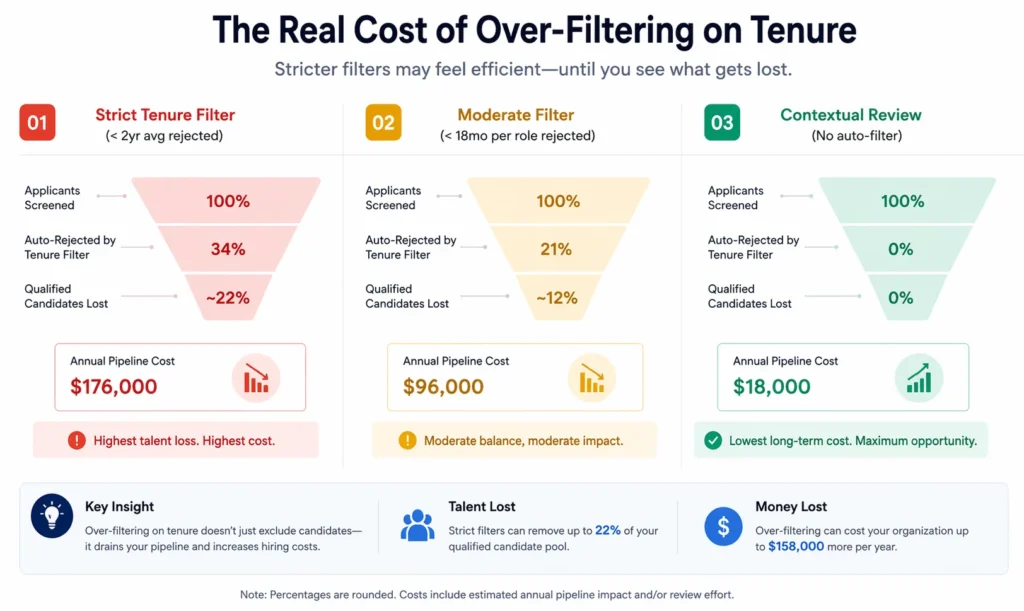
Pipeline cost estimates assume 500 annual applications, $8,000 average cost per qualified candidate sourced.
Related Terms
| Term | Definition |
|---|---|
| Employee Tenure | The length of time an employee has worked at a single organization |
| Attrition Rate | The rate at which employees leave an organization in a defined period |
| Career Trajectory | The pattern of role progression, skill development, and advancement across a professional career |
| Retention Risk | The assessed likelihood that a specific employee or candidate will leave the organization within a defined timeframe |
| Structured Interview | A standardized interview format using predefined questions and scored evaluation criteria |
Frequently Asked Questions
How many job changes in 5 years is considered job hopping?
There is no universal threshold, but the commonly applied heuristic in professional hiring is that three or more full employer changes within a five-year period warrants contextual inquiry. The more useful question is not the count but the pattern: are the moves progressing in a coherent direction, or are they lateral or regressive with unclear narratives?
Should job hopping automatically disqualify a candidate?
No, not in any evidence-based hiring framework. The research on prior tenure as a predictor of future performance and retention consistently shows a weak correlation that does not justify automatic disqualification. Job hopping should trigger contextual inquiry, not automatic rejection.
How do you address job hopping in an interview as a candidate?
Proactively and with specificity. Don’t wait to be asked, introduce the career narrative early in the conversation, framing each move in terms of what you were building toward, what the opportunity represented, and what you achieved. A coherent, forward-looking narrative about frequent moves is significantly more compelling than a defensive explanation offered in response to a direct challenge.
Does job hopping affect salary offers?
It can, in the sense that candidates with short tenures may have less accumulated salary growth within any single organization, but in markets where external hiring is the primary salary growth mechanism, frequent movers often have higher salaries than equivalent tenure-stable candidates. The compensation discussion should be driven by market benchmarks for the role, not penalized based on tenure pattern.
Is job hopping more common in certain industries?
Yes, significantly. Technology, media, and early-stage company ecosystems have markedly shorter average tenures than financial services, law, healthcare, and government. What constitutes “frequent movement” in technology, an average of two years per role, would be considered normal in some sectors and extreme in others. Screening criteria need to be calibrated to industry-specific norms.
Conclusion
Job hopping is a labor market behavior, not a character flaw.
The organizations that have moved beyond tenure screening as a proxy for commitment are evaluating a wider pool of talent, finding that their actual retention data is no worse than before the change, and accessing candidates that their tenure-filtering competitors are systematically excluding.
The research case for tenure as a primary screening criterion is weak. The alternative, contextual trajectory assessment, skills-based screening, and structured departure-reason inquiry, produces better hiring decisions and a more equitable process. The hop isn’t the problem.
What you do with the narrative of the hop is where the evaluation actually lives.