Most hiring processes start with an application.
Great talent strategies start much earlier.
Sourcing is the proactive work that happens before a single candidate raises their hand, and it is the difference between organisations that are always reacting to open roles and those that are consistently ahead of them.
Sourcing is the practice of identifying and engaging potential candidates before a formal application exists, building relationships and pipelines with people who may not be actively looking but are worth knowing. It sits at the very top of the recruitment funnel, feeding every stage that follows with better, more targeted talent than reactive job posting alone can deliver.
The tools and techniques vary significantly. Boolean search, active sourcing on professional networks, campus recruiting, and employee referral programs all sit under the sourcing umbrella, each suited to different roles, industries, and hiring timelines.
What separates good sourcing from great sourcing is not just the channels used but the rigour behind them. Organisations running data-driven recruiting strategies treat sourcing as a measurable function, tracking which channels produce the highest quality candidates and doubling down on what actually works.
The core metric governing talent sourcing effectiveness is the Sourcing Channel Yield Rate: the proportion of candidates engaged through each sourcing channel who ultimately convert to hires. Top-performing sourcing functions achieve Sourcing Channel Yield Rates of 12 to 18% across their primary channels. Industry average sits closer to 5 to 7%. The gap is driven almost entirely by targeting precision and outreach personalization quality, not by the volume of outreach activity.
Sourcing Channel Yield Rate (%) = (Hires per Channel / Total Candidates Contacted per Channel) x 100
High-performing sourcing teams consistently outperform on yield rather than volume: they contact fewer candidates and hire more of them, because their targeting accuracy and outreach quality are higher. Organizations that measure sourcing success by outreach volume rather than yield rate are optimizing for the wrong thing and consistently producing pipeline quantity at the expense of pipeline quality.
What is Sourcing?
Talent sourcing is the proactive, research-driven process of identifying, locating, and initiating contact with potential candidates who are not actively applying for roles, building a pre-qualified pipeline of engaged professionals that the recruiting function can move through assessment and hiring processes more quickly and with higher conversion rates than cold-start inbound applications would allow.
Sourcing is fundamentally about changing the timing of the hiring conversation. An organization that begins recruiting when a role is approved is having its first conversation with candidates at the same moment every competitor is. An organization with an active sourcing function has been building relationships with the relevant talent pool for months – and when the role is approved, those relationships give it a meaningful head start. According to Workable’s research on sourcing effectiveness, proactively sourced candidates are 55% faster to hire than candidates who apply inactively, directly translating into reduced vacancy costs and faster time-to-productivity.
Why Sourcing Is a Proven Competitive Advantage for Modern Organizations?
The case for investing in a dedicated talent sourcing capability is built on a single structural fact: 70% of the global workforce is not actively looking for a new job at any given moment, according to LinkedIn’s Global Talent Trends research. Job boards, career pages, and application-based recruitment reach the 30% who are looking. Sourcing reaches the 70% who are not.
That 30/70 split is not evenly distributed across talent segments. For senior roles, specialized technical positions, and high-demand skill categories, the proportion of qualified professionals who are actively applying at any moment is significantly below 30%. A Fortune 500 CFO or a principal machine learning engineer does not browse job boards. A highly effective sales leader in a target industry is not refreshing their LinkedIn job alerts. These candidates live entirely in the passive candidate market. Organizations that do not source proactively do not compete for this population at all – they compete only among the minority who happen to be actively looking, which is a dramatically smaller and often lower-quality candidate set than the full market of qualified professionals.
The ROI of investing in talent sourcing capability is concrete and measurable. Consider a technology company filling 40 engineering roles per year through a reactive, inbound-only recruitment process with an average time-to-fill of 58 days. At a conservative vacancy cost of $350 per day per role, total vacancy cost is approximately $812,000 annually. Adding a dedicated sourcer who builds proactive pipelines for engineering roles, reducing average time-to-fill to 38 days, saves 20 days per role across 40 roles – 800 hiring days at $350 per day – a saving of $280,000 annually. The fully loaded cost of one senior sourcer in most markets is $80,000 to $110,000. The ROI of that hire is positive before the end of the first quarter.
The competitive intelligence dimension of sourcing is a strategic advantage that goes beyond individual role fills. A sourcing function that is continuously mapping the talent market – tracking who has moved where, which organizations are producing skilled talent, which professionals are approaching the career milestone that typically precedes a move – builds organizational intelligence that improves not just hiring but workforce planning, compensation strategy, and competitor analysis. Organizations with strong sourcing functions know what their talent market looks like. Organizations without them are flying blind.
For TA leaders, the practical implication is clear: talent sourcing should be treated as an infrastructure investment, not a variable cost to be scaled up only when roles are open. The sourcer who is building pipelines before roles open is the most valuable recruiter in the function. The one who starts from zero every time a requisition lands is doing reactive hiring at reactive prices.
Your Resume Isn’t Getting Read
Let’s Get That Fixed!
75% of resumes get auto-rejected. avua’s AI Resume Builder optimizes formatting, keywords, and scoring in under 3 minutes, so you land in the “yes” pile.
The Psychology Behind Sourcing
The Passive Candidate Mindset
Passive candidates are not disinterested – they are unavailable through traditional channels. The distinction matters for sourcing strategy. A passive candidate who is performing well in their current role is not dissatisfied, but they may be open to a sufficiently compelling opportunity if it is presented in the right way at the right moment. Sourcing psychology begins with understanding that the passive candidate’s first question is not “should I apply?” but “is this worth my time to find out more?” The sourcer’s first communication must answer that question convincingly, not with a job description, but with a reason why this specific person should consider this specific opportunity.
Timing and the Receptivity Window
Research on passive candidate behavior consistently identifies windows of elevated career-move receptivity: following a promotion that falls short of expectations, after a key project completion, when the working environment shifts significantly (new leadership, acquisition, restructuring), or at career milestone anniversaries. AI-powered predictive sourcing tools can identify these receptivity windows through career history patterns, company performance signals, and professional network activity data. Sourcing outreach timed to receptivity windows consistently achieves 2.5 to 3x higher response rates than random-timing outreach to equivalent candidate profiles.
Personalization and the Relevance Signal
The most significant variable in passive candidate outreach response rates is personalization. A generic “I came across your profile and thought you’d be interested” message signals that the sourcer has not invested meaningful effort in researching the candidate. A message that references a specific piece of the candidate’s published work, acknowledges a recent professional milestone, or demonstrates genuine familiarity with their career trajectory signals investment and specificity that most professionals find difficult to ignore. Personalization quality – not message length, frequency, or platform – is the primary driver of passive candidate response rates in sourcing outreach.
Sourcing vs. Related Talent Acquisition Functions
| Function | Timing | Candidate State | Primary Output | Typical Owner |
|---|---|---|---|---|
| Sourcing | Pre-requisition and during search | Passive, pre-application | Identified and engaged pipeline | Talent Sourcer |
| Recruiting | During active search | Active and semi-passive | Assessed and selected hire | Recruiter |
| Headhunting | Senior and confidential searches | Passive, senior | Placed executive | External Search Firm |
| Active Candidate Management | During search | Active applicants | Processed applicants | Recruiter |
| Talent Mapping | Pre-search intelligence | All states | Market landscape | Sourcer or Research Analyst |
The fundamental distinction between sourcing and recruiting is timing and candidate state. Recruiting manages candidates who have already expressed interest. Sourcing generates interest among candidates who have not yet expressed it. Both functions are essential; neither can substitute for the other. Organizations that collapse sourcing into recruiting consistently find that recruiting time is consumed by market research and cold outreach rather than by the candidate assessment and relationship management that produces quality hires.
What the Experts Say?
The best sourcers are not Boolean search machines. They are intelligence officers who understand a talent market at a granular level, can identify which candidates are actually movable versus technically qualified, and know how to make first contact in a way that makes a passive professional actually want to respond. That capability is rare and disproportionately valuable.
– Glen Cathey, Head of Talent Advisory, Randstad Enterprise; Author, Boolean Black Belt
How to Measure Sourcing Effectiveness?
Formula
Sourcing Channel Yield Rate (%) = (Hires per Channel / Total Candidates Contacted per Channel) x 100
Passive Candidate Response Rate (%) = (Responses Received / Total Outreach Messages Sent) x 100
Pipeline-to-Hire Ratio = Total Pipeline Candidates / Hires Generated from Pipeline
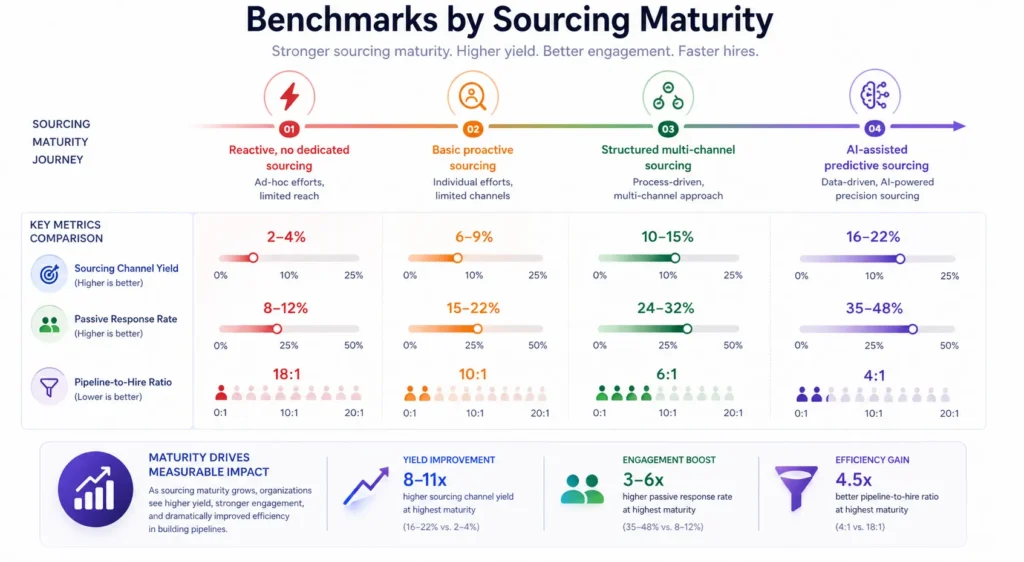
Benchmarks by Sourcing Maturity
| Sourcing Maturity | Sourcing Channel Yield | Passive Response Rate | Pipeline-to-Hire Ratio |
|---|---|---|---|
| Reactive, no dedicated sourcing | 2-4% | 8-12% | 18:1 |
| Basic proactive sourcing | 6-9% | 15-22% | 10:1 |
| Structured multi-channel sourcing | 10-15% | 24-32% | 6:1 |
| AI-assisted predictive sourcing | 16-22% | 35-48% | 4:1 |
Key Strategies for Effective Talent Sourcing
How Can AI and Automation Support Talent Sourcing?
AI-Powered Talent Mapping and Identification
AI talent mapping platforms can construct comprehensive candidate landscapes for any role type, geography, and skill combination in a fraction of the time required for manual research, aggregating signals from professional networks, company databases, publication records, and open-source contributions to identify qualified candidates who may not be visible through conventional sourcing approaches. What required a research analyst two weeks to build five years ago now takes an AI tool forty minutes, and the output is typically more comprehensive because it is not constrained by the sourcer’s personal network or institutional knowledge biases.
Predictive Candidate Availability Modeling
Machine learning models trained on career history data can predict which professionals in a target talent pool are approaching the career moments that correlate with elevated move receptivity: tenure durations typical of role transitions, compensation stagnation signals, company performance indicators correlated with attrition, and professional network activity suggesting active market assessment. This predictive layer allows sourcing teams to concentrate outreach effort on candidates who are statistically most likely to engage, improving response rates and reducing outreach waste significantly compared to random targeting from a candidate universe.
Automated Multi-Channel Outreach Sequencing
AI-powered outreach automation tools manage the sequencing, personalization, and timing of initial candidate contact across multiple channels (email, LinkedIn, professional community platforms), tracking engagement signals (opens, link clicks, profile views, response timing) and adjusting sequence behavior based on candidate engagement data. This automated screening of outreach engagement allows sourcing teams to scale initial contact activity without proportional headcount increase, concentrating human sourcer time on the conversations that generate genuine candidate interest rather than on administrative outreach management.
Engagement Signal Tracking and Pipeline Scoring
AI-powered CRM tools can score pipeline candidates on real-time engagement signals – recency of contact, quality of response content, competitive outreach risk (signals that other recruiters are also actively engaging the candidate) – and surface the candidates most likely to go cold or most ripe for a follow-up conversation. This pipeline intelligence allows sourcing teams to prioritize relationship maintenance effort dynamically, ensuring that the most valuable pipeline candidates receive attention at the moments when it is most likely to be productive.
Stop Juggling
10 Job Boards.
Search One
Your next role is already here. avua pulls opportunities from across the web into a single searchable feed; filtered by role, location, salary, and remote preference.
1.5 Million+
Active Jobs
380+
Job Categories
Sourcing and Building an Equitable Talent Pipeline
Sourcing Channel Bias and Network Homophily
Talent sourcing conducted primarily through personal and professional networks is subject to the same homophily risk that affects headhunting: networks tend toward demographic similarity, meaning sourcers whose professional communities were built in specific demographic contexts will systematically over-represent those demographics in sourced candidate pools. Organizations that rely heavily on referral-based sourcing and network outreach without explicit diversity channel investment consistently find that their sourced pipelines reflect the demographic composition of their existing workforce rather than the available talent market. Channel diversification is the structural correction, not awareness training.
Non-Traditional Sourcing Channels for Diverse Talent
Proactive sourcing from non-traditional channels – HBCU alumni networks, professional associations for underrepresented groups, military transition programs, community college career centers, apprenticeship program graduates, and reentry talent pipelines – accesses qualified candidate populations that mainstream sourcing channels systematically underreach. The investment required to build sourcing relationships with these communities is meaningful (typically three to six months of relationship building before hire-rate payoff), but the candidate quality and retention outcomes consistently justify it. Sourcing from diversity sourcing channels also reduces competitive pressure on candidate acquisition: these talent pools are less contested than mainstream LinkedIn populations for most role types.
Inclusive Outreach Messaging and Candidate Experience
Sourcing outreach messages that emphasize title progression and compensation as the primary appeal factors are calibrated to the preferences of the demographic that has historically dominated senior and specialist talent pools. Research on career move decision-making consistently finds that professionals from underrepresented groups weight growth opportunity, cultural safety, flexibility, and leadership representation more heavily in evaluating outreach than the factors that typically dominate traditional sourcing pitch construction. Sourcers who adapt their outreach framing to address the factors most relevant to the specific candidate they are approaching, rather than defaulting to a compensation-and-title standard pitch, produce more diverse qualified pipelines from equivalent candidate populations.
Common Challenges and Solutions
| Challenge | Solution |
|---|---|
| Passive candidate response rates declining across all channels | Invest in message personalization quality; implement multi-touch sequences that add value (market intelligence, career resources) before requesting a conversation |
| Sourcing effort duplicated across multiple open searches for similar roles | Build a shared talent community for recurring role types; implement a talent pool tagging system in the ATS that makes prior sourcing investment accessible for future searches |
| Difficulty demonstrating sourcing ROI to business stakeholders | Implement source-of-hire tracking at the hire level; calculate and report cost-per-sourced-hire and time-to-fill improvement versus inbound baseline quarterly |
Real-World Case Studies
Case Study 1: The Engineering-First Technology Company
A 400-person technology company with persistent software engineering sourcing challenges implemented a structured talent community program for engineering roles: sourcers built ongoing relationships with 200 qualified engineers who had expressed interest but not yet been matched to an open role.
Community members received monthly market intelligence newsletters, early access to company technical blog content, and periodic personal check-ins from sourcers who had completed their initial qualification conversation. When roles opened over the following eight months, 63% were filled from the talent community rather than from new sourcing campaigns. Time-to-fill for community-sourced hires averaged 22 days versus 54 days for cold-sourced hires in the same period.
Case Study 2: The Financial Services Group
A regional bank’s sourcing team spent 65% of their time on Boolean search and longlist construction for analyst and associate roles, leaving limited time for personalized outreach and relationship management. They implemented an AI-powered talent mapping tool that automated longlist construction for their five highest-volume role types.
Sourcing team time freed from research was reallocated entirely to outreach personalization and pipeline relationship management. Passive candidate response rates improved from 14% to 39% over two quarters. Source-qualified hires increased by 28% with the same headcount, and average time-to-fill for sourced roles fell from 47 days to 31 days.
Case Study 3: The Healthcare Organization
A healthcare network sourcing clinical informatics and health data professionals identified that 71% of qualified candidates in their target market were not active on LinkedIn but were highly active in two specialty professional association online communities and one sector-specific Slack workspace. Sourcers built authentic community presence over four months – contributing expertise, answering questions, and building professional credibility before any direct hiring outreach.
When direct sourcing outreach launched from established community personas, response rates reached 52%, compared to 9% from LinkedIn InMail outreach to comparable professionals. The healthcare network filled all 18 planned clinical informatics roles through community sourcing, at 43% lower cost-per-hire than their previous LinkedIn-primary approach.
Proven Sourcing Metrics Every Talent Leader Must Monitor
Talent Sourcing Across the Recruitment Lifecycle
Pre-Requisition Intelligence Building
Effective sourcing begins before any role is open. The best sourcing functions maintain live, continuously updated talent maps for their core hiring segments – tracking who is in what role at which organization, who has recently changed positions, which companies are growing in target talent pools, and which professionals are approaching the tenure milestones that historically precede career moves.
When a requisition opens, the response is “we have six qualified people in pipeline already” rather than “let us start researching.” This pre-requisition intelligence is built during the periods between active searches – a sourcing investment that every active search will draw upon.
Active Sourcing and Pipeline Building
When a requisition is active, sourcing transitions from intelligence maintenance to targeted outreach: using the market map to identify the strongest candidates, constructing personalized outreach messages for each, and managing the multi-touch sequences that convert initial contact into genuine interest conversations.
AI tools now handle the longlist construction phase almost entirely; the sourcer’s distinctive contribution is the qualification conversation that converts a technically identified candidate into a motivated, well-informed pipeline member who is actively considering the opportunity.
Pipeline Qualification and Candidate Nurture
Not every sourced candidate is ready to move now. Pipeline qualification involves distinguishing between candidates who are genuinely interested in a specific current opportunity, candidates who are open to a future conversation, and candidates who have no interest regardless of the opportunity.
The middle category – future candidates – represents the highest long-term sourcing ROI: maintaining a warm relationship with them through candidate nurturing at low cost until they enter a receptivity window converts future sourcing cost into zero marginal outreach for the next relevant search.
Conversion and Handoff to Recruiting
The sourcing-to-recruiting handoff is where talent quality is most frequently lost. A sourced candidate who has had a genuine relationship with a sourcer and then receives a cold, impersonal ATS-generated recruiter communication experiences a jarring discontinuity that damages the trust the sourcing relationship built.
High-performing sourcing and recruiting teams design the handoff as a warm introduction: the sourcer introduces the recruiter, provides context on the candidate’s specific interests and concerns, and remains accessible as a relationship resource throughout the recruiting process. This continuity produces higher conversion rates from pipeline to offer and higher offer acceptance rates from offer to hire.
The Real Cost of Reactive Sourcing
| Scenario | Sourcing Approach | Avg. Time-to-Fill | Annual Vacancy Cost (40 roles) |
|---|---|---|---|
| No dedicated sourcing | Inbound only | 58 days | $812,000 |
| Basic reactive sourcing | Search opens with req | 44 days | $616,000 |
| Proactive sourcing | Pipeline pre-built | 32 days | $448,000 |
| AI-assisted predictive | Predictive + proactive | 22 days | $308,000 |
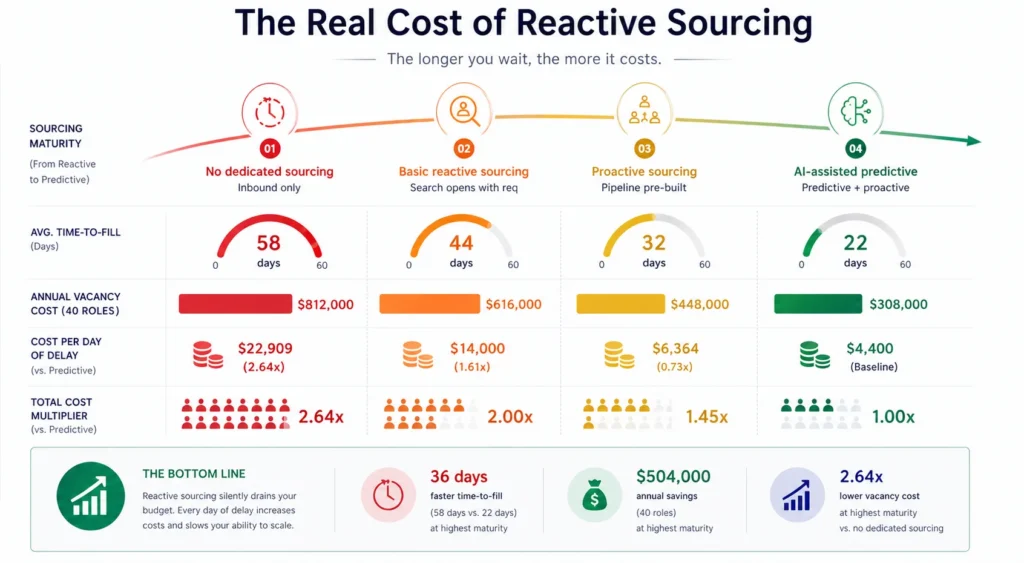
Vacancy cost estimated at $350 per day per role. Costs illustrate the compounding return on sourcing infrastructure investment at scale.
Related Terms
| Term | Definition |
|---|---|
| Candidate Pipeline | The pool of potential candidates at various stages of engagement who could fill current or future roles |
| Passive Candidate | A professional not actively seeking employment who may be receptive to a well-presented opportunity |
| Boolean Search | An advanced search technique using logical operators (AND, OR, NOT) to refine candidate identification across databases and professional networks |
| Talent Mapping | The process of identifying and cataloguing all qualified candidates for a specific role type in a defined market |
| Talent Community | A managed group of interested candidates maintained in relationship with an organization between active search cycles |
Frequently Asked Questions
What is the difference between sourcing and recruiting?
Sourcing is the proactive identification and initial engagement of candidates who have not yet applied – it generates pipeline. Recruiting manages the assessment, selection, and hiring of candidates who are in that pipeline. Sourcing happens before recruiting. Both functions are essential, and the quality of the sourcing function is the primary determinant of the candidate quality available to the recruiting function.
Why do organizations need a dedicated sourcing function?
Because 70% of the qualified workforce for most roles is not actively looking. Without a dedicated sourcing function, an organization can only access the 30% who are actively applying – a smaller, more contested, and often lower-average-quality candidate pool than the full market of qualified professionals who are performing well in current roles and not browsing job boards.
What is a good passive candidate response rate for sourcing outreach?
Industry benchmarks suggest that average passive candidate response rates for generic sourcing outreach are 12 to 18%. Personalized, well-targeted outreach from sourcers with strong market knowledge achieves 30 to 48%. If a sourcing team’s response rate is below 15%, the primary issue is almost always targeting precision or message personalization quality, not platform selection or outreach volume.
How has AI changed talent sourcing?
AI has automated the most time-consuming elements of sourcing: talent mapping, longlist construction, Boolean string generation, outreach sequencing, and engagement tracking. This shifts the sourcer’s role toward the elements that require human judgment: personalization quality, relationship building, candidate qualification conversations, and the pipeline management decisions that require contextual understanding of what candidates actually want from a career move. AI raises the volume ceiling for sourcing; the sourcer’s skill determines what conversion rate that volume achieves.
What is the difference between sourcing and talent mapping?
Talent mapping is the research phase of sourcing: constructing a comprehensive picture of who exists in a target talent market, their current roles, career trajectories, and organizational affiliations. Sourcing encompasses talent mapping plus the outreach and relationship-building phases that convert that map into an engaged candidate pipeline. Talent mapping is an input to sourcing, not a substitute for it – a map with no outreach produces a market intelligence document, not a candidate pipeline.
Conclusion
Talent sourcing is the recruitment function’s earliest and most consequential intervention in the hiring process. The organizations building proactive sourcing capability – maintaining talent communities, mapping markets continuously, personalizing outreach with genuine specificity, and using AI to scale intelligence gathering without sacrificing relationship quality – are systematically outcompeting those that wait for applications and then scramble to fill the pipeline.
The structural math is clear: 70% of the qualified workforce is inaccessible to organizations that do not source proactively, and the best candidates in that 70% are the ones competitors with strong sourcing functions are already in conversation with. Every day spent without a proactive sourcing strategy is a day of competitive talent advantage conceded to the organizations that built theirs.
Start building the pipeline before you need it. The recruiter’s best day is the one where they open a new search and the sourcer already has the person.