At a certain scale, recruitment stops being a task and starts being an operation.
Job requisitions pile up, hiring managers need constant support, candidate pipelines need constant feeding, and the internal HR team is stretched across too many open roles to give any of them the attention they deserve. Recruitment Process Outsourcing is the solution organisations turn to when the volume and complexity of hiring outgrows what an internal team can sustainably manage.
Recruitment Process Outsourcing, or RPO, is the practice of transferring all or part of an organisation’s recruitment function to an external provider, who operates as an extension of the internal HR team rather than a traditional staffing agency. The distinction matters. An RPO partner owns the process, not just the placements, managing everything from employer of record considerations and data-driven recruiting infrastructure to candidate experience and compliance.
For organisations navigating rapid growth, market expansion, or a hiring freeze followed by sudden demand, RPO offers a scalable alternative to building internal capacity that may not be needed long term. It compresses time-to-fill, reduces cost per hire, and brings specialist expertise to hiring functions that generalist HR teams are not always equipped to run at pace.
The core metric governing RPO value delivery is the RPO Cost Efficiency Ratio: the reduction in total recruitment cost per hire achieved through RPO engagement, measured against the organization’s documented pre-engagement baseline.
RPO Cost Efficiency Ratio (%) = ((Baseline Cost per Hire - RPO Cost per Hire) / Baseline Cost per Hire) x 100
High-performing RPO partnerships deliver cost efficiency ratios of 30 to 50% relative to internal baseline costs, while simultaneously improving time-to-fill and Quality of Hire. Organizations entering RPO engagements without defined baselines and performance benchmarks frequently underestimate the value delivered and have no contractual mechanism to enforce accountability when performance falls short.
What is Recruitment Process Outsourcing?
Recruitment Process Outsourcing is the strategic transfer of recruitment function responsibility from an internal talent acquisition team to a specialized external provider, encompassing full-cycle or partial-cycle recruitment for defined role types, geographies, or hiring volumes, with the RPO provider acting as an embedded extension of the organization’s HR function. Recruitment Process Outsourcing engagements vary in scope from end-to-end outsourcing of the entire recruitment function to project-based RPO for specific hiring programs and on-demand RPO for volume fluctuation management during peak periods.
The defining characteristic of RPO that distinguishes it from staffing agencies or contingency search is accountability for process and outcomes, not just candidate delivery. An RPO provider owns the recruitment workflow from requisition intake to offer acceptance, operates within the client’s employer brand and candidate experience standards, and is measured against predefined quality, speed, and cost benchmarks. This accountability structure aligns the provider’s incentives with the organization’s talent outcomes rather than with the volume of placements made, which is the fundamental distinction that drives different behavior in candidate quality and employer brand representation.
How Recruitment Process Outsourcing Shapes Talent Strategy and Business Performance?
The business case for RPO is not primarily about cost reduction, though the cost advantages are real and substantial. It is about accessing recruitment capability at a level of specialization, technology investment, and process maturity that internal teams cannot sustain at equivalent per-hire cost. According to Everest Group’s RPO Market Annual Report, organizations engaged with mature RPO providers achieve average time-to-fill reductions of 40%, cost per hire reductions of 30 to 50%, and Quality of Hire improvements of 18 to 25 percentage points compared to their pre-engagement baselines.
The scalability dimension of RPO is particularly compelling for organizations whose hiring volumes fluctuate significantly across quarters or growth cycles. Internal talent acquisition teams sized for average demand are systematically overstaffed during slow periods and overwhelmed during peak periods, both states representing inefficiency. RPO providers offer variable capacity that expands and contracts with client hiring needs, absorbing demand volatility without the fixed cost structure of a permanent internal team. For organizations with seasonal hiring cycles, growth-stage acceleration requirements, or geographic expansion programs, this scalability is operationally transformative.
The less quantified advantage of RPO is strategic bandwidth recovery. Internal TA leaders engaged in high-volume transactional recruitment have limited capacity to invest in the activities that compound in strategic value over time: employer brand development, talent pipeline building, data-driven recruiting infrastructure, and workforce planning. RPO engagement frees internal talent leaders from operational execution, enabling the strategic investment that produces compounding returns with each subsequent hiring cycle. The organizations with the most advanced talent acquisition strategies are frequently those that have outsourced transactional volume execution to free capacity for strategic capability building.
The ROI case for RPO investment is straightforward to model. A financial services organization with 200 annual hires and an average internal cost per hire of $9,400, covering recruiter time, job board spend, assessment tools, and hiring manager time, engages an RPO provider at a blended rate of $5,800 per hire. At 200 hires annually, the direct cost saving is $720,000.
The program delivers a 38% cost reduction before accounting for the time-to-fill improvement, which reduces productivity loss per open role, and the Quality of Hire improvement, which reduces replacement and underperformance costs. Total economic value delivered by high-performing RPO engagements typically exceeds the direct cost saving by a factor of 1.5 to 2.5 when downstream talent outcomes are fully accounted for.
For TA leaders evaluating RPO, the critical decision framework is not whether outsourcing reduces cost but whether the RPO provider can deliver the candidate quality, cultural alignment, and employer brand consistency that the organization requires at the volume and speed the business demands. Provider selection quality determines Recruitment Process Outsourcing program success more than any contract structure or pricing model variable.
Your Resume Isn’t Getting Read
Let’s Get That Fixed!
75% of resumes get auto-rejected. avua’s AI Resume Builder optimizes formatting, keywords, and scoring in under 3 minutes, so you land in the “yes” pile.
The Psychology Behind RPO Decision-Making
The Control Paradox in Outsourcing
Organizations considering RPO frequently encounter a predictable paradox: the perception that outsourcing the recruitment function means losing visibility into hiring quality and the candidate experience. In practice, well-structured RPO engagements typically produce more performance visibility than most internal TA functions generate, because RPO providers operate under contractually defined KPIs, reporting cadences, and data transparency requirements that informal internal processes rarely replicate. The organizations most resistant to RPO are frequently those whose internal processes would benefit most from the accountability structure RPO imposes.
Employer Brand Anxiety and Provider Trust
A significant psychological barrier to RPO adoption is employer brand anxiety: the concern that an external provider cannot represent the organization’s culture and values with the authenticity an internal team would deliver. This concern is legitimate when providers are selected primarily on cost and when onboarding does not include deep cultural immersion. It becomes negligible when Recruitment Process Outsourcing providers are selected for cultural alignment capability, given genuine access to employees and leadership, and measured against candidate experience outcomes rather than fill rates alone.
The Sunk Cost Resistance Pattern
Many TA leaders resist RPO consideration because of investment already made in internal team infrastructure, technology, and process design. This sunk cost reasoning frequently prevents organizations from making transitions that would deliver significant value, because the calculation weights past investment over future return. The relevant question is not what has been invested in the current model but whether the current model is delivering at the level the organization needs, and whether there is a credible path to improvement within existing resource constraints.
Recruitment Process Outsourcing vs. Related Talent Acquisition Models
| Model | Process Ownership | Scope | Cost Structure | Best Fit |
|---|---|---|---|---|
| RPO | External provider | Defined process scope | Per-hire, management fee, or hybrid | Consistent volume, strategic scalability |
| Internal TA Team | Internal HR function | Full function | Fixed headcount cost | Strategic alignment, deep culture intensity |
| Staffing Agency | External provider | Individual placements | Contingency fee (15-25% of salary) | Urgent single-role needs |
| Contingency Search | External recruiter | Senior or specialist roles | Success fee on placement | Niche or senior leadership roles |
| Internal Hiring and Mobility | Internal HR | Internal redeployment | Indirect development cost | Capability gap coverage, retention improvement |
The critical distinction between RPO and staffing agency models is accountability structure. Staffing agencies are incentivized to place candidates; RPO providers are incentivized to deliver the outcomes the client defines. This alignment difference produces fundamentally different behaviors in candidate quality, employer brand representation, and long-term program performance across hiring cohorts.
What the Experts Say?
The best Recruitment Process Outsourcing partnerships are not vendor relationships. They are genuine talent strategy extensions where the provider’s team knows your culture, your business, and your hiring standards as well as your internal team does. That depth of integration is what separates transformational RPO from transactional outsourcing.
– Rebecca Callahan, President, SourceRight Solutions
How to Measure Recruitment Process Outsourcing Effectiveness?
Formula
RPO Cost Efficiency Ratio (%) = ((Baseline Cost per Hire - RPO Cost per Hire) / Baseline Cost per Hire) x 100
Time-to-Fill Improvement (%) = ((Baseline Time-to-Fill - RPO Time-to-Fill) / Baseline Time-to-Fill) x 100
RPO Quality of Hire Delta = RPO-Sourced Quality of Hire Score minus Internal TA Quality of Hire Score (benchmarked at 12 months)
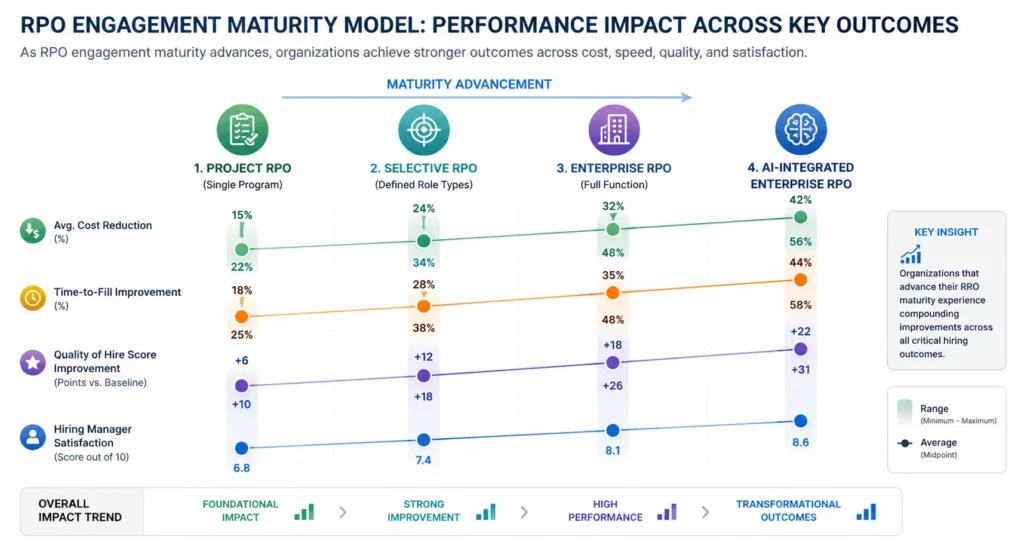
Benchmarks by RPO Engagement Maturity
| RPO Engagement Type | Avg. Cost Reduction | Time-to-Fill Improvement | Quality of Hire Score | Hiring Manager Satisfaction |
|---|---|---|---|---|
| Project RPO (single program) | 15-22% | 18-25% | +6-10 points vs. baseline | 6.8 / 10 |
| Selective RPO (defined role types) | 24-34% | 28-38% | +12-18 points vs. baseline | 7.4 / 10 |
| Enterprise RPO (full function) | 32-48% | 35-48% | +18-26 points vs. baseline | 8.1 / 10 |
| AI-integrated enterprise RPO | 42-56% | 44-58% | +22-31 points vs. baseline | 8.6 / 10 |
Key Strategies for Effective Recruitment Process Outsourcing
How Can AI and Automation Support Recruitment Process Outsourcing?
AI-Powered Candidate Sourcing and Matching
AI-enabled RPO providers can deploy sourcing models trained on the client organization’s historical performance data, matching pre-hire signals to post-hire outcomes to identify candidates with the highest predicted Quality of Hire score for each specific role. This predictive sourcing capability, built on data from thousands of hiring cycles across multiple clients, is typically beyond what internal TA teams can build from a single organization’s hiring history, representing a genuine capability advantage that AI-enabled RPO delivers at scale rather than requiring each organization to develop independently.
Automated Screening and Assessment Integration
RPO providers with AI-powered screening infrastructure can process candidate volumes at a scale and consistency that manual screening cannot match, applying validated assessment instruments and structured screening rubrics across every application regardless of volume peaks. This consistency eliminates the quality degradation that typically accompanies high-volume manual screening periods and ensures that assessment standards remain constant regardless of recruiter workload fluctuations during surge hiring periods.
HR Analytics and Performance Reporting
AI-powered reporting platforms used by leading RPO providers generate real-time dashboards connecting sourcing channel data, candidate pipeline health, interview funnel conversion rates, and Quality of Hire outcomes into a single integrated view. This reporting capability gives internal TA leaders visibility into recruitment performance at a granularity that most manual internal processes never achieve, enabling data-driven decisions about sourcing investment, process intervention, and hiring manager support.
Onboarding Automation and Early Retention Support
AI-powered onboarding automation tools deployed by Recruitment Process Outsourcing providers can extend the recruitment engagement experience into the first 30 to 90 days of employment, automating compliance tasks, delivering role-specific learning content, and flagging early disengagement signals that enable manager intervention before early attrition occurs. Organizations that measure Quality of Hire at the 12-month mark increasingly require RPO providers to support the onboarding experience as part of their delivery scope, recognizing that hire quality and onboarding quality are interdependent outcomes.
Stop Juggling
10 Job Boards.
Search One
Your next role is already here. avua pulls opportunities from across the web into a single searchable feed; filtered by role, location, salary, and remote preference.
1.5 Million+
Active Jobs
380+
Job Categories
Recruitment Process Outsourcing Through a Fair and Inclusive Lens
RPO providers who operate with generic talent pools and undifferentiated sourcing strategies systematically reproduce the demographic patterns of the existing workforce rather than expanding representation where organizations need it most. Selecting an RPO partner without explicit commitments to diverse sourcing strategies, equitable screening processes, and representation tracking is effectively choosing to outsource both recruitment execution and whatever DEI progress might have been made through internal process redesign, outsourcing the problem alongside the function.
The structured screening consistency that well-designed RPO programs provide is one of the strongest available interventions for equitable hiring outcomes. When every candidate is evaluated against the same structured criteria, assessed with the same validated instruments, and advanced through the same defined process, evaluator subjectivity is reduced and the demographic disparities that subjectivity produces diminish across the hiring funnel. RPO providers with mature DEI capability build this structure deliberately and measure representation at every funnel stage rather than only at the point of hire.
RPO programs should explicitly require sourcing channel diversity audits, tracking the demographic composition of candidate pools by source and adjusting channel investment based on both quality and representation outcomes. Organizations that hold RPO providers accountable for representation metrics at the pipeline stage, not just the hire stage, close representation gaps faster than those that measure diversity only at offer stage. Diversity sourcing is a contractual requirement of inclusive RPO delivery, not an optional program feature that can be deferred until foundational processes are running smoothly.
Common Challenges and Solutions
| Challenge | Solution |
|---|---|
| RPO provider lacks sufficient knowledge of organizational culture | Invest in a structured cultural onboarding program for the RPO team; require provider staff to spend time with employees and leaders before managing live candidate interactions |
| Quality of Hire data not tracked or shared with RPO provider | Build post-hire performance data sharing into the contract; require quarterly Quality of Hire reporting at the provider level with performance-adjusted contract terms |
| Hiring managers perceive RPO team as less capable than internal recruiters | Establish SLA standards for RPO recruiter responsiveness, role knowledge, and candidate calibration accuracy; measure hiring manager satisfaction quarterly and include results in provider performance reviews |
| RPO contract structure does not align provider incentives with quality outcomes | Shift from pure volume-based pricing to hybrid models that include quality-adjusted fees, with bonuses for Quality of Hire performance above benchmark and penalties for early attrition above defined thresholds |
Real-World Case Studies
Case Study 1: The Technology Platform Company
A 1,200-person technology company experiencing rapid headcount growth engaged an end-to-end RPO provider after its internal TA team of six struggled to manage 180 annual hires without quality degradation. The RPO engagement reduced average time-to-fill from 52 days to 29 days, reduced cost per hire from $11,200 to $6,400, and improved Quality of Hire scores by 17 points at the 12-month mark. Internal TA leadership was retained in a strategic oversight capacity, focusing exclusively on employer brand, talent strategy, and hiring manager partnership while the RPO provider managed full-cycle execution across all role types.
Case Study 2: The Financial Services Group
A financial services group with significant geographic hiring complexity across 14 markets engaged a selective RPO provider for its analyst and associate hiring program, retaining internal management of senior and specialized searches. The RPO program standardized candidate assessment across markets, implemented structured interviewing across all hiring managers, and built a talent community of 8,400 analyst-level candidates across target geographies. Three-year program outcomes included a 41% reduction in cost per analyst hire, a 33% improvement in 12-month retention, and a 22-point improvement in hiring manager satisfaction scores compared to the pre-engagement baseline.
Case Study 3: The Healthcare Organization
A national healthcare organization facing critical nursing and clinical staff shortages across multiple regions implemented a project RPO engagement focused on high-volume nursing recruitment. The RPO provider deployed a specialized healthcare sourcing team, integrated with the organization’s existing ATS, and activated a multi-channel sourcing strategy including nursing school partnerships, alumni networks, and professional association channels. Within one hiring program, the organization filled 340 nursing roles at an average time-to-fill of 18 days versus a historical baseline of 44 days, and achieved a 12-month retention rate of 81% for RPO-sourced nurses, compared to 67% for agency-sourced nurses in the prior period.
Key Performance Signals Every RPO Program Should Track
Recruitment Process Outsourcing Across the Talent Lifecycle
Workforce Planning and Demand Forecasting
Effective RPO partnerships begin with shared workforce planning intelligence, where the RPO provider receives advance visibility into projected hiring demand by role type, geography, and timeline, enabling proactive talent pipeline building before requisitions are formally opened. RPO providers with strong talent intelligence capabilities can contribute market data on candidate availability, competitive compensation benchmarking, and sourcing lead time estimates that improve the accuracy of the organization’s hiring plan and reduce emergency sourcing cycles that inflate cost and compress quality.
Sourcing, Screening, and Pipeline Management
The sourcing and screening phase is where most RPO programs deliver their highest operational value: deploying multi-channel sourcing strategies, consistent screening processes, and structured candidate communication that internal teams with equivalent headcount cannot replicate at equivalent quality. RPO providers with AI-powered sourcing tools and validated assessment infrastructure generate candidate pipelines with higher predictive Quality of Hire scores than manual sourcing processes, because they apply data-driven matching at a scale and consistency that human judgment alone cannot sustain across high-volume hiring periods.
Interview Coordination and Hiring Manager Enablement
The interview coordination and hiring manager enablement phase is where RPO program quality most directly determines hiring manager satisfaction. Structured interview guide delivery, calendar management, candidate briefing quality, and debrief facilitation are the operational touchpoints where RPO recruiter capability is most visible to the business. High-performing RPO providers invest significantly in hiring manager relationship management, treating it as a core competency alongside candidate sourcing rather than as an administrative function.
Offer Management and Pre-Boarding
The offer and pre-boarding phase is a critical retention window that many Recruitment Process Outsourcing programs underinvest in. The period between offer acceptance and start date is when candidates are most vulnerable to competitive counteroffer and poaching from alternative employers. RPO providers who manage this phase with structured communication, pre-boarding content delivery, and regular candidate touchpoints significantly reduce offer rescission rates and improve first-day readiness compared to programs that treat offer acceptance as the end of the recruitment engagement.
The Real Cost of Ignoring Recruitment Process Outsourcing
| Scenario | Avg. Cost per Hire | Time-to-Fill | Quality of Hire Score | Agency Dependency |
|---|---|---|---|---|
| Internal TA only, no structure | $9,800-$14,200 | 47-58 days | 58-65 | 40-60% |
| Internal TA with partial agency support | $7,400-$10,800 | 38-48 days | 62-70 | 25-40% |
| Selective RPO (defined role types) | $5,200-$7,600 | 26-34 days | 74-82 | 10-20% |
| Enterprise RPO, AI-integrated | $3,800-$5,400 | 18-26 days | 82-91 | 5-12% |
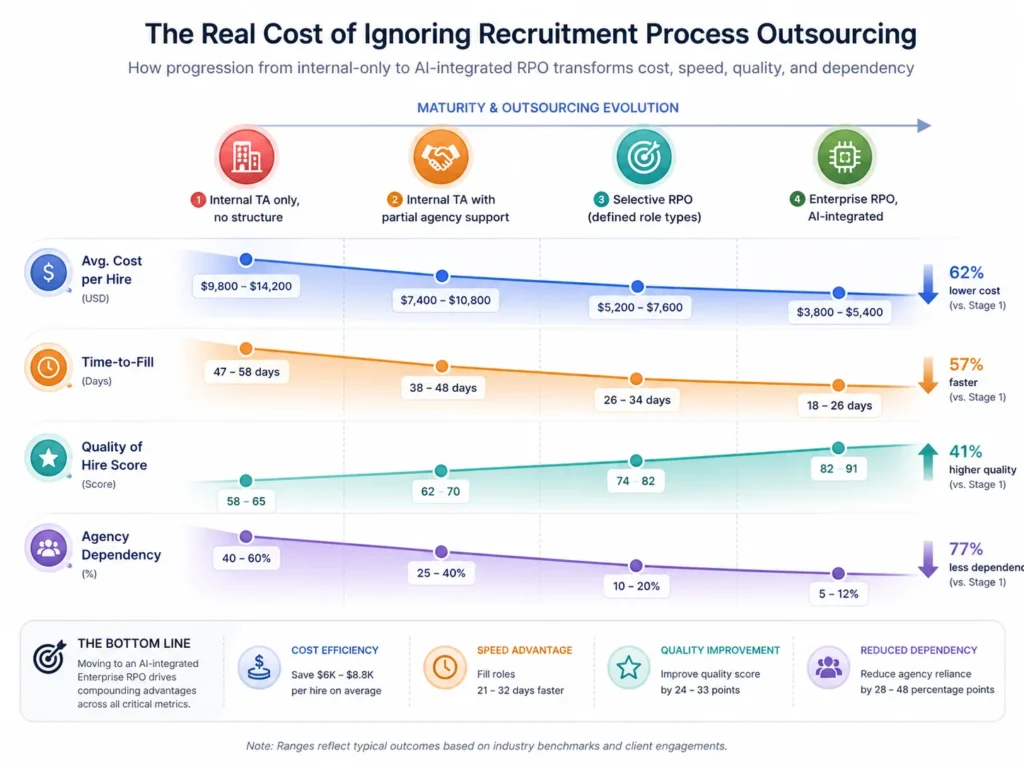
Costs include all-in recruitment spend: sourcing, advertising, assessment, internal recruiter time, and management overhead. Quality of Hire scores are composite 12-month performance ratings on a 100-point scale.
Related Terms
| Term | Definition |
|---|---|
| Business Process Outsourcing (BPO) | The practice of contracting defined business functions to an external provider specializing in that function’s efficient delivery, of which Recruitment Process Outsourcing is a talent-specific application |
| Cost per Hire | The total investment required to recruit and onboard a single employee, including all direct and indirect sourcing, assessment, and process costs used as the primary baseline metric for RPO value assessment |
| Managed Service Provider (MSP) | An external provider managing an organization’s contingent workforce program, distinct from RPO’s focus on permanent and professional direct-hire recruitment processes |
| Talent Acquisition Strategy | The integrated plan governing how an organization sources, attracts, evaluates, and hires talent to meet current and future business capability requirements, within which RPO is an execution delivery mechanism |
| Service Level Agreement (SLA) | The contractually defined performance benchmarks, reporting requirements, and quality standards that govern an RPO provider’s delivery obligations and accountability to the client organization |
| Hiring Manager | The organizational leader responsible for defining role requirements, evaluating candidates, and making final hiring decisions within an RPO-supported recruitment process |
Frequently Asked Questions
What types of organizations benefit most from RPO?
Organizations with consistent hiring volume of 50 or more annual hires, significant geographic hiring complexity, technology investment requirements beyond current TA infrastructure, or strategic need to free internal TA capacity for employer brand and workforce planning typically achieve the strongest RPO returns. Organizations whose primary hiring need is highly specialized senior-level search are often better served by retained executive search than by RPO structures.
How is RPO different from using a staffing agency?
A staffing agency provides individual candidate placements on a contingency or contract basis, with no ownership of the recruitment process or accountability for quality outcomes beyond the immediate placement. An RPO provider assumes ownership of the defined recruitment process, operates within the organization’s employer brand standards, and is measured against quality, speed, and cost benchmarks across the full hiring program. The process ownership and accountability distinction is the fundamental difference that drives different candidate quality and employer representation outcomes.
What does an RPO contract typically include?
RPO contracts typically define the scope of recruitment process ownership, per-hire or management fee pricing structure, service level commitments for time-to-fill, candidate quality benchmarks, reporting cadence and data transparency requirements, employer brand and candidate experience standards, and exit and transition provisions. Performance-linked fee structures that adjust based on Quality of Hire and hiring manager satisfaction outcomes are increasingly common in mature RPO contracts across professional services, technology, and healthcare organizations.
Can RPO be implemented partially rather than as a full-function outsource?
Yes. Selective RPO, which outsources defined role types or geographies while retaining internal management of others, and project RPO, which engages an external provider for a specific hiring program with a defined endpoint, are both well-established models. Most organizations begin with selective or project RPO and expand scope based on demonstrated provider performance and internal TA leadership confidence in the partnership’s cultural and quality delivery.
How should organizations measure RPO provider performance?
RPO performance should be measured against documented pre-engagement baselines across four dimensions: operational efficiency covering time-to-fill and offer acceptance rate; financial efficiency covering cost per hire; quality covering Quality of Hire score and 12-month retention; and experience covering hiring manager satisfaction and candidate experience score. Providers not contractually required to report against quality and experience metrics have no structural incentive to optimize for them.
What is the difference between end-to-end RPO and project RPO?
End-to-end RPO transfers ongoing responsibility for the entire recruitment function to the provider, typically for a multi-year term covering all role types and geographies. Project RPO engages an external provider for a specific, time-bound hiring program, such as a geographic expansion or a technology implementation requiring specialized hiring. Project RPO is lower-commitment and allows organizations to evaluate RPO delivery before committing to an enterprise engagement.
Conclusion
Recruitment Process Outsourcing is not a surrender of talent acquisition responsibility. It is a strategic decision to deploy specialized capability, technology, and scale where internal resources cannot match what the business requires.
Organizations that engage Recruitment Process Outsourcing providers with genuine cultural integration, quality-linked performance accountability, and post-hire outcome measurement consistently outperform those relying on internal TA teams operating beyond their structural capacity.
The question RPO answers is not whether an external provider can recruit as well as an internal team. It is whether a specialized provider with dedicated infrastructure, AI-powered tools, and a contractual accountability structure can deliver better talent outcomes for the business than an internal team managing equivalent volume with equivalent resources.
For most organizations operating above 50 annual hires, the evidence consistently and substantially says yes.