A decade ago, hiring someone you had never met in person felt like a leap of faith.
Today, it is standard practice across industries, seniority levels, and time zones. Remote hiring is no longer a contingency plan organisations dust off during a crisis. It is a core competency that the best talent teams have quietly built into how they hire by default.
Remote hiring is the end-to-end process of attracting, evaluating, and onboarding employees without the candidates or hiring team ever being in the same physical location. It changes almost every assumption traditional recruitment is built on, from how you structure candidate experience to how you run a competency-based interview without the room reading that in-person formats rely on.
The sourcing advantages are significant. Remote hiring opens access to a global candidate pipeline, removing geography as a constraint and dramatically widening the pool of available talent. But wider access also means more volume to manage, which is where automated screening and structured evaluation frameworks become essential rather than optional.
Getting remote employee onboarding right is where many organisations stumble. This guide covers the full remote hiring lifecycle, what works, what does not, and how to build a process that finds and keeps great people regardless of where they are based.
Remote Hire Retention Rate (%) = (Remote Hires Retained and Performing at 12 Months / Total Remote Hires Made) × 100
High-performing remote hiring programs maintain Retention Rates above 87%. The industry average sits at approximately 73%. That gap is explained almost entirely by process design – specifically, the quality of assessment, onboarding, and team integration practices – not by whether the candidates were inherently suited to remote work.
What is Remote Hiring?
Remote hiring is the structured process of recruiting, assessing, selecting, and integrating employees into roles performed fully or primarily outside a central office location, using digital communication tools, virtual interview platforms, online assessment systems, and remote-compatible onboarding programs in place of the physical-presence-dependent methods that characterize traditional recruitment.
What distinguishes remote hiring from standard recruitment is not just the technology involved – it is the evaluation criteria. A remote hire must demonstrate not only the technical and functional competencies required by the role but also a distinct set of remote-work capabilities: self-directed productivity, clear asynchronous communication, comfort with digital collaboration tools, and the discipline to maintain performance without the ambient structure of an office environment. Assessing these capabilities requires deliberate process design that most standard interview frameworks do not address.
Why Remote Hiring Has Become a Strategic Imperative for Modern Organizations?
The business case for remote hiring has shifted significantly over the past five years. What began as a necessity has evolved into one of the most powerful talent acquisition advantages available to organizations that build the capability deliberately. The argument is no longer about whether remote hiring works – it is about whether organizations can afford to compete without it.
The core competitive advantage is geographic reach. An organization that hires exclusively within commuting distance of its offices competes for talent in a bounded market. An organization with mature remote hiring capability competes globally – accessing a candidate pool that is orders of magnitude larger, more diverse in background, and often more cost-effective in compensation terms. LinkedIn’s Global Talent Blog research found that organizations with mature remote hiring programs report 3.4 times the qualified applicant volume for senior specialist roles compared to equivalent location-bound postings.
The compensation mathematics are equally compelling. A senior software engineer in a major financial center commands a base salary that may be 40 to 60 percent higher than an equivalent professional in a secondary city or international market with comparable skills. For organizations building technical teams at scale, the ability to hire remotely at competitive local rates – rather than at premium hub-city rates – represents a structural cost advantage that compounds over time. A 20-person engineering team assembled through strategic remote hiring can cost the equivalent of a 12 to 14-person locally hired team of the same capability level.
The strategic argument for remote hiring extends well beyond financial efficiency. Remote-native organizations consistently report access to talent that is categorically unavailable through local hiring: senior specialists who have relocated to non-hub cities for lifestyle reasons, candidates with caregiving responsibilities who require location flexibility, and high performers who have built careers around remote work and will not consider office-based roles at any salary. These candidates are not on the local job market. They exist on the remote job market – and organizations without remote hiring capability cannot reach them.
The most frequently cited concern – that remote employees underperform their in-office counterparts – is not supported by current research. A 2024 study published through SHRM’s remote work resources found that fully remote workers in appropriately designed roles showed equivalent or superior individual productivity to office-based peers, with the primary performance variable being management quality and onboarding design, not physical location. Organizations that perform poorly with remote hires have typically failed at assessment and onboarding architecture, not at hiring itself.
The ROI case for investing in remote hiring capability is direct. For a senior engineering role with a $180,000 base in a major technology hub, a comparable hire in a secondary market might carry a $120,000 base. Over a three-year retention period, that differential represents $180,000 in direct salary savings before accounting for equity, benefits, or overhead. If building a robust remote hiring process costs $25,000 in tools, training, and process design, the payback period is less than six months on a single hire. Applied across a 20-person annual hiring target in a high-cost discipline, the return is categorical.
For TA leaders, the strategic conclusion is clear: remote hiring should not be a fallback for roles that cannot be filled locally. It should be a deliberate, first-choice strategy for roles where geographic access to talent is a constraint, where compensation efficiency matters, or where diversity of background is a priority. The organizations building this capability now are compounding a talent acquisition advantage that location-constrained competitors will find difficult to close.
Your Resume Isn’t Getting Read
Let’s Get That Fixed!
75% of resumes get auto-rejected. avua’s AI Resume Builder optimizes formatting, keywords, and scoring in under 3 minutes, so you land in the “yes” pile.
The Psychology Behind Remote Hiring
The Digital First Impression Effect
In remote hiring, candidates and evaluators form their assessments almost entirely through digital channels – video calls, written communications, and asynchronous task submissions – before any in-person interaction occurs. Research on digital first impressions shows that evaluators form lasting assessments of candidate competence within the first 30 seconds of a video interaction, based on environmental cues such as background quality, lighting, and audio setup, as much as on verbal content. Candidates with professional home office environments are systematically evaluated more favorably than equivalent candidates in less structured settings, regardless of actual capability. Hiring managers trained to recognize and correct for environmental bias produce significantly more accurate remote candidate assessments.
Trust Calibration and the Out-of-Sight Bias
Hiring managers evaluating candidates for remote roles frequently apply an unconscious penalty to candidates they cannot envision managing without physical proximity. This out-of-sight bias leads evaluators to underweight demonstrated track records of remote work performance and overweight indicators of office-environment productivity – visibility to leadership, in-person collaboration presence, physical availability. The correction is structural: replacing vague remote culture fit assessments with specific, behaviorally anchored criteria – documented asynchronous project delivery, distributed team collaboration examples, independent productivity evidence – that evaluate what remote work actually requires.
Asynchronous Communication Evaluation and Cognitive Load
Evaluating a candidate’s asynchronous communication quality is a skill that most hiring managers have not developed, because it was irrelevant in office-centered recruitment. In remote hiring, a candidate’s ability to write clearly, structure complex ideas in written form, and communicate without real-time feedback is often the single strongest predictor of remote work effectiveness. Hiring managers who assess writing samples, asynchronous task responses, and follow-up email quality alongside interview performance consistently produce better remote hire outcomes than those relying exclusively on synchronous interview assessment.
Remote Hiring vs. Related Recruitment Models
| Hiring Model | Location Scope | Primary Assessment Method | Key Advantage | Main Limitation |
|---|---|---|---|---|
| Traditional In-Office | Local/commutable | In-person interviews | Direct oversight, team proximity | Geographically bounded talent pool |
| Remote Hiring | Global/unrestricted | Video + async tools | Global candidate access, cost efficiency | Requires dedicated process design |
| Hybrid Hiring | Partial local | Mixed in-person/video | Flexibility with some proximity | Retains geographic constraints |
| Contract Remote | Global | Portfolio + task-based | Speed and specialist access | Limited integration and retention |
| Nearshore Remote | Regional | Video-first, time zone aligned | Collaboration overlap | Limited cost arbitrage |
The critical distinction between remote hiring and hybrid hiring lies in assessment design. A hybrid role requires geographic proximity for periodic in-person attendance, reintroducing location constraints into the candidate pool. A fully remote role eliminates location as a filtering criterion entirely, fundamentally changing both the reach of the search and the evaluation criteria applied.
What the Experts Say?
Remote hiring done well is not about replicating the office experience on a screen. It is about designing an entirely different evaluation system for an entirely different way of working. The organizations that understand this build remote teams that outperform their co-located peers. The ones that do not select on the wrong criteria and spend years wondering why their remote hires underperform.
– Darren Murph, Former Head of Remote, GitLab
How to Measure Remote Hiring Effectiveness?
Formulas
Remote Hire Retention Rate (%) = (Remote Hires Still in Role and Performing at 12 Months / Total Remote Hires) × 100
Remote Hire Time-to-Productivity (days) = Date of Full Role Contribution Reached - Hire Start Date
Remote Process Completion Rate (%) = (Candidates Completing Full Remote Assessment / Candidates Invited) × 100
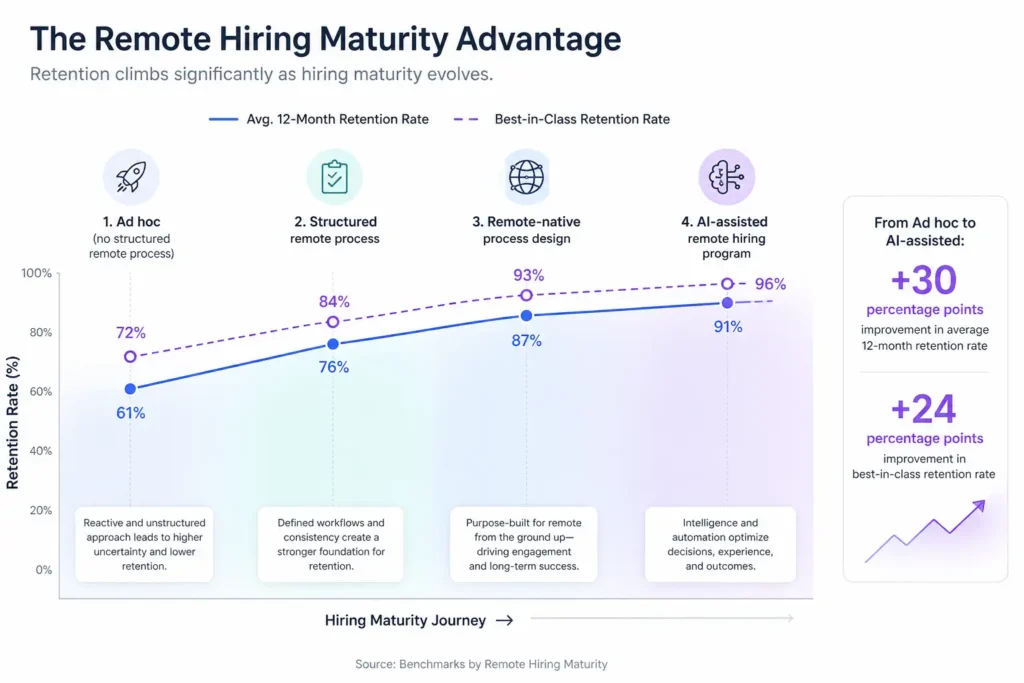
Benchmarks by Remote Hiring Maturity
| Hiring Maturity Level | Avg. 12-Month Retention Rate | Best-in-Class |
|---|---|---|
| Ad hoc (no structured remote process) | 61% | 72% |
| Structured remote process | 76% | 84% |
| Remote-native process design | 87% | 93% |
| AI-assisted remote hiring program | 91% | 96% |
Key Strategies for Effective Remote Hiring
How Can AI and Automation Support Remote Hiring?
AI-Powered Asynchronous Screening
AI-driven screening platforms evaluate asynchronous video responses, written assessments, and structured task submissions at scale – providing standardized candidate scoring across globally distributed applicant pools without requiring human reviewer availability across multiple time zones. This makes genuine 24-hour global remote hiring operationally feasible for TA teams of any size, at consistent evaluation quality.
Automated Global Compliance Verification
Remote hiring across international borders introduces employment law complexity that previously required specialist legal review for every new hiring jurisdiction. AI-powered compliance tools now automate jurisdiction-specific right-to-work verification, employment classification checks, and contractor-versus-employee determination – reducing the legal overhead of international remote hiring from days to hours and enabling faster time-to-offer across markets.
Virtual Assessment and Simulation Platforms
AI-enabled simulation platforms allow candidates to complete role-relevant tasks in virtual environments that mirror actual remote work conditions – assessing not just technical competency but digital collaboration behavior, asynchronous communication style, and distributed tool proficiency. These behavioral assessments predict remote work performance more accurately than traditional competency-based interviews conducted in a live video format.
Predictive Remote Success Modeling
Machine learning models trained on remote hire performance data identify the candidate attributes most predictive of remote work success within a specific organizational context – accounting for role type, team structure, management style, and digital tool environment. This predictive capability enables hiring teams to calibrate remote candidate evaluation against real outcomes data rather than assumptions about remote work suitability that may not reflect the organization’s specific environment.
Stop Juggling
10 Job Boards.
Search One
Your next role is already here. avua pulls opportunities from across the web into a single searchable feed; filtered by role, location, salary, and remote preference.
1.5 Million+
Active Jobs
380+
Job Categories
Remote Hiring and Geographic Equity: Building Truly Inclusive Distributed Teams
Geographic homophily in remote hiring is a subtler form of network bias than the kind that affects traditional executive search. Organizations new to remote hiring frequently default to sourcing in familiar markets – the cities and regions where their leadership team has existing networks – rather than genuinely opening the search to the global pool that remote hiring makes possible. The result is a remote workforce that is distributed on paper but concentrated in the same demographic and professional networks as the existing office-based organization.
Pay equity in remote hiring presents a genuine structural challenge. Organizations that set remote compensation based on candidate location – paying workers in lower-cost markets at local rates for identical work performed to identical standards – introduce a form of geographic pay discrimination that disproportionately affects candidates from emerging markets and regions with historically lower professional wage benchmarks. Transparent compensation frameworks applying consistent pay bands regardless of candidate location produce more equitable outcomes and, according to Gallup workplace research, significantly higher offer acceptance rates from candidates in non-hub markets.
Inclusive hiring in remote contexts also requires specific attention to the digital access gap. Assessment processes requiring high-bandwidth video, expensive hardware, or professional recording environments create structural disadvantages for candidates from lower-income backgrounds or regions with less developed digital infrastructure. Asynchronous text-based assessment options, phone interview alternatives, and clearly communicated technical flexibility reduce this access barrier and produce more representative candidate pools from equivalent talent markets.
The DEI brief for remote roles should explicitly specify geographic diversity targets for the longlist – not just demographic targets – and allocate sourcing budget to non-traditional geographic markets. Organizations that treat “remote” as a location designation rather than as a sourcing strategy miss the primary DEI advantage that remote hiring offers: the ability to reach qualified candidates who are excluded from local hiring by geography alone.
Common Challenges and Solutions
| Challenge | Solution |
|---|---|
| Candidate drop-off during lengthy asynchronous assessments | Reduce assessment length; communicate time expectations clearly upfront; offer flexible submission windows to accommodate different time zones and schedules |
| Hiring manager resistance to candidates never met in person | Provide structured remote hiring training; share historical remote hire performance data; use paid trial projects as a final-stage evaluation mechanism |
| International compliance complexity slowing time-to-offer | Implement AI-powered compliance tools for jurisdiction-specific requirements; pre-clear target hiring markets before a search begins |
| Time zone misalignment extending interview scheduling timelines | Use automated screening to eliminate scheduling dependency in early stages; offer synchronous interview slots across multiple time zones |
Real-World Case Studies
Case Study 1: The Technology Company
A 300-person technology company with offices in three major metros redesigned its engineering hiring program to be remote-first after losing three consecutive senior hires to competitors offering location flexibility. The company built a structured remote assessment framework – including a paid three-day technical project, two asynchronous video responses to structured questions, and a live architecture discussion – and opened sourcing globally. Time-to-fill for senior engineering roles fell from 67 days to 41 days. Offer acceptance rate increased from 54% to 79%. The first 18 months of remote-first hiring produced a cohort with 91% 12-month retention, compared to 71% for the previous in-office hiring cohort.
Case Study 2: The Financial Services Firm
A regional financial services firm needed to build a compliance function but found that qualified professionals in their home market commanded salaries 35% above budget. A remote hiring strategy targeting candidates in secondary cities with equivalent regulatory expertise reduced average compensation for the compliance build-out by 28% while maintaining seniority standards. AI-powered jurisdiction compliance tools reduced per-hire legal review time from five days to under four hours. All 11 planned roles were filled within budget and within the 90-day plan timeline.
Case Study 3: The Global Non-Profit
An international non-profit redesigned its hiring process to be mobile-first and fully asynchronous after discovering that 68% of their target candidate pool in key emerging markets accessed the internet primarily through mobile devices. They eliminated video interview requirements as a first-stage filter and replaced them with structured written responses and audio submission options. Candidate completion rate for the assessment process rose from 39% to 77%. The geographic and institutional diversity of shortlisted candidates increased by 44% compared to the previous hiring cycle.
Remote Hiring Metrics Every Talent Leader Should Monitor
Remote Hiring Across the Talent Lifecycle
Pre-Hire: Role and Process Design
Effective remote hiring begins with deliberate role design. Before any job description is written, the hiring team should define the specific remote-work competencies the role requires, the time zone overlap expectations, the communication tools the candidate must be proficient in, and the asynchronous-to-synchronous work ratio. These design decisions shape the entire assessment framework and determine whether the candidate-facing brief attracts genuinely remote-capable professionals or candidates better suited to office environments.
Active Sourcing and Screening
Active sourcing for remote roles should explicitly target geographic markets beyond the organization’s traditional hiring footprint. Remote-work-oriented professional communities, distributed team networks, and niche talent platforms are disproportionately valuable for building diverse remote candidate pipelines. Screening tools should be calibrated to remote-work competencies – not just functional skill matching – to avoid filtering out candidates who are highly qualified for remote work but present differently than office-based professionals.
Evaluation and Interview Stage
The evaluation stage for remote roles should combine synchronous and asynchronous formats deliberately. Asynchronous assessments evaluate the candidate’s most critical remote capability – independent, structured performance without real-time support. Synchronous video interviews evaluate communication quality, collaboration style, and cultural alignment. Neither format alone provides a complete picture of a candidate’s remote work readiness, and relying exclusively on one produces systematically incomplete candidate assessments.
Onboarding and Integration
Remote onboarding is the stage where most remote hiring programs fail. Adapted in-office onboarding programs compressed into video calls and document sharing produce remote hires who feel disconnected, under-informed, and under-supported in their first 90 days. Purpose-built remote onboarding programs – with structured buddy systems, explicit 30/60/90-day milestones, proactive manager touchpoints, and virtual team integration activities – reduce 90-day attrition for remote hires by approximately 40% compared to adapted in-office approaches applied to a remote context.
The Real Cost of Poor Remote Hiring Practices
| Scenario | Approach Used | 12-Month Retention Rate | Estimated Annual Cost (20 Remote Hires) |
|---|---|---|---|
| No structured remote process | Ad hoc, adapted in-office methods | 61% | $289,000 |
| Partial remote process design | Some async tools, basic digital onboarding | 74% | $187,000 |
| Structured remote-native process | Purpose-built assessment and onboarding | 89% | $82,000 |
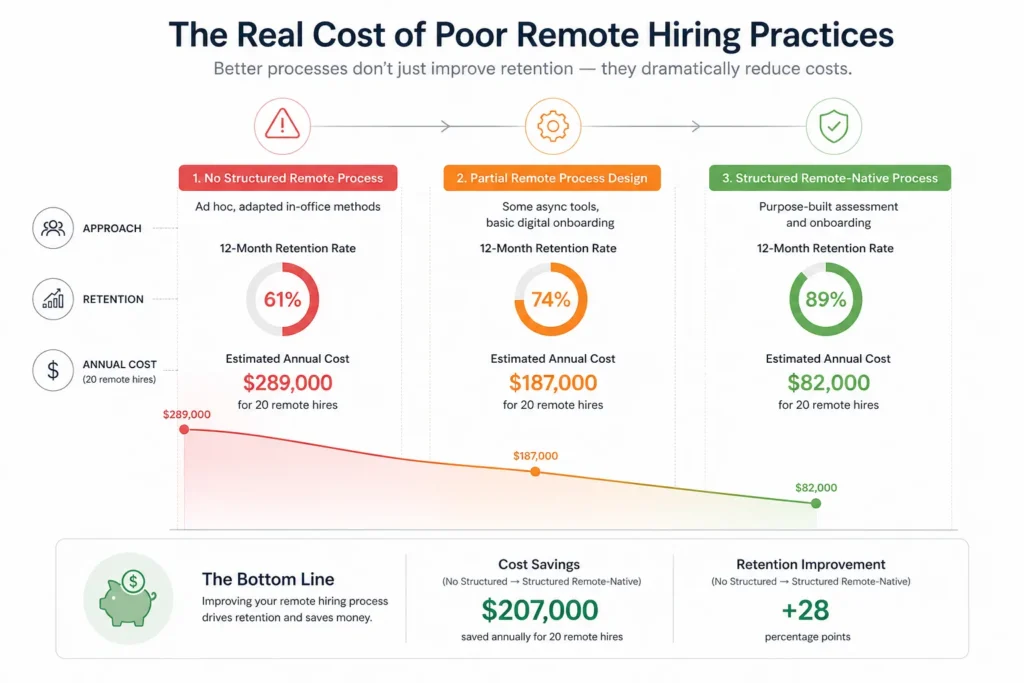
Costs assume average replacement cost of $18,000 per remote hire, including sourcing, assessment time, and productivity loss during role transition.
Related Terms
| Term | Definition |
|---|---|
| Asynchronous Interview | A video or text-based interview format where candidates respond to pre-set questions independently, without a live interviewer present |
| Employer of Record (EOR) | A third-party organization that employs workers on behalf of a company in jurisdictions where the company lacks a legal entity |
| Virtual Onboarding | The structured process of integrating a new employee into an organization’s culture and systems through digital tools rather than physical presence |
| Distributed Team | A team of employees who work across multiple geographic locations or time zones without a shared central office |
| Remote-First | An organizational approach where remote work is the default mode of operation, with office attendance being optional rather than expected |
Frequently Asked Questions
What is the difference between remote hiring and traditional hiring?
Remote hiring eliminates geographic constraints from every stage of the recruitment process – sourcing, assessment, and onboarding – using digital tools in place of physical presence requirements. Traditional hiring assumes candidate proximity to a physical workplace and designs evaluation processes around in-person interaction at every stage.
Does remote hiring produce lower-quality hires than in-office hiring?
Research does not support this when remote hiring processes are well-designed. Studies on remote work performance consistently find that the quality of the assessment process and onboarding program is the primary determinant of hire quality and retention, not the physical location of work itself.
What tools are essential for effective remote hiring?
A remote hiring toolkit typically includes a video interview platform for synchronous and asynchronous evaluation, a structured task assessment tool, an ATS with remote workflow support, a compliance tool for multi-jurisdiction employment, and a purpose-built digital onboarding platform that functions independently of a physical office environment.
How do you assess remote-work capability in a candidate?
Effective remote capability assessment combines structured behavioral questions about past remote work performance, asynchronous task assignments evaluating independent productivity, written communication samples, and reference conversations specifically focused on remote work effectiveness in prior roles.
Is remote hiring suitable for all role types?
No. Roles requiring physical presence, hands-on equipment operation, or continuous in-person interaction with patients, clients, or physical assets are not suited to remote hiring. Roles requiring primarily knowledge work, digital communication, and independent task completion are well-suited to remote arrangements and remote-native hiring processes.
Conclusion
Remote hiring is not an adaptation to changing circumstances – it is a genuine, compounding strategic advantage for organizations that build the capability deliberately and design it from first principles. The talent pools it unlocks, the compensation efficiencies it enables, and the diversity of background and perspective it makes accessible represent returns that location-constrained hiring cannot replicate.
The organizations that will dominate talent acquisition over the next decade are not those with the most attractive offices – they are the ones that have mastered the process of finding, evaluating, and integrating the world’s strongest candidates regardless of where those candidates choose to live.
Invest in remote hiring as a first-class organizational capability, and the available talent market becomes dramatically larger than your competitors believe it to be.